
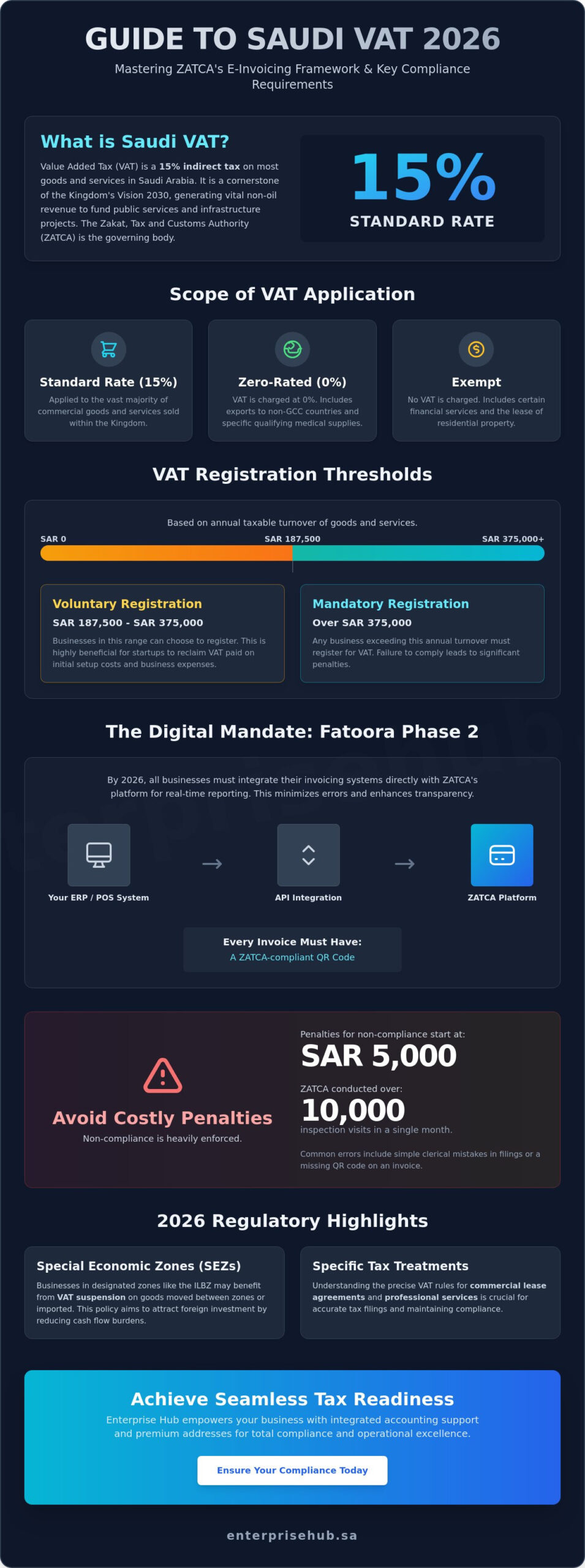
Did you know that ZATCA conducted over 10,000 inspection visits in a single month during 2023 to ensure businesses meet the strict requirements of ضريبة القيمة المضافة السعودية? It’s a sobering reminder that even a small clerical error in your tax filing or a missing QR code on a Fatoora invoice can lead to penalties starting at SAR 5,000. We understand that the technical hurdles of the e-invoicing integration phases often create more questions than answers for ambitious entrepreneurs. You’re likely focused on scaling your operations, yet the fear of non-compliance remains a constant weight on your strategic planning.
We’ve designed this comprehensive 2026 reference to remove that burden and give you total control over your tax obligations. You’ll gain a precise understanding of registration thresholds and the technical nuances of the Fatoora Phase 2 rollout. We’ll walk you through the essential steps to synchronize your systems with ZATCA and share proven methods to optimize your commercial tax planning for maximum growth.
Key Takeaways
- Master the fundamentals of the 15% indirect tax system and its strategic role in supporting the Kingdom’s non-oil economic growth.
- Identify your specific registration obligations by evaluating mandatory thresholds to avoid penalties or leveraging voluntary registration to recover initial business costs.
- Ensure full compliance with the latest ZATCA regulations by understanding the integration requirements of Fatoora Phase 2 for e-invoicing.
- Learn the precise tax treatments for commercial lease agreements and professional services to maintain accuracy in your ضريبة القيمة المضافة السعودية filings.
- Discover how Enterprise Hub’s integrated accounting support and premium business addresses empower your company to achieve seamless tax readiness and operational excellence.
Understanding Saudi VAT (ضريبة القيمة المضافة السعودية) in 2026
Value Added Tax represents a cornerstone of the Kingdom’s modern fiscal policy. As an indirect tax imposed on the supply of goods and services, ضريبة القيمة المضافة السعودية plays a vital role in generating non-oil revenue. This revenue stream is essential for funding public services and infrastructure projects. Since the rate increased to 15% on July 1, 2020, it’s become a standard part of the business landscape. We empower your business to align with these requirements through our strategic insights. This tax framework directly supports Vision 2030, helping the nation pivot toward a diversified, sustainable economy. The Zakat, Tax and Customs Authority (ZATCA) serves as the primary regulator, overseeing registration, filing, and enforcement across the Kingdom.
The Scope of VAT in the Kingdom
VAT is a multi-stage consumption tax collected by registered businesses at each point in the supply chain. Understanding the scope of ضريبة القيمة المضافة السعودية is vital for maintaining compliance. Taxable supplies generally attract the standard 15% rate. However, some sectors benefit from zero-rated status, such as international transport and specific medicines. Other areas, including specific financial services and residential real estate rentals, are exempt. Determining the “place of supply” is a critical technical step for companies providing services across borders. It dictates whether the tax applies in Saudi Arabia or the recipient’s jurisdiction, preventing double taxation or non-compliance.
- Standard Rate (15%): Applied to most commercial goods and services.
- Zero-Rated (0%): Includes exports to non-GCC countries and qualifying medical supplies.
- Exempt: Certain financial services and lease of residential property.
Key Regulatory Changes for 2026
The regulatory environment in 2026 focuses on deep digital integration. ZATCA has moved beyond manual processes to a fully digital tax oversight model. This shift centers on the “Fatoora” project, where e-invoicing is now the mandatory standard for all taxpayers. Recent 2026 amendments to the VAT Implementing Regulations have clarified rules for Special Economic Zones (SEZs). Businesses operating within these zones, such as those in the Integrated Logistics Bonded Zone (ILBZ), may benefit from VAT suspension on goods moved between zones or imported from abroad. These updates aim to attract foreign investment by reducing the immediate cash flow burden of tax payments. We help you navigate these complexities to ensure your operations remain efficient and fully compliant with the latest government mandates.
By 2026, the integration phase of e-invoicing has reached its final waves, requiring every registered business to link their accounting systems directly with ZATCA’s platform. This real-time reporting minimizes errors and ensures that tax data is accurate and transparent. Staying ahead of these changes isn’t just about compliance; it’s about building a resilient business that thrives in the Kingdom’s evolving investment environment.
Registration Requirements and Mandatory Thresholds
Understanding your obligations regarding ضريبة القيمة المضافة السعودية is the first step toward operational excellence in the Kingdom. We help you identify where your business stands in the regulatory landscape to avoid unnecessary penalties. Compliance ensures your business contributes to the national economy while maintaining a competitive edge in the evolving Saudi market.
Mandatory vs. Voluntary Registration
Saudi law dictates that any resident person or business with an annual taxable turnover exceeding 375,000 SAR must register for VAT. If your revenue falls between 187,500 SAR and 375,000 SAR, registration is voluntary. Calculating your “taxable turnover” involves totaling all taxable supplies of goods and services, excluding exempt supplies or capital asset sales. Startups often choose voluntary registration to reclaim VAT paid on high initial setup costs, effectively reducing their capital expenditure. Detailed regulations are available through the Official ZATCA VAT Information portal, which serves as the definitive legal reference for all taxpayers.
The Registration Process Step-by-Step
We enable you to complete this transition efficiently by following a structured digital path. The process is entirely online via the ZATCA e-services portal. You don’t need to visit a physical office; everything is handled through their integrated system. Following these steps ensures your business stays aligned with ضريبة القيمة المضافة السعودية requirements:
- Gather Documentation: Prepare your Commercial Registration (CR), IBAN details, and financial statements for the past 12 months.
- Portal Access: Log in to the ZATCA portal and navigate to the VAT registration section.
- Data Entry: Enter your business activities, projected annual sales, and expense estimates.
- Validation: Submit the application for ZATCA’s review.
Once approved, you’ll receive a unique Tax Identification Number (TIN) and your official VAT Certificate. You must display this certificate prominently at your place of business to signal your compliance to customers and partners. Businesses have 30 days to register after hitting the mandatory threshold. Failing to notify ZATCA results in a 10,000 SAR fine, while late registration carries a penalty of 5% of the tax value for each month of delay. Staying compliant isn’t just about avoiding fines; it’s about building a reputable brand. If you’re unsure about your current status, our team can provide a comprehensive compliance audit to ensure your business remains on the right track.
Compliance, E-Invoicing, and Fatoora Phase 2
Saudi Arabia’s tax landscape has undergone a radical transformation since the Zakat, Tax and Customs Authority (ZATCA) introduced the Fatoora project. By 2026, the transition from Phase 1 (Generation) to Phase 2 (Integration) is the standard for nearly all revenue tiers. This evolution means your business no longer just generates a digital file. You must now integrate your accounting or ERP software directly with ZATCA’s systems. This shift ensures that every transaction involving ضريبة القيمة المضافة السعودية is validated in real-time, creating a transparent and secure economic environment.
Phase 2 requirements apply to specific waves based on taxable revenue. While early waves targeted entities with revenues exceeding SAR 3 billion, subsequent waves have lowered this threshold significantly. By Jan 1, 2026, even mid-sized enterprises must comply with the integration protocols. You’ll need to distinguish between two main invoice types. Standard Tax Invoices (B2B) require real-time “clearance” from ZATCA before they become legal. Simplified Tax Invoices (B2C) require “reporting” within 24 hours of issuance. Failure to sync your systems results in immediate compliance risks and potential penalties.
Mastering E-Invoicing (Fatoora)
Your POS and ERP systems must meet strict technical specifications to operate in 2026. Every device must be capable of connecting to the internet to communicate with the ZATCA API. Anti-tampering features are mandatory; your system shouldn’t allow for the deletion or modification of logs. For B2C transactions, your QR codes must include the seller’s name, VAT registration number, timestamp, invoice total, and the VAT amount. A common pitfall is using non-compliant software that lacks cryptographic stamping. We help you avoid these errors by ensuring your digital certificates are correctly renewed and mapped to your specific business branches.
Input Tax Deduction and Record Keeping
Maximizing your cash flow involves efficiently reclaiming the VAT you’ve paid on business-related purchases. You can deduct input tax only if the expense has a direct link to your taxable activity. For example, VAT paid on raw materials or office rent is deductible, while personal expenses or restricted items like certain entertainment services are not. To claim these amounts, you must hold a valid tax invoice that includes your VAT registration number.
- Retention Period: You’re legally required to maintain all tax records and invoices for at least 6 years.
- Real Estate Exception: For transactions involving real estate, the record-keeping period extends to 15 years.
- Digital Storage: Records must be accessible in a readable format within the Kingdom to ensure compliance during ZATCA audits.
Properly managing ضريبة القيمة المضافة السعودية requires a balance of technical integration and meticulous documentation. We empower your business to automate these processes, ensuring you never miss a deduction while remaining fully aligned with the latest regulatory updates.
VAT Implications for Commercial Rent and Business Services
VAT on Property and Workspaces
Commercial leases differ significantly from residential rentals in the Saudi market. While residential rent is generally exempt from VAT, commercial property owners must charge the standard 15% rate. This means an annual lease of 200,000 ﷼ actually requires a 230,000 ﷼ cash outlay. You must account for this 15% difference in your monthly cash flow projections to avoid liquidity gaps. It isn’t just a cost; it’s a cash flow timing issue.
The rise of modern work environments adds another layer of complexity. Virtual office subscriptions and flexible workspace memberships are taxable business services. If you’re using a co-working space in Riyadh or Jeddah, your monthly invoice will include VAT. We help you identify these reclaimable expenses early. You can recover VAT paid on:
- Office furniture and ergonomic equipment
- Interior fit-out costs and renovations
- IT infrastructure and high-speed internet installations
- Utility bills for commercial premises
Professional Services and VAT
Every professional service you hire to grow your enterprise adds to your tax footprint. Legal counsel, accounting firms, and business formation experts are required to charge 15% ضريبة القيمة المضافة السعودية on their fees. If you engage international consultants who don’t have a physical presence in Saudi Arabia, you’re responsible for the tax via the Reverse Charge Mechanism. This ensures the Kingdom’s tax base remains protected while you access global expertise. Foreign investors planning long-term operations should also consider how their chosen انواع الاقامات في السعودية affects their VAT registration obligations and tax representative requirements.
Ensuring your service providers are VAT-compliant is a critical step in protecting your input tax. If a vendor provides an invoice without a valid VAT registration number or a proper QR code, ZATCA won’t allow you to deduct that tax. This turns a recoverable tax into a direct sunk cost. Integrating these payments through a dedicated corporate account simplifies your record-keeping and audit trails. We recommend opening a bank account in Saudi Arabia that’s specifically structured for business entities to automate these tax tracking requirements.
Success in the Saudi market depends on precision. By verifying the tax status of every lease and service contract, you protect your margins and build a foundation for sustainable growth. Don’t let administrative oversights stall your momentum.
How Enterprise Hub Supports Your Tax Readiness
Success in the Saudi market requires more than just a strategic vision. It demands rigorous adherence to regulatory standards. Enterprise Hub acts as your strategic partner, bridging the gap between premium workspace solutions and the complex requirements of ضريبة القيمة المضافة السعودية. We provide the physical and digital infrastructure necessary to ensure your business remains compliant from day one.
A professional business address is a legal prerequisite for obtaining a Commercial Registration (CR) and completing ZATCA registration. We offer premium office spaces that satisfy all government requirements for a physical presence. This foundation allows you to focus on growth while we handle the structural details. Our facilities are equipped with high-speed, secure digital infrastructure designed to support the latest e-invoicing software, ensuring your Phase 2 “Fatoora” integration is seamless and uninterrupted.
We provide integrated support that goes beyond a standard lease. Members gain access to a network of consultants who specialize in Saudi tax laws. These experts help you navigate the nuances of input tax deductions and output tax liabilities. By aligning your office setup with a clear tax strategy, you reduce the risk of administrative penalties and operational delays. International entrepreneurs who have secured the right investor and entrepreneur residency options in Saudi Arabia are better positioned to take full advantage of these compliance frameworks from the outset.
- ZATCA-Ready Infrastructure: High-security data environments for digital certificate storage.
- Strategic Location: Verified addresses that facilitate faster government approvals.
- Expert Guidance: Direct access to financial consultants familiar with the 2026 tax landscape.
Beyond Space: A Partner in Compliance
Our accounting services simplify the complexity of filing your ضريبة القيمة المضافة السعودية returns. We provide access to tax experts who understand the specific nuances of the Saudi market, from exempt supplies to zero-rated exports. By combining premium office solutions with regulatory peace of mind, we empower you to operate with confidence. Our team ensures your records are audit-ready, maintaining the high standards of operational excellence that Saudi Vision 2030 demands.
Getting Started with Enterprise Hub
Foreign investors entering the Saudi market often find the initial setup daunting. We offer tailored packages for startups and international firms that include comprehensive tax and government support. Our consultation process helps you align your office configuration with your long-term fiscal strategy. Contact us today to secure a workspace that doesn’t just house your team, but actively protects your business through integrated compliance and professional excellence.
Secure Your Strategic Growth Through Tax Excellence
Navigating the evolving landscape of ضريبة القيمة المضافة السعودية requires more than just basic record-keeping. By 2026, every business operating in the Kingdom must fully integrate with ZATCA’s Fatoora Phase 2 systems to avoid penalties that can disrupt operations. Success depends on precise registration, understanding mandatory thresholds, and maintaining flawless e-invoicing records. We provide the expertise needed to turn these regulatory requirements into a competitive advantage. Our team offers specialized tax consultancy for both foreign and local investors, ensuring your business remains compliant while you focus on expansion. We handle every detail of ZATCA registration and e-invoicing integration from our strategic base in the Kingdom’s premier financial hub. Don’t let complex tax codes slow your momentum. Partner with experts who understand the nuances of the Saudi market and the ambitions of Vision 2030. Our solutions are designed to streamline your operations and ensure long-term stability in a rapidly changing environment. Empower your business with our integrated tax and accounting solutions. Let’s build your success story together in a thriving economy.
Frequently Asked Questions
What is the current VAT rate in Saudi Arabia for 2026?
The standard VAT rate in Saudi Arabia for 2026 is 15% on most goods and services. This rate has remained consistent since its implementation on July 1, 2020, to support the Kingdom’s economic goals. We help your business apply this rate accurately across all transactions to ensure your operations align perfectly with the latest ZATCA requirements.
Is VAT registration mandatory for small businesses in the Kingdom?
VAT registration is mandatory for any business with annual taxable supplies exceeding SAR 375,000. If your annual revenue stays between SAR 187,500 and SAR 375,000, registration is optional but provides a strategic advantage for recovering input tax. We empower entrepreneurs to monitor these thresholds closely so you can transition into the tax system at the ideal moment for your growth.
Can a foreign company register for VAT in Saudi Arabia without a local branch?
Foreign companies can register for VAT without a local branch by appointing a resident tax representative. This representative acts as the point of contact with ZATCA and shares responsibility for tax compliance and payments. Our experts enable international investors to establish this link quickly, ensuring your entry into the Saudi market follows every legal and administrative protocol from day one.
How often must VAT returns be filed with ZATCA?
Your filing frequency depends on your annual taxable turnover. Businesses with annual sales exceeding SAR 40,000,000 must file monthly returns, while those earning below this threshold typically file every three months. We provide the structured oversight needed to manage these ضريبة القيمة المضافة السعودية deadlines, ensuring your submissions are always punctual and precise to avoid unnecessary scrutiny.
What are the penalties for VAT non-compliance in Saudi Arabia?
Failure to register for VAT when required results in a fine of SAR 10,000. Late filing or submitting incorrect tax returns can lead to penalties ranging from 5% to 25% of the tax value due. We focus on operational excellence to safeguard your business from these financial risks, allowing you to focus on expansion while we handle the complexities of compliance.
Is commercial rent subject to VAT?
Commercial rent is subject to the standard 15% VAT rate for all business-related leases. Landlords must issue a compliant tax invoice for office, retail, or warehouse spaces, which allows the tenant to claim the tax back as input credit. We help you manage these lease agreements to ensure that your ضريبة القيمة المضافة السعودية records reflect your overhead costs accurately and benefit your cash flow.
How does Fatoora Phase 2 affect daily business operations?
Fatoora Phase 2 requires you to integrate your accounting or POS system directly with ZATCA’s Sandbox and production environments for real-time invoice clearance. This technical integration started for the first wave of taxpayers on January 1, 2023, and continues to expand to smaller groups in 2026. We simplify this digital transformation by implementing integrated solutions that automate your invoicing while maintaining total data integrity.
Can I claim VAT back on my office setup costs?
You can recover VAT paid on office setup expenses like furniture, tech hardware, and fit-out services. These costs qualify as deductible input tax as long as they’re used for taxable business activities and you possess valid tax invoices from VAT-registered suppliers. We help you organize your procurement records to maximize these recoveries, directly improving your bottom line during the critical startup phase.