
What if the primary hurdle to your company’s 2026 expansion in Saudi Arabia isn’t market competition, but the 45-day delay often caused by misaligned banking applications? You likely recognize that a local IBAN is the heartbeat of your operations, yet the gap between personal digital onboarding and complex corporate requirements remains a major frustration for foreign-owned entities. We understand that your time is a premium asset in the Kingdom’s high-velocity economic landscape. At Enterprise Hub, we believe your financial setup should be a catalyst for growth, not a bureaucratic bottleneck.
We’re here to empower your journey and simplify every step of فتح حساب بنكي (opening a bank account) for your corporate entity. This guide offers a definitive roadmap to account activation, ensuring you master the link between your MISA license and banking readiness while avoiding the common errors that stall operational momentum. You’ll gain a clear understanding of how to select a strategic banking partner that supports high-growth needs and aligns with the ambitious targets of Vision 2030. From documentation to final activation, we’ll show you how to secure a seamless transition into the Saudi market.
Key Takeaways
- Understand the strategic necessity of a local account for maintaining MISA license compliance and fulfilling mandatory VAT registration requirements under Vision 2030.
- Master the professional procedure for فتح حساب بنكي by correctly authenticating authorized signatories through the Nafath and Absher platforms.
- Identify the core documentation required by Saudi financial institutions, including valid Commercial Registrations and formalized Articles of Association.
- Learn proven strategies to navigate complex “Know Your Customer” (KYC) hurdles and successfully transition your financial operations from personal to corporate structures.
- Discover how integrated business solutions can simplify your banking journey by providing the National Address and strategic introductions needed for rapid approval.
The Strategic Importance of a Local Bank Account in Saudi Arabia
Establishing a commercial presence in Saudi Arabia requires more than just a physical office; it demands a solid financial foundation. As Saudi Arabia accelerates toward its Vision 2030 goals, the process of فتح حساب بنكي (opening a bank account) has transformed from a routine task into a strategic milestone. It’s the primary gateway through which your business interacts with the Kingdom’s rapidly evolving economic ecosystem. Without a local corporate account, your company remains an outsider to the digital infrastructure that defines modern Saudi commerce.
For international investors, a local account isn’t optional. It’s a mandatory requirement for maintaining a MISA license and completing VAT registration with the Zakat, Tax and Customs Authority (ZATCA). You can’t legally process the 15% Value Added Tax (ضريبة القيمة المضافة السعودية) or prove financial liquidity to regulators without it. The Saudi Central Bank (SAMA) oversees these rigorous standards through the Financial Sector Development Program (FSDP). This program has digitized corporate banking to ensure total transparency and security. A robust relationship with a local bank doesn’t just satisfy regulators; it builds the credit history necessary to secure future financing and expansion loans in a market where liquidity is key to winning large scale contracts.
Banking and Vision 2030: A New Era of Transparency
The Kingdom’s push for a cashless society aims for 70% of all transactions to be digital by 2025. This shift integrates your business directly with government portals, which significantly reduces the risk of financial fraud and administrative errors. Completing the فتح حساب بنكي procedure allows your firm to participate in the massive giga-projects currently reshaping the landscape. Whether you’re bidding for contracts in NEOM or the Red Sea project, having a local account ensures that your financial data is visible and trusted by government entities, facilitating smoother payment cycles and audit processes.
Operational Necessity: Beyond Simple Transactions
Operational agility across the Kingdom depends on your ability to navigate local labor laws. A local bank account is the only way to manage the Wage Protection System (WPS). This mandatory system ensures all employees receive their salaries in SAR through verified channels, protecting your business from legal disputes. Furthermore, a local account streamlines international transfers for global supply chains through the SARIE system, providing the speed required for modern logistics. These steps are vital for those looking to Invest in Saudi Arabia, as they provide the structural stability needed to thrive in a competitive environment.
- Regulatory Alignment: Ensures full compliance with MISA and ZATCA requirements.
- Employee Welfare: Facilitates the mandatory Wage Protection System for all staff.
- Market Credibility: Builds a financial footprint that attracts local partners and investors.
- Digital Integration: Connects your business to the national payment grid for instant settlements.
Step-by-Step Guide to Opening a Corporate Bank Account
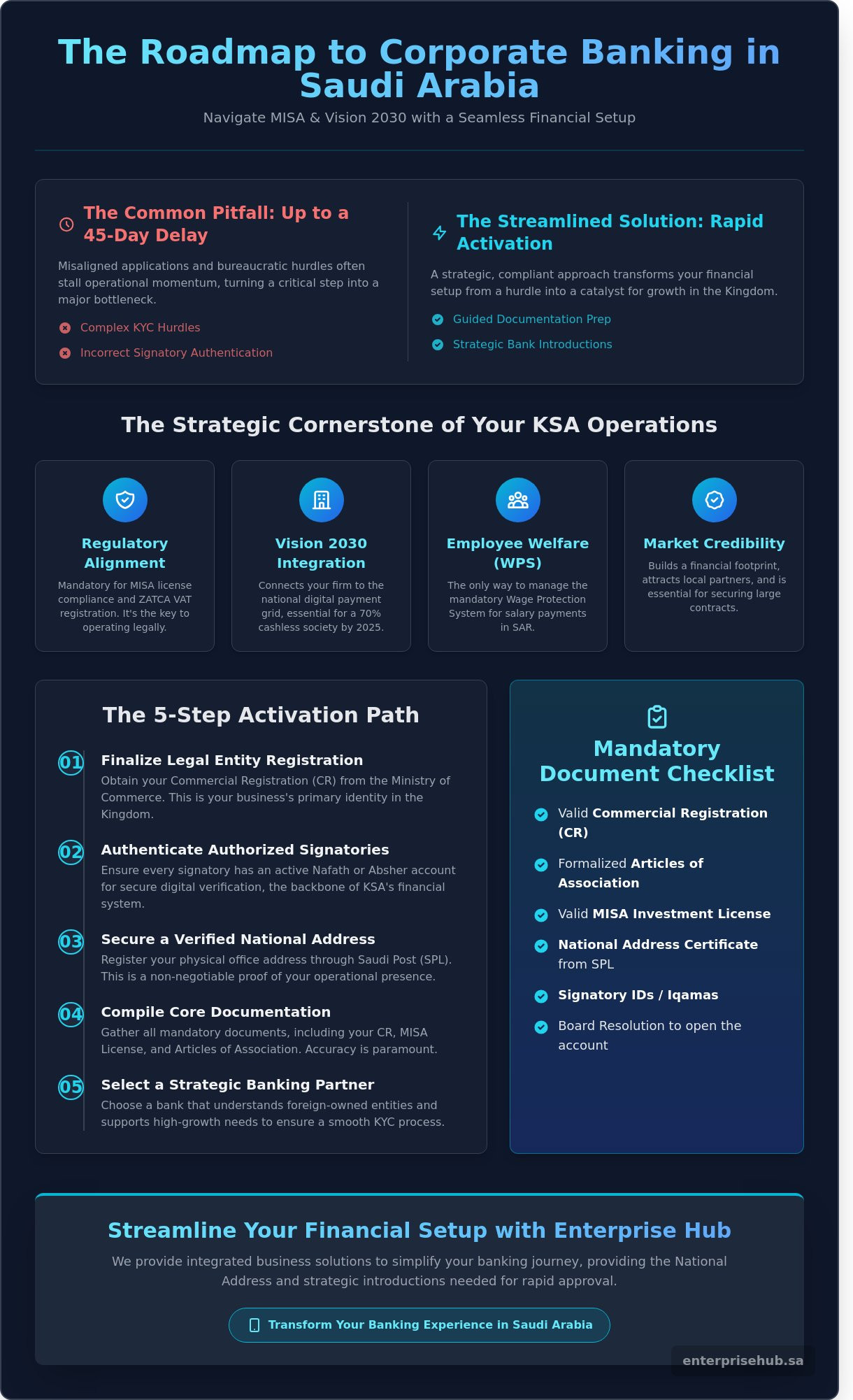
Securing a financial foundation begins with a precise execution of regulatory requirements. We enable your business to transition from a legal entity to an active market participant through a structured approach to فتح حساب بنكي. Success in the Riyadh market depends on following these five critical steps to ensure your application moves through compliance without delays.
- Step 1: Finalize your legal entity registration. You must obtain your Commercial Registration (CR) from the Ministry of Commerce. This document acts as your business’s primary identity and is the first item any bank will request.
- Step 2: Authenticate authorized signatories. Every individual listed as a signatory must have an active Nafath or Absher account. This digital verification is the backbone of security in the Kingdom’s financial system.
- Step 3: Secure a verified National Address. Registered through Saudi Post (SPL), this physical link to your Riyadh office is non-negotiable. Banks use this to verify the actual existence of your operations.
- Step 4: Select a banking partner. Evaluate banks based on their specialized SME desks or their capacity to handle high-volume international transfers in ﷼ SAR. Choose a partner that understands your specific industry’s cash flow patterns.
- Step 5: Complete the KYC interview. This Know Your Customer process follows strict Saudi Central Bank regulations to prevent financial fraud and ensure transparency. Depending on the bank, this may be a digital session or a brief meeting with a corporate manager.
Digital Onboarding vs. Traditional Branch Visits
The Saudi banking sector has seen a 70% increase in digital adoption since 2022. For 100% Saudi-owned SMEs, instant account opening is now a reality through integrated government portals. Most local entrepreneurs complete the process in under 30 minutes without visiting a physical location. Foreign-owned entities still require specialized corporate banking desks because of complex ownership structures and international compliance checks. By 2026, we expect activation timelines for foreign investors to drop to less than 48 hours as API integrations between MISA and local banks continue to improve.
The Role of Authorized Signatories
The General Manager must hold a valid Saudi residency (Iqama) or be a Saudi citizen to act as the primary signatory. Large corporations often manage multi-signatory accounts where transactions exceeding 500,000 ﷼ require dual approval. Modern Saudi banking relies on digital signature protocols, which eliminates the need for physical stamps in most daily operations. Understanding the full spectrum of انواع الاقامات في السعودية is essential, as your residency category directly determines your eligibility to serve as an authorized signatory. If you need assistance with these regulatory hurdles, we provide comprehensive business support to ensure your documentation is flawless before submission. This precision accelerates your ability to فتح حساب بنكي and start operations immediately.
Mandatory Documentation for Corporate Entities
Opening a business bank account in Riyadh requires a rigorous assembly of legal paperwork to satisfy Saudi Central Bank regulations. Compliance isn’t just a regulatory hurdle; it’s the foundation of your financial credibility in the Kingdom. We help you streamline this process by ensuring every document aligns with current institutional standards. To successfully فتح حساب بنكي, your entity must present a comprehensive dossier that proves its legal existence and operational structure.
Your documentation package must include:
- Commercial Registration (CR): A valid certificate issued by the Ministry of Commerce.
- Articles of Association: The original document along with any subsequent amendments registered with the authorities.
- MISA Investment License: This is mandatory for foreign-owned companies or joint ventures involving non-GCC capital.
- Board Resolution: A formal document signed by the board members specifically authorizing the opening of the account and designating authorized signatories.
- Identification: Clear copies of National IDs or Iqamas for all shareholders, directors, and authorized signatories.
Banks in Saudi Arabia have digitized many of these verification steps, yet the physical or digital presence of these documents remains essential for the KYC (Know Your Customer) process. Missing a single amendment in your Articles of Association can pause your application for weeks.
Proof of Address: The National Address Requirement
The era of using a simple P.O. Box for corporate banking ended with the implementation of the unified National Address system. Banks now require a digital link between your commercial profile and a verified physical location. This system verifies your business legitimacy by pinning your operations to a specific geographic point. You must link your office lease, verified through the Ejar platform, to your banking profile. This ensures your account remains active and compliant with anti-money laundering (AML) protocols. It’s a vital step for any business looking to فتح حساب بنكي without facing immediate freezes or restrictions.
Industry-Specific Licensing
Regulated sectors face additional layers of scrutiny. If you operate in Fintech, Healthcare, or Education, you’ll need to present specialized licenses from SAMA, the Ministry of Health, or relevant authorities. Consultancy firms must provide professional licenses that match their specific field of expertise. Securing the right documentation starts early during the process of Company Formation in Riyadh. Having these papers ready prevents delays and ensures your operational readiness from day one. We empower you to navigate these complexities with precision and speed.
Overcoming Common Challenges in Banking Approvals
The process of فتح حساب بنكي in Riyadh involves navigating a sophisticated regulatory framework designed to ensure financial integrity. Foreign investors often encounter rigorous Know Your Customer (KYC) hurdles. These checks go beyond basic identification; they require detailed disclosures regarding Ultimate Beneficial Owners (UBOs) and previous global business footprints. We see many entrepreneurs struggle when they attempt to use personal accounts for business transactions. This practice violates Saudi Central Bank (SAMA) regulations and often leads to account freezes. Transitioning to a dedicated corporate entity is a non-negotiable step for operational stability.
Your business activity codes, specifically the ISIC4 classifications on your Commercial Registration (CR), directly influence the bank’s risk assessment. Certain sectors like financial services or high-volume retail face 40% more scrutiny than standard consultancy firms. Banks also demand absolute consistency across all government platforms. If your address on the National Address portal differs by a single digit from your CR, your application will likely be rejected. We ensure every piece of documentation aligns perfectly before submission to avoid these delays. Statistics show that 90% of banking application rejections in the first quarter of 2023 were due to minor data discrepancies across government systems.
Risk Mitigation and Compliance
Banks prioritize transparency. You must provide clear, documented evidence of your source of funds, especially for initial capital deposits exceeding 100,000 SAR. During your first meeting with a corporate banker, present a professional business plan that outlines your revenue model and expected transaction volumes. This proactive approach demonstrates that you understand the Saudi market’s compliance requirements and reduces the likelihood of being labeled as high-risk. We enable you to prepare these documents to meet the highest institutional standards. Ensuring your financial reporting also aligns with ضريبة القيمة المضافة السعودية obligations under ZATCA further strengthens your credibility with banking institutions.
The Importance of a Professional Business Presence
A prestigious business address in Riyadh does more than look good on a business card; it signals stability to financial institutions. While virtual offices are popular for startups, SAMA regulations often require banks to conduct physical site visits before finalizing the فتح حساب بنكي process. Your office must be a functional space that reflects your stated business activities. We help you secure office solutions that meet these specific banking compliance standards, ensuring your physical setup supports your financial approval. A physical office presence in a recognized business district can speed up the approval process by up to 15 days compared to non-traditional setups.
Success in the Saudi market starts with a solid financial foundation. Let Enterprise Hub guide your banking strategy and handle the complexities of corporate compliance for you.
Streamlining Your Financial Setup with Enterprise Hub
Setting up a business in Riyadh involves more than just signing a lease. It requires a strategic foundation where your physical presence aligns perfectly with your financial goals. We provide integrated business support that bridges the gap between securing a high-end office and completing your فتح حساب بنكي. Our premium workspace solutions are designed to satisfy Saudi Arabia’s strict National Address requirements immediately. This is a critical step because local banks won’t process applications without a verified commercial address registered through the Saudi Post (SPL).
We guide you through the complexities of government portals like Qiwa and Absher with expert precision. These platforms are essential for managing labor contracts and verifying your digital identity, which are prerequisites for any corporate financial activity. Our experts ensure your documentation is flawless before you ever step into a bank. By positioning your brand in the heart of Riyadh’s financial district, you gain instant credibility. This location signals stability and long-term commitment to local financial institutions and potential partners alike.
Beyond the Office: A Partner in Growth
We don’t just provide desks; we offer a gateway to the Saudi economy. Our clients gain direct access to specialized accounting and tax services that ensure ongoing banking compliance. Maintaining a فتح حساب بنكي requires consistent adherence to ZATCA regulations and transparent financial reporting. We leverage our extensive network to provide professional introductions to major corporate banks in the Kingdom. This collaborative approach reduces the time-to-market for international brands entering Saudi Arabia by approximately 35% compared to traditional, unassisted setup methods.
Your Gateway to the Saudi Market
Enterprise Hub removes the administrative friction that often stalls new ventures. For investors planning to launch in 2026, the preparation starts now. You’ll need to secure your commercial registration, establish your digital footprint, and finalize your physical location to meet the evolving regulatory standards of Vision 2030. We handle the logistics so you can focus on your core business strategy. Our team ensures your setup meets every regulatory standard from day one, providing a seamless transition into the local market.
Reach out to our setup experts today to schedule a comprehensive consultation and accelerate your entry into the Saudi market.
Accelerate Your Financial Growth in the Kingdom
Establishing a solid financial foundation is the first step toward long-term success in the Saudi market. By 2026, the process of فتح حساب بنكي has become more streamlined, yet it still requires precise compliance with local regulations and meticulous documentation. Success hinges on understanding the specific requirements of Saudi banks and aligning your operations with the Kingdom’s evolving digital landscape. We’ve seen that prepared businesses reduce their setup time significantly when following these structured guidelines.
Enterprise Hub has been a trusted partner for international investors since 2022. We’re strategically located in the heart of the financial district, providing you with direct access to the nation’s economic pulse. Our team offers comprehensive business setup and government service support to ensure your entry into the market is seamless. We don’t just handle paperwork; we bridge the gap between your global ambitions and local success. You’re not just opening an account; you’re securing a seat at the table of the world’s fastest-growing G20 economy.
Launch your Saudi venture with Enterprise Hub today
Let’s turn your vision into a reality in the heart of Saudi Arabia.
Frequently Asked Questions
Can a foreigner open a business bank account in Saudi Arabia without residency?
You cannot open a business bank account in Saudi Arabia without a valid residency (Iqama) for the authorized signatory or a local legal representative. Saudi Central Bank (SAMA) regulations require a verified local ID to comply with strict “Know Your Customer” protocols. We help you navigate these requirements by ensuring your legal structure aligns with local banking standards from the very beginning.
What is the minimum capital required to open a corporate account in KSA?
There isn’t a universal minimum capital required by all banks, but your Commercial Registration must specify a capital amount, which is often 50,000 SAR for limited liability companies. Some specialized investment licenses might require higher amounts depending on the activity. We recommend checking with your chosen bank as they might have internal policies requiring a specific opening deposit to activate premium features.
Is it possible to open a Saudi bank account entirely online for a company?
You can open a Saudi bank account entirely online for your company through digital platforms provided by major institutions like Al Rajhi Bank or SNB. These banks use the “Wathiq” service to verify your Commercial Registration data automatically and securely. While the initial application is digital, some banks still require a physical visit to a branch to verify the authorized signatory’s signature in person.
How long does the corporate bank account opening process typically take?
The process for opening a bank account typically takes between 2 to 4 weeks for most startups and SMEs in Riyadh. If your company has a complex shareholding structure or involves foreign corporate entities, the compliance review might extend to 6 weeks. We streamline this by preparing your documentation folder to meet every specific bank requirement before you submit your application.
Do I need a physical office to get bank approval for my business?
You need a physical office or a registered commercial address to secure bank approval in Saudi Arabia. Banks require a valid National Address linked to your Commercial Registration to verify your business’s physical existence. Virtual offices are often rejected unless they provide a certified lease contract registered through the “Ejar” platform, which serves as official proof of your business location.
Can I open a bank account with a MISA license before getting a Commercial Registration?
You cannot open a bank account using only a MISA license because the Commercial Registration (CR) is the primary document required by all Saudi banks. The MISA license is your first step as a foreign investor, but the bank needs the CR number to link with the Ministry of Commerce’s database. We ensure your transition from MISA licensing to CR issuance is seamless to avoid delays.
What are the main differences between traditional and digital-first banks in Saudi Arabia?
Traditional banks offer extensive branch networks and complex trade finance products, while digital-first banks focus on speed and lower transaction fees. Digital banks like D360 or STC Bank provide faster onboarding through mobile apps, which suits tech-savvy startups. Traditional institutions remain the better choice for businesses requiring physical cash handling or large-scale international credit lines and guarantees.
How does the National Address system impact banking for new startups?
The National Address system acts as a mandatory verification tool for every bank’s “Know Your Customer” process. Without a registered National Address, you won’t be able to complete the opening a bank account process or receive official bank cards and correspondence. It links your business to a specific geographic location, ensuring your company complies with the latest anti-money laundering regulations in the Kingdom.