
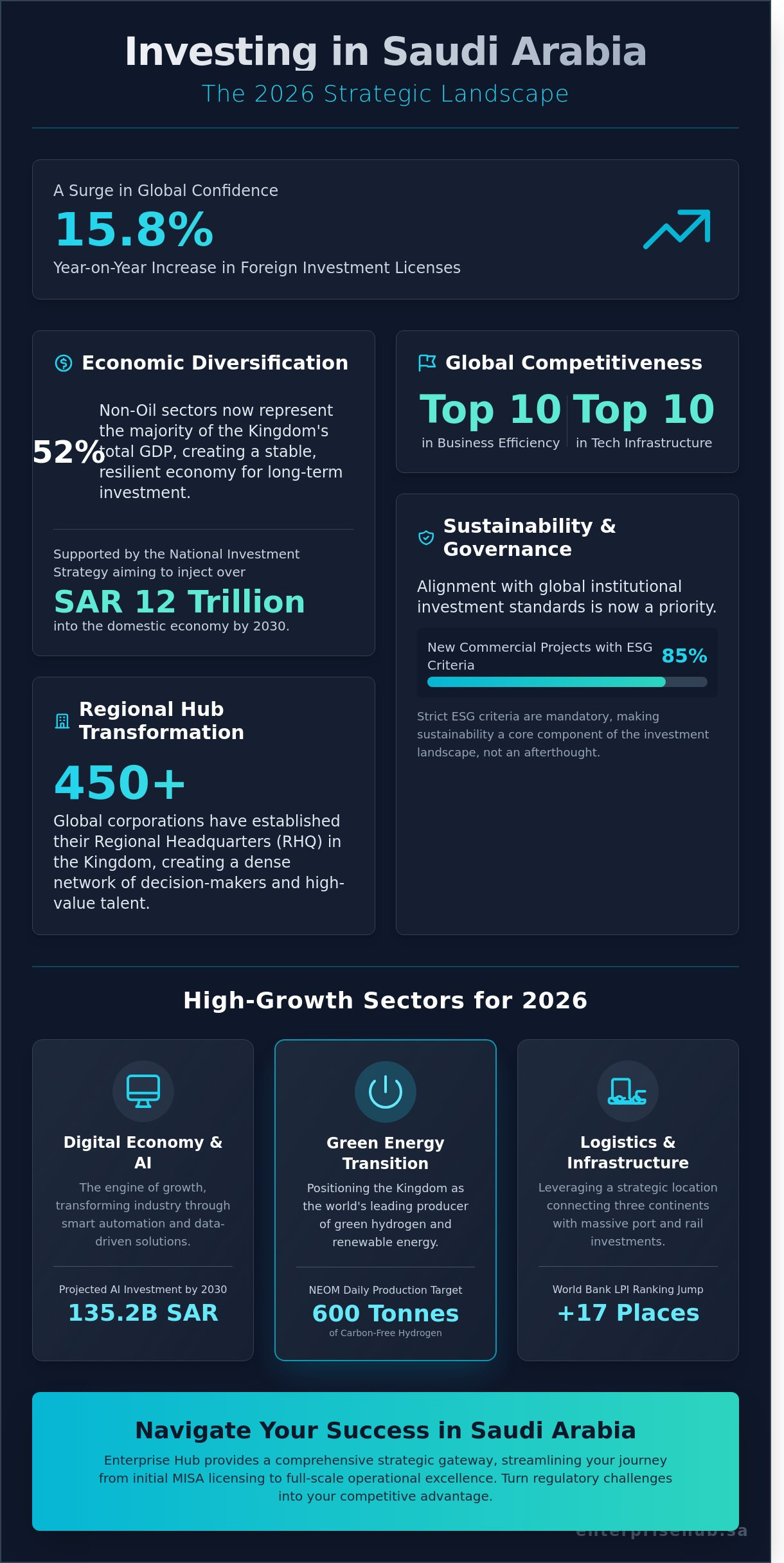
By the end of 2024, the Saudi Ministry of Investment reported a 15.8% year-on-year increase in foreign investment licenses, proving that the Kingdom is no longer just an emerging market but a global economic anchor. You’ve likely recognized that the window for early-mover advantage is closing as the market matures toward its 2030 milestones. We understand that while the scale of opportunity is undeniable, the complexities of MISA licensing and local compliance can create significant operational hurdles.
We’ve designed this guide to empower your next move. It’s time to effectively استثمر في السعودية by understanding the specific regulatory shifts and high-growth sectors that will define 2026. You’ll find a clear roadmap for the year ahead, including how to navigate licensing requirements and why an integrated local partner is essential for your success. We’ll provide the strategic insights you need to turn regulatory challenges into a distinct competitive advantage in the Middle East’s largest economy.
Key Takeaways
- Analyze the evolution of Vision 2030 in 2026 and how the Kingdom’s shift toward service-sector maturity creates a stable environment for global capital.
- Identify high-growth opportunities in the digital and energy sectors, specifically focusing on AI integration and the global green hydrogen transition.
- Master the 2026 MISA licensing requirements and digital government workflows to help you effectively استثمر في السعودية while ensuring full regulatory compliance.
- Understand the mandatory requirements for a physical presence and how flexible private office solutions can fulfill banking and operational needs without long-term lease burdens.
- Discover how Enterprise Hub provides a comprehensive strategic gateway, streamlining your journey from initial licensing to full-scale operational excellence in the Saudi market.
The Saudi Investment Landscape in 2026: Beyond the Horizon
By 2026, Saudi Arabia has solidified its position as the fastest-growing G20 economy, moving well beyond the initial phase of structural reforms. The Kingdom’s fiscal environment is no longer just about potential; it’s about proven performance and stability. For those looking to استثمر في السعودية, the 2026 landscape offers a sophisticated market where the legal and operational frameworks have reached full maturity. We see a shift where the focus has moved from heavy infrastructure spending to a highly competitive, service-oriented economy that rewards innovation and operational excellence.
The Economy of Saudi Arabia maintains a robust trajectory, with non-oil activities contributing significantly to the national balance sheet. This economic resilience is backed by the National Investment Strategy, which aims to pump over SAR 12 trillion into the domestic economy by 2030. We help our partners capitalize on this influx by identifying high-growth sectors that have moved past the “start-up” phase into “scale-up” maturity. The 2026 milestone isn’t just a date on the calendar; it represents the point where the Kingdom’s digital and physical infrastructure has become a global benchmark.
The Regional Headquarters (RHQ) program has fundamentally transformed the national business ecosystem. By the start of 2026, more than 450 global corporations have established their primary Middle Eastern hubs within the Kingdom, bringing a concentration of decision-makers and high-value talent to its key business centers. Enterprise Hub enables your business to integrate into this dense network of global leaders, ensuring you’re positioned where the deals are actually signed. This concentration of corporate power has created a secondary market for specialized services, professional consulting, and advanced technology solutions that didn’t exist five years ago.
Economic Diversification Progress
Non-oil sectors now represent approximately 52% of the Kingdom’s total GDP, a target that seemed ambitious a decade ago but is now a reality. This diversification is fueled by the hosting of major global events and the rapid expansion of the tourism and entertainment sectors. We’ve witnessed the 2026 investment climate evolve into a mature, pro-investor ecosystem. The success of these initiatives has reduced the economy’s sensitivity to global oil price fluctuations, providing a predictable environment for long-term capital deployment.
Global Competitiveness Rankings
Saudi Arabia now consistently ranks within the top 10 globally for business efficiency and technological infrastructure. This rise in the indices is the direct result of the National Investment Strategy (NIS) and its role in streamlining the investor journey. Enterprise Hub achieves results for its clients by leveraging these improvements, particularly in the areas of contract enforcement and digital licensing. Furthermore, sustainability is no longer optional; 85% of new commercial projects in 2026 now incorporate strict ESG (Environmental, Social, and Governance) criteria, aligning the Kingdom with global institutional investment standards.
High-Growth Sectors for Investors in 2026
Riyadh’s economic landscape is shifting rapidly as the 2030 deadline for the Kingdom’s national transformation approaches. For those looking to استثمر في السعودية, the next two years represent a critical window. The government’s focus has moved beyond traditional oil and gas, creating high-growth pockets in technology, logistics, and green energy. By 2026, the artificial intelligence market in the Kingdom is projected to contribute significantly to the economy, with total AI-related investments expected to reach 135.2 billion SAR by 2030. This digital surge isn’t just about software; it’s about the complete transformation of Saudi industry through smart automation and data-driven decision-making.
Energy remains a cornerstone, but the focus has pivoted toward sustainability. Saudi Arabia is currently positioning itself as the world’s leading producer of green hydrogen, with the NEOM Green Hydrogen Project aiming to produce 600 tonnes of carbon-free hydrogen daily by late 2026. This transition provides a massive opening for investors in renewable infrastructure and carbon-capture technologies. Simultaneously, the Kingdom’s strategic location is being fully utilized. Saudi Arabia jumped 17 places in the World Bank’s Logistics Performance Index in 2023, reflecting massive investments in port and rail infrastructure that connect three continents.
The Digital Economy Boom
The digital economy is no longer a niche market. It’s the engine of Riyadh’s growth. Fintech, Edtech, and Healthtech are seeing unprecedented adoption rates. In 2023, the Saudi Central Bank (SAMA) expanded its regulatory sandbox, allowing more startups to test innovative financial solutions in a controlled environment. With 5G coverage exceeding 90% in major urban areas like Riyadh, the infrastructure for smart city operations is already in place. We help you identify the right tech niches that align with these national priorities, ensuring your venture benefits from the 1.1 billion SAR allocated to R&D and innovation hubs annually.
Industrial and Manufacturing Growth
Manufacturing is experiencing a renaissance through the “Made in Saudi” initiative, which now supports over 1,600 local companies. This program provides a seal of quality that enhances export potential across the GCC and beyond. In April 2023, the government launched four new Special Economic Zones (SEZs) offering competitive 5% corporate tax rates for up to 20 years. These zones are designed to attract investment in industrial automation and robotics. According to Saudi Arabia’s Ministry of Investment, these incentives are part of a broader strategy to localize supply chains and reduce reliance on imports. If you’re ready to scale, we can guide your market entry to ensure you maximize these available government incentives while staying compliant with local regulations. The focus on “Industry 4.0” means that استثمر في السعودية is now a call to participate in one of the most advanced manufacturing ecosystems in the Middle East.
Navigating the Regulatory Framework: MISA and Beyond
Success in Riyadh requires a deep understanding of the Ministry of Investment (MISA) and its evolving protocols. By 2026, the Saudi government has fully integrated its digital infrastructure, making it easier to استثمر في السعودية through unified portals. The shift toward a paperless environment isn’t just a goal; it’s a reality. Platforms like Qiwa manage labor contracts and professional accreditation, with government digital platforms efficiently managing residency and other essential permits. This digital transformation reduces the bureaucratic friction that previously slowed down market entry.
Choosing the right legal vehicle determines your operational flexibility and long-term tax liabilities. Most foreign entities opt for a Limited Liability Company (LLC), which allows for 100% foreign ownership in the majority of commercial sectors. Alternatively, a Branch Office provides a direct link to the parent company’s identity but comes with specific capital requirements and liability structures. According to the U.S. Department of State’s Investment Climate Statement, the Kingdom has made significant strides in protecting investor rights and streamlining dispute resolutions, which boosts confidence for those entering the market. We help you evaluate these options to ensure your structure aligns with your 2026 growth targets.
The Licensing Roadmap
Obtaining your MISA license in 2026 follows a structured digital path. You must first identify your activity code under the ISIC4 classification to ensure it matches your intended operations. Documentation requires meticulous localized legal translation to ensure compliance with Saudi Law. For a granular look at the technical requirements and the sequence of government approvals, you can explore this guide on تأسيس شركات في الرياض which details the necessary steps from initial application to final commercial registration issuance.
Post-Incorporation Compliance
Your journey doesn’t end with the license. You must navigate ZATCA requirements, including the 15% Value Added Tax (VAT) and the mandatory “Fatoora” electronic invoicing system. A clear understanding of your obligations under ضريبة القيمة المضافة السعودية is essential to avoid penalties and ensure your Fatoora invoicing remains fully compliant from day one. Workforce planning is equally critical. You’ll need to adhere to Saudization (Nitaqat) ratios, which vary based on your industry and company size. Opening a corporate bank account in 2026 typically takes 2 to 4 weeks, provided all “Know Your Customer” (KYC) documents are verified. Annual audits and regular regulatory reporting are mandatory to maintain your “Green” status in the Nitaqat system. This ensures your business remains in good standing as you استثمر في السعودية and scale your operations within the capital’s thriving economy.
Operational Excellence: The Importance of a Physical Presence
Establishing a physical footprint is a non-negotiable step if you want to استثمر في السعودية successfully. The Saudi Ministry of Investment (MISA) requires a registered office address to issue and maintain your foreign investment license. Without a verified lease recorded in the Ejar system, opening a corporate bank account or obtaining work visas for your team becomes nearly impossible. Local banks often conduct site visits to verify the legitimacy of operations before approving high-value transactions or corporate credit facilities. This regulatory framework ensures that businesses are genuinely contributing to the local economy rather than operating as shell companies.
Riyadh’s commercial real estate market has shifted toward flexible solutions to accommodate rapid growth. According to recent market trends, approximately 60 percent of new firms entering the capital in 2024 opted for flexible workspace models over traditional 5-year leases. These setups allow you to bypass the heavy capital expenditure of fit-outs, which can cost upwards of 3,500 ﷼ per square meter in prime districts. Your choice of location acts as a silent brand ambassador; an office in a prestigious district like KAFD or Olaya signals stability and commitment to local partners. When you decide to استثمر في السعودية, your office address is your first statement of intent to the market. For companies planning their 2026 roadmap, virtual offices offer a strategic entry point to test market demand before committing to a larger physical hub. Long-term operational success also depends on securing the right residency status for your key personnel; understanding the full range of انواع الاقامات في السعودية available in 2026 is essential for retaining top talent and maintaining uninterrupted business continuity.
Choosing the Right Workspace Strategy
Selecting between a serviced office and a shell-and-core unit depends on your growth speed. Serviced offices provide immediate operational capacity with integrated meeting rooms, high-speed IT support, and professional reception services. These amenities allow your team to focus on core business tasks from day one rather than managing utility contracts. If you’re looking for specific criteria to evaluate your options, check out this guide on offices for rent in Riyadh to ensure your choice aligns with MISA regulations and operational needs.
Cultural Nuances in Saudi Business
Success in the Saudi market relies on building deep trust through face-to-face interactions. Digital communication can’t replace the value of a shared coffee or an in-person meeting. You must align your operations with the local calendar, specifically respecting the reduced working hours during Ramadan and the significance of Saudi National Day on September 23rd. Consistent physical presence demonstrates that you aren’t just a visiting entity, but a partner invested in the Kingdom’s long-term prosperity. Networking at local events helps you navigate the social fabric that often dictates business speed and contract approvals. Long-term trust is the currency of the Saudi market; it’s built in person over months of consistent engagement.
Enterprise Hub: Your Strategic Gateway to Saudi Investment
Transforming an investment vision into a functional entity in Riyadh requires more than just capital. It demands local expertise and a deep understanding of the regulatory framework. Enterprise Hub acts as your operational architect. We simplify the complexities for those who want to استثمر في السعودية by removing the administrative friction that often slows down market entry. Our team bridges the gap between your global strategy and the local execution required to succeed in the Kingdom’s fast-moving economy.
We offer a comprehensive support system that covers every stage of your business lifecycle. From securing your initial MISA investment license to providing fully equipped private offices, we handle the logistics. This “All-in-One” partnership model allows you to reduce setup time by up to 50%. You won’t have to deal with multiple vendors or fragmented service providers. We provide a single point of contact for your entire operational setup, ensuring your focus remains on growth rather than paperwork.
Integrated Business Solutions
We provide a unified platform for government compliance and operational management. This includes expert handling of essential platforms like Qiwa for labor services, GOSI for social insurance, and Muqeem for residency permits. Our team manages your accounting and tax compliance, ensuring you meet ZATCA requirements from the first day of operations. By centralizing these services, we help you avoid the common pitfalls of international expansion. Our flexible office solutions are designed to grow with your investment. Whether you start with a small team or a large regional headquarters, our spaces adapt to your needs without the burden of long-term, rigid real estate contracts.
Empowering Your Success
Our services align directly with the strategic pillars of رؤية السعودية 2030. We don’t just provide a workspace; we provide a launchpad. International firms from various sectors have successfully entered the market via Enterprise Hub, citing our ability to navigate the SAR 500,000 capital requirements and licensing nuances as a key factor in their speed to market. When you join us, you enter a community of global leaders and local innovators. This ecosystem fosters collaboration and provides networking opportunities that are vital for long-term prosperity. We take care of the technical and legal overhead so you can lead your industry. It’s time to take your place in the region’s most exciting economy. We’re here to ensure your story is one of rapid growth and sustained excellence.
Start your investment journey with Enterprise Hub today and experience a seamless entry into the Saudi market.
Secure Your Future in the Kingdom’s 2026 Economy
The roadmap to 2026 shows a landscape where Vision 2030 targets transition from ambitious plans to tangible market dominance. Success requires more than just capital. It demands a strategic alignment with high-growth sectors like renewable energy and digital infrastructure. You’ll need a physical foundation that meets strict MISA requirements to ensure your operations remain compliant and scalable. When you choose to استثمر في السعودية, you’re entering a market built on a foundation of massive economic diversification and rapid regulatory evolution.
Enterprise Hub provides the structural support your business needs to thrive today. We offer MISA-compliant business addresses and full integration with government services, removing the administrative friction that often slows down expansion. Our platform serves as your strategic gateway, aligning your corporate goals with the Kingdom’s national objectives. You won’t have to navigate these regulatory complexities alone. We’re here to bridge the gap between your vision and the Saudi market’s vast potential.
Launch Your Business in Saudi Arabia with Enterprise Hub and take your place in the region’s most ambitious economic transformation. The future is ready for your next move.
Frequently Asked Questions
Can foreigners own 100% of a business in Saudi Arabia in 2026?
Yes, you can own 100% of your business in Saudi Arabia in 2026 across the vast majority of economic sectors. The updated Saudi Investment Law removes the previous requirement for a local partner, allowing international entrepreneurs full control over their operations and capital. We help you navigate these regulatory frameworks to ensure your company structure aligns perfectly with Vision 2030 goals.
What is the minimum capital requirement to invest in Saudi Arabia?
Minimum capital requirements depend entirely on your specific business activity and license type. While many service-based licenses require 0 ﷼ in upfront capital, retail and trading activities generally require a minimum of 26.6 million ﷼. We provide the financial clarity you need to invest in Saudi Arabia by identifying the exact thresholds for your industry before you begin the application process.
How long does it take to get a MISA investment license?
You can typically obtain a MISA investment license within 3 to 5 business days once your documentation is complete. This rapid timeline is a result of the Kingdom’s digital transformation initiatives designed to lower entry barriers. Our team accelerates this process by ensuring every document meets the Ministry of Investment’s strict standards on the first submission.
Is a physical office required to obtain a commercial registration?
A physical office address is mandatory to secure a Commercial Registration (CR) from the Ministry of Commerce. You must provide a verified lease agreement registered through the Ejar platform to prove your business has a legitimate local presence. This requirement is essential for finalizing your file with the Ministry of Labor and فتح حساب بنكي (opening a bank account) for your corporate entity.
What are the main tax obligations for foreign investors in the Kingdom?
Foreign investors are subject to a 20% corporate income tax on their annual net profits. You’ll also need to manage a 15% Value Added Tax (VAT) on taxable goods and services if your revenue exceeds the mandatory registration threshold. We ensure you stay compliant with the Zakat, Tax and Customs Authority (ZATCA) while optimizing your financial structure for long-term growth.
How does the Regional Headquarters (RHQ) program affect new investors?
The RHQ program requires companies to establish their Middle East hub in Riyadh to remain eligible for government contracts exceeding 1 million ﷼. Since January 1, 2024, this policy has incentivized firms to move their decision-making centers to the capital. It’s a strategic move that allows you to invest in Saudi Arabia while benefiting from a 30-year corporate tax exemption on RHQ activities.
Can I start with a virtual office before committing to a private space?
You can’t use a purely virtual office to satisfy the legal requirements for a permanent MISA license or Commercial Registration. Saudi law requires a physical site that municipal inspectors can verify. However, we help you secure flexible workspace solutions in licensed business centers that meet all government criteria without the high overhead of a traditional long-term lease.
What government support is available for small and medium-sized foreign investors?
The General Authority for Small and Medium Enterprises, known as Monsha’at, offers extensive resources including the “Tomoh” program for high-growth companies. These initiatives provide access to funding, specialized advisory services, and simplified administrative procedures. The government’s goal is to increase the SME contribution to the national GDP to 35% by 2030, creating a supportive ecosystem for your venture.