
In 2026, failing to distinguish between your Zakat base and Corporate Income Tax requirements isn’t just an accounting error; it’s a direct threat to your market credibility in Saudi Arabia. We understand that keeping up with ZATCA’s shifting electronic auditing and strict 120-day filing deadlines feels like a constant challenge. It’s natural to worry about the 1% monthly late payment penalties for withholding tax or the nuances of mixed-ownership calculations. Securing professional Zakat and tax services for companies in Riyadh is no longer about simple bookkeeping. It’s about building a strategic foundation that ensures your business thrives within the Kingdom’s ambitious vision for growth.
This guide empowers you to master current regulations and optimize your corporate fiscal strategy for the year ahead. You’ll learn how to navigate the 20% flat CIT rate for foreign investors and the 2.5% Zakat base for Saudi or GCC nationals with absolute precision. We provide a clear look at the essential 2026 compliance milestones, from VAT grouping updates to mandatory registration thresholds. This ensures you can focus on your core operations while we work together to handle the complexities of government interactions and achieve long-term fiscal stability.
Key Takeaways
- Distinguish between Zakat obligations for Saudi/GCC nationals and Corporate Income Tax for foreign entities to ensure precise fiscal reporting.
- Utilize expert Zakat and tax services for companies in Riyadh to manage complex e-invoicing (Fatoora) requirements and monthly Withholding Tax obligations.
- Transform your tax strategy from simple filing to a growth tool by using tax due diligence and optimized structures that leverage regional incentives.
- Execute a risk-mitigation roadmap starting with a comprehensive tax health check and the implementation of ZATCA-approved accounting software.
- Streamline your Saudi market entry by integrating premium office solutions in KAFD with professional accounting and government support services.
Understanding Zakat and Tax Services for Companies in Riyadh
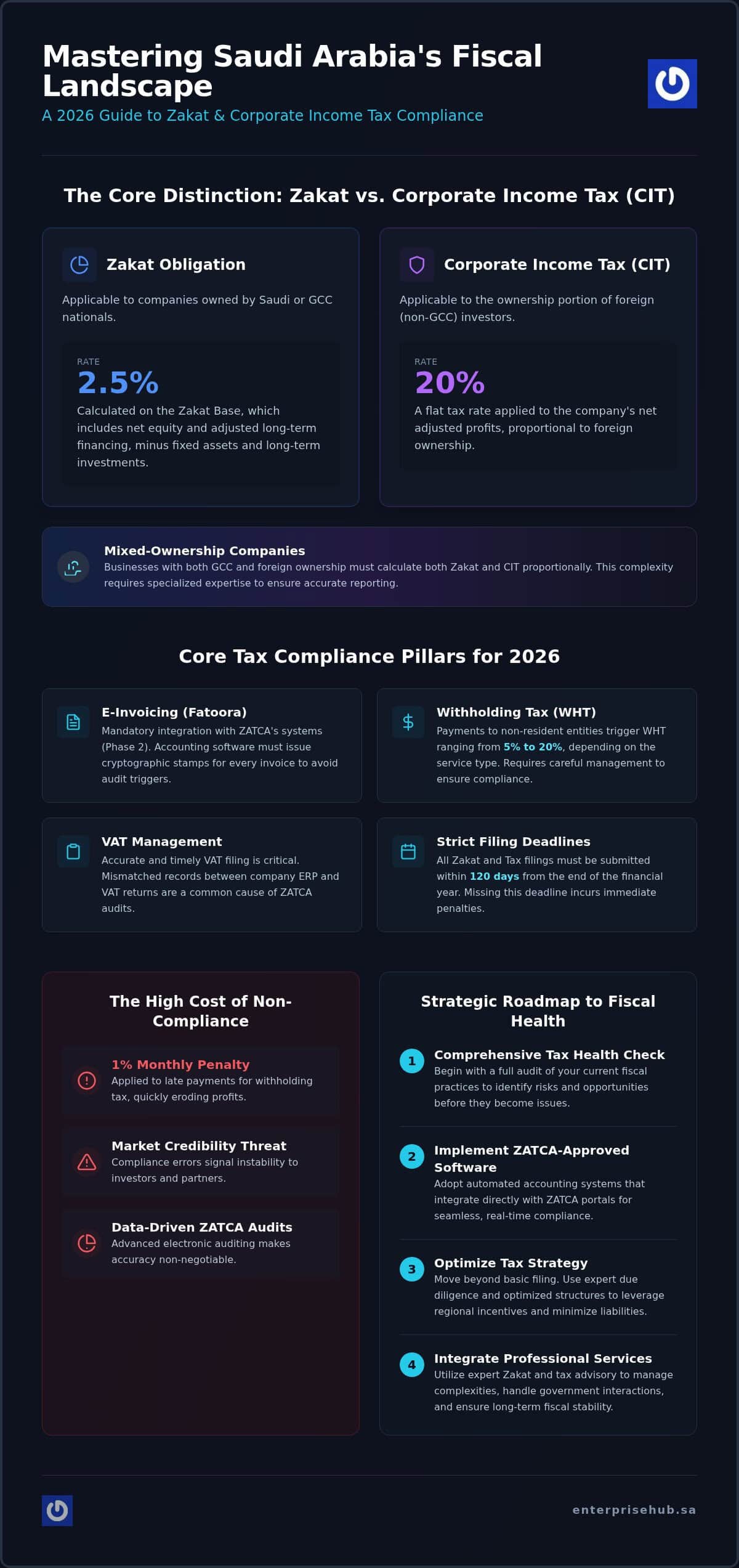
Zakat and tax services for companies in Riyadh represent a comprehensive suite of professional solutions designed to align corporate fiscal health with the Zakat, Tax and Customs Authority (ZATCA) regulations. In 2026, these services have evolved beyond basic compliance. They now act as a strategic bridge for firms aiming to meet the rigorous transparency standards of Saudi Vision 2030. ZATCA’s investment in technology means audits are now data-driven. This makes accuracy non-negotiable for every enterprise operating in the capital. Professional support ensures your business avoids the 1% monthly late payment penalties that can quickly erode profit margins.
The primary difference in the Saudi fiscal system lies in ownership structure. Saudi and GCC nationals contribute Zakat, while foreign investors are subject to Corporate Income Tax (CIT). If a company has mixed ownership, it must calculate both proportionally. This complexity is why specialized Understanding Zakat and tax services for companies in Riyadh are essential for maintaining market credibility. Aligning your fiscal reporting with national standards isn’t just a legal requirement; it’s a signal to investors and partners that your company is a stable, reliable player in the Kingdom’s growing economy.
Zakat Essentials for Saudi and GCC Entities
Companies owned by Saudi or GCC nationals must calculate Zakat at a 2.5% rate based on their Zakat base. This calculation is unique because it focuses on net equity and adjusted items rather than simple net profit. ZATCA utilizes advanced electronic portals to audit these declarations, requiring businesses to maintain impeccable digital records. For 2026 corporate reporting, the Zakat base is defined as the company’s total equity plus long-term financing and provisions, minus fixed assets and long-term investments. Accurate reporting requires a deep understanding of how ZATCA interprets specific deductions and long-term liabilities.
Corporate Income Tax for International Investors
International investors face a 20% flat tax rate on net adjusted profits. This rate applies to the portion of the company owned by non-GCC entities. While this is a competitive rate globally, the challenge lies in navigating double taxation treaties and withholding tax obligations. Payments to non-resident entities can trigger withholding taxes ranging from 5% to 20%, depending on the service type. Expert advisory ensures that international firms don’t overpay while remaining fully compliant with the Kingdom’s evolving transfer pricing rules. As Saudi Arabia aligns with global frameworks like the OECD Pillar Two, having a local partner in Riyadh becomes a critical asset for managing these multifaceted international tax laws.
Core Tax Compliance Pillars for Saudi Enterprises in 2026
Success in the Saudi market requires more than just a great product. It demands a robust understanding of the fiscal pillars enforced by the Zakat, Tax and Customs Authority (ZATCA). As we move through 2026, the shift toward real-time data sharing means manual accounting is a liability. Companies must prioritize automated systems that sync directly with government portals to maintain compliance. Professional Zakat and tax services for companies in Riyadh provide the technical oversight needed to manage these digital links without disruption. This ensures your data is always audit-ready and your reputation remains untarnished.
During your initial business setup in Riyadh, establishing your tax profile is a foundational step. This early registration sets the stage for managing ongoing VAT, Zakat, and CIT filings effectively. It’s better to build a compliant structure from day one than to retroactively fix errors during a high-stakes government audit.
VAT Management and E-Invoicing Compliance
Phase 2 of the Fatoora initiative is now the standard for all taxable entities. Your accounting software must integrate seamlessly with ZATCA’s systems to issue cryptographic stamps for every invoice. Many firms struggle with audit triggers caused by mismatched records between their ERP and VAT returns. Reliable Zakat and tax services for companies in Riyadh help you avoid these pitfalls. Timely and accurate filing doesn’t just avoid fines; it also secures your right to VAT refunds, which can provide a significant boost to your operational cash flow.
Withholding Tax (WHT) and Cross-Border Transactions
If your company pays for royalties, management fees, or technical services to non-resident entities, you’re responsible for withholding tax. Rates vary between 5% and 20% depending on the payment type. For instance, dividend payments typically carry a 5% rate, while royalties often reach 15%. Utilizing expert advisory helps you apply Double Tax Avoidance Agreements (DTAA) correctly. This ensures you don’t overpay while satisfying documentation requirements for your international partners. We can help you manage these monthly obligations through our dedicated accounting and tax services, keeping your cross-border operations lean and compliant.
Real Estate Transaction Tax (RETT) is another critical pillar for expanding firms. At a fixed rate of 5%, RETT applies to the transfer of property ownership. Whether you’re acquiring new warehouse space or moving to a larger office in KAFD, calculating this tax accurately is vital to avoid delays in title deed transfers. Staying ahead of these diverse tax obligations ensures your company remains focused on growth rather than administrative hurdles.
Strategic Tax Advisory: Moving Beyond Basic Filing
Strategic fiscal management serves as the engine of corporate growth, not just a compliance checkbox. As your business scales in the Saudi capital, shifting from reactive filing to proactive advisory becomes essential. Expert Zakat and tax services for companies in Riyadh provide the foresight needed to integrate tax efficiency into your broader investment planning and long-term financial forecasting. This approach ensures that every expansion move or restructuring effort is optimized to protect your bottom line. It’s about making sure your tax strategy works for your business, not the other way around.
When you align your fiscal goals with the broader economic shifts in the Kingdom, you gain a competitive edge. This isn’t just about staying out of trouble; it’s about identifying opportunities that others might miss. Whether you’re a startup looking to attract investors or an established firm planning a merger, having a clear tax roadmap is vital for maintaining market trust and operational agility.
Tax Due Diligence and Restructuring
During mergers, acquisitions, or internal restructuring, assessing historical tax liabilities is a critical step that many firms overlook. Hidden debts from improper VAT filings or miscalculated Zakat bases can quickly derail a deal’s valuation. We help you identify these risks early through rigorous due diligence. Additionally, the Saudi government offers significant incentives through the Regional Headquarters (RHQ) program. By restructuring your operations to meet RHQ criteria, your company can potentially benefit from tax incentives like the 0% corporate income tax rate for 30 years on eligible activities. This level of strategic planning transforms tax from a mandatory cost into a powerful advantage for your regional growth.
Audit Readiness and Dispute Resolution
The Zakat, Tax and Customs Authority (ZATCA) has increased the frequency and depth of its digital audits. Preparing a robust audit file before an inspector even contacts you is the best way to ensure zero-penalty outcomes. This file should contain reconciled records of every transaction, cryptographic invoice stamps, and clear documentation of all deductions. If a dispute arises, you have the right to navigate the appeals process through the General Secretariat of Tax Committees. Success in these appeals depends entirely on the quality of your evidence and the clarity of your legal arguments. You must provide a formal response to a ZATCA audit notification within 20 calendar days to maintain your right to appeal or clarify findings. By maintaining this level of readiness, you protect your company’s operational stability and maintain a positive relationship with the authorities.
A Roadmap to ZATCA Compliance and Risk Mitigation
Establishing a clear compliance roadmap is the most effective way to shield your business from the financial and reputational risks of non-compliance. In 2026, ZATCA’s auditing mechanisms are faster and more precise than ever. A reactive approach is no longer sustainable for companies looking to grow in Riyadh. By following a structured path, you transform tax management from a source of stress into a streamlined operational process. Professional Zakat and tax services for companies in Riyadh provide the technical framework to ensure each step is executed with precision.
Follow these five strategic steps to secure your fiscal standing:
- Step 1: Conduct a Tax Health Check. Review your historical records to identify any discrepancies in VAT filings or Zakat base calculations before they trigger an official audit.
- Step 2: System Integration. Ensure your accounting software is fully integrated with ZATCA’s Phase 2 e-invoicing requirements for real-time cryptographic stamping.
- Step 3: Filing Schedules. Establish a rigid internal calendar for monthly Withholding Tax (WHT) and quarterly VAT submissions to avoid late payment penalties.
- Step 4: Annual Declarations. Engage a certified consultant to handle the complexities of your year-end Zakat and Corporate Income Tax filings.
- Step 5: Ongoing Monitoring. Stay informed about new ZATCA circulars and regulatory shifts to adjust your fiscal strategy proactively.
The 2026 Compliance Calendar
Deadlines in Saudi Arabia are strict and leave little room for error. For companies with a fiscal year ending on December 31st, the deadline for filing Zakat and CIT declarations is April 30th of the following year. Withholding tax is even more frequent, requiring monthly submissions by the 10th day of each following month. Missing these dates triggers a 1% penalty on the unpaid tax for every 30 days of delay. Beyond filing, you must maintain all digital records, invoices, and supporting documents for a minimum of 10 years to satisfy potential retrospective audits. This long-term data retention is a core requirement for all taxable entities operating in the Kingdom.
Implementing Robust Internal Controls
Technology alone isn’t enough; your internal finance team needs to understand the nuances of Saudi tax law. Training staff on the specific documentation required for cross-border transactions and VAT exemptions reduces the risk of human error. In a paperless regulatory environment, digital record-keeping is your strongest defense. Many modern firms utilize virtual offices in Saudi Arabia to manage official ZATCA correspondence and ensure all government notifications are received and processed immediately. This setup provides a professional infrastructure that supports your compliance efforts without the overhead of a large physical footprint. Secure your company’s growth by integrating these controls with our expert accounting and tax services to ensure total peace of mind.
Integrated Business Support: The Enterprise Hub Advantage
Managing complex fiscal obligations shouldn’t distract you from your core mission of growth and innovation. Enterprise Hub bridges the gap between premium infrastructure and technical compliance by offering a unified ecosystem. We don’t just provide a desk; we provide a strategic partnership that handles the heavy lifting of government interactions. Our Zakat and tax services for companies in Riyadh are woven into our physical office solutions, creating a seamless experience for modern leadership teams. This integrated approach ensures that your accounting, tax, and government services are managed under one roof, reducing the friction of dealing with multiple vendors.
By centralizing your operations with us, you gain more than just efficiency. You gain a partner that understands the local landscape and the technical requirements of ZATCA and MISA. We’ve designed our services to act as an extension of your own team, providing the expertise needed to navigate the Kingdom’s evolving regulatory environment. This synergy between professional support and high-end office space allows you to focus on scaling your business while we ensure your foundation remains compliant and secure.
Fiscal Support in the Heart of KAFD
Operating from the King Abdullah Financial District (KAFD) provides your company with immediate prestige and regulatory trust. A prestigious business address isn’t just for show; it’s a vital component of successful tax and MISA registrations. Within our workspace ecosystem, you have direct access to expert consultants who understand the specific challenges of the Saudi market. Our integrated model drastically reduces administrative overhead for your leadership. Instead of coordinating between a remote accountant and a separate office manager, you have a single point of contact. This ensures that official ZATCA correspondence is handled instantly and your digital records are always audit-ready.
Scaling with Confidence in the Saudi Market
Every business journey is unique, and your support system should reflect that. We offer customizable packages that grow alongside your company’s fiscal complexity. Whether you’re a startup navigating your first VAT filing or an international firm managing cross-border withholding taxes, our solutions adapt to your needs. We provide a seamless partnership that takes you from initial business setup to advanced tax advisory and ongoing government compliance. This continuity prevents the data loss and communication gaps that often occur when switching service providers as you scale. You can experience a complete business ecosystem at Enterprise Hub and give your company the strategic advantage it deserves in Riyadh’s competitive landscape.
Empower Your Enterprise for the Future of Saudi Business
Mastering the 2026 fiscal landscape requires a shift from reactive bookkeeping to proactive strategy. By integrating ZATCA-approved digital systems and leveraging regional incentives like the RHQ program, you transform compliance into a competitive advantage. Success in the Kingdom’s evolving economy depends on precise data management and a deep understanding of mixed-ownership obligations. Enterprise Hub stands as your strategic partner in this journey. Located in the prestigious King Abdullah Financial District (KAFD), we provide a complete business ecosystem that combines premium office solutions with comprehensive accounting support. Our team ensures your business remains fully aligned with Saudi Vision 2030 standards, allowing you to scale with absolute confidence.
Don’t let regulatory complexity slow your momentum or lead to avoidable penalties. Partnering with a specialist for Zakat and tax services for companies in Riyadh ensures that your financial foundation is as ambitious as your growth targets. Secure your company’s future with expert Zakat and tax services at Enterprise Hub. We’re ready to help you navigate these administrative challenges and turn them into milestones for your corporate success and long-term prosperity in the heart of the Kingdom.
Frequently Asked Questions
What is the difference between Zakat and Corporate Income Tax in Saudi Arabia?
Zakat is a 2.5% wealth-based contribution applicable to the ownership shares of Saudi and GCC nationals, whereas Corporate Income Tax (CIT) is a 20% profit-based tax for foreign investors. While Zakat is calculated based on the company’s net equity and adjusted Zakat base, CIT applies specifically to adjusted net profits. If your firm has mixed ownership, you’ll need to apply both systems proportionally to the respective shares of the partners.
Are foreign companies in Riyadh subject to Zakat?
No, foreign companies and non-GCC shareholders are strictly subject to Corporate Income Tax rather than Zakat. However, if a foreign entity partners with a Saudi or GCC national, the Saudi share is liable for Zakat while the foreign share pays the 20% CIT rate. Professional Zakat and tax services for companies in Riyadh help manage these split calculations to ensure each partner meets their specific legal obligations without error.
What are the penalties for non-compliance with ZATCA regulations in 2026?
Penalties in 2026 include a 1% charge on any unpaid tax for every 30 days past the due date. Failure to file Zakat or CIT returns within the mandatory 120-day window after your fiscal year-end can result in fines ranging from 5% to 25% of the tax value. Additionally, violating e-invoicing standards can trigger immediate administrative fines that scale based on the frequency and severity of the violation.
How does the E-invoicing (Fatoora) Phase 2 impact my business?
Phase 2 requires your accounting systems to integrate directly with ZATCA’s platform for real-time cryptographic stamping of all invoices. This means every transaction is validated by the authority at the moment of issuance, which eliminates the possibility of retrospective manual adjustments. It’s vital to ensure your software is fully compliant to avoid audit triggers and to maintain your company’s ability to claim VAT refunds effectively.
Can a company apply for VAT deregistration if revenues fall below the threshold?
Yes, you can apply for VAT deregistration if your annual taxable supplies fall below the voluntary threshold of SAR 187,500. If your supplies are between SAR 187,500 and the mandatory SAR 375,000 limit, deregistration remains optional. You must submit the request through the official ZATCA portal within 30 days of the date you no longer meet the registration requirements to avoid any late filing fees.
What documents are required for a ZATCA audit for a Riyadh-based company?
ZATCA inspectors typically require audited financial statements, trial balances, and detailed general ledgers for the period under review. You must also provide cryptographic e-invoices, bank statements, and proof of withholding tax payments for cross-border transactions. Keeping these records digitally for at least 10 years is a mandatory requirement for all enterprises to ensure total transparency during any potential government inquiries.
Does having a virtual office affect my company’s tax status?
A virtual office doesn’t change your fundamental tax obligations, but it provides a professional infrastructure for managing ZATCA correspondence. Using a virtual address in a prime location like KAFD ensures you have a reliable point of contact for official notifications and audits. Specialized Zakat and tax services for companies in Riyadh often utilize these setups to streamline government interactions while maintaining a lean operational footprint for the business.
How can professional tax services help in reducing corporate tax liability?
Professional tax services identify legal deductions and incentives, such as those offered through the Regional Headquarters (RHQ) program, to optimize your tax base. Experts ensure you apply Double Tax Avoidance Agreements (DTAA) correctly on cross-border payments, which prevents the overpayment of withholding tax. This strategic oversight transforms tax management from a mandatory cost center into a tool for financial efficiency and long-term stability.