
What if the biggest hurdle to your Saudi expansion isn’t the government’s approval, but the sequence of your own paperwork? Many investors hesitate, fearing they’ll be trapped paying for a physical space before their legal status is even confirmed. You’re likely asking whether you need a virtual office or commercial registration first to stay compliant with the Ministry of Commerce’s latest 2026 standards. It’s a common point of friction that leads to expensive delays or rejected applications if handled out of order.
We understand that managing the requirements of MISA and the national ‘E-Contract’ system feels complex. This article provides the definitive roadmap to mastering the regulatory sequence, ensuring you secure a legal business address that satisfies all government mandates with minimal upfront risk. We’ll explore how the Saudi Business Center integrates these steps and why your address is the strategic anchor for your entire legal identity in the Kingdom.
Key Takeaways
- Understand why securing a virtual office address is the mandatory regulatory prerequisite before applying for your Commercial Registration (CR) in 2026.
- Learn how the E-Contract system integrates with the Ministry of Justice to provide the unified legal foundation required for your business license.
- Resolve the common setup dilemma of whether to prioritize a virtual office or commercial registration first to ensure a compliant and risk-free market entry.
- Discover how virtual office solutions offer a cost-effective alternative to private offices, minimizing upfront investment during your first year of operations.
- Master the step-by-step process of synchronizing your national address registration with the Saudi Business Center for a seamless enterprise launch.
The Strategic Sequence: Virtual Office or Commercial Registration First?
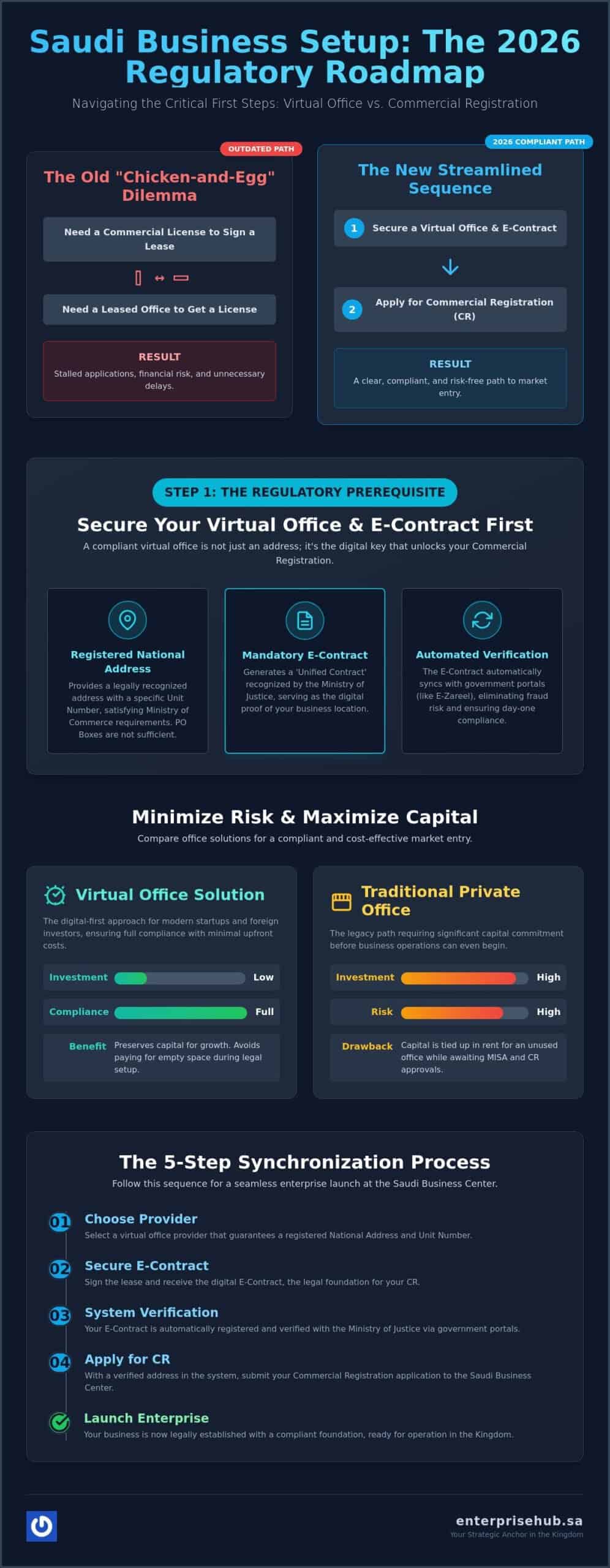
Launching an enterprise in the Kingdom used to present a circular puzzle for many investors. You needed a commercial license to sign a lease, but you needed a lease to apply for the license. This “chicken-and-egg” dilemma often led to stalled applications and unnecessary stress. In the current 2026 regulatory environment, the government has streamlined this process through digital integration. Understanding whether to secure a virtual office or commercial registration first is the foundation of a successful market entry strategy. The sequence is no longer a matter of choice; it’s a structured regulatory path designed to ensure every business has a verified legal anchor before it begins operations.
A virtual office in Saudi Arabia is far more than a digital workspace or a remote mailing address. It’s a legally recognized “National Address” that satisfies the strict requirements of the Ministry of Commerce. Under the framework of Saudi Vision 2030, the link between real estate and legal identity has been fully digitized. This means your business location is validated in real-time during the registration process. Without a verified address already in the system, your journey toward obtaining a Commercial Registration (CR) will likely hit a digital roadblock before it even starts.
The Traditional vs. Digital Setup Path
In the past, physical leases were the only gateway to corporate legitimacy. You had to commit to expensive square footage before knowing if your business activity would be approved. Today, the Unified National Platform has shifted the power back to the entrepreneur. When deciding on a virtual office or commercial registration first, the digital path favors securing the address first. This is because the “National Address” is now a mandatory, validated field in the CR application. Modern startups use this digital-first approach to bypass the heavy overhead of traditional real estate while remaining fully compliant with local laws.
Why Timing Matters for Your Market Entry
Precision in timing prevents significant financial leakage during your first year. For foreign entities, the process often starts with the Ministry of Investment (MISA), which oversees the initial licensing for non-Saudi investors. Securing a verified business address early protects you from “Tasattur” (commercial concealment) concerns. It proves your business has a legitimate, transparent presence in the Kingdom. By following the correct sequence, you avoid paying months of rent for a physical space that sits empty while you wait for legal approvals. This strategic timing ensures that your capital is preserved for growth rather than lost to administrative delays.
Why a Virtual Office is the Regulatory Prerequisite for Entry
The digital lease is the engine of your Saudi business registration. In the current regulatory landscape, the Ministry of Commerce doesn’t just ask for an address; it requires a verified E-Contract. This digital document acts as the primary key for your CR issuance. Without this verified link, your application remains stagnant. Choosing between a virtual office or commercial registration first becomes simple once you understand that the E-Contract is the mandatory starting point. This system ensures every business has a legitimate, traceable footprint within the Kingdom’s digital infrastructure.
A virtual office provides the ‘Unified Contract’ recognized by the Ministry of Justice. This isn’t just a piece of paper. It’s a legally binding, litigation-ready agreement that protects both the landlord and the tenant. These economic reforms under Vision 2030 have replaced outdated manual processes with a seamless, automated verification loop. The E-Contract serves as the digital bridge, automatically synchronizing your lease details with the E-Zareel portal for government verification. This integration eliminates the risk of fraud and ensures your business is compliant from day one. If you’re ready to secure your legal foundation, exploring flexible virtual office solutions can accelerate your timeline significantly.
The Legal Validity of Virtual Addresses
Not every digital address meets the Ministry’s strict criteria. To be valid for a Commercial Registration, your office must have a registered National Address and a specific Unit Number. Traditional PO Boxes are no longer sufficient for business setup. The government now requires a granular location that can be physically verified if necessary. This shift towards transparency ensures that your business is viewed as a serious participant in the local economy rather than a shell entity.
MISA Requirements for Foreign Investors
Foreign entities face an even higher standard of scrutiny. To secure an investment license, you must prove a local presence that aligns with the Kingdom’s strategic goals. A prestigious virtual office in a prime business district acts as a bridge to full-scale operations. It satisfies the initial local presence requirements while you scale toward the ‘Regional Headquarters’ (RHQ) program milestones. This approach allows you to establish your brand in the Saudi market without the immediate burden of a long-term commercial real estate commitment.
Comparing Office Solutions for Commercial Registration Compliance
Deciding on a virtual office or commercial registration first is the initial strategic move, but the type of office you select determines your operational ceiling. For most international entities, the first 12 months represent a critical period of market testing and growth. Balancing regulatory compliance with capital preservation is the primary goal. You need a solution that satisfies the Ministry of Commerce while allowing you to pivot as your team expands. This choice isn’t just about a desk; it’s about building a foundation that supports your corporate banking and recruitment needs.
Your office choice directly impacts your ability to open a local bank account. Saudi banks are increasingly rigorous during the “Know Your Customer” (KYC) phase. They often require proof of a legitimate business hub before activating full corporate facilities. While a virtual office is the perfect catalyst for obtaining your CR, a prestigious address in a recognized business district is essential for gaining credibility in the Saudi market. Choosing a provider that offers both virtual and physical options allows you to scale without changing your legal address, which avoids the paperwork of a CR amendment.
Virtual Offices: The Lean Startup Choice
Virtual offices are the agile entry point for modern enterprises. They provide an instant E-Contract and a prestigious address without the hefty price tag of a multi-year commercial lease. This path is ideal for consultants, tech startups, and companies conducting initial market research. While they offer low overhead, they may limit your ability to recruit a large number of local staff immediately, as government quotas (Qiwa) are often tied to the physical square footage of your workspace.
Private Offices: The Full-Scale Entry
A private office represents a deeper commitment to the Kingdom’s economy. These spaces are best for manufacturing, retail, or any company requiring a significant number of GOSI-registered employees. The primary advantage is the higher recruitment quota provided by the Ministry of Human Resources and Social Development. Although the upfront costs are higher, a private office offers a dedicated environment for culture-building and high-volume operations. It signals to government entities and clients that your business is prepared for long-term, large-scale participation in the local market.
- Virtual Office: Best for administrative compliance and low-risk entry.
- Private Office: Best for operational scaling and high-volume hiring.
- Scalability: Start virtual to secure the CR, then transition to private as your team grows.
Step-by-Step Guide to Synchronizing Your Office and Registration
Executing your market entry with precision requires a clear understanding of the digital sequence. While the theory of why the address comes first is established, the practical application involves navigating several government portals in a specific order. This synchronization ensures that your legal file is airtight and ready for the next stages of operational growth. By following this structured roadmap, you eliminate the guesswork and move from concept to a fully registered entity with confidence.
- Step 1: Provider Selection. Choose a business hub that offers an E-Contract recognized by the Ministry of Commerce. This document is the only lease format accepted for modern digital registrations.
- Step 2: National Address Registration. Once your lease is secured, register your National Address. This provides the granular location data, including the mandatory Unit Number, required by the Saudi Business Center.
- Step 3: CR Application. With your address verified, apply for your Commercial Registration (CR) via the Unified National Platform. Because you’ve already resolved the question of a virtual office or commercial registration first, your application will proceed without address-related rejections.
- Step 4: Contract Linking. Link your digital office contract to your CR through the Ministry’s portal. This step finalizes your legal file and triggers the issuance of your Chamber of Commerce membership.
- Step 5: Banking Activation. Use your combined CR and verified lease documentation to open your corporate bank account. Banks require this integrated proof of presence to satisfy their compliance and KYC protocols.
Avoiding Common Registration Delays
Delays often stem from a mismatch between your business activity (ISIC code) and your office type. Ensure your chosen activity is permitted within a virtual office framework before signing. Additionally, the ‘Authorized Signatory’ must have an active, verified Absher account to sign the digital E-Contract. If the Chamber of Commerce requests address verification, having a provider that offers a physical reception and verifiable location ensures a smooth approval process. To streamline these technical hurdles, you can partner with setup experts who manage the digital synchronization for you.
Upgrading Your Setup After Registration
Your needs will evolve as your Saudi team expands. Many businesses start with a virtual address to secure their CR and then transition to private offices when they are ready to hire high volumes of local staff via Qiwa. When your physical location changes, you must update your CR to reflect the new address. Maintaining compliance during this transition is vital to avoid penalties or pauses in your government services. Starting in a hub that offers both virtual and physical spaces makes this transition seamless and keeps your legal history consistent.
Navigating the Setup Process with Enterprise Hub
Establishing your presence in the Kingdom requires more than just following a checklist; it demands a partnership with a team that understands the local landscape. While mastering the sequence of a virtual office or commercial registration first is your first victory, maintaining that momentum is where many businesses struggle. We act as your strategic anchor, providing the legal foundation that transforms your vision into a compliant reality. By choosing our hub, you aren’t just renting an address. You’re securing a verified E-Contract that government portals recognize instantly, ensuring your registration moves forward without administrative friction.
A prestigious business address does more than satisfy a regulatory requirement. It builds immediate trust with the Ministry of Commerce and local financial institutions. When banks review your corporate account application, a recognized location within a prime district signals stability and long-term commitment. Our deep integration with the nuances of business setup in Saudi Arabia allows you to bypass the common pitfalls that stall international investors. We ensure your documentation is synchronized, from the initial lease to the final CR issuance.
Comprehensive Business Support Services
Your journey doesn’t end once you receive your license. Maintaining a valid Commercial Registration requires ongoing compliance with Zakat, Tax and Customs Authority (ZATCA) and the General Organization for Social Insurance (GOSI). We provide comprehensive accounting and tax services to ensure your profits are managed correctly and your 20% corporate income tax obligations are met. Beyond paperwork, our members enjoy access to high-end meeting rooms and shared spaces, perfect for networking with the local business community and hosting key stakeholders in a professional environment.
Join the Future of Saudi Business
Positioning your brand within our ecosystem places you at the heart of the Kingdom’s economic transformation. We take the burden of administrative renewals and government service liaison off your shoulders, allowing you to focus entirely on your core growth and strategic goals. Whether you’re a tech startup or a regional consulting firm, we provide the flexibility to scale your workspace as your team expands. Don’t let regulatory confusion hold back your ambition. Register your business with Enterprise Hub today and take the first step toward a prosperous future in the Saudi market.
Accelerate Your Saudi Market Entry with Confidence
Establishing your presence in Saudi Arabia is a bold move toward strategic global growth. You now possess a clear roadmap to navigate the 2026 regulatory landscape with absolute precision. By prioritizing a verified business address, you ensure your Commercial Registration is built on a solid, legal foundation that meets every digital requirement. This approach minimizes your initial capital risk while positioning your brand for maximum corporate credibility from day one. It’s about making the right moves in the right order to ensure your enterprise thrives in a competitive environment.
We’re ready to serve as your strategic partner throughout this transformation. Our platform provides fully compliant E-Contracts recognized by the Ministry of Commerce, alongside expert support for MISA and Ministry of Commerce registration processes. Secure your Saudi business address and start your registration today to join the Kingdom’s thriving economic ecosystem. Resolving the dilemma of a virtual office or commercial registration first is just the beginning. We’re here to ensure every subsequent step leads toward your long-term prosperity. Your vision for a Saudi enterprise is within reach, and we’re committed to helping you launch it without delay.
Frequently Asked Questions
Can I get a Commercial Registration (CR) without a physical office address in Saudi Arabia?
No, the Ministry of Commerce requires a valid, verifiable address for every CR application. You cannot skip this step; however, a virtual office address satisfies this requirement legally through the E-Contract system. This allows you to bypass the need for a traditional physical space while still meeting all regulatory mandates for your business launch.
Is a virtual office legally accepted for MISA investment licenses?
Yes, MISA recognizes virtual offices provided they offer a legitimate E-Contract and a registered National Address. Foreign investors often use these solutions to establish a local presence while finalizing their long-term operational plans. It serves as a compliant bridge for international entities entering the Saudi market under current investment reforms.
How long does it take to get an E-Contract for a virtual office?
You can typically receive your E-Contract within 24 to 48 hours once the provider verifies your identification and business details. The process is fully digital and integrated with the Ministry of Justice’s E-Zareel portal. This speed is essential when you are deciding whether to secure a virtual office or commercial registration first to meet tight expansion deadlines.
What is the difference between a National Address and a Commercial Registration address?
The National Address is the specific geographic location registered with Saudi Post, while the CR address is the official place of business listed on your government license. In modern registrations, these two must match exactly. The CR application pulls data directly from your verified National Address to ensure location accuracy and transparency.
Can I use a virtual office to open a corporate bank account in the Kingdom?
Yes, you can open a corporate account with a virtual office, provided you have a valid CR and a verified lease. Most Saudi banks require proof of a legitimate hub where they can send official correspondence. A prestigious virtual office address in a recognized business center increases your credibility during the bank’s KYC verification process.
What happens to my CR if I cancel my virtual office subscription?
Your Commercial Registration may be suspended if you do not have a valid, registered address on file. The Ministry of Commerce monitors lease validity through the digital E-Contract system in real-time. To maintain compliance, you must update your CR with a new address immediately if you transition away from your current service provider.
Do I need a virtual office if I am an online-only business in Saudi Arabia?
Yes, even online-only businesses must have a registered physical address to obtain a CR. The Saudi government does not issue licenses to businesses without a documented, verifiable location. A virtual office is the most cost-effective way for digital enterprises to meet this regulatory requirement without the overhead of renting unnecessary physical space.