
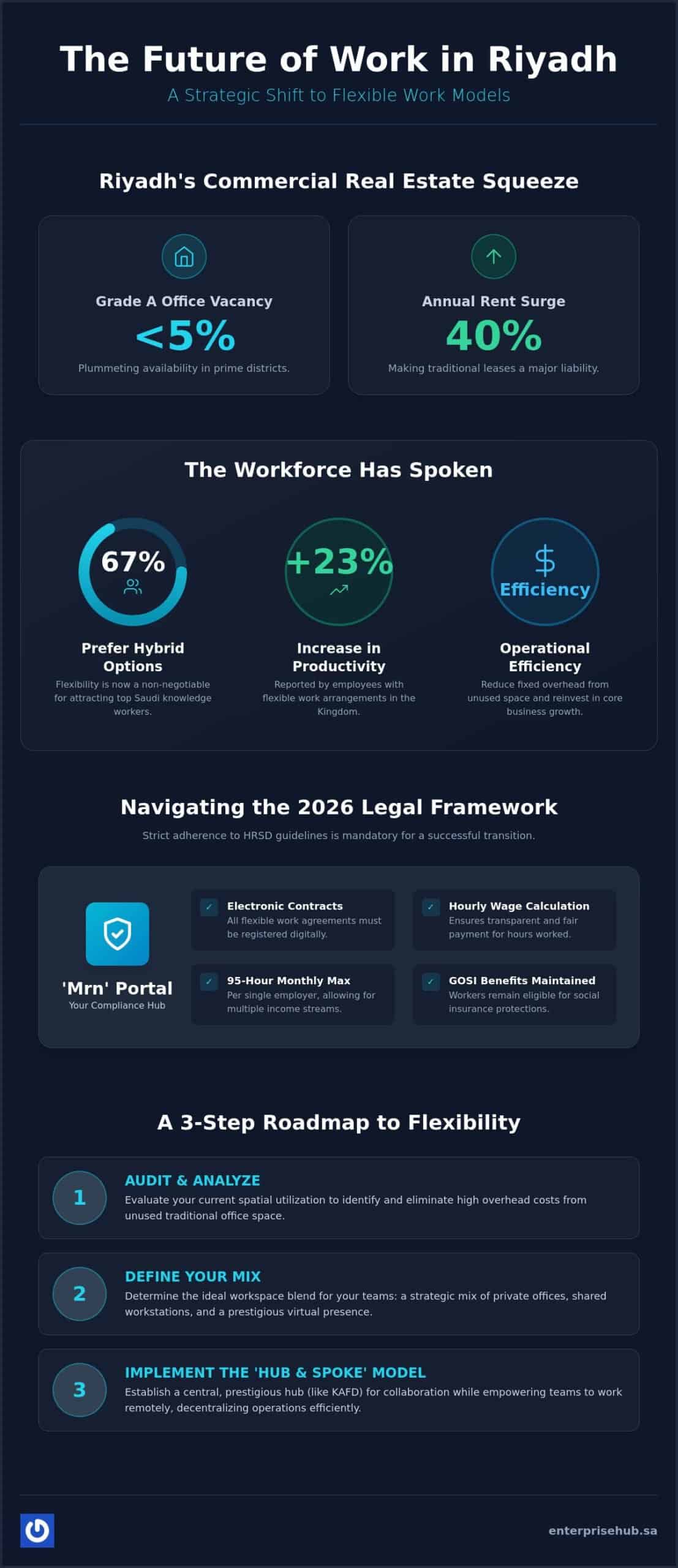
What if the key to your company’s next growth phase isn’t more square footage, but a smarter way to use the space you already have? With Grade A office vacancy rates in Riyadh plummeting below 5% and rents surging by up to 40%, the traditional office model is becoming a luxury few can justify. You likely recognize that 67% of Saudi knowledge workers now prefer hybrid options, yet you’re hesitant to give up the prestige of a physical headquarters. Transitioning to a flexible work model in Riyadh shouldn’t mean compromising your brand’s presence in elite hubs like the King Abdullah Financial District.
We understand the complexity of balancing HRSD compliance with the need for a high-performance corporate culture. This guide offers a strategic roadmap to help you decouple prestige from permanent desk space. You’ll learn how to implement a hybrid framework that reduces operational costs, ensures full legal alignment with 2026 labor regulations, and leverages premium virtual offices to keep your business at the heart of the Kingdom’s economic transformation.
Key Takeaways
- Understand the 2026 legal framework for remote work, including how to utilize the ‘Mrn’ portal for compliant contractual documentation.
- Follow a proven implementation roadmap for transitioning to a flexible work model in Riyadh that balances team productivity with operational cost savings.
- Identify the ideal workspace mix for your organization by evaluating the strategic benefits of private offices, shared workstations, and virtual presences.
- Discover how to maintain a prestigious corporate image in prime districts like KAFD while adopting a decentralized ‘Hub and Spoke’ operational model.
- Learn to audit your current spatial utilization to eliminate high overhead costs associated with unused traditional office space.
The Evolution of Professional Environments in Saudi Arabia
The corporate landscape in the Saudi capital is undergoing a profound structural shift. For decades, the Riyadh business scene relied on rigid 9-to-5 schedules within fixed physical walls. However, 2026 has emerged as a definitive tipping point for how organizations view their real estate. Local enterprises are moving away from measuring attendance and toward prioritizing output. This change isn’t just a trend; it’s a strategic response to a high-growth economy where agility determines survival. Traditional long-term leases are being replaced by agile agreements that allow companies to scale their physical presence up or down based on real-time needs.
Vision 2030 and the Future of Work
The Saudi government is actively accelerating this transformation to empower a modern, digitally-native workforce. On June 2, 2026, the Royal Commission for Riyadh City and the Ministry of Human Resources and Social Development (HRSD) launched a major flexible working hours initiative across six prime districts, including KAFD and Riyadh Digital City. This move allows for a four-hour flexible start window, directly addressing urban challenges like traffic congestion while boosting employee satisfaction. By adopting a Flexible Work Arrangement, companies align themselves with national sustainability goals and the digital transformation pillars of Vision 2030. Transitioning to a flexible work model in Riyadh has become a hallmark of modern leadership that values employee well-being as much as commercial success.
Economic Drivers for Flexibility
Market dynamics are forcing a rethink of traditional office lease structures. Grade A office vacancy rates in Riyadh’s prime districts have dropped below 5% in 2026, causing rents to soar by 20% to 40% year-over-year. Maintaining a massive, underutilized headquarters is no longer a viable strategy for optimizing operational expenditure (OPEX). Instead, savvy firms are adopting a lean physical footprint. Transitioning to a flexible work model in Riyadh allows these firms to maintain a premium image without the burden of empty desks.
Data from May 2026 shows that 42% of Saudi knowledge workers now operate in hybrid arrangements, compared to just 12% before 2020. This shift provides a significant competitive advantage in several areas:
- Talent Acquisition: 67% of Saudi knowledge workers now prefer hybrid options, making flexibility a requirement for attracting global experts; if you are looking for talent in markets such as Cyprus, click here.
- Productivity Gains: Employees with flexible arrangements in the Kingdom report a 23% increase in productivity.
- Operational Efficiency: Reducing permanent desk space allows capital to be reinvested into core business growth and innovation.
Successful organizations are realizing that a prestigious address doesn’t require a desk for every employee. They’re using central hubs for collaboration while empowering teams to work remotely, creating a resilient workforce ready for the next phase of the Kingdom’s economic journey.
Navigating the 2026 Legal and Regulatory Framework
Adopting a hybrid approach requires more than just a policy change; it demands strict adherence to the Kingdom’s evolving labor laws. Under HRSD guidelines as of 2026, flexible work is formally recognized as labor performed by a non-full-time worker where wages are calculated on an hourly basis and documented through the official ‘Mrn’ platform. This regulatory clarity is a key pillar of Saudi Vision 2030, which aims to increase workforce participation through modern employment structures. Successfully transitioning to a flexible work model in Riyadh starts with understanding how these digital systems protect both the enterprise and the professional.
The ‘Mrn’ Portal: Documentation and Compliance
The ‘Mrn’ portal serves as the central nervous system for flexible contracting in Saudi Arabia. To remain compliant, employers must register all flexible contracts electronically, ensuring that work hours are tracked with precision. The hourly calculation mechanism is designed for transparency; it allows for a maximum of 95 hours per month with a single employer while maintaining the worker’s eligibility for GOSI (General Organization for Social Insurance) benefits. This system eliminates the ambiguity often associated with remote work by providing a verifiable digital trail of hours worked and payments made. For companies, this means lower administrative overhead and reduced risk of labor disputes, as every engagement is backed by government-verified documentation.
MISA and Licensing Requirements
For international firms and MISA-licensed entities, the choice of a business address is a critical regulatory decision. Your physical headquarters must serve as more than just a place to work; it’s a statement of compliance and stability. Ensuring your business address meets the specific criteria for a MISA license is essential for maintaining your operational status in the Kingdom. This is particularly true for companies under the Regional Headquarters (RHQ) mandate, where a prestigious presence in districts like KAFD isn’t just about brand image, it’s a requirement for government and financial relations. Avoiding common pitfalls in RHQ compliance involves maintaining a verifiable central hub while transitioning to a flexible work model in Riyadh for the broader team. If you’re looking to streamline this process, our team can help you establish a compliant corporate presence that meets every regulatory standard without the burden of traditional long-term leases.
Recent labor law updates from February 2025 also impact how you manage your flexible team. These include expanded leave policies, such as 12 weeks of maternity leave and 3 days of paternity leave, which reflect the Kingdom’s commitment to international standards. Even in a flexible setup, ensuring your contracts reflect these updates is vital for long-term stability and talent retention. By leveraging official portals and premium business hubs, you can navigate these complexities with confidence and focus on your core growth objectives.
Strategic Workspace Selection: Finding the Right Hybrid Mix
Choosing the right physical infrastructure is the cornerstone of a successful hybrid strategy. It isn’t just about where people sit; it’s about how the environment supports your brand’s prestige and the team’s collective output. Transitioning to a flexible work model in Riyadh requires a departure from the “one desk per person” mentality. Instead, high-performance organizations are adopting the ‘Hub and Spoke’ model. This framework maintains a central, premium headquarters for governance and client meetings while empowering teams to utilize satellite workstations closer to their homes. By decoupling your corporate identity from a massive, fixed floor plan, you gain the agility to scale in a market where Grade A vacancy rates remain below 5%.
Private Offices vs. Coworking Solutions
Determining the right mix depends on your specific operational needs. A dedicated private office remains essential for corporate governance, sensitive financial discussions, and maintaining a high-level executive presence. It provides the quiet, secure environment required for deep work and confidential strategy sessions. Conversely, coworking spaces and shared workstations offer a high-energy atmosphere that fosters spontaneous collaboration and networking. These spaces are ideal for creative teams or project-based groups that thrive on interaction. Balancing these options allows you to provide privacy where it’s needed while leveraging the networking advantages of premium business hubs.
The Power of a Virtual Office Presence
For many enterprises, a physical desk for every employee is no longer a prerequisite for market leadership. You can secure a prestigious KAFD business address and manage professional communications through a virtual office in Saudi Arabia. This solution provides mail management and local phone services without the high overhead of traditional real estate. It’s a strategic move for international firms looking to scale their market entry quickly while adhering to MISA requirements. By utilizing a virtual presence, you maintain a prestigious footprint in the heart of Riyadh’s financial district while your team operates from various remote locations.
Transitioning to a flexible work model in Riyadh also demands a focus on team cohesion. Decentralization shouldn’t lead to isolation. We recommend scheduling regular “anchor days” where the entire team gathers in a central private office or a booked meeting room to align on goals and celebrate wins. This hybrid mix ensures that while your operational footprint remains lean, your corporate culture stays robust and connected. Ultimately, the goal is to optimize your real estate spend by paying only for the space you actually use, reinvesting those savings into talent and innovation.
Implementation Roadmap for Saudi-Based Enterprises
Moving from a traditional office setup to a hybrid framework requires a methodical approach. Transitioning to a flexible work model in Riyadh isn’t an overnight switch but a phased evolution that aligns your physical assets with your human capital. Success depends on clear data and a willingness to challenge long-standing corporate habits. By following a structured roadmap, you can minimize disruption while maximizing the economic benefits of a leaner operational footprint.
Start by auditing your current spatial utilization. Many Riyadh firms discover their desks remain empty 60% of the time, even as they pay record-high rents. Use this data to categorize your workforce into a ‘Core Team’, those required on-site for operational continuity, and a ‘Flexible Team’ of knowledge workers who can excel in a hybrid environment. Once your needs are defined, secure a prestigious office for rent that offers modular growth. In a market where Grade A occupancy has reached 99% in 2026, having a partner that provides scalable private offices ensures you don’t overpay for unused space while retaining an elite presence in districts like KAFD.
Finalize the transition by updating internal policies to reflect the latest HRSD standards. Ensure your employee handbooks include the February 2025 labor law updates, such as the 12-week maternity leave and 3-day paternity leave. This transparency builds trust and ensures your flexible model remains legally sound. Finally, leverage technology to bridge the gap between remote and on-site teams, ensuring that communication remains seamless regardless of physical location.
Managing Flexible Teams Effectively
Technology Stack for the Modern Office
Your digital infrastructure must be as robust as your physical headquarters. Implement cloud-based collaboration tools that offer secure remote access to company data, allowing for real-time cooperation across different time zones. For enterprises utilizing virtual offices, digital mail handling and virtual receptionist services ensure no client communication is missed. Additionally, establish strict cybersecurity protocols to protect your data in a decentralized environment. If you’re ready to modernize your operations, contact Enterprise Hub today to find a flexible workspace solution that fits your 2026 growth strategy.
Elevating Your Strategy with Enterprise Hub at KAFD
Transitioning to a flexible work model in Riyadh requires a partner who understands that corporate prestige and operational agility must coexist. While many providers offer generic desk space in older districts, the true strategic advantage lies in positioning your headquarters within the King Abdullah Financial District (KAFD). As the center of the Kingdom’s financial and economic transformation, KAFD provides the elite environment necessary for high-stakes business. Enterprise Hub serves as your strategic anchor in this district, offering more than just a place to work; we provide a complete ecosystem designed to accelerate your growth under the ambitious goals of Vision 2030.
The current market reality is stark. With Grade A office occupancy in Riyadh reaching 99% in 2026 and prime rents climbing steadily, securing a fixed, long-term lease is increasingly difficult and expensive. Enterprise Hub solves this by providing modular, fully equipped private offices that allow you to maintain a prestigious presence without the burden of traditional real estate overhead. We empower you to scale your physical footprint in real-time, matching your office capacity to your actual team requirements as you navigate the complexities of the modern Saudi market.
Premium Facilities for High-Performance Brands
Our facilities at KAFD are built for organizations that refuse to compromise on quality. Every private office is equipped with state-of-the-art infrastructure and supported by a professional team that acts as an extension of your own. We offer flexible lease terms that align with the agility needed in 2026, ensuring you aren’t locked into rigid contracts that hinder your expansion. Beyond the four walls of your office, being situated in the Kingdom’s premier financial hub places you in direct proximity to global financial institutions, regulatory bodies, and industry leaders. This environment creates natural networking opportunities that are simply unavailable in secondary business districts.
Beyond the Desk: Full Business Support
We recognize that transitioning to a flexible work model in Riyadh involves significant administrative and regulatory hurdles. This is why our solutions extend far beyond the physical desk. We provide comprehensive support for company formation and commercial licensing, ensuring your market entry or expansion is seamless and compliant with the latest MISA regulations. Our team of experts also offers professional accounting and tax services, helping you manage your financial obligations with precision. Additionally, we streamline government services to save you time and effort, allowing your leadership team to focus on strategic consulting and long-term growth. By integrating workspace solutions with essential corporate services, we ensure your business is not just present in Riyadh, but thriving at its very heart.
Future-Proofing Your Corporate Presence in Riyadh
The shift toward agility is no longer a choice but a strategic necessity in the Kingdom’s rapidly evolving economy. By successfully transitioning to a flexible work model in Riyadh, you position your organization to thrive amidst rising office costs while meeting the expectations of top-tier global talent. We’ve explored how a blend of premium private offices and virtual presences can maintain your brand’s prestige without the inefficiencies of traditional leasing. You now have the roadmap to navigate 2026 HRSD regulations and implement a results-oriented culture that prioritizes output over attendance.
Enterprise Hub is ready to be your strategic partner in this journey. Located in the heart of KAFD, we provide more than just space. We offer comprehensive support for company formation and government services, alongside flexible private office and virtual office solutions tailored to your unique needs. Secure your prestigious workspace at Enterprise Hub today and take the first step toward a leaner, more resilient future. The path to Saudi Vision 2030 is paved with innovation, and we’re here to ensure your business leads the way.
Frequently Asked Questions
What is the legal definition of flexible work in Saudi Arabia for 2026?
Flexible work is formally defined as labor performed by a non-full-time worker where wages are calculated on an hourly basis. Under the 2026 HRSD regulations, these arrangements must be documented through the ‘Mrn’ portal to ensure transparency and legal protection for both the employer and the professional. This framework is a core component of the Kingdom’s strategy to modernize the labor market and increase workforce participation.
Is contracting through the ‘Mrn’ portal mandatory for hybrid models?
Yes, utilizing the ‘Mrn’ portal is mandatory for all flexible employment contracts in the Kingdom. The platform serves as the official record for tracking hourly work and automating wage calculations, which is essential for maintaining regulatory compliance. Any enterprise transitioning to a flexible work model in Riyadh that includes hourly or part-time staff must use this system to avoid legal discrepancies.
Can a virtual office address be used for a MISA license?
Yes, a virtual office address in a premium location like KAFD can fulfill the business address requirements for a MISA license. These packages are specifically structured to assist international firms with market entry by providing a compliant, prestigious headquarters. It’s an ideal solution for companies that need a recognized corporate presence while their teams operate in a decentralized or hybrid capacity.
How many flexible work contracts can an individual employee sign?
An individual can sign multiple contracts, but they’re restricted to a maximum of 95 hours per month with a single employer. This limit ensures that flexible work remains a modular employment type rather than a replacement for full-time roles. HR departments must monitor these hours through the ‘Mrn’ portal to stay within the legal boundaries set by the Ministry of Human Resources.
What are the primary benefits of transitioning to a flexible work model in Riyadh?
The primary benefits include a documented 23% increase in employee productivity and a significant reduction in operational expenditure (OPEX) by eliminating unused desk space. Transitioning to a flexible work model in Riyadh also allows companies to tap into the 67% of Saudi knowledge workers who now prioritize flexibility. It enables brands to maintain an elite presence in hubs like KAFD while staying lean and agile.
How do flexible work models impact GOSI and employer obligations?
Flexible workers are eligible for GOSI benefits, and employers are obligated to ensure proper registration and contribution through the ‘Mrn’ platform. The system automatically calculates social insurance contributions based on the actual hours worked and the agreed-upon hourly rate. This ensures that your flexible team members are protected under the Kingdom’s social insurance framework without the administrative complexity of full-time payroll.
What facilities are included in a premium private office at Enterprise Hub?
A premium private office at Enterprise Hub includes state-of-the-art digital infrastructure and access to fully equipped meeting rooms. Beyond the physical space, we provide comprehensive corporate support, including company formation, government services, and accounting. Our facilities are designed to offer a turnkey solution for brands that demand a prestigious KAFD address with flexible, scalable terms.
How can companies maintain corporate culture in a hybrid work environment?
Maintaining culture requires a shift toward results-based management and the use of regular “anchor days” for in-person collaboration. We recommend utilizing professional meeting rooms for periodic alignment sessions to ensure decentralized teams remain connected to the brand’s vision. These face-to-face touchpoints are vital for fostering a sense of belonging and ensuring every team member is aligned with the company’s growth milestones.