
Is your home office actually holding your business back from its next major breakthrough? With the 2026 “Patriotic Home from Work” executive order signaling a massive national shift toward on-site operations, many leaders are finding that scaling a brand requires more than just a stable Wi-Fi connection. Transitioning from working from home to a professional office is no longer just an option; it’s a strategic move to reclaim your professional identity and operational focus. You’ve likely experienced the frustration of blurred boundaries and the difficulty of building a real company culture through a screen. It’s a common pain point that can stall growth and chip away at your credibility with high-tier investors who expect a physical presence.
This guide will help you navigate this shift to unlock enhanced brand authority and a scalable infrastructure. We’ll explore how to leverage the current 12.7% vacancy rate in prime office spaces to your advantage, even as average fit-out costs have risen by 5.5% this year. From establishing clear operational boundaries to fostering spontaneous team collaboration, you’ll discover the roadmap to moving your business into a workspace that reflects your true ambitions. It’s time to stop just “getting by” and start building a legacy in an environment designed for success.
Key Takeaways
- Identify the subtle signs of “workspace fatigue” and how a professional environment restores leadership focus and strategic decision-making.
- Understand the measurable ROI of a physical office, from increased client trust to accessing a high-value ecosystem of potential partners.
- Implement a seamless 5-step framework for transitioning from working from home to a professional office while maintaining operational continuity.
- Bridge the remote-to-office cultural gap by prioritizing mentorship and career visibility to ease team anxiety and boost collaboration.
- Leverage scalable workspace models to establish the infrastructure necessary for national brand expansion and long-term authority.
Recognizing the Work from Home Ceiling in Professional Growth
Every business reaches a tipping point where the home office, once a symbol of lean efficiency, starts to feel like a cage. While the history and evolution of remote work shows us that digital tools have made home setups possible, they haven’t made them optimal for high-level scaling. You might notice subtle signs of this ceiling: a hesitation to invite a major prospect to a video call because of background noise, or a growing sense of isolation that clouds your strategic vision. Transitioning from working from home to a professional office is often the only way to break through these invisible barriers and signal to the market that your business is ready for enterprise-level engagement.
The psychological toll of “workspace fatigue” is a real threat to leadership. When your living room is also your war room, the lines between rest and high-stakes decision-making vanish. This constant blending leads to cognitive drain; it makes it harder to switch into the “commander” mindset required for national expansion. Beyond your own productivity, a home setup often hampers your ability to attract and keep top-tier talent. In 2026, the best professionals aren’t just looking for a paycheck. They’re looking for a culture, a mentorship environment, and a physical space that validates their career choice. Without a professional hub, you aren’t just losing space; you’re losing the human capital necessary to scale.
The Brand Authority Gap
In the competitive national market, perception is reality. A residential address on a contract can subtly undermine your reliability with high-level partners. If you’re looking to secure MISA licenses or engage in government-level tenders, a prestigious business address is often more than a preference; it’s a prerequisite. Moving to a professional workspace allows you to shed the “freelancer” label and step into an enterprise reality. It gives your brand the physical weight it needs to hold its own in a room full of seasoned investors and strategic partners.
Operational Friction and Communication Barriers
Digital-only communication carries a hidden cost that doesn’t show up on a balance sheet until it’s too late. Misinterpreted Slack messages and delayed Zoom responses can add days to project timelines. Physical proximity eliminates this friction. It fosters “spontaneous innovation,” those five-minute hallway conversations that solve problems before they even reach your inbox. Moreover, transitioning from working from home to a professional office provides access to business-grade infrastructure. You won’t have to worry about home-grade internet outages or lack of specialized meeting technology. You’ll have a streamlined environment where the focus stays entirely on your results and growth.
The Strategic ROI of a Professional Workspace
Many entrepreneurs mistakenly view a professional office as a luxury overhead. In reality, it’s a driver of higher contract values. Transitioning from working from home to a professional office signals to high-level clients that your business is stable, scalable, and ready for enterprise-level commitments. This shift in perception often results in a direct ROI through improved conversion rates and higher trust from national stakeholders. When you move beyond the home office, you aren’t just buying space; you’re buying the closing power that comes with a physical corporate identity.
Efficiency is about more than just a quiet desk. It’s about the collective energy of a team working toward a common goal. As of 2026, approximately 90% of the federal workforce has returned to on-site work, reflecting a broader national trend toward physical collaboration. While leadership must navigate employee challenges in returning to the office, the productivity gains are undeniable. You’ll also benefit from streamlined access to government services and administrative support systems that aren’t easily accessible from a home setup.
Networking as a Revenue Driver
Revenue isn’t just about sales calls. It’s about who you know. Transitioning from working from home to a professional office places you in a strategic ecosystem where networking isn’t a chore, but a natural byproduct of your environment. In a professional hub, “corridor conversations” become your most valuable lead source. You’re surrounded by like-minded professionals and potential partners who are also scaling. This environment facilitates national networking opportunities that digital platforms can’t replicate. You aren’t just renting a desk; you’re buying a seat at the table where strategic alliances are formed.
Professional Meeting Environments
Closing a high-stakes deal requires more than a stable internet connection. It requires an atmosphere of authority. A professional meeting room offers high-end technology and hospitality that impresses stakeholders. When you host a client in a space designed for business, you control the narrative. Physical presence matters. This environment is often the final piece of the puzzle needed to close complex deals that would otherwise stall on a screen. Consider how a tailored workspace at Enterprise Hub can turn your operational costs into a growth engine.
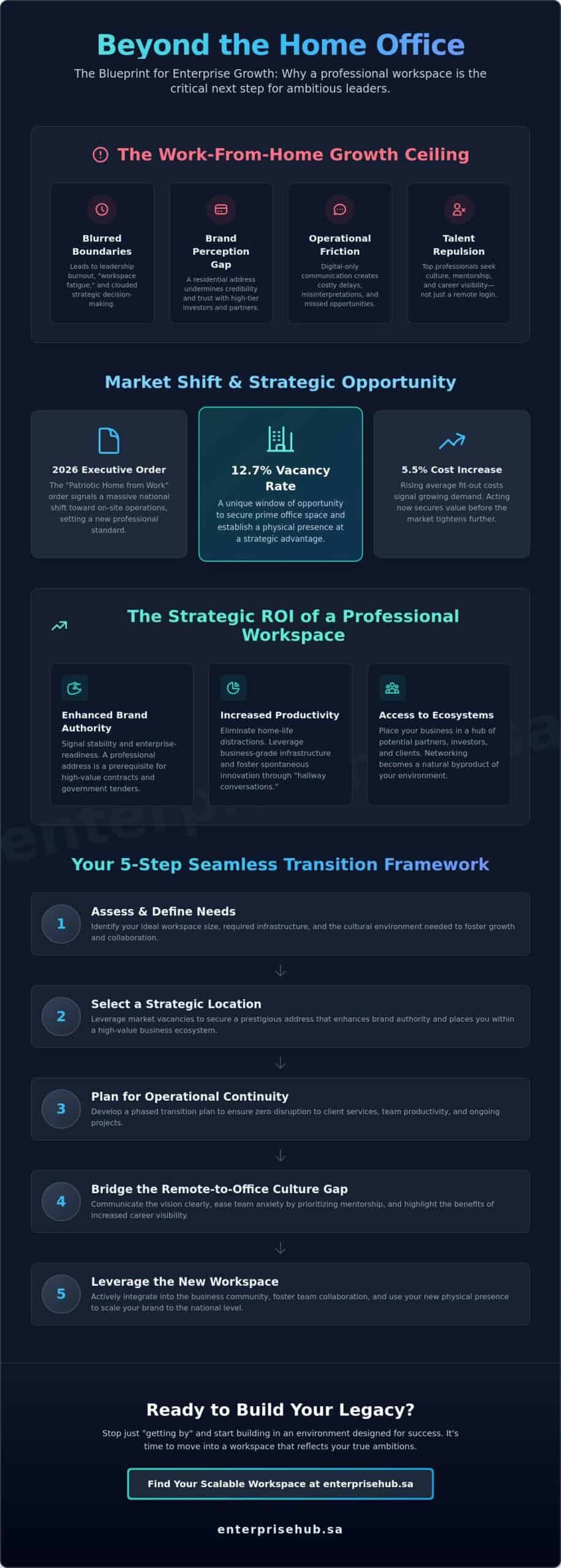
A 5-Step Framework for a Seamless Office Transition
A successful move requires more than just signing a lease. It demands a systematic approach to ensure your operations don’t skip a beat. Transitioning from working from home to a professional office is a complex logistical feat that impacts your team’s rhythm and your brand’s legal standing. To avoid the common pitfalls of sudden relocation, follow this structured 5-step framework designed for the 2026 business landscape.
- Step 1: Audit Your Actual Needs. Don’t pay for space you won’t use. Analyze your team’s peak occupancy, specialized technology requirements, and how often you’ll need high-end meeting facilities.
- Step 2: Select Your Model. Match your workspace to your growth stage. Whether it’s a private suite for maximum branding or a coworking setup for agility, the model must support your five-year vision.
- Step 3: Map the Logistics. Plan your IT infrastructure, mail handling protocols, and legal address registration early. Moving your digital backbone is often more challenging than moving physical furniture.
- Step 4: Align the Vision. Communicate the “why” to your team. Frame the move as an investment in their professional development and the company’s national authority to ensure buy-in.
- Step 5: Execute in Phases. Consider a hybrid occupancy model for the first 30 days. This allows you to troubleshoot infrastructure issues without halting daily productivity.
Evaluating Workspace Models
Choosing the right environment is critical for long-term success. Private offices offer the highest level of privacy and are essential for businesses that handle sensitive data or require a dedicated brand presence. If your team is growing rapidly and values flexibility, coworking spaces provide an immediate community and scalable desk options. For those who aren’t ready for a full physical move but need a prestigious corporate identity, virtual offices serve as an excellent bridge, providing a legal address and mail services while you finalize your physical transition.
Legal and Administrative Checkpoints
Transitioning from working from home to a professional office involves significant administrative updates. You’ll need to update your commercial registration to reflect your new professional address, which is a prerequisite for many national contracts. Ensure your new setup complies with current labor regulations regarding workspace safety and employee well-being. It’s also a strategic time to leverage professional accounting and tax services to ensure your relocation costs are correctly categorized and your business remains compliant during the expansion. This logistical precision ensures that your move strengthens your foundation rather than complicating it.
Bridging the Cultural Gap: Moving Your Team from Remote to In-Person
A move to a physical workspace is as much a cultural shift as it is a logistical one. Transitioning from working from home to a professional office often triggers a mix of excitement and “Return to Office” anxiety among team members. To lead this change successfully, you must prioritize transparent communication. Explain how this move serves as a catalyst for the company’s growth vision and how it directly benefits the professional development of every individual. When your team understands that the office is a tool for their success, buy-in happens naturally.
The most significant advantage of a shared environment is the restoration of career visibility and mentorship. In a remote setup, junior employees often miss the subtle cues and “learning by osmosis” that occur when sitting near experienced leaders. By bringing the team together, you create a space where mentorship is constant and spontaneous. This visibility ensures that hard work is recognized in real-time, boosting morale and retention. We recommend implementing flexible “core hours,” such as 10:00 AM to 3:00 PM, to maintain the work-life balance your team has come to value while ensuring everyone is present for critical collaborative windows.
Rebuilding In-Person Collaboration
Successful leadership means designing workflows that justify the commute. Use your professional space for high-impact activities like strategy sessions, creative brainstorming, and complex problem-solving that digital tools often stifle. A physical office allows for a depth of collaboration that builds stronger interpersonal bonds and faster project iterations. It’s about creating an environment where employees feel empowered to contribute, making the office a destination for innovation rather than just a place to sit at a desk.
Managing the Hybrid Balance
While the goal is a professional hub, hybrid models remain a standard in 2026. Establish clear expectations for in-office versus remote days to avoid confusion. Use synchronized digital tools to ensure that even when some members are remote, they remain fully integrated into the office flow. Equity is vital here; ensure that opportunities for high-stakes projects and promotions are available to all team members, regardless of their daily location. This balanced approach respects individual needs while driving the collective mission forward. If you are ready to build a culture of excellence, explore how Enterprise Hub’s collaborative spaces can transform your team’s dynamic.
Scaling Your Vision with Enterprise Hub’s Ecosystem
Enterprise Hub isn’t just a provider of physical space. It’s a strategic engine for your business’s next chapter. Transitioning from working from home to a professional office requires more than just furniture; it requires a foundation of support that lets you focus on high-level strategy while we handle the operational details. We offer a comprehensive ecosystem that includes everything from company formation to ongoing accounting and tax support. This integrated approach ensures that your move isn’t just a change of scenery, but a significant upgrade to your business’s infrastructure and legal standing.
By joining our hub, you’re stepping into a community of leaders who are actively driving the Kingdom’s economic future. You’ll find yourself surrounded by innovators and investors who share your ambition for excellence. This isn’t just about where you work. It’s about the company you keep and the resources you can access at a moment’s notice. Our environment is designed to foster the kind of elite networking that leads to national growth and long-term brand authority.
Beyond the Square Footage
Our facilities are designed to meet the rigorous demands of modern national expansion. You’ll have access to premium meeting suites and high-speed technology that home environments simply can’t match. One of the most significant advantages is having government and legal support integrated directly into your workspace ecosystem. This eliminates the friction of managing administrative tasks across multiple locations. Whether you need private offices for a growing team of ten or a headquarters for a hundred, our spaces are fully customizable to your evolving needs. We provide the scalability you need to grow without the headache of constant relocation.
Your Next Step Toward National Leadership
2026 is the year to solidify your professional presence. With the national average for office rental rates holding steady between $23 and $38 per square foot, and prime vacancy rates at 12.7%, the market conditions are ideal for securing a high-quality base. Transitioning from working from home to a professional office is seamless with our ready-to-move-in solutions. We’ve removed the complexity of fit-outs and infrastructure setup so you can start operating from day one.
The future of your business environment is waiting. Don’t let another quarter pass in a limited home setup while your competitors establish themselves in the heart of the Kingdom’s business district. Book a tour today to experience how our ecosystem can empower your vision and provide the authority your brand deserves. Your transition to national leadership starts with a workspace that reflects your ambition.
Establish Your Headquarters for National Growth
Establishing a physical headquarters is the definitive step toward moving from a local player to a national leader. We’ve explored how transitioning from working from home to a professional office removes the “brand ceiling” that limits your scalability and client trust. By following a structured framework and focusing on team culture, you transform a logistical move into a strategic growth engine. The ROI of a professional environment isn’t just about a desk; it’s about the ecosystem of innovation and authority that surrounds you.
Enterprise Hub stands ready to be your strategic partner in this evolution. We provide more than just space; we provide the infrastructure for excellence. With our prestigious national business addresses, fully equipped private offices, and comprehensive business setup and government services, your transition will be seamless and professionally superior.
Upgrade your business presence with Enterprise Hub’s premium workspaces today.
The Kingdom’s economic future is being built in professional hubs. We invite you to join this journey of success and secure your place at the forefront of your industry. Your vision deserves an environment that matches its ambition.
Frequently Asked Questions
Is transitioning from working from home to a professional office worth the cost for a small business?
Transitioning from working from home to a professional office is a strategic investment that directly impacts your conversion rates. It moves your brand from a “home-based” perception to an enterprise reality. High-level clients often associate a physical corporate presence with stability and long-term commitment. While there’s an initial investment, the ROI comes through higher contract values and access to an ecosystem of strategic partners that you won’t find in a home setup.
How do I handle employee pushback when moving from WFH to an office?
Address pushback by focusing on the professional advantages for the employees themselves. Highlight how physical presence increases their visibility to leadership and provides daily mentorship opportunities that are often lost in digital-only environments. You don’t have to mandate a rigid 9-to-5 schedule; instead, implement flexible core hours. This approach respects their work-life balance while ensuring the team is present for the high-impact collaborative sessions that drive innovation.
What are the legal requirements for a business address in the Kingdom?
The Kingdom requires a verified business address to maintain a valid Commercial Registration. This is a non-negotiable legal prerequisite for applying for MISA licenses and bidding on government contracts. Whether you choose a physical office or a virtual setup, the address must be registered with the relevant authorities. This ensures your business remains compliant with national labor laws and regulatory standards as you scale your operations beyond a residential setup.
Can I maintain a hybrid model while renting a professional office?
You can definitely maintain a hybrid model while renting a professional workspace. In fact, hybrid work has become the standard for many private sector companies in 2026. Use your office as a collaborative hub for strategy and team-building, while allowing employees to work remotely for tasks that require deep, individual focus. This balance ensures you maximize the value of your office square footage without losing the flexibility that modern talent expects.
What is the difference between a virtual office and a physical workspace?
A virtual office provides a prestigious legal address and mail handling services without providing a dedicated physical desk. It’s an ideal choice for businesses that need a professional identity but aren’t ready for daily in-person operations. A physical workspace, however, provides the actual desks, high-speed infrastructure, and meeting rooms needed for a team to collaborate in person. Both models support your brand authority, but they serve different operational stages and growth needs.
How does a professional office improve my brand’s credibility?
A professional office improves credibility by providing a tangible symbol of your business’s success. Transitioning from working from home to a professional office signals to stakeholders that you have the infrastructure to handle complex, high-stakes projects. It provides a controlled environment for hosting meetings, where high-end technology and professional hospitality can be used to close deals. Physical presence often acts as the final trust factor for national and international investors.
What amenities should I look for in a professional office space in 2026?
Look for high-speed fiber-optic internet, modern meeting suites, and ergonomic workstations. In 2026, the best spaces also offer integrated business support, such as on-site government services and accounting assistance. You should also prioritize environments that offer networking lounges and professional hospitality services. These amenities ensure that your office is more than just a place to work; it’s a comprehensive support system that enables your business to scale efficiently and professionally.
How long does the transition process typically take for a mid-sized team?
The transition typically takes between 30 and 60 days for a mid-sized organization. This period allows you to audit your space requirements, select the right office model, and handle the IT migration. It also provides enough time to update your legal commercial registration and communicate the move vision to your team. Planning in phases helps ensure that daily productivity remains high while you finalize the logistics of your new professional headquarters.