
What if your business address wasn’t just a location, but a strategic asset that provided access to exclusive tax incentives and the Middle East’s most elite financial ecosystem? Establishing a presence in the King Abdullah Financial District is the ultimate ambition for global firms, yet many leaders feel overwhelmed by the regulatory bridge between MISA and the Ministry of Commerce. Success here requires precision. You know that the prestige of this district requires meeting high standards, especially with the new 2026 Special Economic Zone (SEZ) frameworks now in full effect. We’ll help you master the complexities of KAFD business registration so you can secure your place in the Kingdom’s premier financial hub with confidence.
This guide provides a clear roadmap through the latest ECZA regulations and investment licensing requirements. You’ll learn how to align your physical office needs with legal compliance while identifying the most efficient path to operational readiness. By the end, you’ll have the strategic blueprint needed to transform a complex registration process into a seamless entry into Saudi Arabia’s most prestigious business community.
Key Takeaways
- Understand how KAFD’s 2026 status as a Special Economic Zone offers unique regulatory exemptions that differ from standard Saudi commercial law.
- Clarify the specific licensing roles of MISA and the Ministry of Commerce to ensure a seamless KAFD business registration process.
- Discover how your choice of office infrastructure directly influences your firm’s visa quotas and overall licensing capabilities.
- Master a structured, step-by-step onboarding roadmap that transitions your business from preliminary approval to physical operational status.
- Learn how leveraging turnkey workspace solutions and integrated government services can bypass administrative delays and accelerate your market entry.
The Strategic Framework of KAFD Business Registration
The King Abdullah Financial District (KAFD) represents the pinnacle of Saudi Arabia’s economic transformation under Vision 2030. It isn’t merely a collection of architectural marvels; it’s a specialized ecosystem designed to centralize the Kingdom’s financial power. Successfully completing your KAFD business registration requires a shift in perspective. You aren’t just registering a company under general commercial laws. You’re embedding your entity into a Special Economic Zone (SEZ) that operates with a high degree of regulatory autonomy to foster global competitiveness.
The distinction between general commercial registration and KAFD-specific requirements is substantial. While mainland companies follow the standard Saudi Companies Law, entities within this district benefit from a bespoke legal framework. This environment was specifically crafted to attract foreign direct investment, which exceeded $26 billion in 2025. By choosing this district, you position your brand within a jurisdiction that prioritizes ease of doing business and provides a direct path to Regional Headquarters (RHQ) status. For multinational firms, this is a strategic necessity. Establishing an RHQ here unlocks a 30-year corporate tax relief program, a powerful incentive that isn’t available to standard mainland registrations.
Prestige is the silent partner in every KAFD registration. Holding an address in this district signals to investors, partners, and competitors that your firm operates at the highest level of professional excellence. It provides immediate credibility within the Saudi market, where the district is recognized as the Kingdom’s premier financial hub, home to sovereign wealth funds and global banking giants. This concentration of economic powerhouses creates a networking density that’s impossible to replicate elsewhere in the region.
KAFD as a National Economic Catalyst
The district serves as the primary hub for the Kingdom’s fintech and banking initiatives. It’s designed to facilitate high-speed digital transactions and foster innovation through proximity to regulators and capital providers. As of 2026, KAFD operates as a fully independent Special Economic Zone governed by the Economic Cities and Special Zones Authority (ECZA), providing a distinct legal framework from mainland Saudi Arabia. This status allows for more flexible employment regulations and streamlined administrative processes that accelerate growth for financial services and professional firms.
Who Should Register in KAFD?
Target sectors for this district include fintech, asset management, legal consulting, and multinational corporations looking to anchor their Middle Eastern operations. The scalability of registration options makes it accessible for various business sizes. While large enterprises often opt for sprawling private suites, smaller firms and startups can utilize virtual office packages as a low-friction entry point for their initial registration. Determining if KAFD is the right fit depends on your need for a high-prestige environment and your desire to leverage the specific tax and regulatory benefits offered by the SEZ framework.
Legal Requirements and Licensing for KAFD Entities
Completing your KAFD business registration requires navigating a dual-track system involving both the Ministry of Investment and the Ministry of Commerce. This process ensures your entity meets the high compliance standards of the Kingdom’s premier financial hub. While the strategic benefits are clear, the legal execution demands meticulous attention to documentation and sequence. You must synchronize your investment licensing with your local commercial registration to ensure a seamless operational launch.
MISA Licensing Path for KAFD Businesses
Foreign investors must first secure an investment license from the Ministry of Investment (MISA). This license defines your scope of work, whether you’re entering the service, professional, or commercial sectors. MISA allows for 100% foreign ownership in most KAFD-aligned industries, provided you meet the specific capital requirements for your chosen activity. Utilizing the ‘Invest Saudi’ portal has significantly accelerated this stage, offering a digitized path that integrates with other government agencies. You’ll need to submit authenticated documents from your home country, including your current commercial registration and audited financial statements, to prove your firm’s stability and intent.
Commercial Registration (CR) Specifics
Once you hold a MISA license, you must obtain a Commercial Registration (CR) from the Ministry of Commerce. This step involves selecting the precise business activity codes (ISIC) that reflect your KAFD operations. Accuracy here is vital, as these codes dictate your future visa quotas and tax obligations. You’ll also need to finalize your Articles of Association and Board Resolutions during this phase. It’s essential to register with the Zakat, Tax and Customs Authority (ZATCA) immediately after receiving your CR to ensure tax compliance. Multinational companies must realize that 2026 serves as a critical milestone for Regional Headquarters (RHQ) compliance, as government contracting now mandates a substantive local presence.
The final hurdle in this legal journey is the verification of a physical or virtual address through the Ejar system. A valid lease agreement is a non-negotiable requirement for the final issuance of your license. This link between your legal status and your physical location is why choosing the right workspace partner is so impactful. Consulting with professionals to streamline your registration paperwork can prevent administrative delays that often stall market entry. By ensuring every document is notarized and every code is correctly applied, you protect your brand’s reputation and financial interests from the start.
Infrastructure Options: Aligning Office Space with Registration
Your physical presence in the King Abdullah Financial District is more than just a place to work. It’s a critical component of your KAFD business registration. The Saudi regulatory environment links your office infrastructure directly to your operational capacity, specifically influencing your visa quotas and licensing depth. Choosing the right space isn’t just about aesthetics; it’s about matching your infrastructure to your long-term growth objectives in the Kingdom.
Private vs. Shared: Impact on Business Growth
A Private Office remains the gold standard for established firms and those seeking full MISA compliance. These spaces provide the physical security required for confidential financial operations and the square footage necessary to secure higher employee visa allocations. It’s the preferred choice for multinational corporations that need a permanent, branded environment to host high-level stakeholders. For entities that prioritize networking and agility, Coworking spaces serve as an excellent bridge. They place your team in the heart of the financial community, facilitating spontaneous collaborations with economic powerhouses while keeping overhead costs manageable. While private offices offer maximum regulatory stability, shared environments provide a cost-effective entry point for consulting firms and fintech startups that don’t yet require a large-scale physical footprint.
The Virtual Office Registration Model
For firms in the earliest stages of market entry, Virtual Office packages offer a sophisticated solution for address management. These packages are legally valid for obtaining a Commercial Registration (CR) and provide a prestigious KAFD address for all official government communications. It’s a strategic choice for remote entities that need a credible presence in the Kingdom’s financial heart without the immediate need for physical desks. This model allows you to secure your legal status and start building brand equity while you evaluate the next phase of your expansion.
Choosing a virtual presence is ideal for companies that are currently operating with a lean team or those waiting for their permanent space to be finalized. It ensures that your KAFD business registration isn’t delayed by construction timelines or high initial capital expenditures. Regardless of the model you choose, ensuring your lease is properly registered in the Ejar system is the final step in validating your entity’s compliance with local regulations. This alignment between your physical (or virtual) footprint and your legal status is what separates a successful launch from a stalled application.
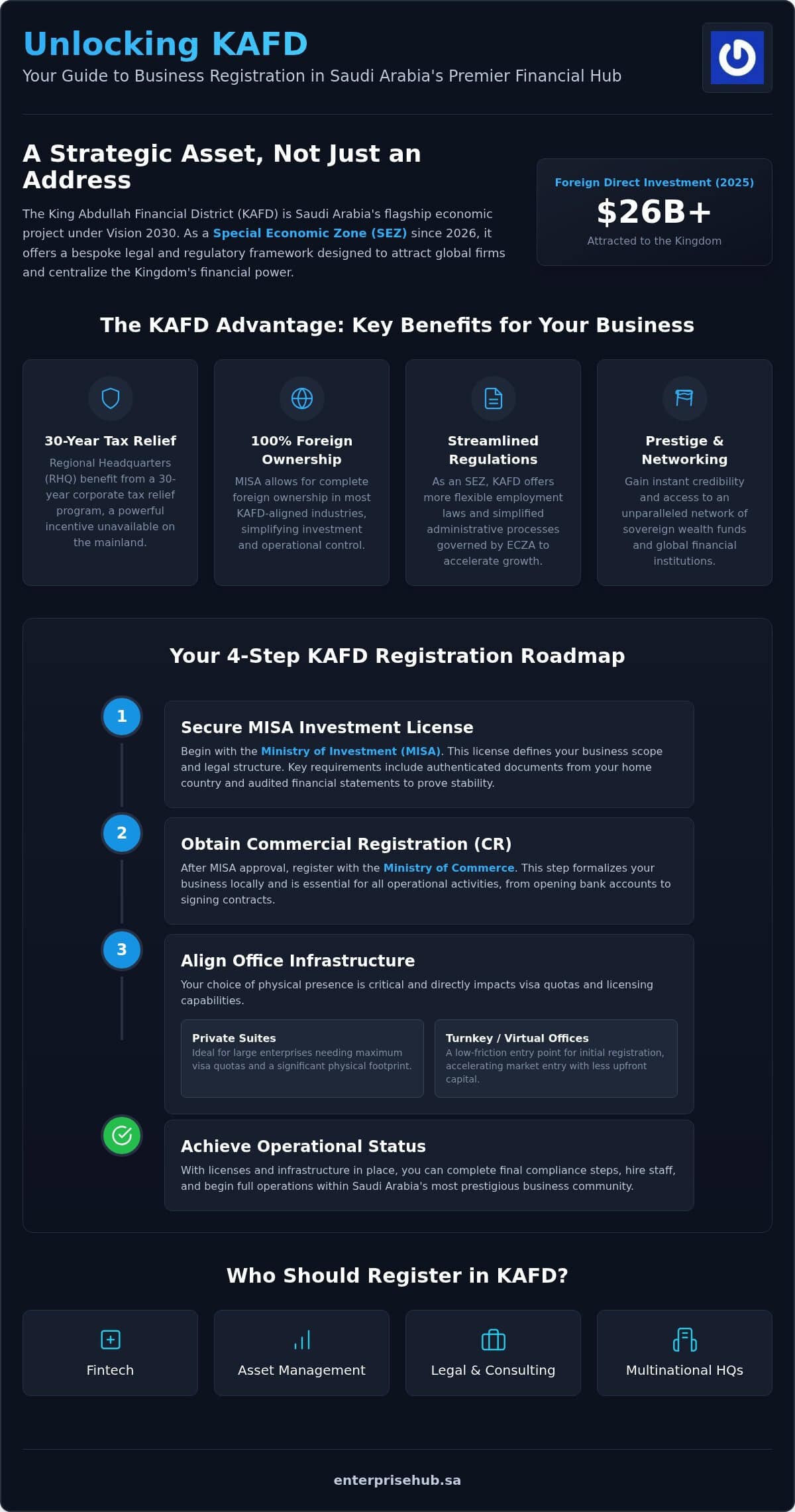
Step-by-Step Guide to KAFD Onboarding and Compliance
Transitioning from strategic planning to operational reality requires a disciplined approach to the Saudi regulatory landscape. Your KAFD business registration isn’t a single event but a sequence of administrative milestones that must be cleared to ensure full legal standing. By following this structured onboarding path, you’ll minimize delays and establish a compliant foundation for your firm’s growth in the heart of Riyadh.
- Step 1: Define Your Legal Structure and Obtain MISA Approval. Before anything else, you must determine if your entity will be a Limited Liability Company (LLC) or a Branch. Submit your application via the ‘Invest Saudi’ portal to secure your preliminary investment license.
- Step 2: Secure a Physical or Virtual Office Lease. As discussed previously, a valid lease is mandatory. Whether you choose a private suite or a virtual package, ensure the contract is registered in the Ejar system to satisfy Ministry requirements.
- Step 3: Register with the Ministry of Commerce. With your MISA license and lease in hand, apply for your Commercial Registration (CR). This document is your primary legal identifier in the Kingdom.
- Step 4: Finalize Chamber of Commerce and ZATCA Registrations. Join the local Chamber of Commerce and register with the Zakat, Tax and Customs Authority (ZATCA) to manage your tax obligations, including VAT.
- Step 5: Setup Post-Registration Government Portals. Activate your accounts on Qiwa for labor management, Muqeem for residency services, and Absher for corporate administrative tasks.
Navigating Government Portals
Setting up your National Address is a critical post-registration task. This digital address is linked to the ‘Wasel’ system, which the government uses for all official document deliveries and legal notices. Failing to maintain an active National Address can lead to service suspensions on your CR. For a deeper look at the broader regulatory environment, explore our guide on Business Setup in the Kingdom 2026. This ensures your KAFD entity remains synchronized with national standards.
Post-Registration Tax and Accounting
Compliance doesn’t end with your CR. You must register for VAT if your annual taxable supplies exceed ﷼375,000, though voluntary registration is available at ﷼187,500. As of August 2026, the standard VAT rate remains 15%, and foreign-owned businesses not qualifying for RHQ incentives face a 20% corporate income tax. It’s also vital to enroll in the Wage Protection System (WPS) from day one. This system monitors payroll to ensure employees are paid according to their contracts, a non-negotiable requirement for maintaining your labor office files in good standing.
Managing these intricate layers of bureaucracy can be taxing for new market entrants. You can delegate your government service needs to our experts to ensure every portal is correctly configured and every tax deadline is met. Taking this proactive step allows your leadership team to focus on strategic growth while we handle the technical compliance details.
Accelerating Your KAFD Entry with Enterprise Hub
Navigating the technicalities of KAFD business registration shouldn’t distract you from your core mission of growth and innovation. While direct leasing through district management is an option, it often leaves your leadership team to manage the administrative burden of registration and compliance alone. Enterprise Hub acts as your tactical accelerator. We provide a turnkey environment that satisfies every regulatory requirement from the moment you sign. By integrating premium workspace with specialized legal and government support, we transform a multi-layered entry process into a streamlined operational launch.
Choosing a managed office is the most efficient path to compliance because it removes the friction of construction, utilities setup, and separate service contracts. We provide the registered address and Ejar-compliant lease required to finalize your CR and MISA license. This integrated approach ensures your legal and physical presence move in perfect synchronization. It prevents common bottlenecks that frequently delay market entry for international firms. You’ll gain immediate access to premium meeting rooms designed for high-stakes investor sessions, ensuring your brand’s first impression matches the district’s global prestige.
Comprehensive Business Support
Our expertise extends far beyond physical desks. We provide a holistic ecosystem that includes accounting, tax compliance, and government relations support tailored to the unique Special Economic Zone framework of KAFD. Our team bridges the gap between international corporate standards and the specific local regulations of the Kingdom, ensuring your entity remains in good standing as laws evolve throughout 2026. Enterprise Hub serves as your dedicated strategic partner, facilitating a seamless entry into KAFD while you focus on scaling your regional operations. We handle the technicalities of ZATCA and labor office filings so you don’t have to.
Next Steps for Your Business
Ready to secure your place in the Kingdom’s financial heart? The journey begins with a clear roadmap and a partner who understands the local landscape. We invite you to schedule a site visit to experience our KAFD facilities firsthand and see how our infrastructure supports your brand equity. Our registration experts are available for a tailored consultation to assess your specific legal structure and licensing needs. We’ll help you identify the most cost-effective path to full compliance without compromising on prestige or operational depth.
Contact Enterprise Hub to start your KAFD journey today and let us handle the complexities while you lead the way in Saudi Arabia’s premier financial district.
Your Future in the Kingdom’s Financial Heart
Registering in KAFD in 2026 is a move that defines your brand’s trajectory in Saudi Arabia. We’ve explored how the district’s status as a Special Economic Zone provides unique advantages, from 30-year tax relief for regional headquarters to streamlined governance under ECZA. Success depends on aligning your physical office infrastructure with MISA and Ministry of Commerce requirements to ensure your entity meets every compliance standard from day one. By choosing a partner that provides fully equipped premium offices and specialized government services support, you bypass the administrative friction that often slows down global competitors. Your KAFD business registration is the first step toward joining an elite ecosystem of financial leaders and sovereign wealth funds.
We’re ready to help you navigate this transition with the precision and speed your business deserves. Secure your KAFD business address and start your registration today. The opportunity to anchor your operations in this strategic KAFD location has never been more accessible or impactful. We look forward to being your strategic partner in this journey and witnessing your growth within the Kingdom’s most prestigious business community.
Frequently Asked Questions
Can I register a business in KAFD with a virtual office?
Yes, you can. Virtual office packages are legally recognized for obtaining your Commercial Registration (CR) in the King Abdullah Financial District. This model allows you to secure a prestigious financial address and establish your legal entity while maintaining a lean operational footprint. It’s an ideal strategy for firms in the early stages of market entry that don’t yet require a full physical suite.
What is the average timeline for KAFD business registration in 2026?
The average timeline typically ranges from 2 to 4 weeks. This duration depends on the speed of your preliminary MISA approval and the authentication of your international corporate documents. Using the “Invest Saudi” portal has streamlined the process, but having your Articles of Association ready is vital for avoiding administrative delays. Strategic preparation ensures your KAFD business registration moves forward without unnecessary friction.
Do I need a local partner to register a business in KAFD?
No, a local Saudi partner is generally not required. Most industries active in KAFD, including financial services, fintech, and professional consulting, allow for 100% foreign ownership. You can register your entity as a wholly-owned subsidiary or a branch of an international company. This flexibility is a key part of the Kingdom’s strategy to attract global capital and expertise into its premier financial district.
What are the MISA requirements for a KAFD commercial license?
MISA requires authenticated copies of your current commercial registration, audited financial statements, and a detailed business plan. You must also select a business activity that aligns with the district’s focus on finance and professional services. Your application should clearly demonstrate your firm’s stability and intent to contribute to the local economy. Meeting these standards is the first step toward securing your investment license.
How does KAFD registration help with the Regional Headquarters (RHQ) program?
Registration in KAFD is the most effective way to satisfy the physical presence requirements of the RHQ program. Establishing your regional headquarters here unlocks a 30-year corporate tax holiday and simplifies the process of bidding for Saudi government contracts. It places your leadership team in the center of the Kingdom’s economic decision-making hub, providing unparalleled access to sovereign wealth funds and major financial regulators.
Is there a specific ‘KAFD license’ or is it a general Saudi commercial license?
It’s a standard Saudi commercial license that is enhanced by the Special Economic Zone (SEZ) framework. While your Commercial Registration (CR) is issued through the Ministry of Commerce, your business operates under the authority of the Economic Cities and Special Zones Authority (ECZA). This status provides unique regulatory exemptions and operational flexibilities that aren’t available to businesses registered in the general Riyadh mainland.
What are the tax benefits of registering a business in KAFD?
Companies qualifying for the Regional Headquarters (RHQ) program receive a 30-year exemption from corporate income tax. For other foreign entities, the standard corporate tax rate is 20%. Additionally, the SEZ framework in KAFD aims to provide streamlined VAT processes and customs exemptions for specific financial activities. These incentives make KAFD business registration a highly competitive choice for firms looking to maximize their regional profitability.
Can I upgrade from a virtual office to a private suite after registration?
Yes, you can upgrade your workspace as your business scales. Transitioning from a virtual office to a private suite involves updating your Ejar contract and your National Address in the government portals. This change often allows you to apply for a higher visa quota, enabling you to relocate more international staff to Riyadh. It’s a flexible way to manage costs during your initial market entry.