
Did you know that Grade A office rents in Riyadh have climbed to an average of SAR 2,100 per square meter in 2026? We understand that maintaining a prestigious presence in the Kingdom’s capital shouldn’t mean sacrificing your growth capital to high CAPEX fit-outs and rigid long-term leases. It’s a challenge every ambitious investor faces while trying to reduce office operating costs in Riyadh without losing their competitive edge in a fast-moving market.
We’re here to help you navigate this transition with confidence. This guide provides a strategic roadmap to help you reclaim your budget by leveraging flexible workspace ecosystems and smarter administrative workflows. We’ll explore the real ROI of serviced versus traditional offices, how to navigate MISA and RHQ regulations with minimal friction, and why shifting from physical asset management to integrated solutions is the key to sustainable expansion in the Vision 2030 era. By focusing on operational efficiency rather than just square footage, you can position your business for long-term prosperity in the heart of the Saudi economy.
Key Takeaways
- Analyze the 2026 commercial landscape to identify hidden overhead costs in traditional lease structures and administrative workflows.
- Discover how to reduce office operating costs in Riyadh by leveraging flexible private office solutions that eliminate heavy upfront CAPEX and fit-out expenses.
- Learn how integrating government relations, accounting, and tax services can significantly lower your administrative burden and improve cash flow.
- Identify the strategic benefits of hybrid work models in optimizing your physical office footprint and reducing long-term utility consumption.
The 2026 Landscape: Understanding Office Operating Costs in the Kingdom
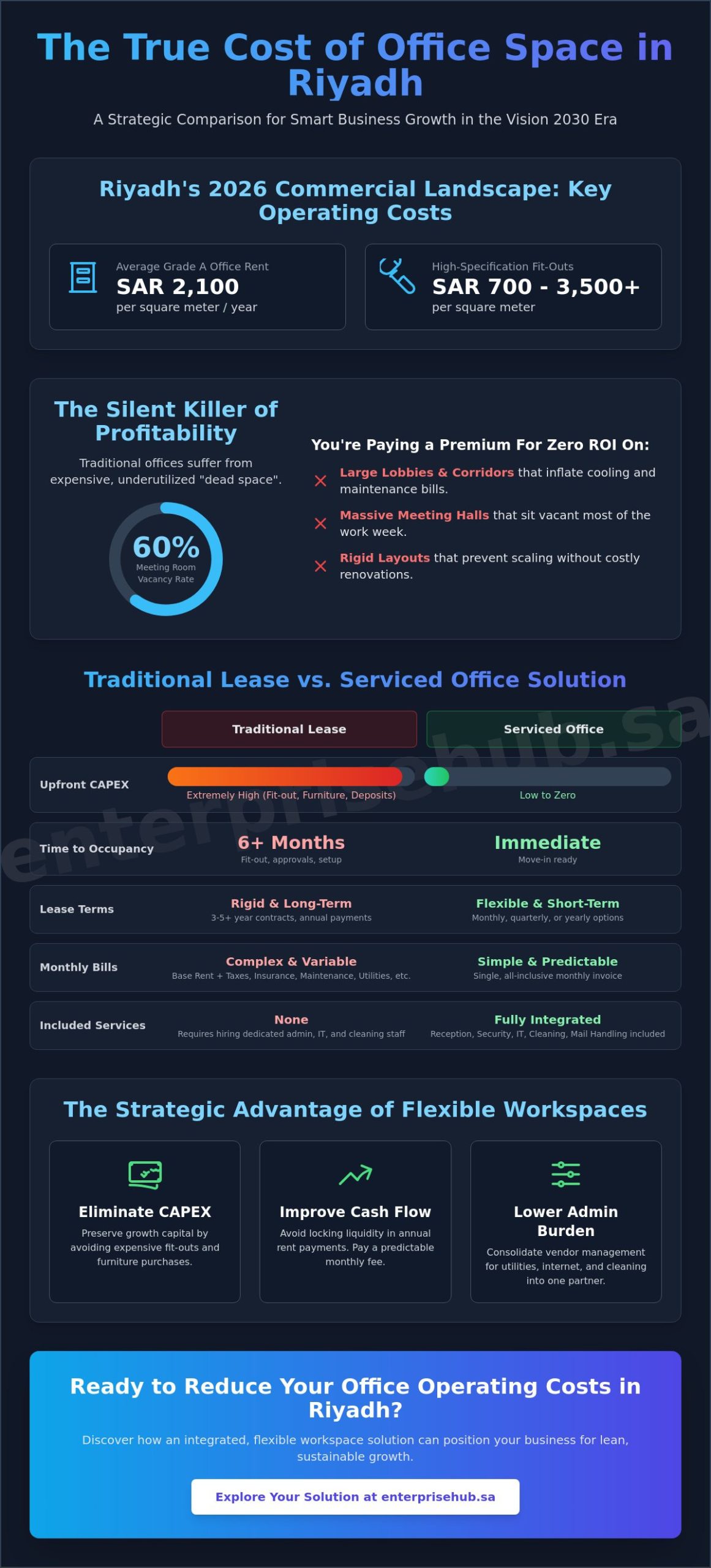
Riyadh’s commercial landscape in 2026 demands a radical shift in how we view business expenses. As Vision 2030 drives unprecedented growth, the influx of international firms has pushed Grade A office rents to an average of SAR 2,100 per square meter. This surge creates a complex environment where traditional cost-cutting measures, such as downsizing or moving to the city’s periphery, often backfire by eroding brand prestige and networking potential. To thrive, leaders need a sophisticated understanding of operating costs that moves beyond simple line items.
Modern OpEx in the Kingdom encompasses much more than monthly rent. It integrates utility consumption, where commercial tariffs now range from SAR 0.22 to SAR 0.32 per kWh, along with essential government fees like the SAR 1,200 annual Commercial Registration renewal. Additionally, maintaining administrative talent requires navigating the Nitaqat program, which mandates a minimum monthly wage of SAR 4,000 for Saudi nationals to count fully toward quotas. Balancing these factors while trying to reduce office operating costs in Riyadh requires a strategic approach that prioritizes flexibility over fixed assets.
Fixed vs. Variable Costs in the Saudi Business Hub
Traditional long-term leases represent a significant balance-sheet liability in the current market. Since Riyadh landlords typically require rent payments annually or semi-annually in advance, large amounts of liquidity are frequently locked away, hampering your ability to pivot. Utility costs and maintenance in premium districts like KAFD or Olaya add another layer of volatility. We also see semi-variable costs, such as government relations (PRO) services, which fluctuate based on your specific hiring and visa renewal cycles. Managing these as fixed overheads leads to inefficiency and wasted capital.
The Hidden Cost of Underutilized Real Estate
Empty space is the silent killer of profitability. Many traditional offices in metropolitan districts suffer from low occupancy rates, with expensive “dead space,” such as reception areas, breakrooms, and massive meeting halls, remaining unused for most of the working day. You’re effectively paying a premium for square footage that provides zero ROI. This inefficiency is compounded by the high cost of fit-outs, which can range from SAR 700 to over SAR 3,500 per square meter for high-specification finishes.
- Meeting rooms often sit vacant for over 60% of the work week.
- Large lobbies and corridors inflate your cooling and maintenance bills.
- Rigid layouts prevent you from scaling your team without undergoing costly renovations.
The Cost-per-Utilized-Desk metric has emerged as the essential 2026 KPI for measuring true workspace efficiency.
Strategic Comparison: Traditional Leases vs. Serviced Office Solutions
Choosing between a traditional lease and a serviced office is a decision that dictates your capital allocation for years. In a market where high-specification fit-outs can reach SAR 3,500 per square meter, the traditional route requires immense CAPEX before a single employee sits down. This capital is often better spent on core business growth or market expansion. Understanding the annual operating cost in Saudi Arabia reveals that traditional “Base Rent” is just the tip of the iceberg.
Traditional models often follow a “Base Rent + NNN” structure, meaning you’re responsible for property taxes, insurance, and maintenance on top of the lease. In contrast, modern workspace solutions offer an all-inclusive model. This consolidates rent, high-speed fiber internet, electricity, and cleaning into a single monthly invoice. It simplifies accounting and allows you to accurately predict your monthly burn rate. If you want to effectively reduce office operating costs in Riyadh, eliminating the management of multiple utility vendors is a critical first step.
The ROI of Fully Equipped Workspaces
Speed is a competitive advantage. A traditional fit-out in Riyadh can take six months or longer to complete, during which you’re paying rent on a space you can’t use. Serviced offices provide immediate market entry. By utilizing shared facilities like premium meeting rooms and designer break areas, you reduce your total square footage requirement, paying only for the space you use daily. You also bypass the need to hire dedicated onsite support staff, as reception, security, and IT maintenance are already integrated into the service.
Lease Flexibility and Market Agility
Committing to a 5-year traditional lease in Riyadh’s rapidly evolving 2026 economy carries significant risk. If your team doubles in size or shifts to a hybrid model, you’re stuck with a rigid physical asset. Serviced offices allow you to scale up or down without the heavy penalty fees associated with breaking a commercial lease. This agility is vital for project-based growth or firms testing the Saudi market for the first time. You’ll find that security deposits and termination clauses are far more favorable, allowing you to reduce office operating costs in Riyadh by maintaining a footprint that matches your current headcount rather than your future projections.
Optimizing Legal, Tax, and Administrative Overhead
Reducing your physical footprint is only half the battle. To truly reduce office operating costs in Riyadh, you must address the administrative “tax” that often goes unnoticed until it’s too late. High-growth environments like the Kingdom require constant interaction with various ministries, making legal and tax compliance a significant operational pillar. Managing these tasks in-house often leads to bloated payrolls and increased risk of error.
Administrative Efficiency and Outsourcing
Hiring an in-house Government Relations Officer (PRO) involves more than just a salary. You’re paying for recruitment, insurance, and the risk of single-point failure. Transitioning to a service-based model allows you to tap into a team of experts for a fraction of the cost. These specialists ensure your Commercial Registration (CR) renewals, which typically cost SAR 1,200 annually plus a SAR 500 publication fee, are handled without delays. Learn how business setup services streamline your entry by managing these complexities from day one.
Similarly, integrated accounting and tax support protect your bottom line. With a 20% corporate income tax rate for foreign-owned firms and stringent ZATCA requirements, manual errors are expensive. Professional management prevents costly penalties and ensures your financial reporting aligns with Saudi standards. This integrated approach transforms administrative tasks from a drain on resources into a streamlined, predictable expense that scales with your business needs.
Compliance as a Cost-Saving Tool
Strategic compliance is often the most overlooked way to reduce office operating costs in Riyadh. For example, the Ministry of Investment (MISA) has suspended several registration fees to encourage foreign investment, yet maintaining the license still requires a valid business address. Instead of leasing a massive traditional space just to satisfy regulatory requirements, you can use prestigious virtual office addresses or smaller private offices in prime districts to maintain your legal status.
This strategy is particularly effective for firms navigating the Regional Headquarters Program, as it allows you to establish a high-profile presence while keeping physical overhead lean. By choosing a partner that offers both the workspace and the necessary government services, you satisfy government mandates without the burden of excessive real estate. This alignment between legal requirements and physical space selection ensures that every riyal spent on rent also contributes to your regulatory standing.
Leveraging Technology and Hybrid Models for Cost Efficiency
Technology is no longer an optional luxury; it’s the primary engine driving operational leanness. In the 2026 market, Riyadh’s smart city initiatives allow businesses to integrate building management systems that automate energy consumption. Since commercial electricity tariffs can reach SAR 0.32 per kWh for high usage, smart sensors that adjust lighting and cooling based on real-time occupancy are essential tools to reduce office operating costs in Riyadh. Moving toward a digital-first administrative structure by shifting from paper-heavy processes to cloud-based ZATCA-compliant systems also eliminates the need for extensive physical storage space. To support this digital transformation with local enterprise expertise, check out BridgeWellTek.
The Shift to On-Demand Meeting Spaces
One of the most effective ways to trim your budget is to eliminate permanent, large-scale boardrooms. A traditional 30-square-meter meeting room in a prime district costs tens of thousands of riyals annually in rent alone, excluding the high CAPEX for furniture and audiovisual equipment. By switching to a model that utilizes shared facilities, you only pay for the time you actually use. This approach ensures your team has access to high-tech presentation tools and designer environments without the burden of maintenance or underutilization. For a deeper look at how to optimize these bookings, consult our Strategic guide to meeting rooms for rent in the Kingdom.
Hybrid Models in the Saudi Context
Adopting a hybrid work model requires a delicate balance between modern remote efficiency and the Kingdom’s traditional business culture that values face-to-face interaction. We’re seeing a rise in the “Hub and Spoke” strategy, where a company maintains a central, prestigious headquarters for client meetings while utilizing flexible coworking spaces for a rotating workforce. This setup allows you to significantly reduce the total physical footprint required per employee.
- Shared workstations support a larger headcount without increasing your lease.
- Digital-first workflows reduce the need for onsite administrative staff.
- Cloud integration enables seamless collaboration between remote teams and the central hub.
This flexibility is vital for firms looking to reduce office operating costs in Riyadh while remaining agile enough to scale during peak project cycles. By leveraging on-demand resources, you transform fixed real estate liabilities into variable expenses that align with your actual business activity. Explore our technology-integrated workspaces to see how smart design can enhance your team’s productivity while protecting your bottom line.
Enterprise Hub: Your Partner in Lean Business Growth
Efficiency is the cornerstone of sustainable expansion in the Kingdom. We’ve designed Enterprise Hub to serve as an integrated ecosystem that addresses the core challenges discussed in this guide. By merging high-tier private offices with essential business services, we empower you to reduce office operating costs in Riyadh without compromising your brand’s authority. You don’t need to juggle separate contracts for rent, utilities, and administrative support. We provide a single, streamlined solution that aligns with your strategic goals.
Our model focuses on eliminating the hidden drains on your capital. When you choose our private office solutions, you’re not just renting a desk; you’re gaining a strategic partner. Companies that have switched to our integrated model report an average OpEx reduction of 30% within their first year. This significant saving stems from consolidating services and removing the need for a large, in-house administrative team. We handle the background operations so you can focus on your core mission.
A Prestigious Address with Minimal Overhead
In Riyadh, your address is your calling card. Establishing your headquarters in prime business districts like Olaya or near the King Abdullah Financial District (KAFD) creates immediate trust with local partners and top-tier talent. Understanding why choosing a prestigious office is a strategic investment is about more than aesthetics; it’s about the psychological impact on your market position. We allow you to hold this premium ground while keeping your overhead lean and predictable. It’s the most effective way to reduce office operating costs in Riyadh while maintaining an elite corporate image.
Ready to Scale: Our Solutions for 2026
Growth in the Saudi market is rarely linear. You might start with a small team and find yourself needing to double your capacity within months. Our workspace plans are built for this reality. You can customize your footprint as you grow, accessing premium amenities like designer meeting rooms and high-speed infrastructure without the burden of CAPEX fit-outs. We integrate company formation, government services, and accounting directly into our support structure. This ensures you remain compliant with MISA and ZATCA regulations without hiring extra staff. Consult with our strategic growth experts today to build a roadmap that protects your margins while accelerating your success in the heart of the Kingdom.
Future-Proofing Your Saudi Expansion
Success in the Kingdom’s capital now requires a shift from managing physical real estate to optimizing integrated business ecosystems. We’ve explored how transitioning from traditional leases to flexible workspaces and outsourcing administrative burdens can protect your margins. By prioritizing agility over fixed assets, you can effectively reduce office operating costs in Riyadh while maintaining the prestigious presence required to compete in a Vision 2030 economy. This strategic lean approach ensures your capital is invested in growth rather than overhead. As you build this digital-first ecosystem, you can discover VirtuWa for advanced cloud computing and virtual simulation solutions that help streamline regional operations.
At Enterprise Hub, we act as your strategic partner by providing a premium business address alongside built-in government, legal, and accounting support. Our flexible terms are specifically designed to support international firms as they scale within the heart of the capital’s business district. It’s time to eliminate the complexity of multiple vendors and focus on your core mission.
Optimize your business costs with Enterprise Hub solutions and take the next step in your Saudi success story. We’re ready to help you thrive in one of the world’s most dynamic markets.
Frequently Asked Questions
Is a serviced office cheaper than a traditional lease in the long run?
Serviced offices are generally more cost-effective for small to medium enterprises because they eliminate massive upfront CAPEX and variable maintenance fees. Traditional leases involve locked-in annual payments and high fit-out costs that often take years to amortize. Serviced models provide a predictable monthly fee that includes utilities and staff, allowing you to reduce office operating costs in Riyadh through consolidated billing and shared infrastructure.
How does a virtual office help in reducing operating costs?
A virtual office reduces costs by providing a prestigious business address and essential administrative support without the expense of physical square footage. This is ideal for satellite branches or remote teams that only need a legal presence for registration and mail handling. It eliminates rent, utility bills, and the need for onsite staff while maintaining high corporate standards and regulatory compliance.
Can I meet MISA requirements with a serviced office space?
Yes, you can satisfy MISA requirements using a serviced office as long as the provider is properly licensed and the space meets the minimum physical requirements for your specific license type. Many international firms use this strategy to establish a legal entity quickly without committing to a long-term lease. It’s a strategic way to maintain compliance while keeping your overhead low during the initial market entry phase.
What are the most common hidden costs in commercial leases?
The most common hidden costs include the 5% Real Estate Transaction Tax (RETT), annual service charges for building maintenance, and the high cost of restoring the space to its original condition at the end of the lease. Additionally, you must factor in the SAR 0.22 to SAR 0.32 per kWh commercial electricity tariffs and sewage fees, which are often 50% of the water consumption cost.
How does the Regional Headquarters (RHQ) program affect office costs?
The Regional Headquarters (RHQ) program mandates that international companies establish their hub in the Kingdom to be eligible for government contracts, which has increased demand for Grade A spaces. This shift often leads to higher rents in prime districts. However, choosing a flexible office partner allows you to satisfy RHQ mandates while scaling your physical footprint only as your local team grows, preventing unnecessary spending on vacant space.
Does hybrid work actually save money for companies in Saudi Arabia?
Hybrid work saves money by allowing you to reduce the total number of permanent desks, which directly lowers your required square footage and associated cooling costs. In the Saudi context, this model works best when combined with coworking spaces for rotating staff. It reduces the cost per utilized desk and allows you to reduce office operating costs in Riyadh by avoiding the expense of underutilized real estate.
What is the average cost of an office fit-out for a traditional lease?
A standard, mid-level office fit-out in Riyadh typically ranges from SAR 700 to SAR 1,200 per square meter as of 2026. If you require high-specification finishes or advanced IT infrastructure, costs can climb between SAR 2,000 and SAR 3,500 per square meter. These upfront expenses represent a significant cash outflow that can be avoided by choosing a fully equipped serviced workspace that is ready for immediate occupancy.
How can I reduce administrative and government service expenses?
You can reduce these expenses by outsourcing your government relations (PRO) and accounting functions to an integrated service provider. Instead of paying a full-time salary and insurance for an in-house officer, you pay for services as needed. This ensures you avoid late fines for Commercial Registration renewals or ZATCA non-compliance while benefiting from professional expertise at a lower cost than a dedicated department.