
In 2026, entering the Saudi market isn’t just about obtaining a commercial registration; it’s about mastering a sophisticated ecosystem where speed and precision define your success. You’ve probably realized that while Vision 2030 has opened doors, the transition from a virtual presence to a physical, tax-compliant operation involves complex layers of MISA regulations and ZATCA requirements. Partnering with a strategic business setup consultant in Riyadh transforms these bureaucratic hurdles into a streamlined roadmap for growth.
We understand that your priority is a prestigious business presence without the typical operational delays. We’ll show you how to leverage the latest 2026 reforms, including the streamlined investor registration process and the 0% corporate tax incentives for Regional Headquarters. This guide provides the clarity you need to handle everything from GOSI compliance to securing the right office space, ensuring your venture isn’t just legal, but positioned for long-term excellence in the Kingdom.
Key Takeaways
- Learn how a strategic business setup consultant in Riyadh navigates the complex MISA and ZATCA regulatory landscape to ensure 100% legal compliance.
- Master the five essential steps for company formation, starting with your investment license and ending with operational excellence in the Saudi market.
- Evaluate different legal structures like LLCs and Regional Headquarters (RHQ) to determine which model offers the best tax benefits and growth potential for your brand.
- Avoid the hidden costs of administrative delays by understanding the critical role of expert guidance in opening bank accounts and securing employee visas.
- Discover how combining professional setup services with a prestigious physical office in Riyadh accelerates your time-to-market and builds immediate local trust.
What is a Business Setup Consultant in Riyadh?
A business setup consultant in Riyadh is your strategic operational architect. They don’t just fill out forms; they design the legal and financial framework that allows your company to thrive in the Middle East’s largest economy. In 2026, the Saudi market is more accessible yet more regulated than ever. A consultant bridges the gap between international corporate standards and local Saudi business practices, ensuring your entry is seamless and compliant from day one.
Their expertise isn’t limited to a single department. They manage the interplay between the Ministry of Investment (MISA), the Ministry of Commerce, and ZATCA tax compliance. By acting as a strategic advisor, they help you select the most tax-efficient structures, such as a Regional Headquarters (RHQ) which currently offers a 30-year tax holiday. Without this guidance, businesses often find themselves stuck in administrative loops that delay their time-to-market by months.
The Evolving Role of Consultants in Vision 2030
The days of simple document clearing are over. As Saudi Arabia pushes toward the goals of Vision 2030, a business setup consultant in Riyadh has become a market entry strategist. They help you align your business activities with current investment incentives and the new Foreign Investment Law that took effect in February 2025. This law streamlined the registration process, but it also increased the need for precise categorization of business activities. Local experts provide the necessary “boots on the ground” to handle government liaison services directly, ensuring that your application reflects the latest regulatory shifts.
Key Government Entities You Will Encounter
Establishing a presence requires engaging with several specialized authorities. You’ll need to master their digital platforms to remain operational and compliant with the Kingdom’s rapid digitization efforts.
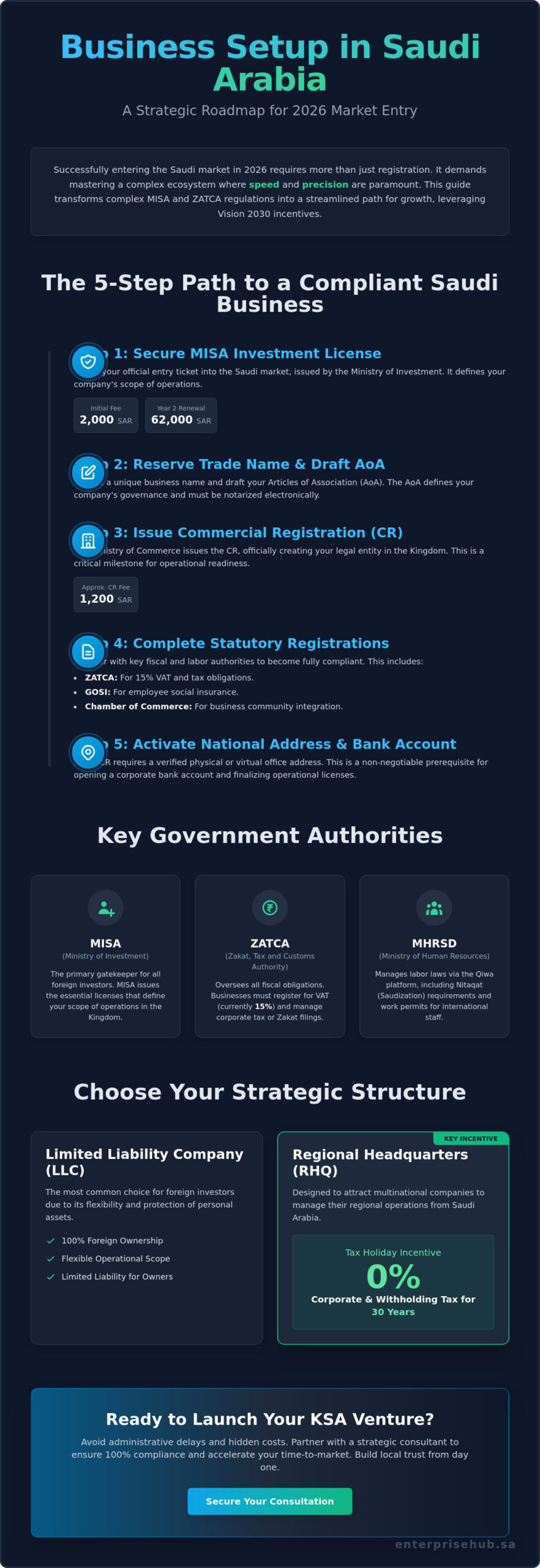
- MISA (Ministry of Investment): They are the primary gatekeeper for foreign investors. They issue the licenses that define your scope of operations in the Kingdom.
- ZATCA (Zakat, Tax and Customs Authority): This body oversees your fiscal obligations. You’ll need to register for VAT, which stands at 15%, and manage your corporate tax or Zakat filings.
- Ministry of Human Resources and Social Development: You’ll spend significant time on the Qiwa platform. This is where you’ll manage your Nitaqat (Saudization) requirements and issue work permits for your international staff.
5 Steps to Establishing Your Business in Saudi Arabia
Launching a venture in the Kingdom requires more than just capital; it demands a chronological mastery of government portals and legal frameworks. While the 2025 reforms have accelerated the pace, skipping a single step can lead to costly delays. Partnering with a business setup consultant in Riyadh ensures you follow a proven path from initial interest to operational excellence. We focus on getting you to market in the fastest possible time while maintaining 100% compliance with evolving local laws.
The journey follows a structured five-step sequence designed to integrate your business into the Saudi economy seamlessly:
- Secure your MISA Investment License: This is your entry ticket. Under the current 2026 fee structure, you can benefit from a promotional initial license fee of 2,000 SAR, though you should budget for the standard 62,000 SAR renewal in your second year.
- Reserve your Trade Name and AoA: You’ll choose a unique name and draft your Articles of Association. This document defines your company’s internal governance and must be notarized electronically.
- Issue the Commercial Registration (CR): Once the Ministry of Commerce approves your name, you’ll pay the CR fee of approximately 1,200 SAR to officially birth your legal entity.
- Complete Statutory Registrations: Your business must be visible to the fiscal and labor authorities. This includes registering with ZATCA for your 15% VAT obligations, GOSI for social insurance, and the Chamber of Commerce.
- Activate your National Address: Every CR requires a verified physical or virtual location. You cannot finalize your operational licenses or open a corporate bank account without a registered office address.
Step 1: Licensing and Legal Structure
Choosing the right vehicle for your investment is a foundational decision. Most foreign investors opt for a Limited Liability Company (LLC) due to its flexibility and the ability to maintain 100% foreign ownership in most retail and industrial sectors. If you prefer a direct link to your global entity, a Branch Office might be more suitable. By 2026, any international firm aiming to secure government contracts exceeding 1 million SAR must establish a Regional Headquarters (RHQ) in Saudi Arabia to remain eligible for those opportunities. We can help you evaluate these official requirements for business setup to ensure your structure matches your long-term vision.
Step 2: Operational Readiness and Address
You can’t operate in a vacuum. A registered business address is a strict legal prerequisite for issuing your Commercial Registration and hiring staff. For consultancy and professional firms, you might start by leveraging virtual offices in Saudi Arabia to minimize initial overhead while securing your license. As you scale, transitioning to a private office in the capital provides the prestigious presence needed to win local trust. If you’re ready to begin this transition, our team offers integrated business setup services that combine legal formation with world-class workspace solutions.
Strategic Considerations: LLC vs. Branch vs. RHQ
Selecting the right legal entity is the most critical decision you’ll make when entering the Kingdom. It dictates your tax obligations, your ability to hire, and your eligibility for government tenders. While digital portals have simplified the application process, a business setup consultant in Riyadh provides the strategic foresight needed to choose a structure that aligns with Saudi Arabia’s economic climate and your long-term commercial goals. In 2026, the landscape has shifted toward specialized structures that reward deep commitment to the local market.
Most investors gravitate toward the Limited Liability Company (LLC) because it offers a robust shield for the parent company and allows for 100% foreign ownership in the majority of sectors. If your goal is to maintain a direct legal link to your home office, a Branch Office is a viable alternative, though it carries the liability of the parent entity. For those in specialized industries like logistics or tech, Special Economic Zones (SEZs) now offer unique regulatory frameworks and customs exemptions that can significantly boost operational efficiency.
The RHQ Mandate: What You Need to Know
By 2026, the Regional Headquarters (RHQ) program has become a cornerstone for any multinational firm eyeing large-scale projects. If your business seeks to compete for Saudi government contracts exceeding 1 million SAR, establishing an RHQ isn’t just an option; it’s a requirement. The incentives are substantial, including a 0% corporate income tax rate for 30 years and exemptions from certain Saudization quotas. However, the criteria are strict. You must employ a specific number of executive-level staff within the Kingdom, and a consultant ensures your application meets these precise MISA standards to avoid rejection.
Taxation and Compliance Framework
Understanding your fiscal responsibilities is essential for maintaining your 100% legal compliance. Foreign-owned entities typically face a 20% corporate income tax on profits, while Saudi or GCC-owned shares are subject to Zakat, a 2.5% religious levy on wealth. You’ll also need to manage the 15% VAT on all taxable supplies from the moment you hit the registration threshold. Because investing in Saudi Arabia involves navigating these dual systems, we help you implement a proactive tax strategy from day one. This ensures your accounting practices satisfy ZATCA requirements while maximizing your available incentives.
Our role as your business setup consultant in Riyadh is to simplify these complexities. We don’t just help you choose a structure; we ensure that structure is an engine for growth rather than a source of administrative friction. Whether you’re launching a lean LLC or a complex RHQ, we provide the clarity needed to operate with confidence.
Overcoming the #1 Objection: Is a Consultant Necessary?
Many investors look at the sleek digital portals of MISA and the Ministry of Commerce and conclude that they can handle the entire process alone. While Saudi Arabia has made incredible strides in digitizing its bureaucracy, the “how-to” of filing a form is very different from the “why” of strategic compliance. A business setup consultant in Riyadh provides the local context that digital interfaces lack. They act as an operational shield, preventing minor clerical errors from turning into months of stagnant growth.
The “Hidden Costs” of a DIY approach often far outweigh the professional fees of an expert. A three-month delay in opening a corporate bank account or a series of visa rejections can cost your business hundreds of thousands of riyals in lost opportunities. Many government systems still require high-level Arabic proficiency for legal documentation and specific portal navigation. Consultants leverage established local networks to accelerate approvals and troubleshoot bottlenecks that aren’t documented in any online guide. They ensure your entry into the market is a sprint, not a slow crawl through administrative hurdles.
The Complexity of Corporate Banking
Opening a corporate bank account is often cited as the most challenging part of the setup journey. Saudi banks adhere to exceptionally strict Anti-Money Laundering (AML) and Know Your Customer (KYC) requirements. They don’t just evaluate your balance sheet; they scrutinize your physical operational footprint. There’s a direct, documented link between a prestigious business address and the speed of bank account approval. If your documentation is disorganized or your office presence appears temporary, banks may flag your application. We prepare your documentation to meet these exact standards, ensuring your financial infrastructure is ready when you are.
Visa and Labor Law Expertise
Once your company is legal, you must manage the human element through the Qiwa platform. This involves more than just issuing contracts; it requires a deep understanding of “Saudization” (Nitaqat) quotas. If your company fails to maintain the correct ratio of local to foreign talent, your ability to issue new work permits or transfer employees will be frozen. A business setup consultant in Riyadh helps you navigate these labor laws to ensure your executive team secures their residency (Iqama) status without delay. This includes managing the 9,600 SAR annual work permit fees and ensuring all GOSI social insurance requirements are satisfied from day one.
Real success in the Kingdom requires moving beyond “registered” status to becoming fully “operational.” If you’re ready to bypass the trial-and-error phase and secure a prestigious presence in the capital, partner with our team for integrated setup solutions that guarantee results.
Enterprise Hub: Your Integrated Partner for Growth
Success in the Saudi market requires more than a paper license; it demands a functional, high-performance base of operations. Enterprise Hub redefines the role of a business setup consultant in Riyadh by merging legal expertise with world-class physical infrastructure. We recognize that for a global enterprise or a scaling SME, time is the most valuable currency. Our integrated model ensures that as soon as your Commercial Registration is issued, your team has a prestigious, fully-equipped environment ready for immediate productivity.
A prestigious address in the heart of the capital is a strategic asset that builds immediate trust with local partners and government entities. We don’t just help you enter the market; we position you within the national financial ecosystem. By providing tailored solutions that range from virtual presence for initial setup to expansive private suites for established teams, we streamline your path from “legal entity” to “market leader” in record time.
Beyond Setup: Operational Support Services
Your journey with us continues long after the initial registration. We provide a comprehensive suite of support services designed to handle the administrative weight of running a Saudi company. This includes integrated accounting and tax services to ensure your ZATCA filings are accurate and timely. Our government liaison (PRO) services manage the ongoing cycle of license renewals and labor portal updates, allowing you to focus on your core business. When it’s time to close a deal or host a board meeting, you have on-demand access to premium meeting rooms for rent in Riyadh, equipped with the latest technology for high-stakes negotiations.
The Enterprise Hub Advantage
Choosing the right partner means choosing a team that understands the nuances of the 2026 investment landscape. We offer flexible offices for rent in Riyadh that scale alongside your success, ensuring you never pay for space you don’t need while always having room to grow. Our commitment goes beyond being a service provider; we act as a strategic ally in your long-term success. By combining our deep knowledge as a business setup consultant in Riyadh with operational excellence, we empower you to navigate the complexities of Vision 2030 with absolute confidence. We’re here to ensure your story in the Kingdom is one of rapid growth and sustained prosperity.
Secure Your Future in the Kingdom’s Evolving Economy
The Saudi market in 2026 offers unparalleled opportunities for those who approach it with a strategic roadmap. You’ve seen that success requires more than just a license; it demands the right legal structure and a seamless transition into full operational status. Whether you’re navigating the complexities of ZATCA compliance or securing your first executive visas, partnering with a business setup consultant in Riyadh ensures you avoid the hidden costs of administrative delays. We empower you to focus on your growth while we handle the intricate layers of local bureaucracy.
Enterprise Hub is here to transform these challenges into your competitive advantage. Our strategic location in the capital’s hub provides the prestige your brand deserves, while our integrated accounting and government services keep you compliant without the stress. We offer flexible private and virtual office solutions that scale with your success, providing a launchpad for long-term excellence. It’s time to move beyond entry and start leading in your industry.
Start your KSA success story with Enterprise Hub today and turn your business vision into a prosperous reality within the Kingdom.
Frequently Asked Questions
How long does it typically take to set up a business in Riyadh?
You can typically obtain your Commercial Registration within 2 to 4 weeks, but the journey to becoming fully operational usually takes 8 to 12 weeks. This longer window accounts for opening a corporate bank account and securing initial employee visas through the Qiwa platform. A business setup consultant in Riyadh helps compress this timeline by ensuring all documents meet the specific standards of MISA and the Ministry of Commerce on the first submission.
Can a foreigner own 100% of a company in Saudi Arabia?
Yes, foreign investors can now enjoy 100% ownership of their entities in the vast majority of commercial and industrial sectors. This policy is a cornerstone of Vision 2030 and removes the historical requirement for a local Saudi partner in most cases. While some strategic sectors like oil and gas or military services still have ownership caps, most retail, tech, and service businesses can be entirely foreign-owned.
What is the minimum capital requirement for an LLC in KSA?
There is no fixed universal minimum capital for a standard Limited Liability Company (LLC), and many investors opt for a notional capital of 100,000 SAR. However, your specific business activity dictates the final requirement. Certain licenses, such as those for real estate development or large-scale agricultural projects, carry much higher mandatory capital thresholds that you must prove during the registration process with MISA.
Do I need a local partner to start a business in Riyadh?
You don’t need a local Saudi partner for most business activities under the current investment laws. The Kingdom has moved away from the traditional sponsorship model to encourage direct foreign investment. You still need a physical or virtual office address within Riyadh to satisfy legal requirements, but the equity and management control can remain entirely with your international parent company or individual foreign investors.
What are the main benefits of hiring a business setup consultant?
The primary benefit is the elimination of administrative delays and the assurance of 100% legal compliance from day one. A business setup consultant in Riyadh navigates the Arabic-language portals of the Ministry of Commerce and ZATCA while managing the complex “Saudization” requirements for your staff. Their local networks are particularly valuable when opening bank accounts, which remains one of the most challenging steps for new market entrants.
How much does it cost to set up a company in Saudi Arabia?
A safe budget for your first year is between 45,000 and 65,000 SAR, which includes government fees, professional consultancy, and your initial office address. While the initial MISA license fee is currently 2,000 SAR under a promotional rate, it’s important to remember that the renewal fee in the second year increases to 62,000 SAR. Total government fees for the first year typically range from 12,000 to 15,000 SAR.
Can I change my business structure after registration?
Yes, you can modify your business structure, but it involves a formal legal process to amend your Articles of Association and Commercial Registration. Changing from a Branch to an LLC or upgrading to a Regional Headquarters (RHQ) requires approvals from MISA and the Ministry of Commerce. Because these changes involve administrative fees and potential operational pauses, it’s more efficient to select your long-term structure during the initial setup phase.
What is the MISA license and who needs it?
The MISA license is a mandatory investment permit issued by the Ministry of Investment for any entity with non-GCC ownership. It’s the primary legal document that allows a foreign company to operate, hire employees, and open bank accounts in Saudi Arabia. Under the new Foreign Investment Law effective February 2025, this process has been streamlined into an investor registration system that acts as the gatekeeper for all international capital entering the Kingdom.