
What if the biggest barrier to your expansion isn’t the Saudi legal code, but the sheer speed of the Kingdom’s digital-first transformation? With over 12 million employment contracts now unified on the Qiwa platform as of May 2026, the margin for error in corporate setup has vanished. Mastering the steps to establish an LLC in Riyadh is no longer just about filling forms; it’s about synchronizing with a high-velocity ecosystem that demands precision from day one. You’ve likely felt the weight of navigating shifting MISA fees or the pressure of meeting the 85% Saudization documentation target required by April 30, 2026.
We understand that juggling multiple portals like ZATCA and the Saudi Business Center can feel like a full-time job before your business even opens its doors. This guide promises to demystify that journey, providing an expert-led roadmap to ensure your entity is not only legally compliant but fully eligible for lucrative government contracts. We’ll walk you through everything from the 20% corporate tax nuances for foreign partners to securing a physical address that satisfies municipal licensing. You’re about to gain a clear, actionable strategy for rapid operational readiness in the heart of the Middle East’s most ambitious economy.
Key Takeaways
- Understand why the Limited Liability Company structure is the preferred strategic vehicle for foreign investors seeking long term growth under Saudi Vision 2030.
- Master the essential steps to establish an LLC in Riyadh, from selecting ISIC4 business activities to securing your MISA investment license and commercial registration.
- Identify the critical post-registration requirements for ZATCA and GOSI to ensure your entity remains fully compliant and eligible for high value government contracts.
- Discover how integrating your company formation with premium office solutions and professional services accelerates your operational readiness and market entry.
Understanding the LLC Structure in Saudi Arabia
The Saudi Companies Law defines the Limited Liability Company (LLC) as a separate legal entity where the company’s debts are its own, rather than the responsibility of its shareholders. This structure is the most popular choice for foreign direct investment (FDI) because it builds a protective barrier between business liabilities and your personal or parent company assets. In the current Economic landscape of Saudi Arabia, the LLC is the primary tool for international firms to integrate into the Kingdom’s massive infrastructure and digital transformation projects. By 2026, the regulatory environment has matured to favor this structure, aligning it with national goals to diversify the economy. When you take the first steps to establish an LLC in Riyadh, you’re adopting a framework designed for institutional stability and high-stakes growth.
Key Characteristics of a Saudi LLC
A Saudi LLC offers a versatile foundation for both small ventures and large-scale operations. You can form an LLC with as few as one shareholder or as many as 50. This flexibility extends to management; the law allows for a single manager or a board of directors, which provides international firms with familiar governance structures. Shares are transferable, though the process requires formal updates through the Ministry of Commerce. Companies also benefit from clear rules regarding statutory reserves, where a portion of net profits is set aside to ensure long-term financial health. This predictability is why the vast majority of new international entrants choose the LLC over other corporate forms.
Benefits of the LLC for International Investors
The advantages of an LLC go far beyond legal protection. Under current investment laws, most sectors allow for 100% foreign ownership, which removes the historical requirement for a local partner. This autonomy is vital for firms that want to maintain full control over their proprietary technology and strategic direction. Most importantly, a registered LLC grants you full eligibility for Saudi government tenders. With trillions of dollars allocated to Giga-projects like NEOM and the New Murabba, having a locally incorporated entity is the only way to participate in these massive procurement cycles. You’ll also find that profit repatriation is straightforward. Your business can even apply for financial support from the Saudi Industrial Development Fund (SIDF), provided you meet specific sector criteria. Taking the initial steps to establish an LLC in Riyadh positions your brand at the very epicenter of this regional transformation.
Essential Requirements for LLC Formation
Setting up a business in Saudi Arabia is a structured process that rewards meticulous preparation. One of the first steps to establish an LLC in Riyadh involves selecting your business activities based on the International Standard Industrial Classification (ISIC4). This isn’t a mere formality; your chosen codes dictate your licensing requirements and tax obligations. Once activities are set, you’ll need to draft your Articles of Association (AoA). By 2026, the Ministry of Commerce requires these to be submitted and authenticated digitally through the Saudi Business Center portal to ensure maximum transparency.
Capital requirements vary significantly by sector. While the law often allows for no statutory minimum, banks typically expect a deposit of at least SAR 25,000 for service-based LLCs. For foreign-owned entities, financial institutions often look for capital between SAR 100,000 and SAR 500,000 to demonstrate financial stability. As highlighted in the U.S. Department of State’s investment climate report, the Kingdom’s regulatory environment has become increasingly efficient, though it demands strict adherence to local address verification. You can’t secure a Baladiya (municipality) license without a verified commercial lease. If you’re looking for a seamless start, exploring integrated formation services can help you secure a compliant address and handle government filings simultaneously.
Required Documentation Checklist
Preparation is the key to speed. Digital authentication is now the standard, so ensure you have these documents ready for upload:
- A certified board resolution from the parent company authorizing the Saudi entity.
- Valid passport copies and proof of residency for all shareholders and appointed managers.
- An authenticated Power of Attorney (PoA) if you’re using a representative to manage the filing process.
- Attested commercial registration of the parent company if the owner is a corporate entity.
The Role of the MISA Investment License
For any company with non-GCC ownership, obtaining a Ministry of Investment (MISA) license is the mandatory gateway. This license defines your operational scope and determines your fee structure. As of May 2026, the first-year MISA fee totals SAR 12,000, which covers the license and subscription to investor relations services. License categories are specific; you’ll choose between Service, Industrial, Trading, or the Regional Headquarters (RHQ) license. The RHQ category is particularly relevant for firms targeting large government contracts. Qualified international firms often benefit from a fast-track approval process, receiving their license in under five business days if all documentation is digitally verified.
5 Key Steps to Establish an LLC in Riyadh and Beyond
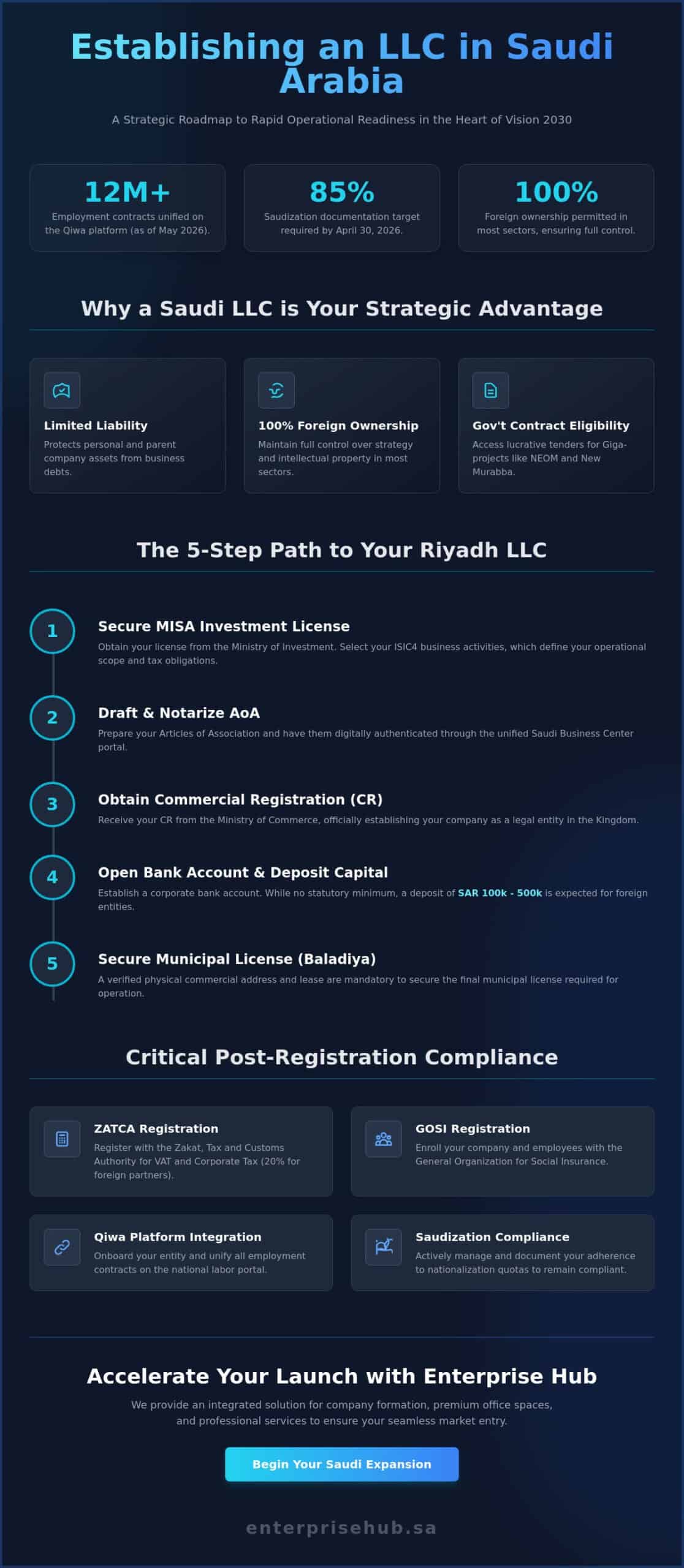
The roadmap to launching your business has been transformed by the Saudi Business Center, which now acts as a unified digital hub for investors. By following these five essential steps to establish an LLC in Riyadh, you’ll ensure your entity is built on a solid legal foundation while avoiding common bureaucratic traps. Precision in the early stages prevents the data mismatches that often stall international ventures.
Step 1: Reserve your trade name. You’ll start by submitting three name options through the Ministry of Commerce (MoC) portal. This process costs approximately SAR 100. Avoid generic terms; the system often rejects names that are too broad or lack a unique identifier. Step 2: Obtain the MISA Investment License. For non-GCC investors, this is the most critical phase. You’ll apply via the Invest Saudi platform, where you’ll pay the first-year fee of SAR 12,000. This covers both the license and mandatory investor relations services.
Step 3: Digital notarization of the Articles of Association (AoA). Once MISA approves your license, you’ll draft your AoA. In 2026, notarization is entirely digital. All shareholders must sign electronically via the Absher system. Step 4: Issuance of the Commercial Registration (CR). After the AoA is signed, the MoC issues your CR. The standard fee for an LLC is SAR 1,200. This step automatically triggers your Chamber of Commerce membership, which costs between SAR 2,000 and SAR 10,000 depending on your company grade. Step 5: Opening a corporate bank account. You’ll need your CR to approach a local bank. This is where you’ll deposit your initial capital to activate the account for operations.
Digital Integration and Timing
Speed is a hallmark of the 2026 business environment. While trade name reservation usually takes 24 hours, the MISA license phase can take 3 to 5 business days. The unified portal has slashed the time required for CR issuance; it’s often instant once the digital notarization is complete. Delays usually stem from inconsistent data between portals, so ensure your passport details match your MISA application exactly. We’ve seen that 90% of successful launches prioritize data accuracy over speed in these early stages.
Infrastructure and Address Verification
You can’t finalize your CR without a verified business address. The Ministry of Commerce links directly to your National Address records to verify your location. For many modern firms, a traditional long-term lease isn’t necessary on day one. You can maintain compliance by using flexible solutions. Learn more about virtual offices in Saudi Arabia to see how they satisfy regulatory requirements for a prestigious Riyadh address. This connection ensures your Baladiya license is issued without the friction of physical site inspections during the initial setup phase.
Navigating Post-Registration Requirements
Securing your Commercial Registration is a milestone, but the operational journey truly begins with post-registration compliance. You can’t legally trade, hire, or issue invoices without synchronizing your entity with several critical government systems. These final steps to establish an LLC in Riyadh ensure your business remains in good standing with the law while unlocking full access to the Saudi market. We help you navigate these portals to ensure your launch is as smooth as your registration.
First, you must register with the Zakat, Tax and Customs Authority (ZATCA). Foreign shareholders are subject to a 20% corporate income tax on net adjusted profits, while Saudi or GCC partners contribute a 2.5% Zakat. You’re also required to register for VAT if your annual taxable supplies exceed the SAR 375,000 threshold. Next, open a file with the General Organization for Social Insurance (GOSI). This is mandatory for managing employee social security contributions and is the prerequisite for hiring any staff under your new CR. You’ll also need to appoint a certified Saudi auditor; the law requires LLCs to submit audited financial statements annually to maintain transparency and creditworthiness.
Tax and Compliance Readiness
Enrolling in the Fatoora e-invoicing system is mandatory from day one. This digital integration helps ZATCA track transactions in real-time, significantly reducing the risk of audit discrepancies. It’s a vital part of the Kingdom’s digital transformation. See our guide to company formation in Riyadh for a deep dive into tax planning and local regulatory nuances.
Human Resources and Saudization
Labor management has shifted entirely to digital-first platforms. As of April 15, 2026, only employees with contracts electronically authenticated on the Qiwa platform count toward your Saudization (Nitaqat) rating. You must meet strict documentation targets: 85% of Saudi employee contracts were required to be documented by April 30, 2026, and this rises to 90% by June 30, 2026. Precision here is vital. A drop in your Nitaqat rating can freeze your ability to issue or renew work permits, which currently cost SAR 9,600 per employee annually. We empower you to manage these complexities through our integrated government and administrative services, ensuring your team is fully compliant and ready to work.
Managing the Muqeem portal for visa processing and the Qiwa portal for contract authentication requires constant attention. The new Nitaqat phase that began on April 26, 2026, is set to increase required Saudization rates across most sectors over the next three years. Early strategic planning for local talent acquisition isn’t just a legal necessity; it’s a competitive advantage in the 2026 business landscape.
Accelerating Your Launch with Enterprise Hub
Launching a business in the Kingdom shouldn’t be a fragmented experience. While the legal steps to establish an LLC in Riyadh are now largely digital, the physical and administrative execution remains a high-stakes challenge. We bridge this gap by integrating professional company formation services with premium, ready-to-use workspaces. By choosing a strategic partner, you transform a complex regulatory journey into a streamlined operational launch. This integrated approach ensures that while you focus on market strategy, your entity’s foundation remains unshakable.
A primary hurdle for many international investors is securing a physical address that meets the strict criteria of MISA and the Ministry of Commerce. We provide prestigious business addresses in the heart of Riyadh that are fully compliant with Baladiya (municipality) licensing requirements. This isn’t just about a desk; it’s about satisfying the 2026 digital verification protocols that link your National Address to your Commercial Registration. By utilizing our private offices or shared workspaces, you significantly reduce your initial CAPEX. You avoid the heavy upfront costs of long-term commercial leases and fit-outs, allowing you to redirect capital toward growth and talent acquisition.
Comprehensive Business Support Services
Our commitment to your success extends far beyond the issuance of your CR. We provide end-to-end support that covers every post-registration detail discussed in this guide.
- Government Relations (PRO) Services: We handle all ministry interactions, ensuring your Muqeem and Qiwa portals are set up correctly from day one.
- Accounting and Tax Advisory: Our experts manage your ZATCA filings and VAT registration, keeping you compliant with the 20% corporate tax regulations.
- Professional Facilities: Access high-end meeting rooms and boardrooms equipped with the latest technology for your first strategic meetings in the Kingdom.
These solutions ensure that your business isn’t just registered, but is truly operational and ready to compete for government contracts.
Start Your Saudi Journey Today
Success in the Saudi market favors the prepared and the well-partnered. International firms that have launched via Enterprise Hub consistently report faster operational readiness and fewer compliance hurdles. We act as your on-the-ground expert, navigating the shifts in Saudization rates and digital portal updates so you don’t have to. Our proven track record with global entities demonstrates that the right environment is a catalyst for rapid growth. Don’t let regulatory complexity stall your vision. Contact Enterprise Hub to start your LLC formation today and take your first step toward a prosperous future in the Kingdom.
Empowering Your Vision in the Kingdom
The Saudi market moves at an unprecedented pace. By 2026, the Kingdom has simplified the steps to establish an LLC in Riyadh, yet the precision required for digital compliance remains higher than ever. You’ve seen how a well-structured entity protects your global assets while opening doors to massive procurement cycles. Success in this environment requires a perfect blend of legal accuracy and operational agility. You don’t have to navigate this transition alone.
We are here to ensure your market entry is seamless. With our strategic presence in the King Abdullah Financial District (KAFD), we provide much more than a prestigious desk. We offer full-spectrum government relations support to keep your Muqeem and Qiwa portals compliant. Our compliant virtual and private office solutions satisfy every regulatory standard from day one. Launch your Saudi LLC with Enterprise Hub’s integrated solutions and secure your place in the region’s most dynamic economy. Your journey toward long term growth starts with a partner who understands the high stakes of the Saudi business landscape.
Frequently Asked Questions
How long does it take to establish an LLC in Saudi Arabia in 2026?
The full setup process typically takes 10 to 15 business days to complete. Obtaining the MISA investment license usually requires 3 to 5 business days; while the issuance of the Commercial Registration is often instant once the digital notarization of the Articles of Association is finalized through the Saudi Business Center.
What is the minimum capital required for a Saudi LLC?
There’s no universal statutory minimum capital for most service-based companies under the current Companies Law. However; banks and authorities often expect a deposit of at least SAR 25,000 for local entities or between SAR 100,000 and SAR 500,000 for foreign-owned firms to demonstrate financial stability during the initial steps to establish an LLC in Riyadh.
Can a foreigner own 100% of an LLC in Saudi Arabia?
Yes; international investors can maintain 100% ownership of their LLC in the vast majority of sectors. This policy eliminates the historical requirement for a local partner; allowing you to retain full control over your operations and simplified profit repatriation processes.
Is a physical office mandatory for LLC registration in Riyadh?
Yes; a verified business address is required to secure your Commercial Registration and Municipality (Baladiya) license. You must link a National Address to your Ministry of Commerce records; though compliant virtual office solutions or shared workspaces are fully accepted for this regulatory requirement.
What are the annual compliance requirements for a Saudi LLC?
Your company must submit audited financial statements through a certified Saudi auditor every year. Additional requirements include filing Zakat or corporate tax returns with ZATCA; maintaining a 90% contract documentation rate on the Qiwa platform by June 30, 2026; and renewing your MISA and CR licenses annually.
How much are the government fees for LLC formation?
Initial government costs include SAR 12,000 for the first-year MISA license and SAR 1,200 for the Commercial Registration. You’ll also need to account for Chamber of Commerce membership; which ranges from SAR 2,000 to SAR 10,000 annually; and work permits for foreign staff which cost SAR 9,600 per employee.
Do I need a Saudi partner to start an LLC?
You don’t need a Saudi partner for most business activities in the Kingdom. The current investment climate favors 100% foreign direct investment; allowing you to complete the steps to establish an LLC in Riyadh as a sole international owner without local equity participation.
What is the difference between a MISA license and a Commercial Registration?
The MISA license is the specific authorization granted by the Ministry of Investment allowing a foreign entity to invest in the Kingdom. The Commercial Registration (CR); issued by the Ministry of Commerce; is the official document that legally incorporates your business and provides your unique unified national number.