
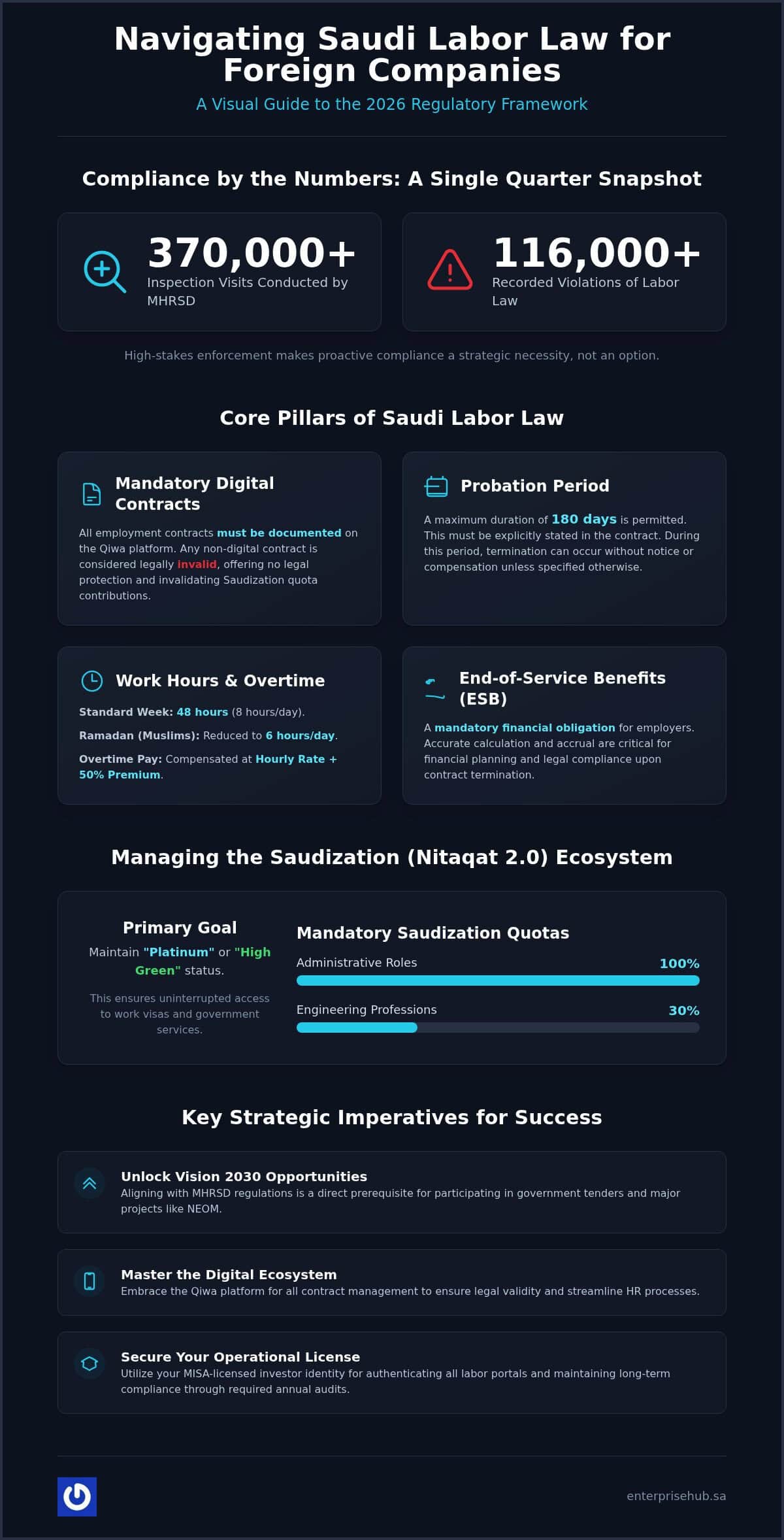
Did you know that the Ministry of Human Resources conducted over 370,000 inspection visits in a single quarter, resulting in more than 116,000 recorded violations? For international entities, staying ahead of Saudi labor law for foreign companies is no longer just about compliance; it’s a strategic necessity for operating in the Kingdom’s fast-evolving economy. We understand that the complexity of Nitaqat 2.0 ratios and the mandatory shift to digital platforms like Qiwa can feel overwhelming. It’s a high-stakes environment where missing a deadline for contract documentation or miscalculating a Saudization quota can lead to substantial penalties.
This guide provides the clarity you need to master the 2026 regulatory framework and ensure seamless workforce management. You’ll learn how to navigate the 100% Saudization requirements for administrative roles and the updated 30% threshold for engineering professions. We’ll also break down the integration between GOSI and Qiwa, helping you manage both expat and local regulations with total confidence. By the end, you’ll have a clear roadmap to align your labor practices with Vision 2030 and secure your company’s future in the Saudi market.
Key Takeaways
- Understand how aligning with MHRSD regulations serves as a prerequisite for participating in government tenders and major Vision 2030 projects.
- Master the mandatory digital documentation requirements on the Qiwa platform to ensure your contracts under Saudi labor law for foreign companies remain legally valid.
- Learn how to navigate the Nitaqat 2.0 ecosystem to maintain a “Platinum” or “High Green” status, ensuring uninterrupted access to work visas.
- Gain clarity on managing international entities’ specific contract regulations, including the 180-day maximum probation period and termination notice requirements.
- Discover the essential role of the MISA-licensed investor identity in authenticating labor portals and maintaining long-term compliance through annual audits.
The Strategic Role of Labor Compliance in Vision 2030
Labor regulations in the Kingdom have evolved from a simple set of administrative rules into a sophisticated strategic framework designed to fuel national economic growth. The Ministry of Human Resources and Social Development (MHRSD) has meticulously aligned every facet of the labor market with the objectives of Vision 2030. For international entities, understanding Saudi labor law for foreign companies is no longer just an HR task; it’s a fundamental requirement for commercial survival. Compliance acts as a gateway to the Kingdom’s most lucrative opportunities, including multi-billion riyal government tenders and high-profile Vision 2030 giga-projects like NEOM and the Red Sea Project.
A pivotal shift in this landscape is the transition from the traditional sponsorship system to the Labor Relation Initiative (LRI). This modernization has redefined expat mobility, allowing for a more flexible and competitive job market that attracts global talent while protecting employer rights. Maintaining a clean labor record is now a prerequisite for commercial legitimacy. Companies that fail to adapt find themselves locked out of the digital infrastructure required to operate, as the government uses real-time data to monitor every entity’s adherence to the law.
Labor Law as a Commercial Validator
In the 2026 business environment, your compliance score is your corporate reputation. A firm’s adherence to Saudi Arabia’s legal system serves as a primary indicator of its operational maturity and reliability. High compliance scores directly influence your ability to issue new work visas, renew commercial licenses, and secure partnerships with local firms. Beyond the paperwork, labor stability is a core pillar for any successful investment in Saudi Arabia. Investors and partners look for entities that demonstrate a deep commitment to local regulations, as this minimizes operational risks and signals long-term viability in the market.
Modernizing the Workforce Landscape
Digital transformation has revolutionized how Saudi labor law for foreign companies is enforced. By 2026, the unified Qiwa portal has become the heartbeat of labor management, standardizing contracts and reducing disputes through transparent, electronic documentation. This shift ensures that every worker and employer operates under a verified, legally binding agreement. Additionally, the Wage Protection System (WPS) provides an extra layer of financial transparency. By tracking salary payments in real-time, the WPS ensures that businesses meet their financial obligations, which in turn fosters a culture of trust and professional accountability across the private sector.
- Strategic Access: Compliance is mandatory for bidding on government-funded projects.
- Talent Mobility: The LRI enhances the Kingdom’s appeal to high-skilled international professionals.
- Risk Mitigation: Real-time monitoring through digital portals prevents costly legal bottlenecks.
Core Pillars of Saudi Labor Law for Foreign Entities
Building a successful enterprise in the Kingdom requires a deep dive into the operational mechanics of the local workforce. In 2026, the regulatory environment is uncompromisingly digital. Mastering Saudi labor law for foreign companies means moving away from legacy paper systems and embracing real-time compliance. Every employment relationship must be documented through the Qiwa platform. If a contract isn’t registered electronically, it’s considered legally invalid, which strips the employer of legal protection and prevents the employee from being counted toward your Saudization targets.
The probation period is a vital tool for risk management. Current regulations allow for a maximum probation duration of 180 days. It’s essential that this is explicitly written into the contract. During this window, either party can terminate the relationship without notice or compensation unless the contract states otherwise. Regarding daily operations, the standard workweek is 48 hours, with an eight-hour daily limit. During the holy month of Ramadan, these hours are reduced to six per day for Muslim workers. Any work beyond these limits is classified as overtime, requiring compensation at the hourly rate plus a 50% premium on the basic wage.
End-of-Service Benefits (ESB) are a mandatory financial obligation that requires careful accounting. For the first five years of employment, the benefit is calculated as half a month’s wage for each year. For any service beyond five years, the entitlement increases to a full month’s wage for every year. Properly managing these liabilities is crucial for your firm’s financial health and ZATCA readiness.
Contractual Frameworks: Fixed vs. Indefinite
International firms typically utilize fixed-term contracts for their expatriate workforce. These contracts have a clear end date, providing administrative clarity. However, the rules for Saudi nationals are different. A fixed-term contract for a Saudi employee automatically converts into an indefinite contract after three consecutive renewals or once the total period of service reaches four years. This shift changes the termination dynamics, requiring a 60-day notice period from the employer and a 30-day notice period from the employee for contracts with monthly wages.
Digital Onboarding via the Qiwa Platform
The Qiwa platform serves as the primary interface for all labor-related transactions. Your first step is registering your foreign entity and authenticating your ‘Establishment Number’ by linking it to your commercial registration and MISA license. This link is what allows you to initiate ‘Employee Transfers’ for local hires or issue new work visas. Because setting up these digital portals involves high-stakes government relations, many successful investors utilize professional business setup services to ensure their digital infrastructure is compliant and fully operational from the start.
Managing the Saudization (Nitaqat) Ecosystem
The Nitaqat program is the cornerstone of the Saudi labor market, functioning as a color-coded incentive system that rewards firms for hiring Saudi nationals. In 2026, the updated Nitaqat Al-Mutawwir program has moved away from generic targets to more precise, industry-specific quotas. For your international entity, understanding Saudi labor law for foreign companies means recognizing that your Nitaqat tier is your “license to grow.” Entities are categorized into Platinum, Green (High, Medium, Low), Yellow, and Red tiers based on their Saudization performance relative to their industry peers and total headcount.
Maintaining a Platinum or High Green status is the ultimate strategic goal. These tiers grant your business priority access to work visas, the ability to recruit talent from other firms without employer consent, and a smoother path for government contract approvals. By contrast, falling into the lower tiers creates immediate operational bottlenecks. Calculating your ratio requires precision; for instance, as of 2026, engineering firms must maintain a 30% Saudization rate with a minimum monthly wage of 8,000 ﷼ for those roles to count toward the quota. Similarly, marketing roles now carry a 60% requirement for companies with three or more employees in that department, with a minimum wage floor of 5,500 ﷼.
The government supports this transition through significant incentives. The Human Resources Development Fund (HRDF) provides various training subsidies and salary support programs that can cover a portion of a Saudi employee’s wage for the first two years. Leveraging these programs turns a compliance requirement into a cost-effective talent development strategy.
The Cost of Non-Compliance
Failure to meet your Saudization targets triggers immediate restrictions. Companies in the ‘Yellow’ or ‘Red’ categories are often blocked from issuing new work visas or renewing existing ones through the Qiwa portal. Financial penalties have also become more targeted under the February 2026 update to the Table of Labor Law Violations. If your status drops, rehabilitation is your only path forward. This involves a strategic hiring plan or “corrective recruitment” to boost your numbers back into the Green zone, which restores your access to essential digital government services.
Expatriate Management and Visa Quotas
Your ability to bring in global talent is directly linked to your Nitaqat performance. Every expat visa allocation is a reflection of your commitment to local hiring. In 2026, the ‘Professional Verification’ process is mandatory for skilled foreign workers. This ensures that any expat you hire possesses the verified credentials required for their specific role. Additionally, firms must account for the annual ‘Expat Levy’ (Mali), which is a monthly fee paid for each foreign employee. Managing these costs effectively requires a balanced workforce strategy that integrates both local expertise and international specialists while keeping overheads predictable.
- Platinum Status: Offers maximum flexibility for visa issuance and employee transfers.
- Wage Thresholds: Saudi employees must meet specific wage minimums (e.g., 8,000 ﷼ for engineers) to count toward your ratio.
- Digital Integration: All Saudization data is pulled automatically from GOSI and Qiwa, leaving no room for manual reporting errors.
Special Considerations for MISA-Licensed Companies
Entering the Saudi market via a Ministry of Investment (MISA) license provides a robust legal foundation, but it’s only the first step. Activating your labor files requires a seamless transition from your investment permit to the operational platforms managed by the MHRSD. For global firms, Saudi labor law for foreign companies introduces specific requirements that don’t apply to local startups. One critical element is the ‘Investor Identity,’ which serves as the digital keys to your labor portals. Without authenticating this identity through the proper government channels, you can’t issue contracts or enroll employees in social insurance.
Your physical presence is equally vital. To activate a labor file and obtain an establishment number, you must provide proof of a registered address. Many modern entities opt for a virtual office in Saudi Arabia to maintain agility while meeting these regulatory demands. This address is linked to your commercial registration (CR) and is verified during labor inspections. Additionally, international parent companies must navigate ‘Know Your Customer’ (KYC) protocols. These ensure that the ultimate beneficial owners are transparently documented, a process that often requires high-level coordination between your global HQ and local Saudi authorities.
Bridging MISA and MHRSD Requirements
Your MISA license activities must perfectly match your MHRSD classifications. If they don’t, you’ll face delays in visa approvals and portal access. Managing documentation from foreign jurisdictions is another hurdle. Every document, from articles of association to professional certificates, must undergo attestation and professional translation to be accepted. Many investors find that working with experts in founding companies in Saudi Arabia is the most efficient way to ensure every labor audit is passed without issue.
Expat Leadership and Local Talent Balance
Balancing international leadership with local talent is a strategic art. Foreign CEOs and board members must be correctly registered in the company’s labor file to secure their residency (Iqama) status. While you bring in global expertise, hiring a Saudi ‘Mudir’ (Manager) is often a smart move to satisfy localization targets and navigate local administrative nuances. Remember that executive payroll for both expats and locals must comply with GOSI and SAMA regulations. If you’re ready to streamline these complex processes, you can partner with Enterprise Hub for comprehensive government services and compliance support.
- Activity Alignment: Ensure MISA license codes match Qiwa classifications to avoid visa blocks.
- Document Attestation: All foreign certificates must be stamped by the Saudi Embassy in the country of origin.
- Payroll Compliance: Use the Wage Protection System (WPS) for all executive salary transfers, regardless of nationality.
Maintaining Long-Term Compliance and Market Growth
Compliance isn’t a destination. It’s a continuous journey. For international entities, the initial setup is just the beginning of a long-term commitment to the Kingdom’s regulatory standards. Annual labor audits and internal policy reviews are essential tools for staying ahead of the frequent updates to Saudi labor law for foreign companies. In 2026, the Ministry of Human Resources has intensified its focus on data accuracy across all digital platforms. Proactive reviews help you identify potential gaps in contract documentation or Saudization ratios before they result in warnings or penalties. In January 2026, the MHRSD introduced a settlement mechanism for first-time violations, allowing firms to reduce fines by up to 80% under specific conditions. Accessing these reliefs requires a clean historical record and immediate corrective action.
Integrating labor compliance with your tax and ZATCA readiness is another strategic priority. Your payroll data on the Wage Protection System (WPS) must align perfectly with your tax filings and social insurance records. Discrepancies between these systems often trigger automated flags, leading to synchronized audits from both labor and tax authorities. Leveraging professional government relations (PRO) services ensures that your renewals, visa allocations, and portal management are handled with precision. This integrated approach minimizes administrative friction and allows your leadership team to focus on scaling operations within the Saudi market.
The Role of Digital Portals: GOSI and Mudad
Success in the Saudi market requires mastery of the digital ecosystem. The GOSI portal is the primary tool for managing social insurance contributions for your Saudi workforce. Accuracy here is vital, as GOSI data feeds directly into your Nitaqat calculation. Simultaneously, the Mudad platform serves as the technical backbone for the Wage Protection System. It tracks every salary transfer to ensure compliance with the basic wage and allowance structures agreed upon in the Qiwa contracts. Automating notifications within these portals helps you avoid administrative lapses that could lead to the suspension of your commercial services.
Enterprise Hub: Your Strategic Partner
Sustaining market growth requires a partner that understands the local landscape’s nuances. Enterprise Hub provides comprehensive support for founding companies in Saudi Arabia, bridging the gap between initial licensing and long-term operational excellence. Our expert teams manage the complexities of MHRSD and Qiwa, ensuring your business remains in the ‘Platinum’ or ‘High Green’ tiers. By providing private offices, virtual addresses, and integrated accounting and tax support, we deliver the administrative foundation necessary for your entity to thrive. We don’t just help you enter the market; we ensure you have the infrastructure to lead it.
- Annual Audits: Conduct regular reviews of Qiwa contracts and GOSI records.
- Financial Alignment: Ensure WPS data matches ZATCA tax reporting.
- Strategic Outsourcing: Utilize expert PRO services for seamless visa and license renewals.
Mastering Your Strategic Future in the Kingdom
Adopting a proactive approach to Saudi labor law for foreign companies is the most effective way to safeguard your investment and unlock long-term growth. We’ve explored how mastering the digital-first ecosystem of Qiwa and Mudad ensures operational continuity, while staying ahead of Nitaqat 2.0 ratios positions your firm as a preferred partner for major national projects. By integrating these regulatory requirements into your broader market entry strategy, you transform compliance from a hurdle into a competitive advantage that validates your commercial legitimacy.
Success in this high-growth market requires more than just legal awareness; it demands a strategic foundation built on local expertise and real-time administrative precision. You don’t have to manage these complex government relations alone. You can streamline your Saudi market entry with Enterprise Hub to benefit from our expert MISA and MHRSD compliance support. We provide a strategic setup in the heart of the Saudi economy, offering tailored government relations for international firms that value precision and speed. Let’s work together to turn your vision for the Kingdom into a thriving and compliant reality.
Frequently Asked Questions
Can a foreign company hire only expatriates in Saudi Arabia?
No, foreign companies cannot hire only expatriates. Under the Nitaqat program, even small firms with five or fewer employees must have at least one Saudi national on the payroll. Larger entities with over 100 employees face a 30% Saudization requirement. Compliance with these ratios is a core component of Saudi labor law for foreign companies, as failing to meet these targets prevents the issuance of new work visas.
What is the Nitaqat system and how does it affect foreign firms?
The Nitaqat system is a localization framework that categorizes companies into Platinum, Green, Yellow, and Red tiers based on their percentage of Saudi employees. Foreign firms in the Platinum or High Green tiers enjoy priority access to work visas and streamlined services on the Qiwa portal. Conversely, those in the Yellow or Red categories face severe restrictions, including the inability to renew work permits or hire new staff.
Is it mandatory to have a physical office to register employees?
Yes, having a registered physical or virtual address is mandatory for activating your labor file and establishment number. This address is verified by the MHRSD and is used for labor inspections. Without a verified commercial address linked to your commercial registration, you cannot register employees or enroll them in GOSI, making a professional business setup essential for maintaining your operational legitimacy in the Kingdom.
How is the End-of-Service Benefit (ESB) calculated for foreign workers?
End-of-Service Benefits are calculated based on the employee’s final basic wage and total length of service. For the first five years, the worker is entitled to half a month’s wage for each year. For any service beyond five years, the entitlement increases to one full month’s wage for every year. These liabilities must be calculated accurately to ensure financial transparency and compliance with the Wage Protection System.
What is the role of the Qiwa portal in the hiring process?
The Qiwa portal is the mandatory digital platform for documenting all employment contracts and managing labor services. In 2026, any contract not registered electronically through Qiwa is considered legally invalid. The platform automates social insurance enrollment and tracks your Saudization status in real-time, making it the primary interface for managing Saudi labor law for foreign companies and ensuring all hiring is compliant.
Can an expat change employers without the current employer’s consent?
Yes, expatriates can change employers without the current employer’s consent under specific conditions of the Labor Relation Initiative (LRI). This typically applies when the employee has completed their fixed-term contract or if the employer has failed to document the contract on Qiwa or pay wages for three consecutive months. This mobility is designed to create a more competitive and flexible labor market while protecting worker rights.
What are the penalties for failing the Wage Protection System (WPS)?
Failing to comply with the Wage Protection System (WPS) results in immediate administrative penalties and fines for each worker. If an entity fails to upload its payroll files for two consecutive months, the MHRSD may suspend all digital government services, including the ability to issue or renew visas. Maintaining 100% compliance through the Mudad platform is critical for avoiding these operational bottlenecks and ensuring corporate legitimacy.
Do foreign companies need a local partner for labor law compliance?
No, foreign companies don’t need a local partner for labor law compliance if they hold a 100% foreign-owned MISA license. However, navigating the complexities of the Saudi bureaucracy and digital portals often requires expert government relations (PRO) support. While the entity remains fully foreign-owned, successful firms often partner with local experts to manage the technicalities of labor portal authentication and annual compliance audits.