
What if your multi-million dollar entry into the Middle East’s largest economy took less time than a standard bank transfer? You’ve likely heard that the Saudi market is the ultimate destination for growth under Vision 2030, yet the complexity of the Saudi Arabia company formation requirements 2026 can feel daunting. It’s natural to feel overwhelmed by the transition from manual filings to a digital-first ecosystem where MISA license processing times have dropped to as little as 3 business days. You’re not alone if the shifting Saudization quotas, such as the 60% requirement for marketing roles effective April 19, 2026, make you feel cautious about your next move.
We’re here to bridge that gap and turn your regulatory anxiety into a strategic advantage. We’ll help you master the 2026 business landscape with a comprehensive, step-by-step checklist that covers every legal, digital, and physical requirement for your new entity. You’ll get a clear preview of the 12,000 SAR initial MISA fees, the 90% Qiwa documentation mandate due by June 30, 2026, and the specific ZATCA tax obligations that define the current market. Let’s transform your vision into a compliant, thriving reality in the Kingdom through a process that values your time and professional ambition.
Key Takeaways
- Identify the correct ISIC4 business activity codes to unlock sector-specific incentives and ensure full Vision 2030 alignment.
- Navigate the updated Saudi Arabia company formation requirements 2026 to secure your MISA license through a streamlined digital workflow.
- Establish a compliant physical or digital presence by understanding the necessity of a National Address and the role of virtual office solutions.
- Master post-incorporation compliance, from maintaining ‘Green’ Nitaqat status to meeting ZATCA’s quarterly filing deadlines.
Phase 1: Strategic Readiness and Vision 2030 Alignment
Success in the Kingdom starts long before you submit a single digital form. It begins with aligning your corporate DNA with the national agenda. Understanding the Saudi Arabia company formation requirements 2026 means recognizing that the government isn’t just looking for capital; they’re seeking strategic partners who contribute to specific economic pillars. You’ll need to select your International Standard Industrial Classification (ISIC4) code with precision. This choice dictates your licensing path and determines if your business qualifies for 100% foreign ownership. While most service and industrial sectors now permit full foreign control, certain strategic areas still require local partnerships to protect national interests.
To facilitate this transition, Saudi Arabia’s Ministry of Investment (MISA) has evolved into a powerhouse of digital efficiency. They’ve replaced the old SAGIA model with a streamlined approach that prioritizes high-value sectors. By early 2026, the integration between MISA and other government portals became so seamless that your ISIC4 selection automatically triggers relevant incentive offers. It also identifies mandatory local content requirements through the Saudi Development and Reconstruction Program (SDRP) guidelines if you’re aiming for infrastructure-related activities.
The 2026 Sector Priority Checklist
Your first step is verifying if your business activity supports the Saudi Green Initiative or the national Digital Transformation goals. If you’re in Green Tech or the Circular Economy, you might qualify for reduced tax rates as low as 5% in designated economic zones. It’s essential to assess the strategic value of investing in Saudi Arabia for your specific niche. For instance, companies focusing on renewable energy components currently benefit from expedited customs clearances and specialized grants. We help you evaluate these sector-specific incentives to ensure your business plan hits the ground running.
Regional Headquarters (RHQ) vs. Standard Branch
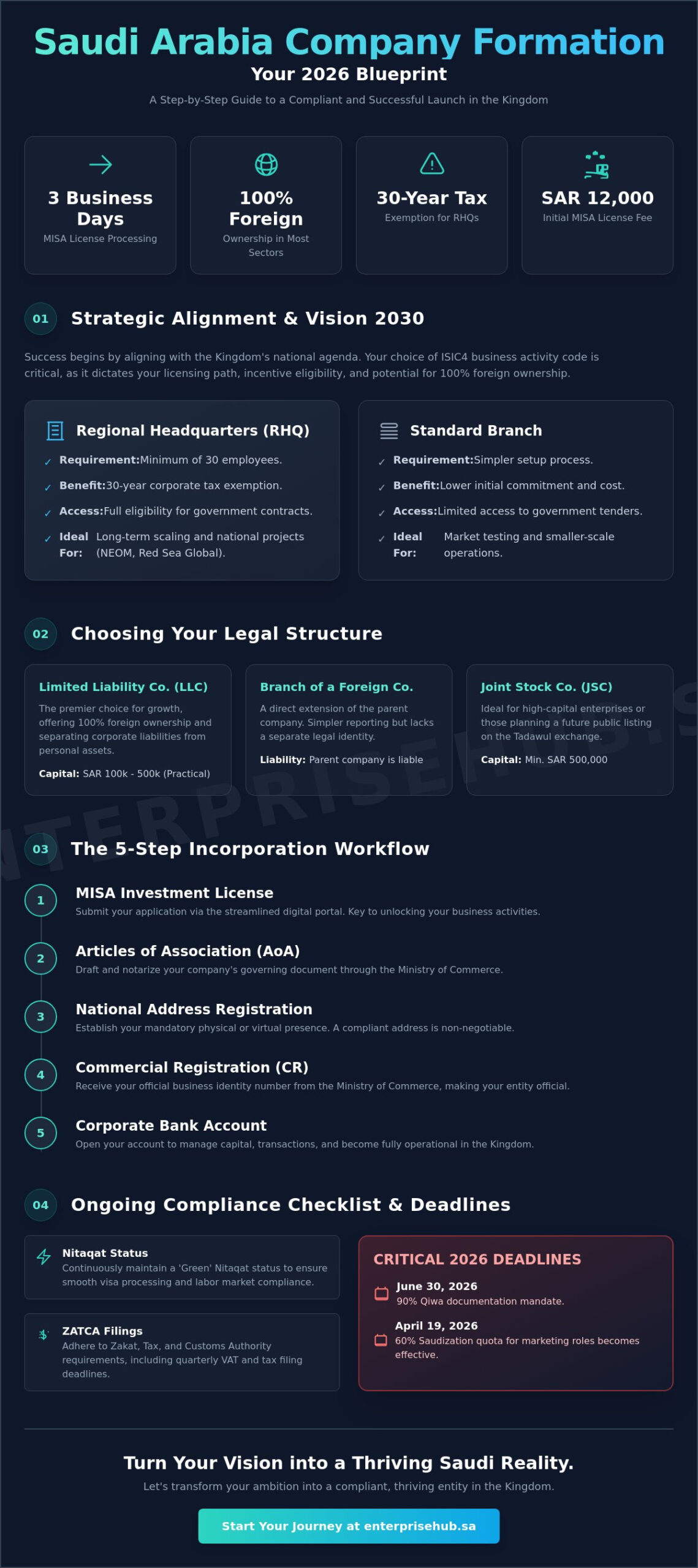
The 2026 landscape has a hard line regarding government contracts. If you intend to bid on tenders with government agencies, the Regional Headquarters mandate is a critical component of the Saudi Arabia company formation requirements 2026. To qualify for RHQ status this year, you must maintain a minimum of 30 employees within your Saudi office, including executive-level leadership. The rewards for this commitment are substantial. RHQ entities enjoy a 30-year corporate tax exemption and specialized visa quotas. Contrast this with a standard branch, which is simpler to set up but lacks the same level of access to massive national projects like NEOM or the Red Sea Global initiatives. Choosing between these paths defines your long-term scaling potential in the region.
Phase 2: Legal Entity Selection and MISA Licensing
Selecting your legal structure is a defining moment for your Kingdom-wide operations. It’s not just about paperwork; it’s about how you’ll scale, pay taxes, and protect your assets. The Saudi Arabia company formation requirements 2026 emphasize the Limited Liability Company (LLC) as the premier choice for sustainable growth. This structure supports 100% foreign ownership in most sectors and provides a clear separation between personal assets and corporate liabilities. For established global players, a Branch of a Foreign Company offers a direct extension of the parent entity. This simplifies some administrative reporting but lacks the separate legal personality of an LLC.
High-capital enterprises often look toward Joint Stock Companies (JSC). These require a statutory minimum capital of 500,000 SAR and are ideal for those planning a future public listing on the Tadawul. Regardless of the structure, your entry point is the Ministry of Investment. We help you navigate these choices to ensure your corporate architecture aligns with your long-term vision. If you’re feeling stuck between these options, our advisors at Enterprise Hub can help you weigh the operational flexibility of each model against your specific industry needs.
Comparing LLC and Branch Structures
Liability and capital are the two biggest differentiators. While LLCs generally require a practical minimum capital of 100,000 SAR to 500,000 SAR to satisfy bank and MISA expectations, they offer total flexibility in profit repatriation. A branch, however, is often perceived as a lower-risk entry for testing the market. The timeline for company formation in Saudi Arabia has drastically improved. MISA license processing now takes as little as 3 to 5 business days for many sectors. This speed allows you to move from strategic planning to physical operations without the months of waiting that characterized the previous decade.
Securing the MISA Investment License
Your MISA license is your “golden ticket” to the Saudi market. The application process is now entirely digital through the Official Invest Saudi portal. You’ll need to prepare specific documents, including audited financial statements from your home country and a board resolution authorizing the Saudi expansion. Financial planning is key here. The initial first-year fee for a MISA license is 12,000 SAR, which includes a 2,000 SAR issuance fee and a 10,000 SAR service fee. Subsequent annual renewals are 62,000 SAR for most foreign-owned entities. We ensure your documentation is flawless to prevent delays in this critical approval phase.
Phase 3: The Mandatory Physical and Digital Infrastructure
Once you’ve secured your MISA license, the focus shifts to building your operational foundation. The Saudi Arabia company formation requirements 2026 dictate that your physical presence isn’t just about desk space; it’s a regulatory anchor. You’ll find that the Kingdom’s rapid development, supported by the World Bank’s partnership with Saudi Arabia, has created a highly sophisticated digital environment. This environment requires your business to be both physically verifiable and digitally integrated from day one. We ensure that your setup satisfies these dual requirements so you can focus on growth rather than paperwork.
Securing a Compliant Business Address
A ‘National Address’ is now a non-negotiable component of your corporate identity. It’s the primary link between your legal entity and the Saudi Post (SPL). Without a verified lease agreement registered on the Ejar portal, your final Commercial Registration (CR) will remain pending. This physical root is what gives you the authority to open bank accounts and issue visas. For many modern businesses, virtual offices in Saudi Arabia offer a strategic, lean entry point that meets MISA compliance while keeping overhead low. We help you select the right space, whether it’s a private suite or a flexible workspace, ensuring your address projects the prestige your brand deserves.
The Digital Portal Setup Checklist
Your digital infrastructure is the spine of your HR and tax compliance. As of April 15, 2026, the Qiwa platform is the only way to document labor contracts and count toward your Saudization rates. You’re required to have 85% of your Saudi employee contracts documented on Qiwa by April 30, 2026, rising to 90% by June 30. Missing these deadlines can freeze your ability to issue new work permits or renew existing ones. It’s a high-stakes environment where compliance isn’t optional.
Beyond HR, you must activate your GOSI account for social insurance and integrate with the ZATCA portal for VAT and e-invoicing. With the standard VAT rate at 15%, maintaining ‘Phase 2’ e-invoicing compliance is essential for avoiding significant penalties. We enable you to navigate these portals efficiently, ensuring that every digital checkbox is marked before you make your first hire or issue your first invoice. This integrated approach saves you time and protects your reputation as a reliable investor in the Kingdom.
Phase 4: Step-by-Step Incorporation Workflow
Securing your MISA license was the permission slip; now you’re entering the actual construction phase of your legal entity. It’s vital to distinguish between the investment license and the Commercial Registration (CR). While the license defines what you can do as a foreign investor, the CR is the legal birth certificate of your company in the eyes of the Ministry of Commerce. The Saudi Arabia company formation requirements 2026 have moved toward a unified digital flow, but the sequence of your actions remains critical for a smooth launch. We guide you through this technical transition to ensure your business is fully operational without administrative friction.
Your first move is trade name reservation. This isn’t just about branding; it’s a legal check to ensure your name doesn’t conflict with existing entities or violate local naming conventions. Once reserved, you’ll draft your Articles of Association (AoA). In 2026, this process is largely automated for standard LLCs, but foreign investors often require custom clauses to handle complex shareholder agreements. After notarizing the AoA, the system generates your CR number. You’ll then pay the registration fees, which typically range from 200 SAR to 1,200 SAR depending on your specific entity type. Finally, you must activate your Chamber of Commerce membership, with annual fees ranging from 2,000 SAR to 10,000 SAR based on your company’s capital.
From AoA to Commercial Registration
The ‘Meraas’ platform has become the central nervous system for this phase. It integrates the Ministry of Commerce, ZATCA, and the Ministry of Labor into a single workflow. In 2026, many service-sector businesses qualify for “Instant CR” issuance, meaning your registration can be active within minutes of notarizing your AoA. However, a common pitfall for international brands is failing to align the AoA with the specific activities listed on their MISA license. Any discrepancy here can halt the process. We help you synchronize these documents to ensure your digital path remains clear.
Corporate Banking and Capital Requirements
Opening a corporate bank account is often the most time-consuming part of the Saudi Arabia company formation requirements 2026. While service-sector LLCs don’t have a statutory minimum capital, banks and MISA generally expect to see 100,000 SAR to 500,000 SAR to prove financial viability. If you’re entering the wholesale or retail trade with 100% foreign ownership, you must deposit a minimum of 30 million SAR. Banks now enforce rigorous Know Your Customer (KYC) procedures for foreign shareholders, which can take 2 to 4 weeks. If you want to accelerate this timeline and move toward full operational status, our experts at Enterprise Hub can streamline your documentation for faster bank approvals.
Phase 5: Post-Incorporation Compliance and Scaling
Your journey doesn’t end with a stamped Commercial Registration. Maintaining your operational standing requires constant vigilance over the evolving Saudi Arabia company formation requirements 2026. This phase is where many international firms struggle, particularly with the Nitaqat program’s shifting targets. For example, if you employ three or more people in marketing or sales roles, you must reach a 60% Saudization rate by April 19, 2026, to keep your “Green” status. Failure to comply doesn’t just mean a fine; it stops you from renewing visas or accessing government portals. We help you stay ahead of these quotas by integrating your HR strategy with the latest Qiwa documentation mandates.
The 2026 landscape also offers unique personal incentives for high-value investors. The Premium Residency options have become a powerful tool for those seeking long-term stability without the need for a local sponsor. These residency tracks are often linked to your investment’s scale and its alignment with Vision 2030 goals. By securing this status, you gain the freedom to own property and move across borders with ease, further cementing your commitment to the Kingdom’s growth. We provide the strategic guidance needed to evaluate if your investment qualifies for these elite programs.
Labor and Tax Compliance Checklist
Compliance is a quarterly cycle, not an annual event. You’re required to file your tax returns with ZATCA within 120 days of your fiscal year-end. Foreign-owned entities face a 20% corporate income tax on net adjusted profits, while VAT remains at 15%. Additionally, the Wages Protection System (WPS) ensures every salary is paid through a Saudi bank, providing the transparency the government demands. You’ll also need to submit an annual audited financial report to MISA to maintain your investment license. We simplify this by providing integrated accounting and tax services that keep your records audit-ready at all times.
The Role of a Strategic Partner
Scaling in Riyadh or Jeddah requires more than just a legal presence; it requires a physical home that grows with you. We’ve designed our ecosystem to handle everything from your initial office rental process to complex government relations. By leveraging our private offices and meeting rooms, you fulfill the mandatory Saudi Arabia company formation requirements 2026 while gaining access to our specialized tax and legal advisors. This integrated approach means you aren’t just renting a desk; you’re joining a community of visionaries. We’re ready to help you navigate every regulatory turn and celebrate every milestone. Join the ecosystem of successful businesses in the Kingdom today and turn your expansion into a lasting legacy.
Accelerate Your Entry into the Middle East’s Largest Market
The Kingdom’s business landscape has shifted into a high-speed, digital-first environment where precision is the currency of success. You’ve seen how mastering the Saudi Arabia company formation requirements 2026 requires a perfect blend of strategic Vision 2030 alignment and rigorous digital compliance. With MISA processing times now as short as 3 business days, the speed of your launch depends entirely on your readiness. Whether you’re opting for an LLC or establishing a Regional Headquarters to capture government tenders, the technical details of your setup will define your scaling potential.
We’re here to ensure those details are handled with expert care. Empower your business journey with Enterprise Hub’s integrated setup solutions and gain more than just a workspace. We provide the strategic partnership you need for a seamless market entry, offering fully equipped private offices, virtual office solutions, and expert government support. Don’t let administrative friction slow your ambition. We’ll help you secure your infrastructure and maintain your “Green” Nitaqat status from day one. The future of Saudi business is already here, and we’re ready to help you lead it.
Frequently Asked Questions
Can a foreigner own 100% of a company in Saudi Arabia in 2026?
Yes, foreign investors can own 100% of their entities in most service and industrial sectors. While some strategic areas like retail trade require a 30 million SAR capital for full ownership, the general trend has removed the need for a local partner. This shift is a core part of the Saudi Arabia company formation requirements 2026, allowing you to maintain full control over your strategic direction and profits.
What is the minimum capital required to start an LLC in Saudi Arabia?
There is no statutory minimum capital for general service-sector LLCs. However, MISA and local banks typically require a practical minimum of 100,000 SAR to 500,000 SAR to prove financial viability. For specialized licenses, the numbers change significantly. For instance, a 100% foreign-owned retail license requires 30 million SAR, while industrial licenses often start at 1 million SAR. We help you determine the exact figure based on your ISIC4 activity.
How long does the entire company formation process take in 2026?
The entire process generally takes between 3 to 6 weeks to reach full operational status. While the MISA investment license can be issued in as little as 3 to 5 business days, other steps take longer. Opening a corporate bank account and completing the KYC process usually requires 2 to 4 weeks. Digital registrations on portals like Qiwa and ZATCA are typically completed within 48 hours once your Commercial Registration is active.
Is a physical office mandatory for obtaining a MISA license?
Yes, a physical address is mandatory to complete your Commercial Registration and obtain a National Address. While you can start the MISA application without a lease, you can’t finalize your legal setup or open a bank account without a verified location. Virtual office solutions are often sufficient for MISA compliance in the service sector. These provide a cost-effective way to meet regulatory standards while keeping your initial overhead low.
What are the requirements for the Regional Headquarters (RHQ) program?
To qualify for the RHQ program in 2026, you must employ at least 30 people in your Saudi office and house your executive leadership there. This status is now mandatory for multinational corporations wishing to bid on Saudi government contracts. In exchange, your company receives a 30-year corporate tax exemption and specialized visa quotas. It’s a strategic move for firms aiming to lead large-scale national projects within the Kingdom.
Do I need a Saudi sponsor (Kafeel) to register my business?
No, you don’t need a Saudi sponsor or “Kafeel” to register a foreign-owned business under MISA. The modern regulatory framework allows international investors to act as their own sponsors for business purposes. This independence is a major draw for global firms. You’ll have the authority to manage your own visas, hire staff through the Qiwa platform, and control 100% of your company’s equity without local interference.
What is the difference between MISA and the Ministry of Commerce (MoC)?
MISA issues the investment license that permits you as a foreigner to invest in the Kingdom. The Ministry of Commerce (MoC) issues the Commercial Registration (CR), which is the legal document that officially recognizes your company as a business entity. Think of MISA as your “permission to play” and the MoC as your “legal birth certificate.” Both are essential components of the Saudi Arabia company formation requirements 2026.
What are the costs associated with company formation in 2026?
Your primary costs include the first-year MISA fee of 12,000 SAR, which covers the 2,000 SAR issuance and 10,000 SAR service fees. Annual renewals for MISA licenses are 62,000 SAR for most entities. Commercial Registration fees range from 200 to 1,200 SAR, while Chamber of Commerce membership costs between 2,000 and 10,000 SAR annually. These figures exclude your physical office lease and any capital deposit required by your bank.