
Over 780 international firms have already secured their Regional Headquarters licenses in Riyadh, shattering the original Vision 2030 targets years ahead of schedule. It’s clear that the Kingdom’s economic transformation is accelerating, yet many investors still find themselves stalled by the intricacies of the 2026 regulatory framework. You’ve likely realized that navigating the latest Nitaqat mandates or choosing the right entity structure isn’t a task for the unprepared. Partnering with professional business setup consultants in Riyadh ensures you don’t just enter the market; you do so with a foundation built for long term growth.
We understand that securing a MISA license and finding a prestigious business address that meets strict licensing requirements can feel like a daunting hurdle. This guide will show you how to master the complexities of the Saudi business landscape with expert guidance on licensing, entity structures, and national regulatory compliance. You’ll learn exactly how to achieve 100% foreign ownership where applicable and transition into a fully operational business with the right physical or virtual office support. From understanding the 20% corporate income tax on foreign shares to leveraging the 30 year tax relief for RHQs, we’re covering the strategic essentials you need to thrive in the heart of KAFD.
Key Takeaways
- Understand how the evolving Saudi economy under Vision 2030 impacts your market entry and why DIY approaches often lead to costly regulatory delays.
- Learn how professional business setup consultants in Riyadh streamline MISA investment license acquisition and manage essential commercial registrations.
- Compare the strategic advantages of Limited Liability Companies (LLCs) against the Regional Headquarters (RHQ) model to determine the best legal fit for your brand.
- Follow a proven step-by-step roadmap that moves your project from initial sector feasibility to final operational readiness in the Kingdom.
- Discover the critical synergy between a prestigious KAFD business address and meeting national labor and regulatory compliance standards.
The Strategic Role of Business Setup Consultants in the Saudi Market
The rapid diversification of the Economy of Saudi Arabia has transformed Riyadh into a global magnet for capital. Under the ambitious framework of Vision 2030, the Kingdom isn’t just opening its doors; it’s redesigning the entire hallway. This shift has replaced old bureaucratic hurdles with sophisticated digital ecosystems. However, sophistication brings its own set of challenges. Attempting a DIY setup often results in avoidable regulatory delays and spiraling costs that can drain your initial investment before you’ve even secured a physical office.
Experienced business setup consultants in Riyadh act as your strategic bridge, aligning your international expansion goals with specific national mandates. They don’t just fill out forms. They mitigate risks by ensuring every document, from your MISA application to your Chamber of Commerce membership, aligns with the latest 2026 standards. This professional oversight is the difference between a stalled application and a successful market entry.
Navigating National Regulatory Frameworks
The Ministry of Investment (MISA) serves as the primary gateway for foreign entities, but the entry requirements are dynamic. As of 2026, the new Companies Law mandates full disclosure of beneficial ownership, a step that requires precise documentation. Consultants streamline your communication with the Ministry of Commerce, ensuring your Commercial Registration (CR) reflects the correct activities to avoid future licensing conflicts. Relying on local expertise is essential for interpreting 2026 policy updates, such as the new Enforcement Law coming into effect on October 23, 2026, which overhauls how commercial disputes are handled.
Reducing Time-to-Market for International Brands
Speed is a competitive advantage. Professional business setup consultants in Riyadh accelerate the CR process by pre-empting common pitfalls in drafting Articles of Association. They ensure your documents satisfy both MISA and the Ministry of Labor requirements from day one. This proactive approach prevents the “start-stop” cycle common in unassisted setups.
- Optimized Documentation: Aligning your legal structure with Saudi’s digital platforms like Qiwa and Invest Saudi.
- Compliance Integration: Meeting the mandatory Qiwa contract documentation mandate that began on April 15, 2026.
- Strategic Soft Landing: Utilizing virtual or private office support in hubs like KAFD to establish immediate credibility.
Choosing a guided path allows your leadership team to focus on market growth while the technicalities of government liaison are handled by experts who understand the local regulator’s expectations. It’s about building a foundation that supports long term scalability rather than just ticking a box.
Core Services Offered by Saudi Business Setup Experts
Establishing a commercial presence in the Kingdom requires more than just intent. It demands a synchronized execution of administrative and legal tasks. Business setup consultants in Riyadh provide the technical expertise needed to handle these requirements without disrupting your core operations. They manage the heavy lifting of government liaison, allowing you to focus on market penetration from day one. These experts ensure that every step, from initial application to final tax registration, aligns with the latest 2026 mandates.
The process usually begins with the Ministry of Investment (MISA), where consultants secure your investment license. Once this foundation is in place, they facilitate your Commercial Registration (CR) through the Ministry of Commerce. This registration carries a standard annual fee of approximately SAR 1,200. Following this, membership in the Chamber of Commerce is mandatory. Fees for this membership range from SAR 2,000 to SAR 10,000, depending on your company’s capital and classification.
Compliance continues through the Zakat, Tax and Customs Authority (ZATCA). Consultants handle your registration for the 15% VAT and corporate income tax, which stands at 20% for foreign owned shares. They also provide essential PRO services, managing Iqama renewals for your foreign workforce at an annual cost of approximately SAR 9,700 per employee. This integrated approach ensures you meet all labor and tax obligations without missing critical deadlines.
Licensing and Legal Structuring
Every sector has unique regulatory requirements. Consultants ensure your license matches your specific industry activity to avoid future legal friction. They also manage legal translation and document attestation services, which are vital for foreign entities. Beyond the initial setup, they oversee post-incorporation compliance and the management of annual renewals, including the SAR 60,000 MISA service subscription fee.
Financial and Administrative Support
Opening a corporate bank account is a critical milestone that often proves time consuming for international brands. Experts provide the necessary documentation and local introductions to expedite this process. They also ensure your payroll systems comply with the Qiwa platform mandate for contract authentication and GOSI registration. If you’re looking for a partner to manage these complexities, our business setup services offer a streamlined path to full operational readiness.
By delegating these administrative burdens, you protect your business from the risks associated with non-compliance. You gain a partner who understands the nuances of the 2026 Saudi market, from minimum wage requirements for Saudization to the latest e-invoicing standards. This support is the catalyst for a successful and sustainable expansion into the region.
Evaluating Business Structures: LLC vs. Regional Headquarters
Selecting the right legal entity isn’t just a compliance step; it’s a strategic decision that dictates your tax liability, ownership control, and ability to win government contracts. While many investors default to a Limited Liability Company (LLC), the 2026 landscape offers specialized vehicles like the Regional Headquarters (RHQ) and Special Economic Zones (SEZs) that might better serve your regional ambitions. Professional business setup consultants in Riyadh help you weigh these options against your three to five year growth plan to ensure your foundation is scalable.
The LLC remains the most popular choice for foreign investors due to its flexibility and familiar corporate governance. Recent reforms highlighted in the World Bank’s Doing Business report have made it significantly easier to register these entities, removing many historic barriers to entry. However, as the market matures, the distinction between a standard commercial presence and a regional hub has become more pronounced.
The 100% Foreign Ownership Model
For many sectors, 100% foreign ownership is now the standard under the MISA framework. It’s vital to recognize that while service sectors often have no minimum capital requirement, specific industries like wholesale and retail trading still require a minimum capital of SAR 30 million for full foreign ownership. Choosing an LLC provides operational flexibility, allowing you to hire staff, open multiple branches, and engage in various commercial activities. Business setup consultants in Riyadh can guide you through the Articles of Association to ensure your shareholders’ rights are protected under the 2026 Companies Law, which mandates full disclosure of beneficial ownership.
Strategic Benefits of the Regional Headquarters (RHQ) Program
If your goal is to manage operations across the Middle East from a central hub, the RHQ program is your most powerful tool. Since January 1, 2024, it’s been mandatory for multinational companies to have a licensed RHQ in Saudi Arabia to secure contracts from government agencies. As of 2026, over 780 international firms have adopted this model, far exceeding initial projections. The incentives are unmatched in the region.
- Tax Relief: Approved RHQs receive a 30 year tax relief package, including a 0% corporate income tax on eligible activities.
- Saudization Flexibility: These entities enjoy a 10 year exemption from Nitaqat requirements, easing the initial recruitment of global talent.
- Government Access: Mandatory for any firm seeking to participate in the Kingdom’s massive public procurement projects.
To qualify in 2026, your entity must be a branch or a subsidiary of a multinational group and manage at least two other countries outside of Saudi Arabia. While a branch of a foreign company remains an option for established brands, it lacks the liability protection of an LLC and may face more scrutiny during bank account opening. Your choice should reflect your commitment to the market and your specific revenue goals.
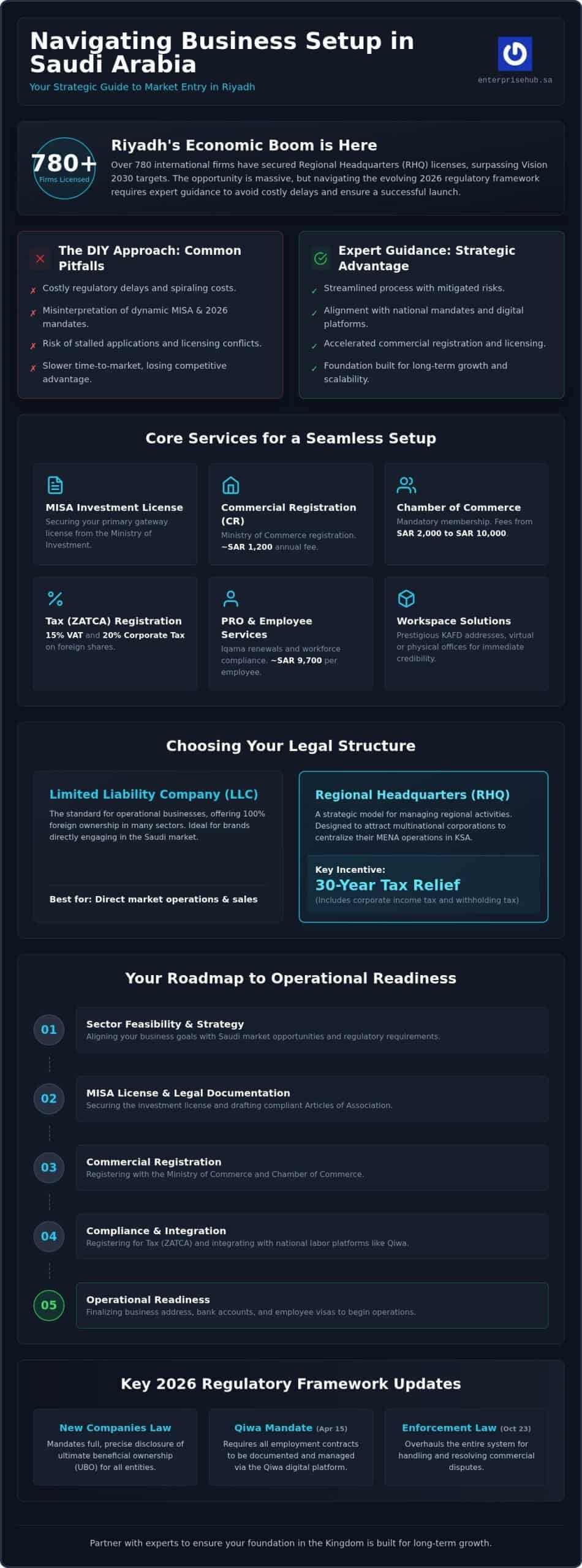
The Step-by-Step Roadmap to Establishing Your Presence
Establishing a commercial entity in Riyadh is a sequence of dependencies where one missed detail can reset your timeline. By following a structured roadmap, business setup consultants in Riyadh transform a complex government process into a predictable project plan. Success in 2026 requires more than just paperwork; it requires a synchronization of legal, financial, and physical requirements. We’ve refined this process into five critical steps to ensure your market entry is both swift and compliant.
- Step 1: Consultation and Sector Feasibility: We begin by identifying the precise ISIC activity codes that match your business model. This ensures your license covers all intended operations without triggering unnecessary restrictions.
- Step 2: Securing the MISA Investment License: This is the primary gateway for foreign capital. The initial issuance usually involves a combined first year fee of SAR 12,000, covering both the license and service fees.
- Step 3: Trade Name Reservation and CR Issuance: Once MISA approves, we reserve your trade name and secure the Commercial Registration (CR) from the Ministry of Commerce. The annual fee for this registration is approximately SAR 1,200.
- Step 4: Establishing a Physical Office: A local address is mandatory for final licensing. Securing a prestigious location in the King Abdullah Financial District (KAFD) provides immediate market credibility and satisfies MISA’s physical presence requirements.
- Step 5: Finalizing Tax and Labor Registrations: The final stage involves registering with ZATCA for VAT and corporate tax, and opening your files with the Ministry of Human Resources and GOSI.
Phase 1: Pre-Incorporation Strategy
Success starts before you submit your first application. We focus on gathering and legalizing your home country documents, ensuring every Apostille and embassy stamp is correct. Developing a compliant business plan for MISA approval is equally vital. This plan must demonstrate how your company aligns with national growth goals. For a deeper look at the current economic climate, read our analysis on Invest in Saudi Arabia 2026.
Phase 2: Operational Kick-off
Once the CR is in hand, the focus shifts to operational readiness. We support you in opening corporate bank accounts, a process that requires meticulous documentation in the current regulatory environment. We also manage your registration on the Qiwa platform. It’s critical to remember the April 15, 2026, mandate requiring all employment contracts to be authenticated on Qiwa to count toward your Saudization rates. If you’re ready to begin this journey, our business setup solutions provide the end to end support your brand needs to thrive.
By following this roadmap, you move from a concept to a fully operational entity with a prestigious Riyadh address. This methodical approach minimizes the risk of rejection and ensures your team can hit the ground running in the Kingdom’s most competitive district.
Beyond Licensing: Integrating Workspace and Corporate Support
Securing your license is only half the battle. In the Saudi market, your physical presence is your identity. It’s the most visible signal of your commitment to the Kingdom’s economic vision. Many business setup consultants in Riyadh will tell you that a post office box isn’t enough. To truly unlock high-level commercial opportunities, especially within the King Abdullah Financial District (KAFD), you need a space that reflects your brand’s authority. This isn’t just about aesthetics; it’s about building a foundation of trust with local partners and regulators.
With the demand for Grade A office space in Riyadh reaching record highs—vacancy rates dropped to nearly 3% in early 2026—securing a prestigious address is more than a luxury. It’s a regulatory necessity. MISA and the Ministry of Human Resources require evidence of a physical office to approve your Saudization quotas and labor visas. This “substance” requirement ensures that businesses aren’t just paper entities but active contributors to the local economy. Without a verified lease, your journey toward full operational status can stall indefinitely.
The Synergy of Legal Setup and Physical Presence
Your legal structure and your office space must work in tandem. For instance, the MISA licensing process is often contingent on having a verified lease agreement registered through the Ejar system. While established firms might move directly into private suites, many international brands prefer a phased approach. Using virtual offices for initial market testing allows you to establish a footprint while your legal documents are finalized. This strategy provides a low-risk entry point without sacrificing the prestige of a Riyadh address. For a detailed breakdown of this approach, explore our Virtual Offices in Saudi Arabia guide.
Enterprise Hub: Your Strategic Partner in the Kingdom
Enterprise Hub bridges the gap between administrative setup and operational excellence. Unlike traditional providers who silo these services, we integrate your legal journey with our premium workspace ecosystem in KAFD. Our partners gain access to fully equipped private offices for their founding teams while leveraging on-site government and accounting experts. This unified model eliminates the friction of dealing with multiple vendors. You can scale your presence seamlessly, moving from a virtual office to a private corporate suite as your team grows. If you’re ready to take the next step, our comprehensive Business Setup in Riyadh guide provides the tactical roadmap you need.
Ultimately, your success in the Saudi market depends on the strength of your local infrastructure. By combining the expertise of business setup consultants in Riyadh with a physical base in the nation’s financial heart, you position your brand as a serious player. We don’t just help you start; we provide the ecosystem for you to lead and prosper. This integrated approach ensures that your business is not only compliant but also optimized for the high-speed growth defined by Vision 2030.
Secure Your Strategic Position in the Saudi Market
Entering the Kingdom’s economy in 2026 requires more than just a license. It’s about aligning your global ambitions with the specific regulatory pulse of Vision 2030. You’ve seen how choosing between an LLC and a Regional Headquarters (RHQ) can define your tax advantages and government procurement potential. You’ve also learned that a prestigious address in KAFD isn’t just a status symbol; it’s a vital component of your legal substance and labor compliance. Business setup consultants in Riyadh provide the local wisdom and technical precision needed to turn these complex requirements into a competitive edge.
Don’t let administrative hurdles slow your momentum. Enterprise Hub offers a comprehensive ecosystem that combines end to end MISA licensing and government support with flexible workspace solutions from virtual offices to private corporate suites. By establishing your base in the prestigious King Abdullah Financial District, you signal your commitment to excellence and long term growth. It’s time to launch your Saudi presence with Enterprise Hub’s integrated setup solutions and join a community of leaders driving the region’s transformation. The future of Saudi business is happening now, and we’re here to ensure you’re at the forefront of it.
Frequently Asked Questions
What are the requirements for 100% foreign ownership in Saudi Arabia?
You can achieve 100% foreign ownership in most sectors by securing a MISA investment license. While many service industries have no minimum capital requirements, specific sectors like wholesale and retail trading require a minimum capital of SAR 30 million. You must also provide legalized corporate documents from your home country and a compliant business plan that outlines your contribution to the local economy.
How long does the business setup process take with a consultant?
The timeline for full operational readiness typically spans four to eight weeks when working with professional business setup consultants in Riyadh. While the initial MISA license and Commercial Registration can often be secured within days, opening a corporate bank account and finalizing labor registrations require more time. A consultant accelerates this by ensuring all documentation is correct on the first submission to avoid government rejections.
Can I set up a business in Saudi Arabia without a local partner?
Yes, you can establish a business in Saudi Arabia without a local partner in most commercial and industrial sectors. The Kingdom’s updated investment laws allow for full foreign control through a Limited Liability Company (LLC) or a Branch of a Foreign Company. This shift eliminates the historical requirement for a local sponsor, granting you complete operational and financial autonomy over your Saudi entity.
What is the role of MISA in the company formation process?
The Ministry of Investment (MISA) acts as the primary regulator and gateway for all foreign entities entering the Kingdom. Its role is to issue the mandatory Investment License, which serves as the legal foundation for your business. MISA also monitors compliance with investment regulations and provides the strategic framework to ensure your project aligns with the goals of Vision 2030.
What are the ongoing compliance requirements for new companies?
New companies must manage several ongoing obligations, including ZATCA registration for the 15% VAT and corporate income tax. You’re also required to document all employment contracts on the Qiwa platform and maintain your Saudization rates under the Nitaqat program. Regular compliance also includes annual MISA license renewals and mandatory GOSI contributions for all employees to stay in good standing with the Ministry of Labor.
Is a physical office address mandatory for obtaining a commercial license?
A physical office address is mandatory to obtain a full commercial license and secure labor visas in Saudi Arabia. While business setup consultants in Riyadh can use virtual office solutions to initiate your legal registration, the Ministry of Labor requires a verified lease for final operational approval. This ensures the business meets the “substance” requirements needed to hire staff and conduct commercial activities within the Kingdom.