
Would you gamble your company’s future on the assumption that a missed filing is just a minor clerical error? In 2026, the Saudi regulatory environment has shifted from a “documentation-first” approach to strict operational enforcement. You’ve likely felt the pressure of managing complex requirements across Qiwa, ZATCA, and MISA while worrying about the sudden suspension of your license. The risks of non-compliance with Saudi commercial laws are no longer just theoretical. They now include direct financial penalties of up to SAR 20,000 for failing to deposit audited financial statements and potential imprisonment for trademark violations.
We understand that your goal isn’t just to survive these changes but to lead with confidence. This guide promises to clarify the legal, financial, and operational consequences of oversight and provide a clear strategy to keep your business in the “Green.” We’ll explore the new unified Commercial Register, the latest PDPL enforcement trends, and how professional accounting and government services can turn compliance into your strongest competitive advantage. By the end of this guide, you’ll have the map you need to protect your market access and focus on growth.
Key Takeaways
- Map the 2026 regulatory landscape to understand how entities like MISA and ZATCA enforce the latest Commercial Transactions Law.
- Identify the precise risks of non-compliance with Saudi commercial laws, including direct fines for managers and the potential suspension of your Commercial Registration.
- Assess the operational impact of a “Red” Nitaqat status on your workforce management and your ability to renew essential employee visas.
- Establish a proactive compliance strategy by conducting regular internal audits of your ZATCA filings and labor records to maintain a “Green” status.
- Secure your business continuity by utilizing compliant office solutions and expert support for company formation and government service management.
The Evolving Landscape of Saudi Commercial Regulations in 2026
The Saudi business environment in 2026 is defined by a decisive move toward total transparency and legal certainty. For decades, the Kingdom operated under a more flexible legal structure. Today, the shift toward codified civil laws has fundamentally changed how every business operates. Understanding Saudi Arabia’s legal framework is no longer just a task for legal departments; it’s a core strategic requirement for every CEO and founder. This modernization is a key pillar of Vision 2030, aiming to attract $280 billion in foreign direct investment by creating a predictable, world-class market.
Codification means that the rules are now written, standardized, and accessible. This reduces the risks of non-compliance with Saudi commercial laws because the expectations are clearer than ever. However, this clarity comes with a zero-tolerance approach to oversight. Transparency is the new currency. If your beneficial ownership isn’t disclosed or your internal policies don’t match the new statutes, the government’s digital systems identify these gaps almost instantly. We’ve seen a shift where compliance is no longer a “check-the-box” activity but a vital asset for market access.
The Impact of the Civil Transactions Law
The Civil Transactions Law has revolutionized contract enforcement across the Kingdom. It standardizes how agreements are interpreted, which significantly reduces judicial discretion. For investors, this means predictability. You can now forecast legal outcomes with much higher accuracy. It’s essential that companies immediately align their internal policies with these codified statutes. It’s the only way to ensure your contracts remain enforceable and your business stays protected in a 2026 courtroom.
Regulatory Bodies and Their Jurisdictions
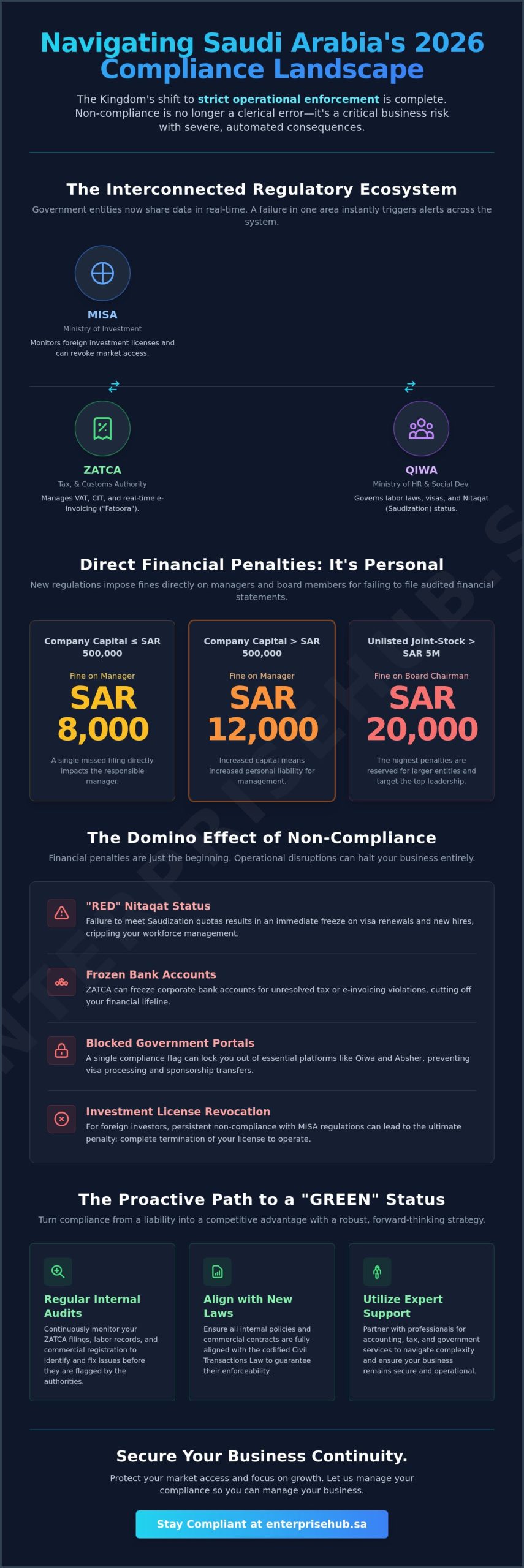
Enforcement in 2026 is a coordinated effort between powerful, tech-driven entities. The Ministry of Investment (MISA) keeps a close watch on foreign entities to ensure they meet their specific licensing conditions. Meanwhile, the Zakat, Tax, and Customs Authority (ZATCA) manages tax, VAT, and the mandatory e-invoicing system. These agencies don’t work in silos. They share data through unified portals. A compliance failure in your tax filings can trigger an immediate investigation into your MISA license. Staying ahead of the risks of non-compliance with Saudi commercial laws requires a holistic view of how these different ministries interact with your data.
Primary Financial and Administrative Penalties
Financial penalties in the Saudi market are no longer just a cost of doing business. They’re designed to be deterrents that target decision-makers directly. As of May 15, 2026, Ministerial Decree No. 236 has introduced direct financial penalties for companies failing to deposit their audited financial statements. These fines aren’t just corporate liabilities; they’re imposed on managers and board chairmen. For companies with a capital of SAR 500,000 or less, a single manager faces a fine of SAR 8,000. If the capital exceeds this amount, the penalty jumps to SAR 12,000. For unlisted joint-stock companies with capital over SAR 5 million, the fine reaches SAR 20,000. These figures represent the baseline risks of non-compliance with Saudi commercial laws in the current fiscal year.
Administrative sanctions often hurt more than the initial fines. A single violation can trigger a “block” on essential government portals like Qiwa and Absher. This digital freeze stops you from renewing employee visas, transferring sponsorships, or even accessing your own commercial data. For foreign investors, the stakes are even higher. MISA maintains a strict monitoring protocol. Consistent failure to meet regulatory benchmarks can lead to the total revocation of your investment license, effectively ending your market access. Ensuring your business stays operational requires a proactive approach to accounting and tax management to avoid these automated triggers.
ZATCA and Tax-Related Sanctions
ZATCA’s “Fatoora” system is now fully integrated with most business operations. This e-invoicing framework automates the detection of tax discrepancies in real-time. Missing a VAT filing or submitting an incorrect e-invoice doesn’t just lead to a fine; it flags your company for a full audit. Penalties for non-compliance with e-invoicing regulations can be severe, and failing to meet Corporate Income Tax deadlines can lead to the freezing of company bank accounts. The speed of digital enforcement means that errors are identified almost as soon as they’re made.
Licensing and Registration Risks
Your Commercial Registration (CR) is your license to operate, but it’s not static. Operating outside the specific scope of your registered activities is a major violation. Furthermore, the 2026 Law of Commercial Register requires a single, unified entry for all branches. Failing to update your National Address or local headquarters information can lead to immediate administrative blocks. Perhaps most critical is the “Anti-Concealment” (Tasattur) law. Any arrangement where a non-Saudi operates a business under a Saudi national’s name faces criminal prosecution, heavy fines, and permanent deportation. These risks of non-compliance with Saudi commercial laws highlight why maintaining an accurate, updated legal presence is non-negotiable for long-term success.
Operational and Reputational Consequences
While financial fines are painful, the operational risks of non-compliance with Saudi commercial laws often pose a greater threat to a company’s survival. In 2026, the Saudi government’s digital infrastructure ensures that a single regulatory failure ripples through every department. Your ability to hire, grow, and compete depends on maintaining a “Green” status in the Nitaqat system. Falling into “Red” status isn’t just a label; it’s an immediate freeze on your company’s pulse. When the system flags you, the digital gates close, and the friction begins.
Reputation is the most valuable currency in the Saudi market. Government audits are no longer private affairs; their outcomes influence your eligibility for public tenders and Vision 2030 projects. If your compliance record shows a history of labor violations or tax discrepancies, you’re viewed as a high-risk partner. This doesn’t just affect government contracts. Private sector partners and banks also monitor these metrics. A poor compliance standing can lead to the sudden termination of commercial contracts or the tightening of credit facilities, leaving your business isolated and underfunded.
Labor Law and Visa Restrictions
The Qiwa portal acts as the gatekeeper for your workforce. When a compliance violation is flagged, the system automatically blocks your ability to issue new visas or renew existing ones. This is critical as the Nitaqat program enters its next phase (2026-2028), aiming to localize over 340,000 jobs. If you can’t manage your workforce because of a block, you can’t meet these localization targets. This creates a cycle of non-compliance that’s hard to break. Losing the ability to hire or retain talent can halt projects mid-execution, causing massive internal friction and lost revenue.
Market Access and Tendering Risks
Exclusion from government procurement is a death sentence for many growth-oriented firms. Major Vision 2030 projects require partners who demonstrate total alignment with national standards. Non-compliance makes you ineligible for these opportunities. Beyond tenders, the risks of non-compliance with Saudi commercial laws extend to brand trust. In a market that prizes reliability and strategic alignment with national goals, a public record of regulatory breaches can take years to repair. Staying compliant is the only way to ensure your brand remains a trusted name in the Saudi business community.
Building a Robust Compliance Framework
Building a compliance framework in 2026 starts with shifting from reactive fixes to proactive systems. You can’t afford to wait for a notification from ZATCA to check your tax records. A robust framework integrates legal requirements into your daily operations. This means conducting regular internal audits of your labor records and tax filings before the government does. It also involves training your team on the Saudi Civil Transactions Law so every contract signed is fully compliant from day one. These steps are vital. They transform compliance from a burden into a strategic shield. By investing in these systems, you eliminate the risks of non-compliance with Saudi commercial laws before they manifest as penalties or operational blocks.
The Importance of a Valid Business Address
Your physical or virtual footprint is the first thing auditors look at. MISA and the Ministry of Commerce require a verified address to confirm your company’s legitimacy. A prestigious business address does more than build trust with clients; it satisfies the technical requirements for commercial registration. For many modern firms, Virtual Offices in Saudi Arabia provide a fully compliant local footprint without the overhead of traditional leasing. These solutions ensure you have a registered National Address, which is essential for receiving official communications and passing government inspections. It’s the simplest way to maintain a professional presence that meets every regulatory standard.
Managing Government Services Professionally
The sheer number of portals like Qiwa, GOSI, and ZATCA can overwhelm even experienced teams. Professional management of these services is a strategic necessity. Outsourcing these tasks ensures that your commercial licenses, certificates, and tax filings are renewed on time. This proactive management keeps your business in the “Green” and avoids the administrative blocks discussed earlier. If you’re just starting, following a clear guide for Company Formation in Riyadh is the first step toward a compliant future. Managing these details correctly from the beginning prevents the risks of non-compliance with Saudi commercial laws from ever taking root.
Taking control of your regulatory standing doesn’t have to be a solo journey. Partnering with experts allows you to focus on growth while we handle the technical details. Explore our comprehensive government and accounting services to safeguard your operations today.
How Enterprise Hub Mitigates Compliance Risks
Enterprise Hub serves as your strategic anchor in a market that moves at the speed of Vision 2030. We understand that the risks of non-compliance with Saudi commercial laws aren’t just legal hurdles; they’re barriers to your long-term growth and reputation. That’s why we’ve built a comprehensive ecosystem that integrates every essential business pillar into one seamless platform. We provide the infrastructure and expertise you need to ensure your operations remain fully aligned with the Kingdom’s 2026 standards. From securing a verified National Address to managing complex tax filings, we act as an extension of your team. Our goal is to remove the friction of regulatory oversight so you can focus on scaling your vision with total confidence.
Our approach combines physical infrastructure with professional government and accounting services. We don’t just give you a desk; we provide a compliant local presence that satisfies MISA and Ministry of Commerce audits. By integrating ZATCA-ready accounting and tax services, we help you prevent the financial penalties associated with late filings and e-invoicing errors. We monitor the portals, track the deadlines, and manage the renewals on your behalf. This proactive administrative management is the most effective way to eliminate the risks of non-compliance with Saudi commercial laws and maintain a “Green” status across all government platforms. We believe that compliance should be your competitive advantage, not a source of stress.
Compliant Workspace Solutions
A legitimate physical presence is the foundation of your Saudi license. Enterprise Hub provides high-end office solutions that meet all Ministry requirements for commercial activities. Whether you need private suites or shared environments, our spaces ensure you pass every inspection with ease. Choosing the right Offices for Rent in Riyadh places your business in a prestigious district while satisfying the strict local headquarters mandates. It’s about more than just a location. It’s about securing your right to operate in the Kingdom’s economic heart without the risk of license suspension.
Your Strategic Partner in Saudi Arabia
Entering a new market requires more than just capital; it requires local wisdom and a partner who understands the terrain. We provide strategic advisory for foreign investors, helping you navigate the nuances of company formation and the Civil Transactions Law. We handle the heavy lifting on portals like Qiwa, GOSI, and Absher, ensuring your workforce management remains uninterrupted. When you choose to Invest in Saudi Arabia with Enterprise Hub, you aren’t just hiring a service provider. You’re joining a shared path to success where your compliance, growth, and prosperity are our top priorities. Let us handle the complexity while you lead the innovation.
Empower Your Business for Long-Term Success
The 2026 regulatory shift in Saudi Arabia has transformed compliance from a legal formality into a core strategic asset. You now understand how the unified Commercial Register and Ministerial Decree No. 236 have raised the stakes for every manager and board member. Avoiding the risks of non-compliance with Saudi commercial laws requires more than just awareness; it demands a proactive system that integrates tax, labor, and licensing into a single, cohesive workflow. Whether it’s maintaining a “Green” Nitaqat status or ensuring your e-invoicing aligns with ZATCA’s latest standards, the path to growth is paved with regulatory precision.
Success in the Kingdom’s evolving market belongs to those who view compliance as a foundation for expansion. We’re here to ensure your journey is smooth and your operations remain uninterrupted. Through our strategic support for Vision 2030 investors, expert government service management, and fully compliant office spaces, we provide the tools you need to lead with confidence. Secure your business with Enterprise Hub’s compliant solutions and focus on what you do best: building the future. We look forward to being your partner in this journey toward lasting prosperity and growth.
Frequently Asked Questions
What are the most common reasons for a commercial license suspension in Saudi Arabia?
License suspension usually stems from operating outside your registered commercial scope or failing to renew mandatory certificates like the Chamber of Commerce membership. Other triggers include significant labor violations or failing to update your National Address. These actions flag your business on the unified National Commercial Register, leading to an automatic digital block on operational portals like Qiwa and Absher.
How much are the fines for VAT non-compliance under ZATCA regulations?
ZATCA penalties for VAT violations vary based on the severity of the oversight. Failing to register for VAT when eligible carries a SAR 10,000 fine, while late tax returns attract a penalty between 5% and 25% of the tax value. Submitting incorrect e-invoices can result in fines ranging from SAR 1,000 to SAR 50,000, depending on the frequency of the offense and the type of error detected.
Can a foreign company operate in Saudi Arabia without a local headquarters?
Foreign entities cannot legally operate in Saudi Arabia without a registered local headquarters. MISA requires a verified address to issue and maintain your investment license. While you don’t always need a traditional large-scale office, a verified physical or virtual office that meets the Ministry of Commerce’s standards is a mandatory requirement for maintaining a compliant presence in the Kingdom.
What is the “Anti-Concealment Law” and why is it a risk for investors?
The Anti-Concealment Law, known as Tasattur, prohibits non-Saudis from managing or owning a business using a Saudi national’s name or license. This is a critical area of enforcement in 2026, with penalties reaching up to five years in prison and SAR 5 million in fines. It aims to ensure all foreign investments are transparent and officially registered through MISA to protect the economy’s integrity.
How does the “Nitaqat” system affect a company’s commercial standing?
The Nitaqat system dictates your ability to manage your workforce by assigning a color-coded compliance status based on your localization rates. A “Red” or “Yellow” status indicates you haven’t met Saudization targets, which blocks your ability to issue new visas or transfer sponsorships. Maintaining a “Green” status is essential for operational continuity and avoiding the broader risks of non-compliance with Saudi commercial laws.
What should I do if my business receives a notice of non-compliance?
You must immediately identify the source of the violation through the relevant government portal and take corrective action within the stated grace period. Most notices from ZATCA or MISA provide a specific window for rectification before penalties escalate or bank accounts are frozen. Consulting with a professional government services partner can help you resolve the issue quickly and prevent the permanent suspension of your activities.
Are there specific compliance risks for virtual offices in the Kingdom?
The primary risk for virtual offices is using an address that isn’t officially recognized by the Ministry of Commerce or ZATCA. A compliant virtual office must provide a valid National Address and meet the technical requirements for commercial registration. Using unverified “mailing addresses” can lead to your registration being rejected or flagged during a regulatory audit, potentially halting your business setup.
How often should a company conduct a regulatory audit in Saudi Arabia?
We recommend conducting a comprehensive internal regulatory audit at least once every quarter. This frequency allows you to identify discrepancies in your ZATCA filings, labor records on Qiwa, and beneficial ownership disclosures before they trigger automated government penalties. Regular reviews are the best defense against the risks of non-compliance with Saudi commercial laws in a rapidly changing 2026 market.