
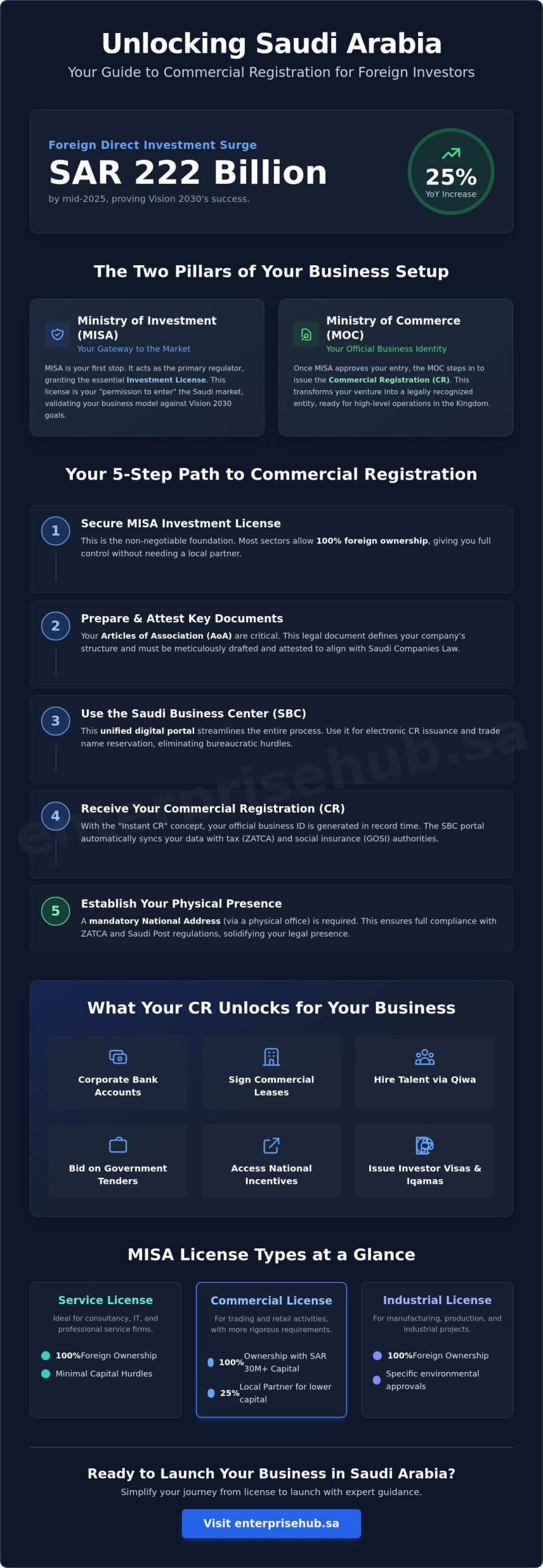
Did you know that foreign direct investment in Saudi Arabia surged to SAR 222 billion by mid-2025? This 25% year-on-year increase proves that the Kingdom’s Vision 2030 isn’t just a plan; it’s a thriving reality for global entrepreneurs. We understand that starting a business in a foreign market feels daunting, especially when you’re trying to distinguish between MISA licenses and Ministry of Commerce regulations. It’s natural to feel overwhelmed by 100% ownership laws or the search for a compliant physical address.
You’re in the right place to simplify this journey. We’ll help you master the legal landscape and the specific requirements to open a commercial register for non-Saudis, ensuring you secure your Saudi Commercial Registration (CR) with ease. This guide provides a clear roadmap from obtaining your investment license to establishing a legal business presence. We’ll explore everything from digital integration and compliance costs to the essential steps for securing a physical office that meets all regulatory standards.
Key Takeaways
- Clarify why securing a MISA Investment License is the essential first step for any foreign investor before pursuing a Commercial Registration.
- Navigate the specific documentation and requirements to open a commercial register for non-Saudis, including the legal attestation of your company’s Articles of Association.
- Streamline your setup by using the unified Saudi Business Center (SBC) portal for electronic CR issuance and trade name reservation.
- Secure a mandatory National Address through professional office solutions to ensure full compliance with ZATCA and Saudi Post regulations.
- Leverage your CR to unlock critical business functions, such as opening corporate bank accounts and accessing the Kingdom’s talent pool.
Understanding the Commercial Registration (CR) Framework for Foreign Investors
Commercial Registration (CR) isn’t just a certificate. It’s the digital pulse of your enterprise, linking you directly to the Kingdom’s booming economy. Under Saudi Vision 2030, this document serves as the official “identity card” for your business. It transforms your investment vision into a recognized legal entity capable of high-level operations. Without a valid CR, your business remains a concept on paper. You can’t open corporate bank accounts, sign commercial leases, or access the Qiwa platform to hire your first team members.
The institutional landscape involves two main pillars. The Ministry of Investment (MISA) acts as your primary regulator, evaluating your business model and granting the initial investment license. This license is the “permission to enter” the Saudi market. Once MISA approves your presence, the Ministry of Commerce steps in to issue the actual Commercial Register. Understanding the requirements to open a commercial register for non-Saudis is critical because foreign investors typically register as Limited Liability Companies (LLCs) rather than individual establishments. This structure protects your assets and allows for 100% foreign ownership in most sectors.
Why Non-Saudis Need a Specialized CR
A specialized CR ensures your business enjoys full legal protections under the Saudi Companies Law. It’s your ticket to the big leagues. This document is mandatory if you intend to bid on massive government tenders or benefit from national industrial incentives. Beyond business deals, your CR is the legal foundation for issuing investor visas and residency permits (Iqama) for your leadership team; for those managing regional relocation, khtvisaservices.ae offers expert guidance. It proves your commitment to the local market and establishes long-term stability.
The Shift to Digital: Saudi Business Center (SBC) in 2026
By 2026, the Saudi Business Center (SBC) has completely redefined the registration journey. This unified portal eliminates the old bureaucratic hurdles by merging different agency requirements into one digital stream. The “Instant CR” concept is now a reality for many foreign investors. Once your MISA license is active, the SBC platform can generate your registration number in record time. This digital leap automatically synchronizes your data with the Zakat, Tax and Customs Authority (ZATCA) and the General Organization for Social Insurance (GOSI). You don’t have to chase different departments; the system ensures you’re tax-ready and insurance-compliant from the moment you launch.
The Essential Pre-requisite: Obtaining a MISA Investment License
Before you can access the Ministry of Commerce portal, you must first secure your MISA Investment License. Think of this as your regulatory foundation. For foreign entities, this license is the non-negotiable first step. It validates your business activity against the Kingdom’s economic goals. If you’re exploring Invest in Saudi Arabia 2026 strategic sectors, you’ll find that the government has opened doors wider than ever. Most service and industrial sectors now allow for 100% foreign ownership. This removes the historical need for a local partner, giving you full control over your operations and profits from day one.
One of the most critical requirements to open a commercial register for non-Saudis is a properly drafted and attested Articles of Association (AoA). This document isn’t just a legal formality. It defines your company’s structure, share distribution, and management powers. MISA reviews this document meticulously to ensure it aligns with the Saudi Companies Law. If you need support with the technicalities of company formation in Saudi Arabia, our team can guide you through the drafting phase to ensure your application meets every regulatory standard.
MISA License Types and Their Requirements
Choosing the right license category determines your operational freedom. Service licenses are ideal for consultancy, IT, and professional firms. They offer 100% ownership with minimal capital hurdles. Commercial licenses for trading activities are more rigorous. While 100% ownership is possible, it typically requires a minimum capital of SAR 30 million. If your capital is lower, you’ll likely need to consider a 25% local partnership. Industrial licenses focus on manufacturing and require specific environmental approvals. Each path has unique documentation needs that must be met before you move to the Starting Your Business in Saudi Arabia phase on the Ministry of Commerce portal.
Financial Solvency and Capital Requirements
Proving financial health is a cornerstone of the MISA application. You’ll need to provide audited financial statements from your parent company to demonstrate stability and long-term viability. For most Limited Liability Company (LLC) activities, there’s no fixed minimum capital requirement, but the proposed capital must be sufficient to achieve the business’s objectives. Entrepreneurial licenses offer a more flexible path for startups, focusing on innovation and technology rather than massive upfront capital. Keep in mind that once your registration is active, your entity will be subject to a 20% corporate income tax on net profits, so planning your financial structure early is vital for sustainable growth.
Detailed Requirements and Documents for Non-Saudi CR Issuance
Securing your MISA license is a significant victory, but it’s only the first half of the journey. To finalize your legal standing, you must present a specific bundle of documents to the Ministry of Commerce. Accuracy at this stage is vital. Any discrepancy between your MISA license and your application for requirements to open a commercial register for non-Saudis can lead to delays. You’ll need your valid MISA Investment License certificate as the anchor for the entire application. Along with this, you must provide clear passport copies for all shareholders and the appointed General Manager. If any shareholder is already a resident in the Kingdom under a different sponsorship, a “No Objection” letter from their current employer is often required to facilitate the transition to an investor status.
Your physical presence in the Kingdom must be verifiable. A registered physical address, specifically a National Address, is mandatory. This isn’t just a mailing preference; it’s a regulatory requirement for ZATCA compliance and activating your CR. The Ministry of Commerce expects your Articles of Association (AoA) and Bylaws to be fully attested and aligned with the Saudi Companies Law. These documents serve as the internal constitution of your firm, detailing how decisions are made and how profits are distributed among global partners.
Shareholder and Management Documentation
If your shareholders are corporate entities rather than individuals, the documentation grows more complex. You’ll need to provide a Certificate of Incorporation and a formal Board Resolution from the parent company authorizing the Saudi investment. Don’t underestimate the attestation phase. Every document issued outside the Kingdom requires a multi-step verification process. This typically starts with a notary in your home country, moves to the Saudi Embassy there, and concludes with a final stamp from the Saudi Ministry of Foreign Affairs (MOFA). Appointing a General Manager also requires careful thought; their credentials must be documented, and they must have the legal authority to represent the company in all government transactions.
Technical and Activity-Specific Requirements
Precision in defining your business activities is essential. You must select the correct ISIC codes that match the scope of your MISA license. Picking the wrong code can trigger unnecessary tax audits or restrict your ability to bid on specific contracts. While the process of issuing a commercial registration is largely digital, regulated sectors like health, education, or finance require additional pre-approvals from relevant authorities like the Saudi Central Bank (SAMA). Finally, ensure your trade name is unique. The Ministry of Commerce has strict guidelines against names that are too similar to existing brands or those that use prohibited terms, so reserving your name early in the portal is a smart strategic move.
Step-by-Step Guide to Issuing Your CR Electronically in 2026
By 2026, the Saudi Business Center (SBC) has emerged as the definitive gateway for all commercial activities. The days of visiting multiple government offices are over. Once you’ve secured your MISA license, your digital journey begins with linking your investment data to the Ministry of Commerce system. This seamless integration ensures that your requirements to open a commercial register for non-Saudis are verified instantly against your approved investment scope. You’ll start by reserving a unique trade name through the portal. This name must be distinct and follow specific cultural and linguistic guidelines set by the Ministry to avoid rejection.
The digital drafting of your Articles of Association (AoA) follows. The SBC platform allows shareholders to review and modify their bylaws in real-time. This isn’t just about filling in blanks; it’s about structuring your company for long-term success. Using a proven Business Setup framework during this stage helps you avoid common filing errors that could stall your application for weeks. Once the draft is ready, it moves to the E-notary for final verification and remote approval.
Initiating the Application via SBC
The process starts by entering detailed shareholder data and determining the capital distribution. You don’t need to be physically present in Riyadh or Jeddah to complete this. The system pulls your MISA license details automatically, ensuring consistency across all government records. This stage is where you define the management powers of your General Manager and set the company’s fiscal year. Accuracy here is paramount. These details will appear on your final certificate and dictate your operational limits for years to come.
The Digital Signature and Payment Phase
The final hurdle is the digital signature. Shareholders sign the AoA remotely using the Absher platform or the Nafath digital identity app. This high-security method replaces physical signatures and ensures the integrity of the document. After signing, you’ll receive a consolidated invoice covering the Ministry of Commerce registration and the mandatory Chamber of Commerce subscription. Fees vary depending on whether you’re issuing a main CR or a branch CR. Once payment is confirmed, you can download your electronic CR certificate instantly. If you find the technical steps daunting, our team provides expert business licensing and government services to handle the heavy lifting for you.
Beyond the CR: Establishing Your Physical Presence with Enterprise Hub
Securing your digital certificate is a landmark achievement, but your journey toward operational readiness is just beginning. One of the most critical requirements to open a commercial register for non-Saudis involves the formal activation of your National Address. In 2026, the Saudi government requires every foreign entity to have a verified physical location linked to their tax and labor records. This step is mandatory to move your CR from “issued” to “active” status. Beyond the law, your physical office acts as your business’s face in the Kingdom. It builds immediate trust with local clients, banks, and government inspectors who view a professional address as a sign of long-term stability.
Transitioning from a legal entity to a functioning business requires more than just a desk. It demands a strategic base that reflects your brand’s ambition. We specialize in bridging this gap, providing the infrastructure needed to satisfy both regulatory bodies and high-tier corporate partners. Our solutions ensure that your transition into the Saudi market is seamless, allowing you to focus on growth while we manage the complexities of your physical and administrative footprint.
Office Solutions for MISA Compliance
Navigating the initial setup often requires flexibility. Many investors choose Virtual Offices in Saudi Arabia to meet the immediate requirements to open a commercial register for non-Saudis without committing to a long-term traditional lease. These virtual solutions provide a valid National Address and the documentation necessary for MISA and Ministry of Commerce compliance. For companies targeting high-tier licenses or those aiming for a presence in the King Abdullah Financial District (KAFD), we provide premium private offices and dedicated desks. These spaces are fully equipped to meet the rigorous standards expected of global firms entering the Riyadh market.
Post-CR Government Integrations
Once your CR is active, the focus shifts to government integration. You must immediately open a file with the Ministry of Human Resources and Social Development (HRSD) to begin hiring staff. Simultaneously, your company must register with the General Organization for Social Insurance (GOSI) to manage employee contributions. Tax compliance is equally urgent; you have a strict window to register with the Zakat, Tax, and Customs Authority (ZATCA) to avoid penalties. Our dedicated government services team handles these registrations on your behalf. We ensure your labor files, tax registrations, and Chamber of Commerce subscriptions are perfectly synchronized, moving your business from a registered name to a fully operational enterprise in record time.
Step Into the Future of Saudi Business
The landscape of foreign investment in Saudi Arabia has never been more accessible or digitally integrated. By mastering the dual pillars of MISA licensing and Ministry of Commerce registration, you position your enterprise at the heart of a trillion-dollar economy. Success requires more than just submitting paperwork; it demands a strategic understanding of the requirements to open a commercial register for non-Saudis and a commitment to maintaining a compliant local presence. From securing your National Address to integrating with ZATCA and GOSI, every step is a building block for your Kingdom-wide expansion.
You don’t have to navigate this complex regulatory environment alone. Start your Saudi investment journey with Enterprise Hub’s professional business setup services and leverage our strategic presence in KAFD. Our expert government relations team and comprehensive accounting and tax support ensure your business remains compliant and competitive from day one. The Kingdom’s Vision 2030 is calling for global pioneers. We’re ready to help you answer that call and turn your investment goals into a thriving reality.
Frequently Asked Questions
Can a non-Saudi open a Commercial Registration without a Saudi partner?
Yes, you can obtain 100% ownership for most business activities in the Kingdom. This shift is a core part of the Vision 2030 reforms to attract global talent. You simply need to secure a MISA investment license before applying for your Commercial Registration. Some specific sectors like upstream oil or military services remain restricted, but the vast majority of service and industrial sectors are fully open to international entrepreneurs.
How much capital is required for a foreigner to open a CR in Saudi Arabia?
For a standard Limited Liability Company (LLC), there is no fixed minimum capital requirement under the current law. The capital you declare should be sufficient to support your business objectives and must be documented in your Articles of Association. However, if you’re entering the trading sector with 100% ownership, the minimum capital requirement is SAR 30 million. It’s vital to plan your capital structure to meet both operational needs and regulatory expectations.
How long does it take to issue a Commercial Registration for a non-Saudi?
The timeline is remarkably efficient thanks to digital transformation. Once the Ministry of Investment approves your license, which typically takes 2 to 4 working days, the CR issuance through the Saudi Business Center can happen almost instantly. The entire process from initial application to receiving your digital certificate often concludes within a single business week. This speed allows you to move quickly from the planning phase to active market entry.
Is a physical office required to issue a CR for foreign investors?
Yes, you must provide a verified National Address to activate your registration and ensure ZATCA compliance. While you’re finalizing the requirements to open a commercial register for non-Saudis, you can utilize a virtual office to satisfy the initial address mandate. This gives you the flexibility to secure your legal status before committing to a long term lease for a private suite or a dedicated corporate headquarters in a prime location like KAFD.
What are the annual fees for maintaining a Commercial Registration?
Annual renewal fees for a business license start at SAR 2,000. You’ll also need to factor in the mandatory Chamber of Commerce subscription fees, which vary based on your company’s grade and capital. Beyond these base costs, your entity will be subject to a 20% corporate income tax on net profits. Staying on top of these annual commitments is essential to maintain your company’s “Good Standing” status with the Ministry of Commerce.
Can I change my business activity after the CR is issued?
Yes, you can modify or add business activities to your registration at any time. However, any change must first be approved and updated in your MISA investment license to ensure it aligns with your permitted scope. Once MISA grants the amendment, you can update the Ministry of Commerce records through the SBC portal. Keeping your registered activities synchronized with your actual operations is a critical requirement for maintaining legal compliance in the Kingdom.
Do I need a local bank account before applying for a CR?
No, you don’t need a local bank account to start the application. In fact, you’ll find that having a valid Commercial Registration is a mandatory requirement for opening a corporate bank account in Saudi Arabia. The CR acts as your company’s official identity document. Once the registration is issued, you can approach local or international banks operating in the Kingdom to set up your financial infrastructure and begin local transactions.
What is the role of the Saudi Business Center in the CR process?
The Saudi Business Center (SBC) serves as the unified digital gateway for all business setup steps. It integrates services from MISA, the Ministry of Commerce, and tax authorities into one platform to simplify the requirements to open a commercial register for non-Saudis. Instead of visiting different government offices, you use the SBC portal to reserve your trade name, sign your Articles of Association electronically, and pay all integrated fees in one go.