
What if your company’s path to the most lucrative government tenders in the Middle East was blocked by a single missing document? As of 2026, the mandate is clear: without establishing a Regional Headquarters, foreign firms are effectively excluded from the Kingdom’s massive procurement pipeline. We recognize that the requirements to open a branch of a foreign company in the Kingdom have become more sophisticated, particularly with the new Nitaqat phase launched on April 26, 2026, and the 90% Qiwa documentation target set for June 30. It’s a landscape where precision is the only currency that matters.
At Enterprise Hub, we act as your strategic partner to simplify this complexity and ensure your business thrives. We’ll provide you with a comprehensive roadmap to navigate the legal and operational landscape, helping you secure 100% foreign ownership and a prestigious physical presence. This guide covers everything you need to know, from the SAR 500,000 minimum capital requirement for branches to the specific strategic functions required for a 30-year corporate tax exemption.
Key Takeaways
- Understand the legal distinction of a foreign branch and the pivotal role MISA plays as the primary gatekeeper for your Saudi expansion.
- Master the step-by-step requirements to open a branch of a foreign company in Riyadh, from embassy attestation to digital license acquisition.
- Learn why the 2026 Regional Headquarters (RHQ) mandate is a non-negotiable prerequisite for accessing the Kingdom’s government procurement pipeline.
- Navigate the mandatory physical office regulations and the Ejar registration system to ensure your commercial lease meets strict compliance standards.
- Discover how integrating licensing support with premium office solutions can accelerate your operational readiness in the heart of Riyadh.
Understanding the Legal Framework for Foreign Branches in Saudi Arabia
A foreign branch operates as a direct legal extension of your parent company. Unlike a subsidiary, it doesn’t possess a separate legal personality. This distinction is vital because it means the parent company maintains full control while also bearing 100% of the legal and financial liabilities. We help you understand that while this structure simplifies certain internal reporting, it requires a robust compliance strategy to protect the global entity from local risks.
In 2026, the Ministry of Investment (MISA) serves as your primary gatekeeper. It’s the first authority you’ll encounter when fulfilling the requirements to open a branch of a foreign company in Riyadh. One of the most significant advantages of this framework is the right to 100% foreign ownership. You don’t need a local Saudi partner or a sponsor to enter the market. This autonomy allows you to maintain your corporate culture and operational standards while tapping into the Kingdom’s rapid economic transformation.
MISA Licensing Categories for 2026
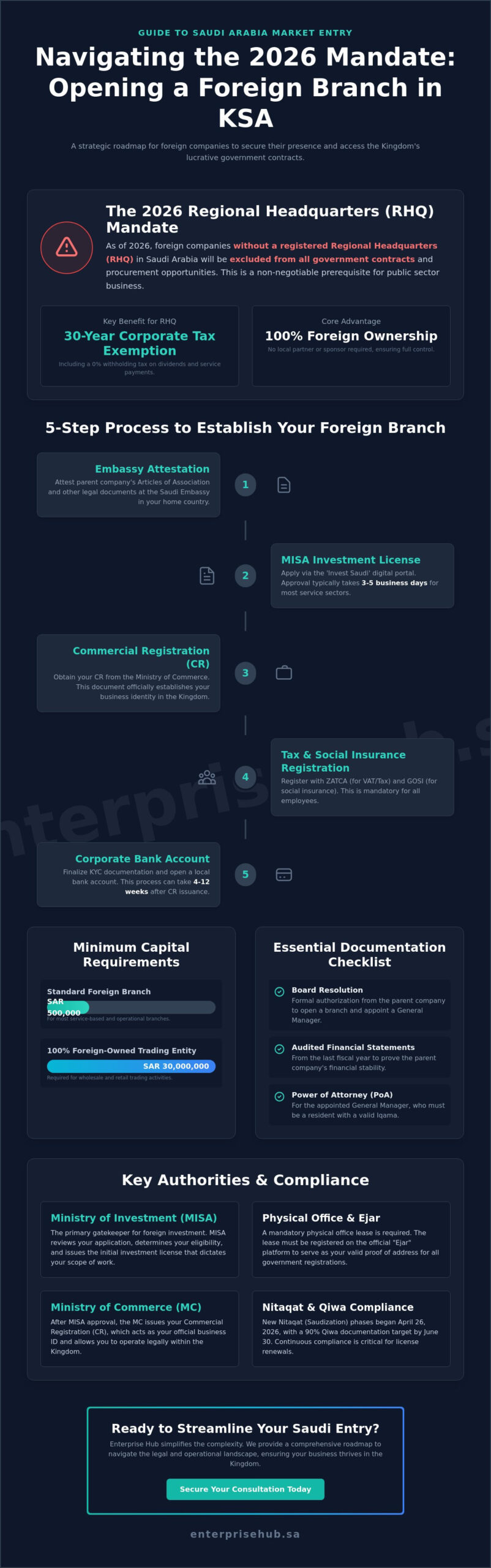
Choosing the right license is a strategic decision that dictates your scope of work. Service licenses are ideal for consulting, IT, and engineering firms. Commercial licenses are necessary for wholesale and retail activities. For instance, a 100% foreign-owned trading entity requires a minimum capital of SAR 30,000,000. Tech and industrial sectors often benefit from expedited processing times, with some licenses issued in as little as 3 to 5 business days. Most MISA licenses are issued for one year initially, with subsequent renewal cycles heavily dependent on your compliance with current Saudization and Regional Headquarters mandates.
The Ministry of Commerce (MC) Registration
Once your MISA license is secured, we assist you in obtaining your Commercial Registration (CR) from the Ministry of Commerce. This document acts as your official business identity in the Saudi market. You’ll need to submit the parent company’s Articles of Association, which must be fully attested by the Saudi Embassy in your home country. Naming conventions are strict; the branch’s name must usually match the parent company’s name followed by “Branch of a Foreign Company.” We ensure your documentation aligns perfectly with these standards to avoid administrative delays in the final registration phase. This dual-layered process ensures your branch is recognized by both investment and commercial authorities.
Step-by-Step Requirements to Open a Branch of a Foreign Company
Establishing a physical presence in the Kingdom requires a precise sequence of administrative actions. We guide you through each milestone to ensure your entry is seamless and compliant with 2026 standards. The process has become increasingly digital, yet the order of operations remains critical for a successful launch.
You begin by attesting your parent company’s documents at the Saudi Embassy in your home country. This foundation allows you to apply for the MISA Investment License via the Invest Saudi digital portal. Most service-sector licenses are now processed within 3 to 5 business days if your paperwork is in order. Approval from MISA triggers the issuance of your Commercial Registration (CR) from the Ministry of Commerce. This digital certificate is your ticket to the next phase: tax and social insurance. You must register with the Zakat, Tax and Customs Authority (ZATCA) for VAT and corporate tax, alongside GOSI for your workforce’s social insurance.
The final step is opening a local corporate bank account. While the Kingdom’s digital systems are fast, banking protocols usually take between 4 and 12 weeks to finalize after your CR is issued. We assist you in preparing the necessary KYC documentation to streamline this final hurdle and get your operations funded quickly.
Essential Documentation Checklist
Your success hinges on document accuracy. You’ll need a board resolution from the parent company that formally authorizes the branch opening and appoints a General Manager. Don’t forget your audited financial statements from the last fiscal year to prove your company’s stability. Finally, you must issue a Power of Attorney (PoA) for your appointed General Manager, who must be a resident of Saudi Arabia holding a valid Iqama.
Capital and Financial Requirements
Meeting the requirements to open a branch of a foreign company in Riyadh involves specific financial commitments. For a standard branch office, you need a minimum paid-up capital of SAR 500,000. If you’re entering the wholesale or retail trade sector with 100% ownership, that requirement increases to SAR 30,000,000. Government fees are also part of the equation. Expect a one-time MISA fee of SAR 10,000 for the first year, followed by an annual renewal fee of approximately SAR 12,000. Our experts at Enterprise Hub can help you calculate these costs precisely to ensure your budget is fully optimized for the Saudi market.
The 2026 Regional Headquarters (RHQ) Mandate
As you evaluate the requirements to open a branch of a foreign company in Riyadh, you’ll find that the legal landscape has shifted dramatically since early 2024. The Regional Headquarters (RHQ) mandate isn’t just an option anymore; it’s a strategic necessity for firms aiming to secure government contracts. We see this as a pivotal move for global brands to truly integrate into the Saudi economy. By the first half of 2024, 184 foreign companies had already relocated their regional hubs to the Kingdom, proving that the momentum is real.
To qualify as an RHQ, your company must maintain a presence in at least two countries other than Saudi Arabia and your home country. You’re also required to hire a minimum of 15 full-time employees within the first year of operation. This team must include at least two senior executives, such as a CEO or CFO, who oversee regional operations from Riyadh. Your branch must perform at least three strategic functions, like financial management, marketing coordination, or business planning, to maintain its status.
Compliance brings substantial rewards. The most attractive benefit is the 30-year corporate tax exemption on net profits, a powerful incentive for long-term growth. Additionally, RHQs receive specialized visa quotas, making it easier to bring in global talent while remaining compliant with Saudi labor laws. We help you navigate these staffing requirements to ensure your branch isn’t just a physical space, but a functional powerhouse that meets every regulatory benchmark.
Eligibility and Strategic Benefits
If your business model relies on government procurement, an RHQ is mandatory. Companies without this status are effectively excluded from the Kingdom’s government procurement pipeline in 2026. While private-sector-only operations can still function as standard branches, the prestige of being part of the “Riyadh 2030” hub offers unparalleled networking opportunities. You’ll gain a competitive edge by being physically closer to the decision-makers driving the Kingdom’s transformation.
Operational Deadlines for 2026
Enforcement is now in a strict, performance-driven phase. There are no longer broad grace periods for established firms. If you’re a new entrant, you must align your licensing with RHQ standards from day one to avoid being locked out of major projects. Transitioning from a standard branch to an RHQ is a logical step for growth, but it requires a detailed restructuring of your regional strategic functions. We assist you in managing this transition smoothly, ensuring your documentation on platforms like Qiwa stays ahead of the 90% documentation target required by June 30, 2026.
Physical Office Requirements and Proof of Address
Securing your MISA license is a significant milestone, but your operational journey truly begins with a physical footprint. To meet the requirements to open a branch of a foreign company in Riyadh, you must navigate the ‘Ejar’ system. This is the Kingdom’s mandatory electronic portal for commercial lease registration. A digital Ejar contract isn’t just a piece of paper; it’s the primary proof of address required by ZATCA, banks, and the Ministry of Commerce. We ensure your lease is compliant from day one to prevent delays in your final registration steps.
Don’t assume a virtual office will suffice for your long-term goals. While they offer initial flexibility, the requirements to open a branch of a foreign company in Riyadh in 2026 increasingly demand verifiable physical spaces for foreign entities. This is especially true for companies under the Regional Headquarters mandate, where a dedicated office is essential to house your required 15 full-time employees. Beyond legalities, a physical presence builds immediate trust with Saudi financial institutions. Banks often verify your office location before finalizing the 4 to 12-week corporate account opening process.
Your office staffing also plays a role in your address compliance. Your General Manager must be a legal resident of Saudi Arabia with a valid Iqama. This ensures there’s a local point of accountability at your registered address. We help you synchronize these residency requirements with your office setup to avoid any administrative friction during government inspections.
Private Offices vs. Shared Workspaces
Compliance isn’t just about having an address; it’s about having enough space. Your office must meet specific square footage requirements based on your projected headcount and license type. For firms seeking rapid market entry, fully serviced private offices provide a turnkey solution that includes utilities, furniture, and IT infrastructure. We specialize in integrating these physical solutions with our تأسيس شركات في الرياض services, ensuring your legal and physical foundations are built simultaneously.
The Prestige Factor: Locating in Prime Districts
Your choice of district sends a powerful message to the market. Establishing your branch in high-tier locations like the King Abdullah Financial District (KAFD) positions you at the center of the Kingdom’s economic engine. These prime districts attract international talent and offer unparalleled networking with major financial institutions. A premium address reflects your brand’s long-term commitment to Vision 2030 and enhances your credibility during government tender evaluations. If you’re ready to secure a workspace that matches your ambition, explore our premium office solutions tailored for global innovators.
Streamlining Your Saudi Entry with Enterprise Hub
Navigating the requirements to open a branch of a foreign company in Riyadh often feels like a race against shifting regulations. We simplify this journey by acting as your strategic partner on the ground. We don’t just offer advice; we provide the tangible infrastructure and local expertise required for a seamless market entry. Our integrated approach ensures that your licensing, tax registration, and physical office setup move in perfect synchronization. We help you bridge the gap between global ambition and local compliance without the typical bureaucratic delays.
We provide end-to-end support that covers every legal and operational milestone. Our specialized government relations (PRO) services handle the technicalities of ZATCA and GOSI registration, ensuring your branch is fully compliant from its first day of operation. Furthermore, we offer prestigious مكاتب للإيجار في الرياض located in the heart of the financial district. These spaces are specifically designed to meet the 2026 MISA and RHQ mandates, providing the physical footprint necessary for government tender eligibility.
Beyond the License: Integrated Business Support
Success in the Saudi market requires more than just a certificate on the wall. We empower your branch with comprehensive accounting and tax compliance services, ensuring you meet ZATCA’s rigorous reporting standards. You gain access to high-spec meeting rooms for critical board presentations and high-stakes negotiations. Beyond the physical walls, you become part of an ecosystem of like-minded global innovators. This community provides a fertile ground for networking and strategic partnerships that can accelerate your regional growth.
Your Strategic Partner in Riyadh
We are the preferred choice for international firms targeting KAFD-based operations because we understand the nuances of the local business landscape. Our flexible workspace solutions are designed to grow as your Saudi expansion gathers pace. You won’t be held back by rigid leases or administrative hurdles. We provide direct access to the Kingdom’s most ambitious business community, positioning your brand exactly where the future of Vision 2030 is being built. Secure your prestigious Riyadh office and start your branch setup today to ensure your company is ready for the opportunities of 2026 and beyond.
Securing Your Future in the Kingdom’s Economic Transformation
Success in the Saudi market during 2026 demands a shift from mere registration to strategic integration. We’ve highlighted how the Regional Headquarters mandate is now the primary gateway for government tenders, and why a physical office in a prime district is non-negotiable for banking credibility. Navigating the requirements to open a branch of a foreign company in Riyadh is a journey that rewards those who prioritize compliance and local expertise. You’ve seen that the road to expansion involves precise steps, from embassy attestation to meeting the 90% Qiwa documentation target by June 30, 2026.
We’re here to ensure your entry is both rapid and robust. As a dedicated Vision 2030 partner, we offer fully equipped offices in KAFD and comprehensive government relations support to handle the complexities of ZATCA and GOSI for you. We don’t just provide space; we provide the foundation for your regional success story. Launch your foreign branch with Enterprise Hub’s integrated solutions today. The Kingdom’s most ambitious business community is waiting for you, and we’re ready to help you lead the way.
Frequently Asked Questions
Can a foreign company own 100% of its branch in Saudi Arabia?
Yes, you can maintain 100% foreign ownership in the vast majority of investment sectors. This allows your parent company to retain full operational control and brand integrity without the need for a local Saudi shareholder or sponsor.
How long does it take to get a MISA license in 2026?
You can obtain a MISA license in as little as 3 to 5 business days for most service, technology, and consulting sectors. This rapid processing is part of a streamlined digital initiative to simplify the requirements to open a branch of a foreign company in Riyadh for global investors.
Is a local Saudi partner required to open a branch office?
No, a local Saudi partner is not required for a branch office. The current legal framework treats the branch as a direct extension of the international parent company, granting you total autonomy over your business decisions and management structure.
What is the difference between a branch and a Regional Headquarters (RHQ)?
A branch is a local operational unit, whereas an RHQ is a strategic hub that must oversee operations in at least two countries other than Saudi Arabia and the home country. RHQs require a minimum of 15 full-time employees and provide a 30-year corporate tax holiday.
Can a foreign branch bid for Saudi government contracts?
Foreign branches are generally excluded from government procurement unless they have established a Regional Headquarters in Riyadh. This regulation, enforced since January 2024, makes the RHQ mandate a critical requirement for any firm targeting the Kingdom’s massive public sector projects.
What happens if a foreign company operates without a physical office?
Operating without a physical office is impossible because a verifiable commercial lease registered in the Ejar system is mandatory for licensing. MISA and the Ministry of Commerce will not issue or renew your Commercial Registration without a valid, physical proof of address.
What are the tax implications for a foreign branch in the Kingdom?
Foreign branches are subject to a 20% corporate income tax on their net annual profits. You must also register for Value Added Tax (VAT) with ZATCA if your taxable supplies exceed the mandatory registration threshold of SAR 375,000 per year.
How much is the minimum capital for a foreign branch in Saudi Arabia?
The standard minimum paid-up capital for a foreign branch is SAR 500,000. For specific sectors like 100% foreign-owned wholesale and retail trade, the capital requirement significantly increases to a minimum of SAR 30,000,000 to ensure market stability and commitment.