
Proving to a board of directors that this dynamic national market is no longer a future opportunity but a present-day necessity requires more than just optimism. We know that the fear of regulatory red tape and the complexity of national compliance initiatives often stall even the most ambitious expansion plans. It’s difficult to quantify long-term ROI when market conditions shift so rapidly. This guide from Enterprise Hub provides the data-driven framework you need to secure C-suite buy-in by detailing the actual cost of establishing a business presence within this market and outlining a low-risk operational roadmap for 2026.
You’ll gain a clear understanding of government financial incentives and the latest regulatory requirements that have streamlined the entry process. We’ll provide a structured presentation framework designed to satisfy your senior management’s need for precision and strategic alignment. From navigating the latest national investment regulations to selecting the right physical or virtual workspace, this roadmap ensures you move from a proposal to a fully operational presence with confidence. Enterprise Hub is here to help you turn market uncertainty into a measurable competitive advantage.
Key Takeaways
- Learn how to align your corporate expansion goals with Saudi Vision 2030 to demonstrate long-term strategic feasibility to your board.
- Access a detailed breakdown of the total cost of setting up a business in Riyadh to provide your C-suite with a precise, data-driven financial roadmap.
- Discover how to leverage MISA’s streamlined licensing and the “Instant License” concept to accelerate your market entry and reduce operational downtime.
- Address common management concerns regarding regulatory complexity and Saudization (Nitaqat) with proven compliance strategies and 2026 transparency data.
- Find out how choosing the right workspace partner can solve the “immediate readiness” challenge and provide a soft landing for your regional headquarters.
Strategic Alignment: Connecting Riyadh Investment to Saudi Vision 2030
Strategic feasibility in the Saudi market goes beyond simple market entry; it represents the deliberate alignment between your corporate objectives and the National Investment Strategy. For senior management, the primary value driver isn’t just the immediate revenue potential but the long-term stability offered by a state-backed economic transformation. Saudi Arabia has successfully pivoted from an oil-dependent framework toward becoming a premier global business and logistics hub. This shift creates a unique environment where your company’s growth is supported by massive national infrastructure projects and regulatory reforms.
Securing board approval requires a clear understanding of the 2026 window. This year is critical for capturing government procurement opportunities as the Kingdom accelerates its preparations for major global events. When evaluating the cost of setting up a business in Riyadh, leaders must view these expenses as an entry ticket to a highly protected and incentivized ecosystem. Understanding Saudi Arabia’s Economic Landscape reveals a market that’s actively de-risking private sector entry by providing a decade of regulatory clarity and predictable legal frameworks. Vision 2030 effectively de-risks private sector entry by providing long-term regulatory stability that’s rare in other emerging markets.
The RHQ Program as a Feasibility Catalyst
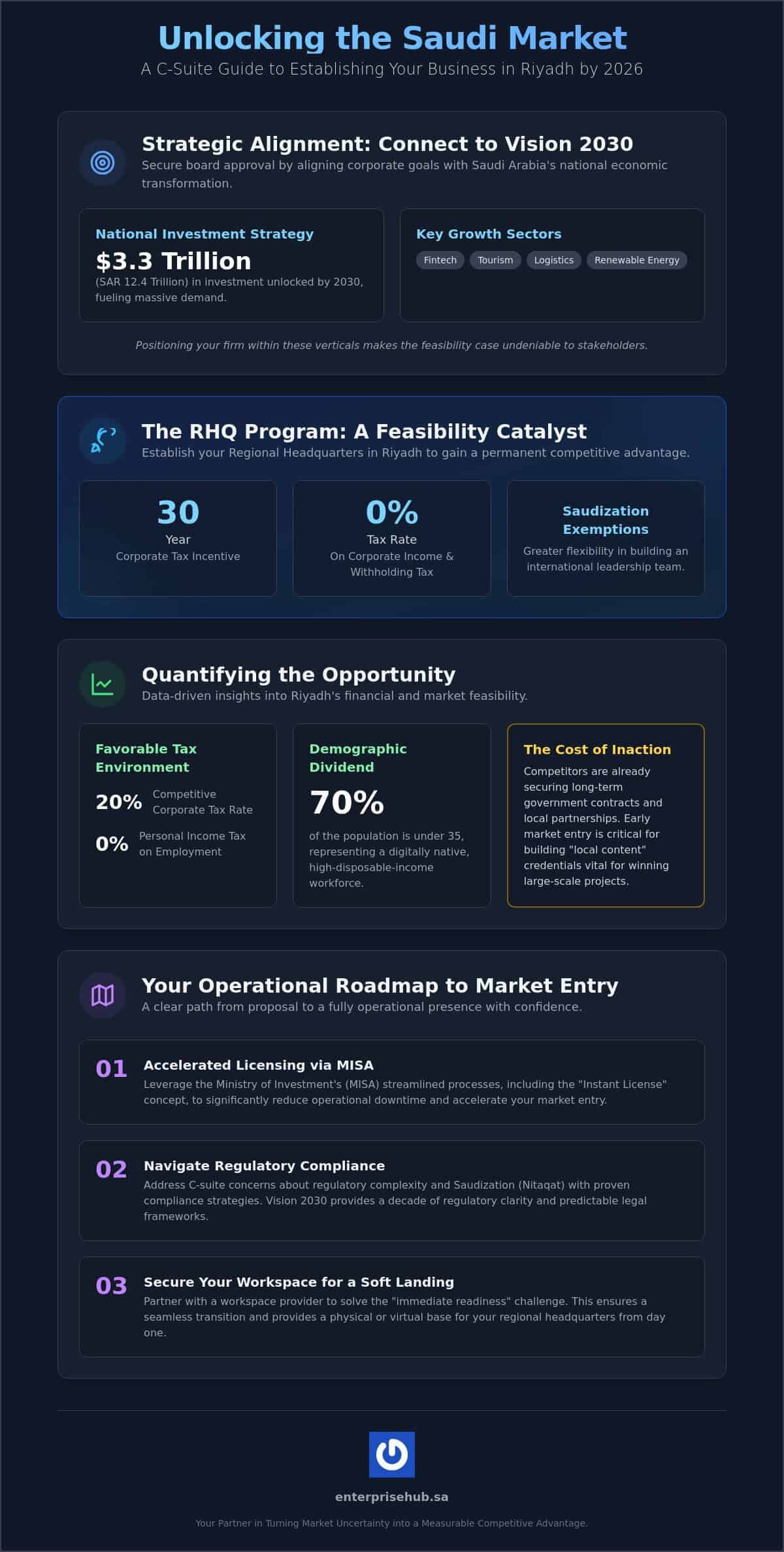
The Regional Headquarters (RHQ) program serves as a powerful strategic incentive for global firms. Companies that establish their regional base in Riyadh benefit from a 30-year corporate income tax incentive, which includes a 0% rate on corporate income tax and withholding tax for RHQ-related activities. This fiscal advantage significantly lowers the long-term cost of setting up a business in Riyadh compared to other regional hubs. Additionally, RHQ-licensed entities enjoy specific Saudization exemptions, allowing for greater flexibility in building an international leadership team. Establishing an RHQ isn’t just a compliance step; it’s a move that secures a permanent competitive advantage in the Middle East’s largest economy.
Tapping into the National Investment Strategy
The National Investment Strategy aims to unlock a staggering $3.3 trillion (SAR 12.4 trillion) in investment by 2030. This capital injection is fueling high-growth sectors such as Fintech, Tourism, Logistics, and Renewable Energy. For B2B service providers, this represents a massive surge in demand for specialized expertise and technology. We recommend reviewing our Invest in Saudi Arabia 2026 report for a deeper macro analysis of these sector specific opportunities. By positioning your firm within these high-priority verticals, you align your success with the Kingdom’s national prosperity, making the feasibility case undeniable to stakeholders.
Market and Financial Feasibility: Quantifying the Opportunity
Numbers don’t lie when it comes to the Saudi capital’s potential. Riyadh’s GDP growth projections for 2026 consistently outperform global emerging market averages. This economic momentum is anchored in Saudi Vision 2030, which prioritizes non-oil sector expansion and private sector participation. When senior management calculates the cost of setting up a business in Riyadh, they must factor in these growth premiums. Projects here often exceed global hurdle rates because the corporate tax rate is a competitive 20%, and there’s no personal income tax on employment income. This fiscal environment, coupled with access to innovative financing via platforms like Beehive, acts as a multiplier for your return on investment.
The cost of inaction is perhaps the most overlooked metric in boardrooms today. Competitors are already moving, securing long-term contracts and establishing local partnerships. By the time a traditional five-year plan is fully vetted, the most lucrative government tenders may already be awarded. Capturing market share early allows your firm to build the necessary “local content” credentials that are increasingly vital for winning large-scale projects.
Demographics and Consumer Demand
The demographic dividend in Saudi Arabia is staggering. Approximately 70% of the population is under the age of 35. This isn’t just a statistic; it’s a high-disposable-income workforce that’s digitally native and globally connected. They demand premium B2B services and innovative tech solutions. To estimate market share, firms should analyze current sector maturity. In many tech-driven verticals, the market is still in its early growth phase. Delaying entry means losing ground to early movers who are already establishing brand loyalty in a market that values long-term commitment.
Financial Incentives and ROI Benchmarks
Financial feasibility is bolstered by massive government backing through the Public Investment Fund (PIF). This sovereign wealth fund is a primary engine, injecting capital into infrastructure and local industries, which reduces systemic risk for private investors. For your initial pitch logistics, utilizing professional Meeting Rooms for Rent in Riyadh allows your team to maintain a high-level presence without immediate heavy investment.
| Category | Traditional Office (CAPEX Heavy) | Flexible Workspace (OPEX Optimized) |
|---|---|---|
| Initial Setup | High (Fit-out, Furniture) | Zero to Minimal |
| Lease Terms | 3-5 Years (Fixed) | Flexible and Scalable |
| Utilities & IT | Separate Management | Included in Fee |
| Scalability | Difficult and Costly | Instant and Seamless |
Transitioning your operational model to an agile framework allows you to test the market with lower risk. It converts potential capital expenditure into manageable operating expenses. If you’re ready to explore how a strategic presence can be established quickly, consider browsing our comprehensive business solutions designed for international firms.
Operational Feasibility: Navigating Licensing and Setup
Operational success in the Saudi market hinges on navigating a digital-first regulatory environment that rewards preparation. The Ministry of Investment (MISA) acts as your primary strategic gateway, offering a streamlined path for international firms to enter the Kingdom. For companies in eligible service sectors, the “Instant License” concept has revolutionized market entry. It allows firms to bypass traditional waiting periods and obtain their investment license within hours. This efficiency significantly reduces the initial cost of setting up a business in Riyadh by minimizing administrative delays and legal overhead.
While digital speed is essential, securing government contracts still requires a verifiable local physical presence. This isn’t just a regulatory checkbox. It’s a strategic requirement for building trust with local stakeholders and demonstrating a long-term commitment to the market. For those in Fintech or emerging technology, “sandboxing” through regulators like SAMA or the CMA provides a safe harbor. These programs allow you to test innovative products under a light-touch regulatory framework before full-scale deployment. You can find real-time updates on these sector-specific opportunities through the official Invest Saudi portal.
The MISA Licensing Process
Moving from a proposal to a legal entity involves a clear, three-step journey. First, you must obtain a MISA Investment License, which defines your permitted business activities. Second, you reserve your Trade Name through the Ministry of Commerce. Finally, you secure your Commercial Registration (CR). The integration between MISA, the Ministry of Commerce, and the Saudi Business Center (SBC) means these steps often happen through a unified digital interface. For a granular breakdown of these requirements, refer to our Guide for Company Setup in Riyadh 2026.
Local Presence and Compliance
Senior management must decide between a representative office and a full-service branch. A representative office is ideal for market research, while a branch allows you to execute contracts and generate revenue directly. Regardless of the structure, a prestigious business address is critical for brand equity and securing senior management trust. Once operational, your team will use portals like GOSI for social insurance and Muqeem for residency management. Staying ahead of these compliance requirements ensures your operations remain smooth and scalable from day one. Choosing the right partner for your initial setup can help you manage the cost of setting up a business in Riyadh while maintaining the highest standards of professional excellence.
Risk Mitigation: Addressing Senior Management Objections
Senior management often views international expansion through the lens of potential failure points. The most common objection is regulatory complexity. However, 2026 transparency data shows a significant shift in the Kingdom’s business environment. The Saudi Business Center now integrates over 160 government services into a single digital portal, drastically reducing the time spent on administrative hurdles. When you present the projected cost of setting up a business in Riyadh, emphasize that these digital efficiencies have cut down the hidden “bureaucracy tax” that previously plagued foreign investors.
Legal protection is another pillar of risk mitigation. The Saudi Civil Transactions Law provides a robust, codified framework for contracts, property rights, and commercial obligations. This legal clarity ensures that your corporate interests are protected under a system that aligns with international commercial standards. By utilizing flexible infrastructure, you can further de-risk the entry phase. Instead of committing to massive sunk costs, firms can now use agile operational models to test the market before scaling up their physical footprint.
Managing Talent and Saudization
Building a compliant local talent strategy is essential for long-term feasibility. The Saudization (Nitaqat) program is often misunderstood as a barrier, but it’s actually an opportunity to integrate into the local economy. We recommend a balanced framework that pairs your expatriate expertise with local talent development. The Human Resources Development Fund (HRDF) provides strategic support here, often subsidizing training costs for Saudi employees to ease the financial transition. For your global leadership team, the Premium Residency scheme offers a pathway for top-tier talent to secure long-term residency, ensuring leadership continuity. Factoring these human capital incentives into the cost of setting up a business in Riyadh changes the narrative from a compliance burden to a talent acquisition advantage.
Infrastructure and Real Estate Risks
Traditional five-year leases represent a significant capital risk during the initial testing phase. Contrast this with the agility of premium private offices in Grade A business districts like King Abdullah Financial District (KAFD). Being situated in a premier district isn’t just about prestige; it’s a critical factor for talent retention and networking with government entities. To minimize initial exposure, many firms are now opting for Virtual Offices in Saudi Arabia as a low-risk method to establish a legal presence while finalizing their long-term office strategy. This “soft landing” approach allows your board to see tangible results before committing to a permanent physical headquarters.
If you’re ready to secure your foothold in the capital with a strategy that minimizes risk and maximizes readiness, explore our tailored setup solutions today.
The Execution Roadmap: A Soft Landing with Enterprise Hub
The selection of a workspace partner represents the final, critical piece of your feasibility study. It transitions your plan from a theoretical model into a functioning reality. For global firms, the “Immediate Readiness” problem is often the biggest hurdle to a successful launch. By choosing fully equipped private offices, your team can begin operations the moment your license is issued. This agile approach minimizes the initial cost of setting up a business in Riyadh by eliminating the months of lead time typically associated with traditional fit-outs and utility installations.
Execution requires more than just a physical desk. It demands a suite of integrated services that handle the complexities of local regulations. A strategic partner provides essential support in areas like Accounting, Tax, and Government Relations. This allows your leadership team to focus on business development and market penetration while experts manage compliance in the background. We position this partnership as a de-risking mechanism that ensures your first 90 days are focused on growth rather than administrative friction.
Why a Strategic Partner is Essential
Relying on plug-and-play infrastructure within high-value business zones offers immediate credibility. Outsourcing back-office functions like payroll and tax filing ensures 100% regulatory compliance with ZATCA and other local authorities. Beyond the logistics, joining a dedicated hub provides immense networking value. You aren’t just renting a space; you’re entering an ecosystem populated by other global corporations and innovative Saudi firms. This proximity facilitates partnerships and market insights that would take years to cultivate in isolation. It effectively turns your office space into a strategic asset for market intelligence.
Final Boardroom Recommendations
To secure the final “yes” from senior management, summarize the case around three pillars: high growth potential, lowered entry barriers through digital transformation, and strategic government incentives. Your feasibility report should conclude with a clear roadmap that demonstrates how the cost of setting up a business in Riyadh will be managed through an OPEX-optimized model. This approach demonstrates fiscal responsibility while maintaining the flexibility to scale rapidly as opportunities arise.
Use this 90-day execution checklist for your final report:
- Days 1-30: Secure MISA Investment License and reserve trade name through the unified digital portal.
- Days 31-60: Establish your legal address and move into a premium private office hub to satisfy physical presence requirements.
- Days 61-90: Complete Commercial Registration (CR), open corporate bank accounts, and finalize tax registrations for immediate operational status.
If you’re ready to present a turn-key solution to your board, the next logical step is to explore how to Rent offices in Riyadh that align with your strategic growth targets and provide a prestigious base for your regional headquarters.
Accelerate Your Strategic Entry into the Middle East’s Largest Economy
The transition from a board-level proposal to a successful market launch requires a partner who understands the intricacies of the Saudi landscape. By aligning your corporate goals with Saudi Vision 2030 and leveraging the regional headquarters incentives, you position your firm for long-term growth. We’ve explored how a data-driven approach to the cost of setting up a business in Riyadh, combined with an agile operational model, effectively de-risks your entry and satisfies the most stringent C-suite requirements.
Enterprise Hub serves as your strategic anchor in the heart of the capital’s premier financial district. We provide the Grade-A office infrastructure and full-service support, including company setup, accounting, and government relations, needed for immediate readiness. Our goal is to ensure your transition is seamless and compliant from day one. Consult with Enterprise Hub for Your Custom Feasibility Assessment and transform your expansion vision into a measurable success story. The future of global business is happening in Riyadh; we’re here to help you lead it.
Frequently Asked Questions
What is the most important factor in a Riyadh feasibility study for 2026?
Strategic alignment with Saudi Vision 2030 is the most critical factor for success. Investors must demonstrate how their operations contribute to the Kingdom’s economic diversification and non-oil GDP growth. This alignment unlocks access to government procurement and national incentives that significantly improve long-term ROI. Senior management should prioritize projects that fit into high-growth sectors like tech, tourism, or logistics.
How does the RHQ program affect the financial feasibility of investing in Saudi Arabia?
The Regional Headquarters (RHQ) program provides a massive financial boost through a 30-year corporate income tax exemption. This includes a 0% rate on corporate income tax and withholding tax for RHQ activities. These incentives drastically lower the total cost of setting up a business in Riyadh for multinational firms looking to centralize their Middle Eastern operations and secure a competitive edge.
Can I test the Saudi market without a full physical office setup initially?
Yes, you can utilize virtual offices or co-working spaces to establish a legal presence while testing market demand. While a physical address is required for Commercial Registration (CR), high-end flexible workspace partners offer compliant solutions that satisfy regulatory needs. This approach allows your team to validate the business model without committing to the heavy CAPEX of a traditional long-term lease.
What are the typical tax implications for new international investors in Riyadh?
International investors generally face a 20% corporate income tax on net profits. Saudi Arabia doesn’t impose personal income tax on employment income, which is a major advantage for attracting global talent. You should also account for a 15% Value Added Tax (VAT) on most goods and services. It’s essential to factor these into your financial modeling to ensure accurate cash flow projections.
How long does it take to prove operational feasibility for a new branch?
Proving feasibility typically takes between 90 to 180 days after securing your Commercial Registration. This period allows you to finalize local banking, complete the initial Saudization hiring process, and begin executing your first contracts. Using turn-key office solutions can accelerate this timeline by providing immediate operational readiness. This speed is vital for capturing time-sensitive government tenders and market opportunities.
What government entities are involved in approving investment feasibility?
The Ministry of Investment (MISA) is the primary entity for issuing investment licenses and setting regulatory standards. You’ll also interact with the Ministry of Commerce for trade name reservation and the Saudi Business Center for integrated services. For specific sectors, entities like SAMA for Fintech or the Ministry of Tourism will play a direct role in granting the necessary operational approvals.
Is Saudization a significant risk to project feasibility for foreign firms?
Saudization (Nitaqat) is a manageable compliance requirement rather than a risk if you approach it strategically. The Human Resources Development Fund (HRDF) offers various subsidies to offset training and salary costs for local hires. Firms that build a compliant talent strategy early find that local employees provide invaluable market insights and cultural capital that are essential for long-term growth.
How do flexible workspaces improve the financial feasibility of market entry?
Flexible workspaces convert high upfront capital expenditures into predictable operating expenses. This shift significantly reduces the initial cost of setting up a business in Riyadh by including utilities, maintenance, and IT infrastructure in a single monthly fee. It allows your board to scale operations up or down based on real-time performance without the burden of long-term real estate liabilities.