
The traditional wisdom that a Limited Liability Company is always the superior choice for entering the Kingdom has shifted. In 2026, your decision between an LLC vs branch office in Saudi Arabia is no longer just about liability; it’s a high-stakes strategic move dictated by your eligibility for the Regional Headquarters (RHQ) program and your long-term government contracting goals. You’ve likely recognized that the Saudi market offers unparalleled growth, yet the evolving MISA licensing landscape and the April 2026 Nitaqat updates can make the initial steps feel like a regulatory maze.
We’ll provide you with a clear decision matrix that cuts through the complexity of the 2026 tax and Saudization landscape. You’ll gain a comprehensive understanding of the legal structures, tax obligations, and the specific physical office requirements needed to secure your Commercial Registration. We’ll also outline a roadmap for compliance that ensures your setup is both efficient and scalable. By the end of this comparison, you’ll have the clarity required to select the optimal entry strategy and begin your success story in the Kingdom’s thriving economy.
Key Takeaways
- Understand how the 2026 MISA framework and Vision 2030 initiatives influence your entity choice and long-term market sustainability.
- Discover the strategic benefits of an LLC, including the protection of separate legal personality and the latest 100% foreign ownership regulations.
- Learn why a branch office might offer a faster route to market and the specific scenarios where it outperforms a subsidiary for international parents.
- Access a definitive decision matrix for an LLC vs branch office in Saudi Arabia that factors in the critical 2026 Regional Headquarters (RHQ) requirements.
- Identify mandatory physical office requirements and how the Ejar system integrates with your Commercial Registration to ensure full regulatory compliance.
Navigating Saudi Business Entities in 2026: The MISA Framework
Saudi Arabia’s economic landscape has undergone a radical transformation under Vision 2030. The Kingdom is no longer just an oil-dependent nation; it’s a global investment hub that actively courts foreign capital through the National Investment Strategy. For any international firm, success begins with understanding the regulatory gateway. Your choice between an LLC vs branch office in Saudi Arabia acts as the foundation for your Commercial Registration (CR) and dictates how you’ll interact with the Saudi market for years to come. Choosing the wrong structure early can lead to administrative hurdles or restricted access to lucrative government tenders.
The Ministry of Investment (MISA) serves as the primary regulator and facilitator for all foreign-owned entities. Before you can register with the Ministry of Commerce, you must secure a MISA Investment License. This license is the prerequisite for your legal existence in the Kingdom. It defines what you can do, where you can operate, and which structural path you’re eligible to follow. A Saudi Limited Liability Company (LLC) serves as the primary vehicle for 100% foreign-owned commercial activity, offering a distinct legal personality that separates the entity’s liabilities from its shareholders.
The Impact of Vision 2030 on Corporate Structures
The National Investment Strategy has moved the goalposts for foreign investors. In 2026, the Saudi government prioritizes companies that demonstrate a long-term commitment to the local economy. This shift has made “fly-in, fly-out” business models effectively obsolete. If you want to secure significant government contracts, you’ll likely need to align with the Regional Headquarters (RHQ) program. This initiative rewards companies that establish a substantial local presence with tax incentives and preferential treatment in procurement. Your entity selection should reflect these strategic goals rather than just immediate administrative ease.
MISA Licensing Basics for Foreign Investors
Securing a MISA license isn’t a one-size-fits-all process. The Ministry categorizes licenses based on your business activity, such as service, industrial, or commercial. Each category has its own set of requirements and minimum capital expectations. For instance, an industrial license might require a higher capital commitment but offers access to specialized industrial cities and utility subsidies. Your specific ISIC (International Standard Industrial Classification) codes will ultimately determine whether an LLC or a branch office is the most viable path for your operations. We’ll help you navigate these codes to ensure your license matches your actual business intentions.
The Saudi Limited Liability Company (LLC): Flexibility and Growth
The Limited Liability Company (LLC) remains the gold standard for international firms seeking a permanent, scalable presence in the Kingdom. Its primary appeal lies in its status as a separate legal entity. This structure creates a robust “corporate veil” between the parent company and the Saudi subsidiary. If the Saudi entity faces financial or legal challenges, the parent company’s global assets remain protected. This distinction is a fundamental difference in the LLC vs branch office in Saudi Arabia debate, as it allows for aggressive local growth without exposing the entire international organization to localized risk.
Ownership regulations have evolved significantly to favor the investor. Most sectors now permit 100% foreign ownership, a detail highlighted frequently on the Invest Saudi official portal. You no longer need a local partner to enter the market, though some investors still choose joint ventures for strategic local insights. Under the 2022 Companies Law, there’s no longer a statutory minimum capital requirement for service-based LLCs. However, practical experience shows that MISA and local banks typically expect a paid-up capital between SAR 100,000 and SAR 500,000 to establish operational credibility. Industrial LLCs maintain a higher threshold, requiring at least SAR 1 million.
Advantages of the Saudi LLC
Choosing an LLC grants your business a “local” identity that resonates well with both government and private sector clients. This structure simplifies the process of entering into local contracts and participating in massive government tenders under Vision 2030. Management is also flexible. You can appoint a single General Manager or establish a full Board of Directors. This adaptability makes the LLC the preferred vehicle for long-term expansion and complex operations. While the legal structure provides the framework, utilizing professional business setup services can bridge the gap between initial registration and operational readiness.
Key Considerations and Compliance
Operating an LLC brings specific compliance obligations that require disciplined management. Every Saudi LLC must undergo an annual statutory audit by a locally licensed accounting firm. Your Articles of Association (AoA) serve as the governing document, and they must align strictly with Saudi law to be enforceable. Regarding fiscal responsibilities, foreign-owned shares in an LLC are subject to a 20% corporate income tax on net adjusted profits. If there are Saudi or GCC shareholders, their portion is subject to Zakat at a rate of 2.5%. Navigating these requirements demands a clear roadmap from day one to avoid penalties from the Zakat, Tax and Customs Authority (ZATCA).
Establishing a Branch Office: Streamlined Market Entry
A branch office represents the most direct way to plant your flag in the Kingdom without the structural complexities of creating a new corporate citizen. Unlike the LLC structure, a branch acts as an operational extension of the foreign parent company. It carries the parent company’s name, global reputation, and its full legal weight. This direct connection simplifies many internal reporting processes, as the branch’s financial performance flows directly into the parent company’s consolidated books. A branch office must perform the same activities as its parent company, ensuring that your Saudi operations remain perfectly aligned with your global core competencies.
However, this lack of legal separation comes with a significant caveat that every board must consider. The parent company remains 100% responsible for every contract signed, every debt incurred, and every legal dispute faced by the Saudi branch. When weighing the LLC vs branch office in Saudi Arabia, businesses must determine if their risk appetite allows for such direct exposure. While an LLC limits risk to the capital invested in the subsidiary, a branch keeps the parent company’s global assets on the table. For many, this is a fair trade-off for the increased speed and reduced administrative friction during the initial setup phase.
Despite the liability risks, the branch office is frequently the fastest route to market for established international firms. Insights from the World Bank’s Doing Business report reflect the Kingdom’s significant strides in reducing administrative hurdles for foreign entrants. Because there’s no need to draft complex Articles of Association or negotiate shareholding agreements among partners, the MISA approval process for branches can move with impressive efficiency. You are essentially registering an existing entity rather than birthing a new one.
When to Choose a Branch Office
A branch office is often the ideal choice for project-specific contracts with a defined timeline, such as a three-year infrastructure project or a specialized consulting engagement. It offers a streamlined reporting structure back to global headquarters, avoiding the need for a separate board of directors in Saudi Arabia. This model carries a lower administrative burden compared to a full subsidiary LLC, making it a favorite for companies that want to “test the waters” or fulfill a specific government contract without committing to a permanent subsidiary structure.
The Registration Roadmap for Branches
The path to establishing a branch is methodical and relies heavily on the parent company’s existing standing. First, you’ll need a formal Board Resolution from the parent company authorizing the branch and appointing a General Manager. Second, all corporate documents, including the parent’s Certificate of Incorporation, must undergo attestation at the Saudi Embassy in your home country. Finally, you’ll submit these through the MISA portal for your investment license and subsequent Commercial Registration. Keep in mind that a branch typically requires a capital deposit of SAR 500,000, which serves as a baseline for your operational credibility in the local market.
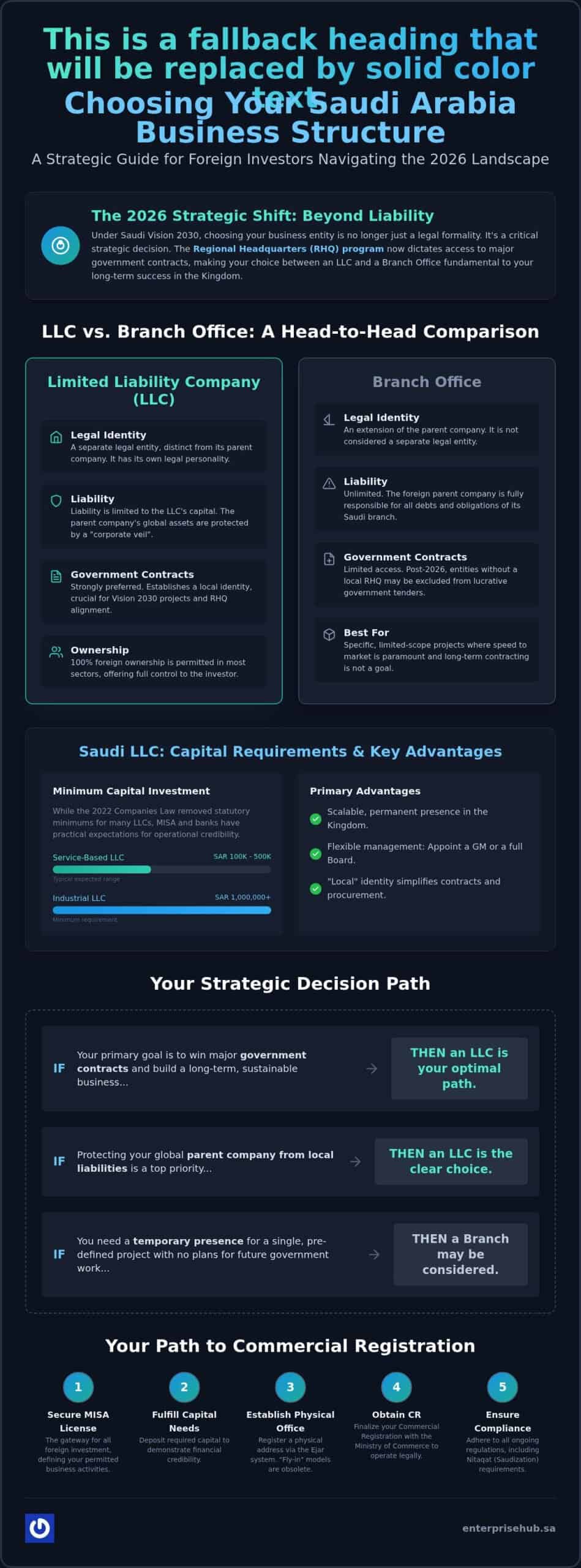
LLC vs. Branch Office: The 2026 Selection Matrix
Deciding on the right structure requires a side-by-side analysis of capital availability and long-term objectives. While the LLC offers a lower practical capital entry point for services, often starting between SAR 100,000 and SAR 500,000, a branch typically necessitates a SAR 500,000 deposit. The most decisive factor in 2026 is the Regional Headquarters (RHQ) program. Foreign firms aiming for government contracts exceeding SAR 1 million must establish an RHQ. This initiative often dictates the underlying legal structure and determines your eligibility to compete in the Kingdom’s massive procurement pipeline. Choosing an LLC vs branch office in Saudi Arabia is now a decision that directly impacts your revenue potential from public sector projects.
Annual maintenance costs remain relatively consistent across both entities. You should budget for a MISA annual service fee of approximately SAR 60,000 and a Commercial Registration renewal of SAR 1,200. Chamber of Commerce memberships add another SAR 2,000 to SAR 10,000 to your yearly overhead, depending on your company’s classification. The primary difference lies in the administrative burden of the parent company. A branch’s lack of separate legal personality means the parent’s global balance sheet is directly tied to these local obligations and any potential legal disputes within the Kingdom.
Comparing the Tax Landscape
The tax environment for foreign investors is transparent but demands strict compliance. Foreign entities pay a 20% corporate income tax on net adjusted profits. If your structure includes Saudi or GCC partners, Zakat at 2.5% applies to their specific share. Branches face unique complexities regarding withholding tax on payments made to the parent company, which can range from 5% to 20% depending on the service type and applicable tax treaties. Navigating these fiscal requirements is a critical step for those who plan to Invest in Saudi Arabia 2026 and beyond.
The Operational Reality: Banking and Visas
Opening a corporate bank account is often the first major operational hurdle. LLCs generally find this process more straightforward because they are registered as local Saudi entities. For staffing, the Nitaqat program’s newest phase, effective April 26, 2026, imposes strict Saudization quotas. For example, marketing roles require 60% Saudization, while engineering roles require 30%. All employment contracts must be processed through the Qiwa platform to be recognized by the Ministry of Human Resources and Social Development. If you’re looking to streamline these administrative tasks, our team offers specialized business setup and compliance support to help you hit the ground running.
Operationalizing Your Setup: Physical Presence Requirements
Securing your MISA license is a significant milestone, but your journey to operational readiness doesn’t end there. You cannot finalize your Commercial Registration (CR) without a verified physical address in the Kingdom. This requirement applies regardless of whether you choose an LLC vs branch office in Saudi Arabia. The Saudi government uses the physical office as a primary indicator of “substance,” ensuring that foreign firms are truly invested in the local economy rather than just operating as shell entities. Failing to provide a valid address will stall your registration and prevent you from opening bank accounts or hiring staff.
The Ejar system acts as the digital bridge between your lease and your legal status. Every commercial lease must be registered on this platform to be recognized by the Ministry of Commerce. When you sign a contract for your office, the landlord issues an Ejar certificate that links directly to your CR. This integration ensures transparency and protects your rights as a tenant. For many investors, choosing between virtual offices in Saudi Arabia and traditional physical spaces depends on their immediate hiring needs and the specific requirements of their MISA license type.
Enterprise Hub simplifies this transition by providing the physical infrastructure required for full compliance. We offer premium private offices and flexible coworking spaces that satisfy every regulatory check. By choosing a serviced workspace, you bypass the long lead times associated with traditional real estate, allowing you to go live in days rather than months. We bridge the gap between your legal registration and your daily operations, providing a professional environment that reflects your brand’s global standards.
The Role of Premium Workspaces in MISA Compliance
Regulatory audits often focus on whether a company maintains a genuine presence. Premium serviced offices provide the necessary “substance” for tax and regulatory inspections, offering dedicated phone lines, meeting rooms, and administrative support. These spaces are particularly beneficial for those following our guide on setting up companies in Riyadh, where the business hub’s pace demands immediate agility. A strategic address in a recognized business district enhances your credibility with local partners and government agencies alike.
Beyond the Address: Government and Support Services
Operating in Saudi Arabia requires navigating several interconnected government portals. Once your address is secured, you must register with the General Organization for Social Insurance (GOSI) and the Ministry of Labor (MOL). These registrations are essential for managing your workforce and staying compliant with Saudization quotas. We recommend leveraging local expertise for these tasks, as accounting and tax support are non-negotiable for foreign firms facing ZATCA’s e-invoicing requirements. Your next step is to book a consultation with our team to secure a turnkey setup that handles everything from your physical office to your final government approvals.
Accelerate Your Strategic Entry into the Kingdom
Choosing between an LLC vs branch office in Saudi Arabia is the first decisive step in your Vision 2030 success story. You’ve seen how the LLC offers robust liability protection for long-term growth, while a branch office provides a streamlined path for project-specific entries. Both structures demand a firm commitment to local substance, starting with the mandatory physical office address required to secure your Commercial Registration. Navigating the 2026 MISA landscape requires more than just legal knowledge; it requires a strategic partner who can turn regulatory requirements into operational advantages.
We empower your expansion by providing MISA-compliant office solutions and turnkey business setup services. Our team handles the complexities of government relations and administrative compliance, allowing you to focus on your core business objectives. By establishing a strategic presence in Saudi Arabia’s premier business districts, you ensure your company is positioned at the center of the Kingdom’s economic transformation. Secure your Saudi business address and start your setup with Enterprise Hub today. We’re ready to support your journey toward growth and prosperity in this dynamic market.
Frequently Asked Questions
Can a foreign company own 100% of a Saudi LLC in 2026?
Yes, foreign investors can maintain 100% ownership of a Saudi LLC in 2026 across most commercial and service sectors. The Ministry of Investment (MISA) has streamlined this process to align with Vision 2030 goals, removing the previous requirement for a local Saudi partner. You can control your operations entirely while benefiting from the legal protections of a local subsidiary registered within the Kingdom.
What is the minimum capital requirement for an LLC in Saudi Arabia?
There is no longer a statutory minimum capital for a services-based LLC under the 2022 Companies Law. However, MISA and local banks practically expect a paid-up capital between SAR 100,000 and SAR 500,000 to ensure operational credibility and smooth account opening. Industrial LLCs are different; they still require a minimum capital of SAR 1 million to secure the necessary industrial licensing.
Is it easier to open a bank account for an LLC or a branch office?
Opening a corporate bank account is typically more efficient for an LLC. Since an LLC is registered as a local Saudi entity with its own legal personality, banks find the KYC and compliance checks more straightforward. Branch offices often face longer processing times as banks must review the parent company’s global documentation, financial history, and legal standing in its home country before approval.
How does the Regional Headquarters (RHQ) program affect branch offices?
The RHQ program significantly influences the LLC vs branch office in Saudi Arabia decision for large multinational firms. As of 2026, companies seeking to participate in government contracts exceeding SAR 1 million must establish a Regional Headquarters. While an RHQ has its own specific licensing path, its presence often determines whether a firm should operate through a branch or a separate subsidiary to maximize tax incentives.
Do I need a local Saudi partner to establish a branch office?
You don’t need a local Saudi partner to establish a branch office. A branch is legally considered an extension of your existing foreign parent company rather than a separate legal person. This allows you to maintain full control over the Saudi operations and its management without sharing equity or decision-making power with a local third party or partner.
What are the physical office requirements for a MISA license?
A verified physical office address is a mandatory requirement for all MISA-licensed entities. You must provide a registered lease through the Ejar system to obtain your Commercial Registration (CR). This physical space must meet “substance” requirements for tax and regulatory audits. Many firms choose serviced offices or private workspaces to satisfy this requirement quickly during the initial setup phase.
How long does it take to register a foreign branch in Saudi Arabia?
Registering a foreign branch typically takes between three to six weeks, depending on the speed of document attestation in your home country. Because a branch doesn’t require drafting local Articles of Association, the MISA approval phase is often faster than that of an LLC. However, the time required for embassy attestation of parent company corporate documents remains the primary variable in the timeline.
Can an LLC convert into a branch office later on?
You cannot directly convert an LLC into a branch office or vice versa under current Saudi corporate law. Each structure has a distinct legal foundation and separate tax registration with ZATCA. If you wish to change your entity type, you must usually liquidate the existing structure and re-register the new one, which involves a fresh application for a MISA investment license and Commercial Registration.