
Is your technology venture ready to keep pace with a Kingdom that’s redefining the global digital economy? By 2026, the Saudi market isn’t just an opportunity; it’s a high-speed ecosystem where regulatory precision is the only currency that truly matters. We know that the requirements for setting up a tech company in KSA can feel like a complex puzzle of MISA licensing, Nitaqat quotas, and the fully enforced Personal Data Protection Law. You’re right to feel that the transition is demanding, especially when you’re trying to balance technical innovation with a 20% corporate income tax and strict ZATCA e-invoicing standards.
This strategic guide promises to dismantle those barriers, giving you the clarity needed to launch your venture with absolute confidence and a fully compliant operational status. We’ll walk you through the essential steps to securing your MISA license, navigating the June 2026 engineering localization benchmarks, and establishing a prestigious business address that anchors your brand. From managing the SAR 10,000 first year service fees to mastering the Qiwa platform for Saudi contracts, we provide the roadmap to turn your vision into a landmark success within the Saudi landscape.
Key Takeaways
- Identify high-growth opportunities within the Saudi ICT sector by aligning your venture with Vision 2030 priorities in AI, Fintech, and EdTech.
- Navigate the essential requirements for setting up a tech company in KSA, focusing on the dual-step process of securing a MISA Investment License and Commercial Registration.
- Establish a robust legal foundation by ensuring your digital operations comply with mandatory CST registration and the latest Personal Data Protection Law (PDPL) standards.
- Secure compliant physical infrastructure and implement strategic talent plans to meet Nitaqat (Saudization) quotas effectively.
- Streamline your market entry by leveraging expert government relations and professional setup services to handle complex bureaucratic procedures with precision.
Navigating the Saudi Tech Ecosystem in 2026
Saudi Arabia has solidified its position as the premier technology hub in the Middle East. This transformation isn’t accidental. It’s the result of a deliberate, multi-billion riyal investment strategy under Vision 2030. For international founders, the requirements for setting up a tech company in KSA begin with a deep understanding of this shifting landscape. The Kingdom is no longer just a consumer of global tech; it’s a fertile ground for AI, Fintech, Cloud Computing, and EdTech innovations. Success here requires more than just a great product. It demands alignment with national priorities and a presence in the heart of the action.
The strategic importance of the Saudi market lies in its scale and purchasing power. However, entering this market involves navigating specific mandates like the Regional Headquarters (RHQ) requirement. To compete for lucrative government contracts, international firms must establish their primary regional base within the Kingdom. The Ministry of Investment (MISA) facilitates this transition, acting as a bridge for companies looking to scale across the MENA region from a foundation within the Kingdom. This move signals long-term commitment and unlocks doors to the Kingdom’s most ambitious projects.
The Digital Transformation Mandate
Government-led digitization is the primary driver of demand for private tech firms. From the mandatory FATOORAH e-invoicing system to the comprehensive Qiwa platform for labor management, every regulatory shift creates a need for sophisticated software solutions. These aren’t just administrative hurdles; they’re market opportunities for agile tech providers. The National Technology Development Program (NTDP) functions as a strategic financial catalyst in 2026 by offering specialized grants and debt financing to accelerate the growth of both local and international tech ventures. This support system ensures that companies with the right solutions have the capital to deploy them effectively.
Market Entry Strategies for Tech Founders
The legal landscape has evolved to empower founders. You’re no longer required to seek local partners for majority ownership in the tech sector. The shift toward 100% foreign ownership has fundamentally changed the requirements for setting up a tech company in KSA, offering entrepreneurs total autonomy over their operations and intellectual property. While direct entry is common for maintaining brand control, some still find value in joint ventures to gain immediate access to established local networks.
Choosing the right physical infrastructure is equally critical. MISA regulations require a valid commercial address to maintain your license. You can start with virtual office packages to establish a legal presence or move directly into private offices to accommodate a growing team. The competitive landscape in 2026 is sophisticated. Founders who combine high-tier infrastructure with a “compliance-first” mindset will find the Saudi market both welcoming and highly rewarding.
Essential Legal and Licensing Frameworks for Tech Entities
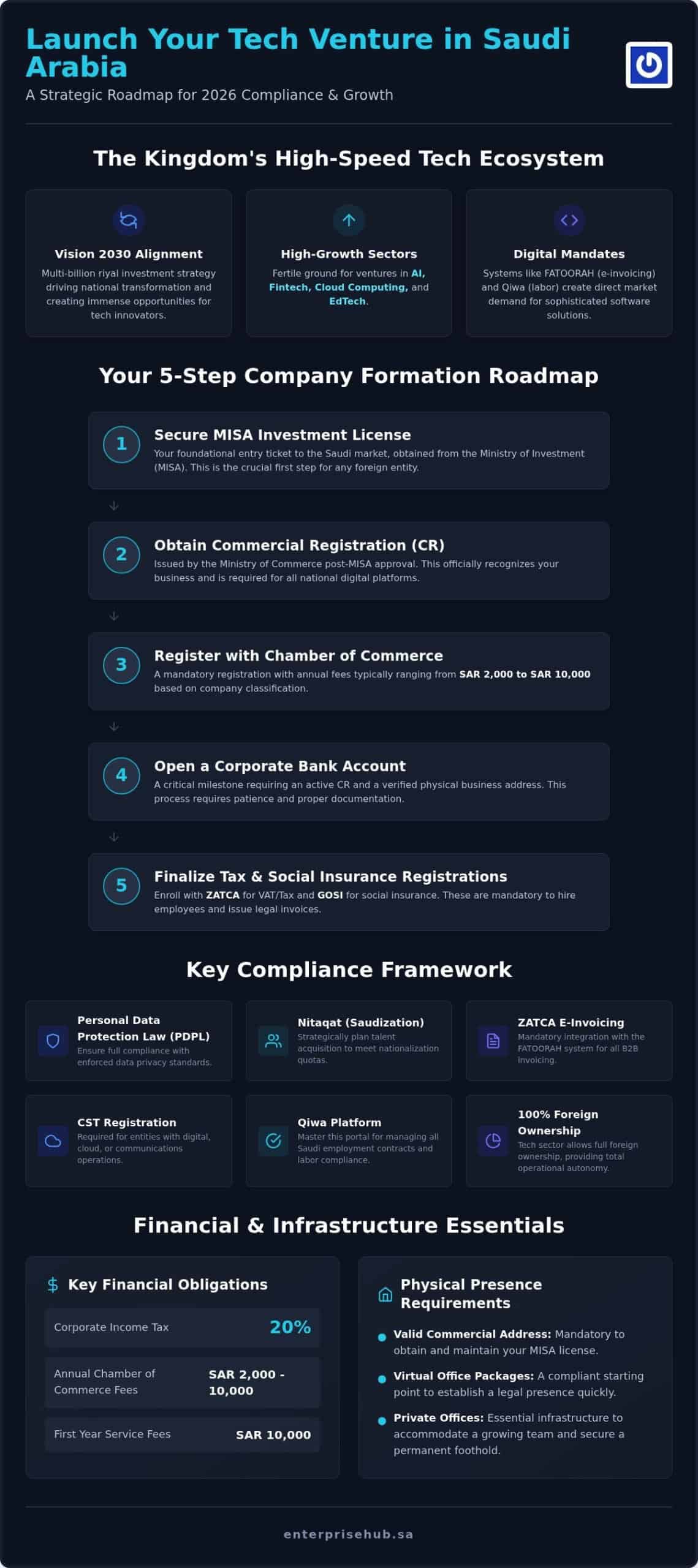
Establishing a tech presence in Saudi Arabia requires a sequential approach to legal compliance. The foundational requirements for setting up a tech company in KSA start with obtaining an investment license from the Ministry of Investment. This document isn’t just a permit; it’s your entry ticket to the Saudi market. Once issued, you move to the Ministry of Commerce for your Commercial Registration (CR). This synergy between MISA and the Ministry of Commerce ensures your business is recognized across all national digital platforms, including the vital Qiwa and Muqeem portals.
Following the CR issuance, you must register with the Chamber of Commerce, where annual fees typically range from SAR 2,000 to SAR 10,000 based on your company’s capital and classification. In 2026, opening a corporate bank account remains a critical milestone that requires patience. Banks now mandate a fully active CR and a verified physical address, often verified through a virtual office package or a private lease. Finally, you must enroll in the ZATCA system for VAT and tax compliance, alongside GOSI for social insurance. These registrations are mandatory for any entity wishing to hire talent or issue legal invoices within the Kingdom.
MISA Licensing Categories for Tech
Choosing the right license category is vital for your operational flexibility. Most software firms and digital platforms opt for a Services License. However, if your tech venture involves manufacturing hardware or local assembly, an Industrial License is necessary. You can check the latest regulatory updates on the official MISA portal to ensure your documentation is current. For innovative startups, the Entrepreneur License offers a streamlined path with lower initial costs, provided you have venture capital backing or a registered patent. Standard MISA applications usually take 5 to 15 business days to process once the SAR 2,000 initial application fee is paid.
Commercial Registration (CR) and Business Activity Codes
Your CR must accurately reflect your business through specific ISIC codes. For tech companies, selecting the correct codes for software development, IT consulting, or data processing is essential. Consistency is key. Your activities listed on the CR must match your MISA license and your ZATCA filings to avoid administrative delays or fines. If your venture spans multiple domains, you can include several activities under one CR, provided they are logically related. Navigating these bureaucratic layers is easier with a partner who understands the nuances of local regulation. If you’re feeling overwhelmed by the paperwork, you can connect with our consultants to simplify the entire setup process.
Sector-Specific Tech Regulations: Data, Cloud, and CST
Securing your MISA license is only the first step in a multi-layered regulatory journey. Tech firms face a second, equally critical layer of oversight that many general guides overlook. The requirements for setting up a tech company in KSA involve mandatory registration with the Communications, Space & Technology Commission (CST). This body acts as the primary regulator for the ICT sector, overseeing everything from cloud service providers to telecommunications equipment. If your business model involves hosting data, providing internet-based services, or managing digital infrastructure, you’ll need to secure specific CST permits before you can legally sign your first client.
Cybersecurity is another non-negotiable pillar for 2026 operations. The National Cybersecurity Authority (NCA) sets the Essential Cybersecurity Controls (ECC) that all tech entities must implement. These standards aren’t just suggestions; they’re often integrated into government procurement requirements and private sector audits. We’ve seen that companies prioritizing NCA compliance from day one find it much easier to scale into high-value contracts. By aligning your security protocols with national frameworks early, you build the trust necessary to operate within the Kingdom’s sensitive digital ecosystem.
Data Residency and Sovereignty Rules
The Personal Data Protection Law (PDPL), which reached full enforcement on September 14, 2024, dictates how you handle user information. You must store Saudi citizen data on servers physically located within the Kingdom unless you receive specific exemptions for cross-border transfers. These rules ensure national data sovereignty and protect user privacy against unauthorized global access. Compliance requires clear data mapping, robust consent mechanisms, and a local data protection officer in many cases. Non-compliance with the PDPL can result in criminal penalties including imprisonment for up to two years or fines reaching SAR 5,000,000.
Fintech and Specialized Licensing
Startups in the financial sector face additional scrutiny from the Saudi Central Bank (SAMA). The SAMA Regulatory Sandbox allows fintech firms to test innovative products in a live environment under relaxed regulatory requirements before full commercialization. This is a vital stepping stone for digital payment platforms and e-commerce ventures that handle financial transactions. Beyond SAMA, digital payment providers must also secure specific permits for electronic money institutions (EMI). Understanding these layers is part of a broader Invest in Saudi Arabia 2026 strategy that prioritizes long-term stability. The requirements for setting up a tech company in KSA within the fintech space are the most rigorous, but they offer the highest barriers to entry for competitors once you’re fully licensed.
Infrastructure and Human Capital Requirements
Beyond the initial legal paperwork, the requirements for setting up a tech company in KSA extend into your physical presence and human resource management. You can’t operate a MISA-licensed entity in a vacuum. Every business must be linked to a verified commercial address to maintain its standing with the Ministry of Commerce. This address serves as more than just a mailing point; it’s the foundation for your labor files on the Qiwa platform and your registration with the national address system. Without a compliant physical or virtual footprint, your ability to issue visas or secure government contracts remains frozen.
Managing human capital in 2026 requires a firm grasp of the Nitaqat (Saudization) system. To hire international tech talent, you must first meet specific localization quotas that vary by sector and company size. For instance, establishments with five or more employees must achieve a 30% localization rate for engineering professions by June 30, 2026. All Saudi employee contracts must be documented on the Qiwa platform to count toward these quotas. Additionally, your payroll must align with the Mudad system to stay compliant with the Wage Protection Program. Remember that a minimum monthly wage of SAR 4,000 is required for a Saudi national to be fully counted in your Nitaqat quota, while marketing roles require a minimum of SAR 5,500.
Choosing the Right Workspace Solution
Tech teams often start lean, but scaling rapidly is the primary goal. While shared workstations offer flexibility for solo founders, private offices in KSA provide the privacy and security necessary for handling sensitive code and proprietary data. A prestigious business address in a prime district does more than satisfy MISA; it builds immediate authority with local investors and partners who value stability. Choosing a space that can grow with your team ensures you don’t face administrative delays when you need to expand your headcount.
Virtual Offices and Compliance
For many international founders, virtual office packages are the most efficient way to satisfy the initial requirements for setting up a tech company in KSA. This solution allows you to secure your MISA license and CR without the overhead of a large physical footprint during the market-entry phase. It’s a strategic choice for companies that manage remote development teams but need a legal anchor in the Kingdom. As your team grows and your Saudization requirements increase, transitioning to a dedicated physical space becomes a natural next step. To ensure your infrastructure meets every regulatory benchmark from day one, consult with our setup experts today for a tailored roadmap.
Accelerating Your Tech Launch with Enterprise Hub
Launching a technology venture in a market as dynamic as Saudi Arabia requires more than just a visionary product. It demands a partner who understands that regulatory precision is the foundation of scalable growth. We position ourselves as that strategic bridge, transforming the complex requirements for setting up a tech company in KSA into a streamlined, manageable roadmap. Our end-to-end business setup services handle the heavy lifting of MISA licensing and Commercial Registration, allowing you to focus on your core innovation while we secure your legal standing in the Kingdom.
Bureaucracy shouldn’t be a bottleneck for your progress. Our dedicated Government Relations Officers (GRO) possess deep expertise in local administrative protocols, ensuring your applications move through government portals with speed and accuracy. Beyond the initial setup, we provide comprehensive accounting and tax management services. We ensure your venture remains fully compliant with ZATCA’s evolving regulations, including the mandatory FATOORAH e-invoicing standards. By integrating legal, financial, and operational support, we provide a “Compliance-First” environment where your tech venture can thrive without the risk of administrative setbacks.
The Enterprise Hub Advantage for Tech Firms
Success in the Saudi tech ecosystem is often about who you know and where you’re located. Choosing our ecosystem gives you more than just a desk; it provides access to a prestigious network of professional tech founders and strategic investors. We offer a seamless integration of legal infrastructure and high-tier physical space. Whether you need the agility of coworking and flexi desks for your initial team or a more permanent base, our solutions grow alongside your venture. This flexibility ensures that your workspace always aligns with your current headcount and your Nitaqat localization goals.
Next Steps: Your Roadmap to Compliance
Your journey toward a fully operational status begins with a thorough initial consultation. We review your documentation and business model to ensure it meets the specific requirements for setting up a tech company in KSA for your chosen niche. In 2026, founders can expect a MISA license to be processed within 5 to 15 business days, followed by the issuance of the Commercial Registration. We manage this timeline meticulously, coordinating with all relevant ministries to ensure a synchronized launch. Your path to market leadership in the Kingdom is clear. Contact Enterprise Hub today for a strategic consultation and take the first step toward establishing your tech legacy in Saudi Arabia.
Secure Your Place in Saudi Arabia’s Digital Future
The Saudi technology landscape in 2026 offers unparalleled growth for those who prioritize regulatory excellence. Success depends on mastering the requirements for setting up a tech company in KSA, from securing your MISA license to navigating the specific data residency mandates of the PDPL. You’ve seen throughout this guide that a “Compliance-First” approach isn’t just about following rules. It’s about building the institutional trust required to scale within the Kingdom’s ambitious ICT sector and securing your competitive edge.
Enterprise Hub stands ready as your strategic partner in this journey. We provide the expert MISA and government relations support needed to dismantle bureaucratic barriers before they slow your momentum. Our comprehensive services include compliant accounting and ZATCA tax management, alongside premium business addresses that satisfy every regulatory benchmark. Whether you’re hiring your first local team through the Qiwa platform or establishing a high-tier private office, we ensure your operational status remains impeccable.
The Kingdom’s digital transformation is moving fast. Don’t let administrative complexity hold your innovation back. Launch your tech company in KSA with expert support and join a thriving ecosystem designed for your success. We’re here to help you turn these strategic requirements into a foundation for lasting growth and prosperity.
Frequently Asked Questions
What is the minimum capital required to start a tech company in KSA?
Most technology service licenses don’t require a specific statutory minimum capital, although we recommend a practical baseline of SAR 100,000 to ensure smooth banking and visa approvals. This amount should be clearly reflected in your articles of association during the setup process. Demonstrating financial readiness is a key part of the requirements for setting up a tech company in KSA during the initial MISA evaluation phase.
Can a foreigner own 100% of a technology company in Saudi Arabia?
Yes, foreign investors can maintain 100% ownership of their tech entities without the need for a local Saudi partner. This policy is a cornerstone of Vision 2030, designed to attract international innovation and digital expertise to the Kingdom. It provides you with total operational autonomy and full protection of your intellectual property while operating within a transparent legal framework.
How long does it take to get a MISA tech license in 2026?
You can expect your MISA tech license to be issued within 5 to 15 business days once your application is submitted and the SAR 2,000 initial fee is paid. This timeline depends on having all your corporate documents properly attested and translated into Arabic. For strategic investments or those qualifying for the Entrepreneur License, the Ministry of Investment often provides even faster processing times.
What is the CST registration and is it mandatory for all tech firms?
Registration with the Communications, Space and Technology Commission (CST) is mandatory for any firm providing ICT services, cloud hosting, or operating digital platforms in the Kingdom. It’s a sector-specific requirement that ensures your digital infrastructure meets national standards for connectivity and security. You must complete this registration after obtaining your Commercial Registration to ensure your operations remain fully compliant with Saudi law.
Do I need a physical office to get a Commercial Registration in KSA?
Yes, a verified commercial address is a non-negotiable requirement for obtaining your Commercial Registration (CR). You don’t necessarily need a large private office immediately; a compliant virtual office or a dedicated co-working desk is often sufficient for the initial setup. This address must be registered with the national address system to successfully link your company’s files with the Ministry of Commerce and ZATCA.
What are the Saudization requirements for IT and software companies?
Tech firms must navigate the Nitaqat system, which includes a mandatory 30% localization rate for 46 engineering professions by June 30, 2026. To count toward your quota, Saudi employees must earn a minimum monthly salary of SAR 4,000 and have their contracts documented on the Qiwa platform. Marketing roles within your tech venture face a higher 60% Saudization requirement as of early 2026.
How does the Regional Headquarters (RHQ) program affect tech companies?
The RHQ program requires international tech firms to base their regional headquarters in Saudi Arabia if they wish to qualify for government contracts or public sector projects. This initiative is an essential consideration in the requirements for setting up a tech company in KSA for those targeting high-value public tenders. The program offers a 30 year tax holiday and specialized visa exemptions for senior management.
What is the difference between a MISA license and a Ministry of Commerce CR?
The MISA license is your investment permit that allows a foreign entity to operate in the Kingdom, while the Commercial Registration (CR) is your actual legal business identity. Think of the MISA license as your “entry permit” from the Ministry of Investment and the CR as your “national ID” issued by the Ministry of Commerce. You must secure the MISA license first before you can apply for the CR.