
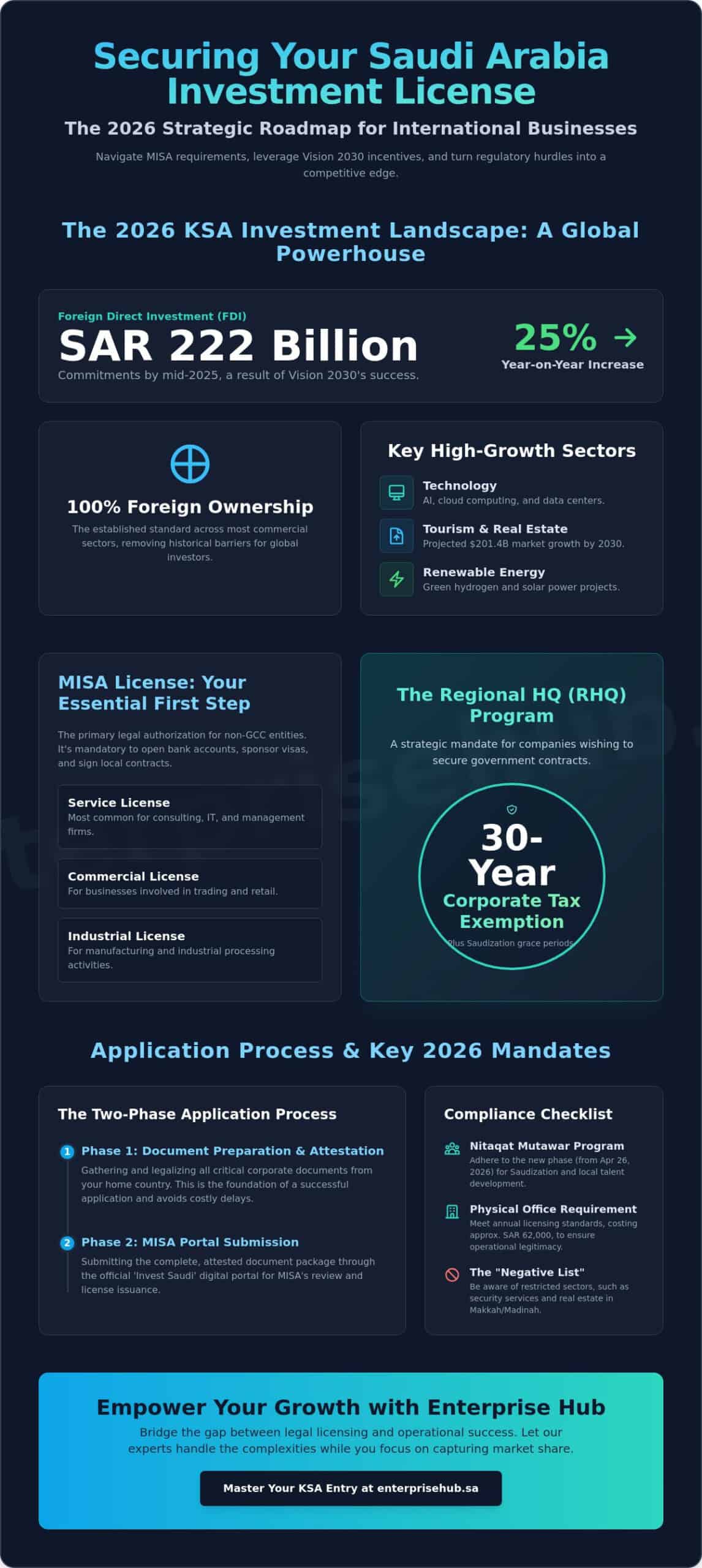
Did you know that foreign direct investment commitments in Saudi Arabia surged to SAR 222 billion by mid-2025, a 25% increase from the previous year? You likely recognize that the Kingdom’s G20 growth offers unparalleled potential, yet securing an investment license in Saudi Arabia 2026 requires more than just basic paperwork. The new Nitaqat Mutawar phase that began on April 26, 2026, and the strict Regional Headquarters mandates mean that compliance is now a high-stakes strategic necessity. Managing MISA requirements or ensuring your physical office meets the SAR 62,000 annual licensing standards shouldn’t stall your momentum.
At Enterprise Hub, we empower you to turn these regulatory hurdles into a competitive edge. We’ll help you master the current regulatory landscape and secure your MISA license with an expert-led roadmap for international businesses. You’ll gain a clear document checklist, an understanding of the 100% ownership rules, and a strategic path from your initial application to a fully operational office. This guide explores the 30-year corporate tax exemptions for RHQs and the essential steps to integrate your business into the Vision 2030 economy.
Key Takeaways
- Identify the optimal MISA license category for your business, whether Commercial, Industrial, or Service, to ensure full alignment with your operational goals.
- Understand the mandatory requirements of the Regional Headquarters (RHQ) program to maintain your investment license in Saudi Arabia 2026 and qualify for government contracts.
- Master the two-phase application process, from critical document attestation to final portal submission, to avoid administrative delays and non-compliance costs.
- Leverage the latest 2026 strategic incentives, including 30-year tax exemptions and Saudization grace periods, to maximize your return on investment.
- Learn how to bridge the gap between legal licensing and operational success by integrating premium workspace solutions with comprehensive government and accounting services.
The 2026 Investment Landscape: Why Saudi Arabia is the Strategic Choice
Entering the second half of the decade, Saudi Arabia has transitioned from a promising emerging market into a global economic powerhouse. By mid-2025, foreign direct investment commitments reached a record SAR 222 billion, representing a 25% year-on-year increase. This momentum isn’t accidental. It’s the result of a meticulously planned economic transformation that makes obtaining an investment license in Saudi Arabia 2026 a priority for any growth-oriented international firm. The Ministry of Investment (MISA) serves as the primary gateway for this capital, having evolved from its previous role as SAGIA into a sophisticated, digital-first regulator that actively champions investor success. Today, 100% foreign ownership is the established standard across nearly all commercial sectors, effectively removing the historical barriers that once required local partnerships.
Vision 2030 Milestones and Investor Confidence
The regulatory maturity we see in 2026 has significantly reduced the perceived risk for global capital. We’ve seen the National Investment Strategy overhaul the “Ease of Doing Business” framework, replacing bureaucratic friction with transparent, data-driven processes. This shift has built a foundation of trust where legal protections are robust and predictable. The 2026 investment climate is a bridge between global capital and regional execution. With the new three-year phase of the Nitaqat Mutawar Program launched on April 26, 2026, the government has provided a clear, long-term roadmap for localization, allowing businesses to plan their human capital strategies with precision. We help you navigate these updates to ensure your entry is both compliant and competitive from day one.
The Shift Toward Value-Added Investment
Saudi Arabia’s strategy has moved decisively beyond oil toward a knowledge-based economy that prizes technology transfer and local talent development. In 2026, the most significant growth projections are concentrated in three key pillars:
- Technology: Massive investments in AI, cloud computing, and data centers are turning the Kingdom into a regional tech hub.
- Tourism: With revenues projected to contribute significantly to the USD 201.4 billion real estate market growth by 2030, the hospitality sector remains a primary focus.
- Renewable Energy: Projects in green hydrogen and solar power are attracting specialized firms looking for long-term infrastructure stability.
Because of these focused initiatives, the process for تأسيس شركات في الرياض has been streamlined to match international speeds. We enable you to bypass the complexities of setup, allowing your leadership to focus on capturing market share in these high-growth sectors while we handle the administrative intricacies of the investment license in Saudi Arabia 2026.
What is a MISA Investment License and Who Needs It?
A MISA license acts as the primary legal authorization for any non-GCC entity looking to establish a footprint in the Kingdom. It’s the essential first step toward operational legitimacy. Without it, your business cannot open bank accounts, sponsor visas, or sign commercial contracts within the local market. In 2026, the Invest Saudi official portal has become the centralized hub for these applications, reflecting the government’s commitment to a digital-first economy. While most sectors are now open to international capital, a “Negative List” still exists to protect specific national interests. This list includes activities like military catering, security services, and real estate investment within the holy cities of Makkah and Madinah.
Primary License Categories for 2026
Choosing the right category for your investment license in Saudi Arabia 2026 is critical because it dictates your tax obligations and operational scope. Each category has its own set of requirements and benefits:
- Service Licenses: These are the most common for consulting, IT, and management firms. In 2026, the withholding tax for technical and consulting services was reduced from 15% to 5%, making this category highly attractive for international service providers.
- Commercial Licenses: These allow for wholesale and retail trade. While 100% ownership is standard, certain retail activities may require a minimum capital investment of SAR 30 million to qualify for full foreign control.
- Industrial Licenses: Designed for manufacturing and production, these licenses require a physical factory setup and adherence to specific environmental and production standards.
Ownership Structures: 100% Foreign vs. Joint Venture
The shift toward 100% foreign ownership has redefined the market landscape. You no longer need a local partner for the majority of commercial activities, allowing for full strategic and financial control over your operations. This autonomy is a major draw for global brands looking to maintain strict quality standards. However, some investors still opt for a Joint Venture (JV) when local market expertise or specific government relations are required for large-scale infrastructure projects.
Regardless of the ownership path, your Articles of Association (AoA) must be drafted with high precision to ensure compliance with the 20% corporate income tax rate on net adjusted profits. We enable you to navigate these legal structures with confidence while providing the premium office solutions required to satisfy MISA’s physical presence standards. Whether you choose a private office or a coworking space, your physical location must be verified to finalize your licensing process.
The Regional Headquarters (RHQ) Program: A 2026 Strategic Mandate
As we navigate the second half of the decade, the Regional Headquarters (RHQ) Program has evolved from an attractive option into a non-negotiable requirement for global enterprises. If your business strategy involves securing Saudi government contracts valued at over SAR 1 million, obtaining this specific type of investment license in Saudi Arabia 2026 is mandatory. This policy ensures that the Kingdom isn’t just a sales territory but the operational and decision-making heart of your Middle Eastern activities. While a standard MISA license allows for general market entry, the RHQ status provides a specialized legal framework designed for high-level management and strategic oversight.
Compliance Timeline for RHQ Establishments
The “Center of Mind” concept is the cornerstone of the RHQ program in 2026. Regulators now strictly audit whether your regional decision-making actually happens within the Kingdom. To maintain this status, your company must hire a minimum of 15 full-time employees within the first year of operation. This requirement includes at least three high-level executives who must be based in your Saudi office. Because of these physical staffing mandates, your choice of infrastructure becomes critical. While مكاتب افتراضية في السعودية provide an excellent starting point for administrative agility, an RHQ eventually requires a physical hub that can accommodate a growing executive team. We help you transition from a digital presence to a premium physical office that meets every MISA and RHQ licensing standard.
Strategic Advantages of the RHQ Status
The incentives provided to RHQ entities in 2026 are among the most competitive globally. Qualifying companies receive a 30-year exemption from corporate income tax on eligible activities, providing three decades of fiscal predictability. Additionally, the government offers a 10-year exemption from the mandatory local hiring quotas of the Nitaqat program, allowing you to build your core team with international talent while you gradually integrate into the local workforce. Other benefits include:
- Procurement Priority: Exclusive access to the massive government procurement pipeline that drives the Vision 2030 projects.
- Visa Facilitation: Simplified and expedited visa processing for senior management and their families, including work permits for spouses.
- Operational Flexibility: Exemptions from certain professional accreditation requirements for foreign employees working within the RHQ.
The RHQ is the ultimate mark of commitment to the Saudi market in 2026. It signals to both government partners and private clients that your business is here for the long term. We enable you to navigate this complex mandate by integrating your licensing journey with our comprehensive business setup and accounting services, ensuring you capture the full value of these 30-year tax holidays from day one.
Step-by-Step Guide to Applying for Your Investment License
Applying for an investment license in Saudi Arabia 2026 is a structured four-phase journey that requires meticulous attention to detail. While the Ministry of Investment has digitized much of the workflow, the preparation phase remains the most critical element. You must ensure your “Investment Certificate” from your home country’s chamber of commerce is valid for at least 30 days at the time of submission. Any lapse here can lead to immediate rejection, forcing you to restart the expensive attestation process from scratch.
Phase 1 focuses on document preparation and legal attestation. This involves verifying your parent company’s credentials at the Saudi Embassy in your home country and subsequently with the Ministry of Foreign Affairs (MOFA) within the Kingdom. Once your documents are ready, Phase 2 moves to the MISA portal for submission and fee payment. For most foreign-owned entities in 2026, the annual fee for a MISA license is SAR 62,000. In your first year, this includes a discounted issuance fee of SAR 2,000 and a SAR 10,000 service center fee. Some service licenses may have different structures, often around SAR 12,000 per year plus a one-time SAR 10,000 fee.
Phase 3 involves the actual issuance of your MISA license, followed immediately by registration with the Ministry of Commerce to obtain your Commercial Registration (CR). Finally, Phase 4 covers post-license registrations. You must register with the Zakat, Tax and Customs Authority (ZATCA), the General Organization for Social Insurance (GOSI), and the Muqeem portal for residency management. These steps are essential for hiring staff and managing your tax obligations under the 20% corporate income tax rate for non-oil sectors.
Document Checklist for 2026
To avoid administrative delays, ensure you have these three core documents prepared and attested:
- Certified Commercial Registration: A copy of the parent company’s registration from its home country.
- Audited Financials: Financial statements for the last fiscal year to prove the entity’s economic stability.
- Board Resolution: A formal document approving the expansion into Saudi Arabia and appointing a General Manager with the necessary legal powers.
Post-License: The Physical Office Requirement
Obtaining your investment license in Saudi Arabia 2026 is a major milestone, but you aren’t operational until you secure a physical presence. The Saudi government has intensified its push for “Economic Substance,” meaning “PO Box” companies are no longer viable. A valid lease agreement, known as an Ejar, is a mandatory prerequisite for issuing your Commercial Registration. This lease must be linked to a physical location that meets specific licensing standards.
This is where the transition from a licensed entity to an operational business happens. You need a space that satisfies MISA’s standards while providing a professional environment for your team. We help you bridge this gap by providing integrated business setup services that combine legal licensing with premium, ready-to-use office solutions. By aligning your physical office with your licensing timeline, you ensure that your business meets every compliance standard from day one without the stress of managing multiple vendors.
Empowering Your Growth with Enterprise Hub
We believe that your success in the Kingdom shouldn’t be delayed by administrative friction. While obtaining an investment license in Saudi Arabia 2026 is a vital legal milestone, it’s only the beginning of your journey. Many businesses lose valuable months trying to coordinate between legal consultants, government agencies, and real estate brokers. We bridge this gap by offering a unified solution that transforms your vision into an operational reality. Our integrated approach combines expert business setup services with premium workspace solutions, ensuring you move from license application to your first high-level board meeting in record time.
Positioning your brand in the heart of the Kingdom’s financial district isn’t just about prestige; it’s a strategic move that places you at the center of the Vision 2030 transformation. We provide the infrastructure that allows you to reduce time-to-market significantly. Instead of managing multiple vendors, you work with a single strategic partner that understands the nuances of the 2026 regulatory environment. This efficiency allows you to capture market share while your competitors are still stuck in the preliminary stages of setup.
Strategic Business Setup Support
We don’t just provide advice; we act as your dedicated liaison through the MISA and Ministry of Commerce bureaucracy. Our team handles the complexities of ZATCA and GOSI registrations, ensuring your tax and social insurance foundations are compliant from day one. We recognize that the investment license in Saudi Arabia 2026 requires continuous adherence to evolving standards, such as the new Nitaqat localization percentages. By managing these technicalities, we enable your leadership to focus on high-level strategy and regional execution. Our commitment is to be the partner that secures your legal standing while you build your commercial legacy.
A World-Class Environment for Success
Compliance with the “Economic Substance” requirements discussed in previous sections requires a physical presence that demonstrates real operational depth. We provide fully equipped private offices that meet every MISA licensing standard, ensuring your Ejar lease agreement is verified and valid for your Commercial Registration. Beyond compliance, our spaces offer an environment designed for high-performance teams and networking. You can explore our premium office solutions for your new Saudi entity to find a space that aligns with your corporate identity.
Our facilities include premium meeting rooms and shared spaces that facilitate networking with other global leaders entering the Saudi market. In the 2026 economy, your office environment is a strategic asset that attracts top talent and impresses potential partners. We ensure that your physical hub isn’t just a requirement but a catalyst for your growth. We’re here to simplify the complex and empower your business to thrive in the region’s most dynamic investment landscape.
Securing Your Future in the Kingdom’s G20 Economy
The roadmap to success in the Middle East’s largest economy is now clearer than ever. By prioritizing the RHQ mandate and leveraging the 30-year tax exemptions, your business can capitalize on the SAR 222 billion in foreign investment commitments recorded by mid-2025. Securing an investment license in Saudi Arabia 2026 is the essential first step, but the real advantage lies in establishing a physical presence that demonstrates true operational substance. We’ve shown throughout this guide that the seamless integration of legal registration with a premium workspace is what separates market leaders from those who stall during the initial setup phases.
Since 2022, we’ve served as a strategic partner for Vision 2030 success, helping international firms master the complexities of MISA, ZATCA, and GOSI. As a premium workspace provider, we ensure your physical office meets every licensing standard while fostering high-level networking opportunities. Don’t let administrative hurdles slow your momentum in this dynamic landscape. Start your 2026 Saudi expansion with Enterprise Hub. Contact our experts today. We’re ready to turn your regional ambitions into a thriving reality and help you build a lasting legacy in the Heart of the Kingdom.
Frequently Asked Questions
What is the minimum capital required for a Saudi investment license in 2026?
Most service and professional licenses don’t require a minimum capital deposit in 2026. However, industrial licenses typically require SAR 1 million, and 100% foreign-owned retail entities must have a minimum capital of SAR 30 million. These requirements are specific to your business activity, so it’s vital to verify your sub-category with MISA before starting the application process.
Can a foreigner own 100% of a company in Saudi Arabia?
Yes, you can own 100% of your company in the vast majority of commercial and industrial sectors. The Kingdom has removed the historic requirement for local partners to encourage global capital flow. This full ownership applies to service, industrial, and commercial licenses, allowing you to maintain complete strategic and financial control over your Saudi operations.
How long does it take to get a MISA license in 2026?
Obtaining the actual investment license in Saudi Arabia 2026 typically takes 3 to 5 business days once your application is submitted via the Invest Saudi portal. However, you should account for 4 to 8 weeks for the preliminary phase of document attestation and legalization in your home country. This preparation is the most time-consuming part of the journey.
Is a physical office mandatory to get an investment license?
Yes, a physical office is mandatory to finalize your registration. While you can obtain the initial MISA license without one, you cannot issue your Commercial Registration (CR) without a verified lease agreement, known as an Ejar. This requirement ensures your business has “Economic Substance” and a legitimate operational base within the Kingdom’s borders to support your growth.
What are the main costs associated with a MISA license in 2026?
The standard annual fee for a MISA license is SAR 62,000 for most foreign entities in 2026. During your first year, you’ll pay a discounted issuance fee of SAR 2,000 plus a SAR 10,000 service center fee. Service licenses often have a lower annual cost of approximately SAR 12,000 with a one-time SAR 10,000 fee in the first year.
What happens if my company doesn’t apply for the RHQ license?
If your company doesn’t apply for an RHQ license, you’ll be ineligible to secure government contracts worth more than SAR 1 million. This mandate applies to all government agencies and state-owned entities. While you can still operate in the private sector with a standard investment license in Saudi Arabia 2026, you’ll miss out on the massive public procurement pipeline.
Can I change my business activity after the license is issued?
You can change or add business activities after your license is issued through the MISA “Amendment” service. This process requires updating your Articles of Association and may involve additional fees depending on the new activity’s scope. It’s important to ensure your new activity doesn’t fall under the “Negative List” of sectors restricted to Saudi nationals.
Do I need a Saudi partner for a service-based business?
You don’t need a Saudi partner to start a service-based business in the Kingdom. Professional and technical services are among the most accessible sectors for 100% foreign ownership. This autonomy allows you to maintain full control over your consulting, IT, or management operations while benefiting from a pro-investor regulatory framework and simplified visa processing for your international team.