
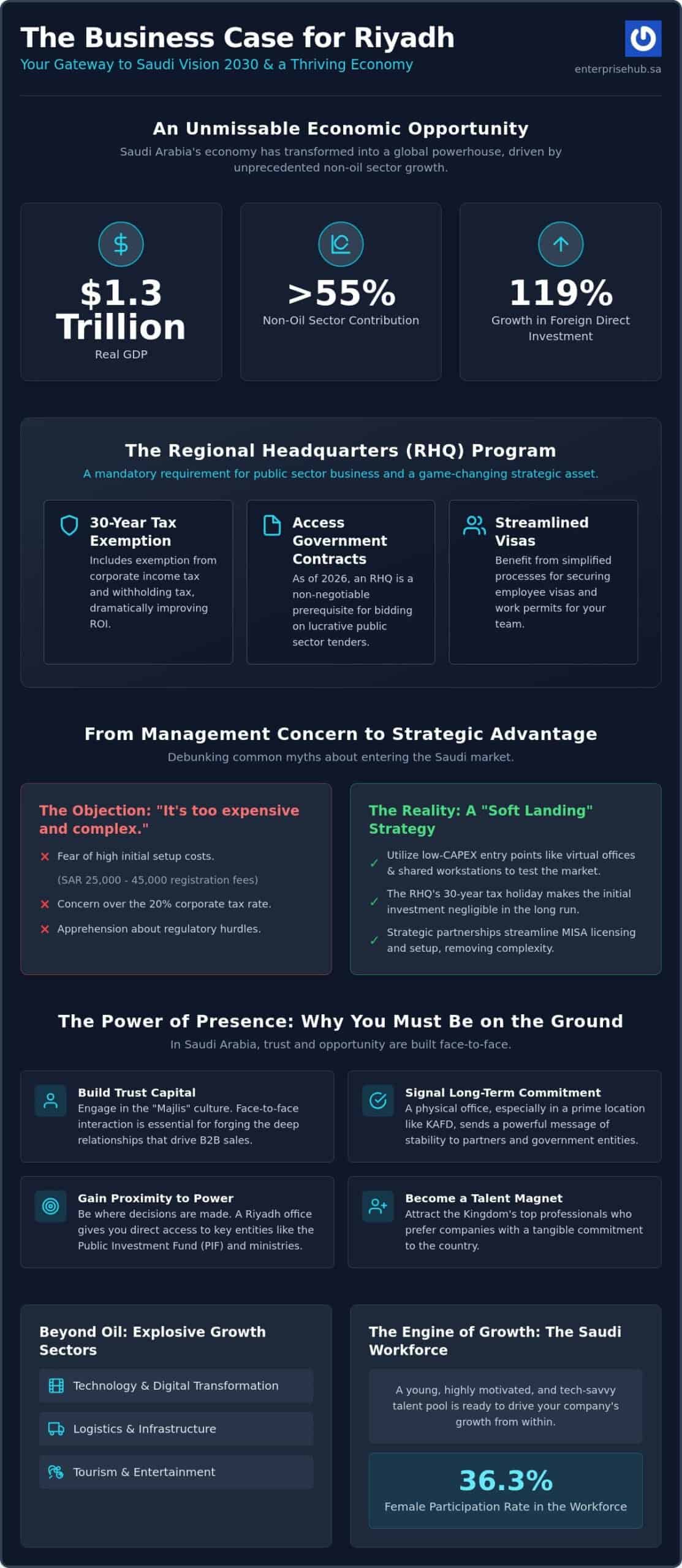
Did you know that Saudi Arabia’s non-oil sector now contributes over 55% to a massive $1.3 trillion economy? In 2026, a physical presence in the Kingdom is no longer just a geographical expansion; it’s a regulatory necessity for any firm seeking long-term regional leadership. We understand that trying to convince management to open a branch in Riyadh often feels like an uphill battle against fears of high setup costs and complex Saudi regulations. It’s difficult to quantify ROI when the board is focused on the initial SAR 25,000 to SAR 45,000 registration fees or the 20% corporate tax rate for foreign entities.
This article provides the strategic ammunition you need to secure executive approval. You’ll master the arguments for the Regional Headquarters program, which offers an incredible 30-year tax exemption, and learn how to present low-risk entry strategies that satisfy even the most cautious CFO. We’ll walk you through a structured presentation framework, clear data points on the 119% growth in foreign direct investment, and a roadmap to navigate the latest 2026 investment laws. By the end, you’ll have a bulletproof business case that turns management hesitation into decisive action.
Key Takeaways
- Understand how the Regional Headquarters (RHQ) program provides a 30-year tax exemption and unlocks essential access to lucrative government contracts.
- Learn why a physical presence in the King Abdullah Financial District (KAFD) is vital for building trust capital within the Kingdom’s face-to-face business culture.
- Master a data-driven framework to convince management to open a branch in Riyadh by debunking myths regarding setup costs and regulatory hurdles.
- Discover low-CAPEX entry strategies, such as utilizing virtual offices and shared workstations, to validate the market with minimal initial risk.
- Identify how a strategic partnership streamlines the entire expansion process, from securing MISA licenses to establishing premium private offices.
The Strategic Imperative: Why Riyadh is the Gateway to Saudi Vision 2030
Riyadh has transformed into the most significant economic powerhouse in the Middle East. As of 2026, the Kingdom’s real GDP has reached $1.3 trillion, with the non-oil sector contributing a record-breaking 55% of that total. These aren’t just numbers on a spreadsheet; they represent a fundamental shift in where global business happens. To convince management to open a branch in Riyadh, you must frame the move as an essential step toward capturing a share of the world’s fastest-growing G20 economy. The decision-making center for trillion-dollar projects has moved firmly to Riyadh-based entities like the Public Investment Fund (PIF) and key ministries.
The RHQ Program: A Non-Negotiable Requirement
The Saudi government has implemented a clear mandate: foreign firms without a Regional Headquarters (RHQ) in the Kingdom are no longer eligible for government contracts. This policy has fundamentally changed the competitive landscape. For management, an RHQ license is a strategic asset that grants a 30-year corporate tax exemption and provides streamlined paths for employee visas. It’s the only way to ensure your company remains a viable candidate for the massive infrastructure and digital transformation tenders currently hitting the market. Simply put, an RHQ license is the mandatory “key” that unlocks any business relationship with the Saudi public sector.
Economic Diversification and Market Depth
The ambition behind Saudi Vision 2030 has opened doors in sectors previously untouched by foreign investment. We’re seeing explosive growth in technology, logistics, and tourism. This diversification creates a resilient market where domestic purchasing power is surging, driven by a young, tech-savvy workforce with a 36.3% female participation rate. When you’re looking to convince management to open a branch in Riyadh, emphasize that the Kingdom isn’t just an oil giant anymore; it’s a deep, multi-layered market. Understanding these nuances is critical for anyone seriously investing in Saudi Arabia in 2026. The depth of the market ensures that your expansion isn’t just a short-term play but a long-term hedge against global economic volatility.
Building Trust Capital: The Cultural Necessity of a Physical Presence
Saudi Arabia’s business environment operates on a foundation of deep-seated relationships and mutual respect. While digital tools have modernized communications, the “Majlis” culture remains the heartbeat of B2B sales. This tradition emphasizes face-to-face interaction, hospitality, and the time taken to build personal rapport before ink ever touches paper. To convince management to open a branch in Riyadh, you need to explain that trust isn’t built through Zoom calls; it’s forged in person. A physical office isn’t just an expense; it’s a bridge to the local business community.
Beyond sales, a local branch acts as a powerful talent magnet. The Kingdom’s top professionals, particularly the ambitious youth driving the 2030 vision, prefer working for companies that demonstrate a tangible commitment to their country. By establishing a physical footprint, you gain access to a highly skilled local workforce that can help you navigate the nuances of the market from the inside out.
The “Commitment Signal” in B2B Negotiations
Saudi procurement officers and government entities look for signals of long-term stability. A company that operates remotely is often viewed as a temporary player, whereas a firm with a physical office in the King Abdullah Financial District (KAFD) sends a powerful message of permanence. Data from Invest Saudi highlights how the Kingdom is streamlining the entry for foreign investors, yet the cultural preference for local representation remains a deciding factor in high-value tenders. Success rates for companies with a local office are significantly higher than those attempting to win bids from abroad. A prestigious address doesn’t just provide a workspace; it buys you credibility in a market that values reputation above all else.
Navigating Local Regulations and Compliance
Operating locally also simplifies the complex web of regulatory compliance. Having a physical presence allows for more effective management of “Nitaqat” (Saudization) requirements, ensuring you hire and develop local talent in line with national goals. Establishing a branch also means having access to local Public Relations Officers (Mandoob) who understand the nuances of government portals and administrative procedures. If you’re looking for a comprehensive guide to company formation in Riyadh, you’ll find that having local support for MISA licenses and commercial registrations is non-negotiable for a smooth launch. This physical proximity allows your team to resolve administrative bottlenecks in hours rather than weeks.
To truly convince management to open a branch in Riyadh, frame the expansion as a move to secure “Trust Capital.” It’s about being part of the community, hiring from the local talent pool, and showing up where the deals are made. If you want to explore how a premium workspace can accelerate this process, consider reviewing the solutions at Enterprise Hub to see how we help businesses plant their roots in the capital.
Addressing Management Objections: Risk Mitigation and ROI
Skepticism from the board is natural when discussing international expansion. Most executives view a new branch through the lens of high upfront costs and regulatory “red tape.” To effectively convince management to open a branch in Riyadh, you must dismantle these myths with hard data. Start by comparing Riyadh to other global financial hubs. While prime Grade A office space in Riyadh averages around SAR 3,630 per square meter, this is significantly more affordable than the costs found in London or New York City. Riyadh offers world-class infrastructure without the astronomical price tag of established Western capitals.
The objection regarding regulatory complexity is also increasingly outdated. The Saudi government has digitized almost every aspect of business administration through platforms like MISA and ZATCA. From the Fatoora e-invoicing system to streamlined visa processing, the Kingdom has built one of the most transparent digital business environments in the world. Relying on a “remote service” model is a strategic error. Remote teams lack the deep market intelligence needed to anticipate policy shifts. As highlighted in recent discussions on gaining credibility in the Saudi market, a physical presence is the only way to prove you’re a serious contender for long-term partnerships.
The Financial Case: Tax Incentives and Zakat
The most compelling argument for any CFO is the 30-year tax holiday available to companies under the Regional Headquarters (RHQ) program. This incentive effectively eliminates corporate income tax for three decades, providing a massive boost to long-term profitability. Additionally, the Kingdom’s extensive network of double taxation treaties ensures that your regional tax structure remains optimized. When you combine these incentives with a reduced 5% withholding tax on technical and consulting services, the financial case for a local branch becomes undeniable. It’s an opportunity to protect margins while scaling in a high-growth environment.
Operational Agility and Market Intelligence
Operational risk is often tied to a lack of information. On-the-ground teams gather real-time market data that remote analysts simply can’t access. This local intelligence allows your firm to pivot faster when government tenders are announced or when regulatory updates, like the 2026 Foreign Investment Law, open new market segments. Having local legal and accounting support ensures that compliance is proactive rather than reactive. This level of agility reduces the risk of project delays and ensures that your branch hits its ROI targets within a standard three-year horizon. You aren’t just opening an office; you’re building an early-warning system for regional opportunities.
The Soft Landing Strategy: How to Enter Riyadh Without Massive CAPEX
One of the most effective ways to convince management to open a branch in Riyadh is to demonstrate that expansion doesn’t require an immediate, massive capital expenditure. Many executives hesitate because they associate international growth with long-term leases and heavy infrastructure costs. By proposing a “soft landing” strategy, you present a low-risk, phased approach that scales alongside your revenue. This methodology allows your firm to establish a presence in the King Abdullah Financial District (KAFD) with the agility of a startup but the prestige of a global leader.
A structured entry roadmap typically follows these four stages:
- Stage 1: Secure a Legal Anchor. Start with a virtual office in Saudi Arabia to obtain your MISA license and commercial registration. This provides a prestigious business address without the cost of physical square footage.
- Stage 2: Market Validation. Utilize shared workstations for your first one or two local hires. This allows for on-the-ground market research and early-stage business development at a fraction of the cost of a traditional office.
- Stage 3: Team Integration. Transition to private serviced offices as your team grows to 5 or 10 professionals. These “plug-and-play” solutions include furniture, high-speed internet, and utilities in a single monthly fee.
- Stage 4: Strategic Scaling. Move into a full corporate suite once your first major government contracts are secured. At this point, the branch is self-sustaining and the risk of expansion has been fully mitigated.
Virtual vs. Physical: Choosing the Right Starting Point
The choice between a virtual and physical presence depends on your immediate regulatory needs. A virtual office is often the fastest path to MISA compliance, allowing you to bypass the complexities of local property laws while you finalize your regional strategy. However, as your team begins to convince management to open a branch in Riyadh for operational reasons, moving into a shared workspace becomes essential. These environments offer more than just a desk; they provide a networking ecosystem where your staff can interact with other global firms already thriving in the Riyadh market. As companies scale their presence in global markets, the need for premium corporate housing becomes just as critical as the office itself; you can learn more about MOT Rentals to see how these solutions are implemented in other key international destinations.
Managed Services: Outsourcing the Administrative Burden
Success in the Saudi market requires focus on growth, not paperwork. You can reduce overhead by utilizing managed services for accounting, tax, and government relations. Instead of hiring a full back-office team immediately, a strategic partner can handle your VAT filings, Zakat compliance, and employee visa permits. This allows your executive team to focus on securing tenders and building partnerships. If you’re ready to explore how flexible workspace solutions can reduce your entry risk, discover our premium office packages designed for seamless expansion.
Partnering with Enterprise Hub for a Seamless Riyadh Expansion
Enterprise Hub stands as your primary strategic partner within the King Abdullah Financial District (KAFD), the crown jewel of Saudi Arabia’s modern economy. We provide more than just square footage; we offer a launchpad for global success. To successfully convince management to open a branch in Riyadh, you need a partner that removes the friction of market entry. We handle the logistical complexities so your leadership can focus on high-level strategy and immediate market capture. Our role is to act as your local expert, ensuring that every step of your expansion aligns with the Kingdom’s ambitious 2026 economic milestones.
Choosing the right partner means choosing a team that understands the nuances of the Saudi market. We don’t just provide a desk; we provide an ecosystem. From the moment you decide to expand, we’re with you to ensure that your corporate identity is established with the prestige it deserves. Our professional support staff acts as an extension of your own team, providing a seamless experience for your clients and executives alike.
Premium Workspace Solutions in KAFD
Our facilities are designed for high-performance teams that demand excellence. We offer premium private offices and state-of-the-art meeting rooms that reflect the prestige of your brand. Being located in KAFD places your firm at the center of the Kingdom’s financial ecosystem, literally steps away from global tech giants and leading financial institutions. Our office configurations are fully customizable. Whether you’re starting with a small executive team or scaling to a larger corporate presence, our spaces adapt to your growth. This flexibility is a key selling point when presenting your case to the board, as it eliminates the risk of being locked into rigid, long-term traditional leases.
Comprehensive Business Support
Speed to market is a critical competitive advantage in a fast-moving economy. Enterprise Hub accelerates your timeline by providing an all-in-one solution that covers the entire business lifecycle. We integrate company formation, government services, and accounting under one roof. Our experts navigate the MISA licensing process with precision and ensure your Zakat and tax filings are compliant from day one. By outsourcing these administrative headaches to us, you reduce the initial operational risk and overhead costs. We invite you to contact Enterprise Hub for a tailored expansion proposal. Let us help you transform your business case into a thriving reality. Our team is ready to host a virtual tour or a strategic consultation to show your leadership exactly how we facilitate a seamless entry into the heart of the Riyadh market. This is your opportunity to demonstrate to management that the path to Saudi Arabia is clear, managed, and ready for activation.
Accelerating Your Strategic Entry into Riyadh
The economic transformation of Saudi Arabia is moving at an unprecedented pace. Establishing a presence in the capital is no longer a luxury for global firms; it’s a fundamental requirement for those seeking to lead in the Middle East. By leveraging the Regional Headquarters program and adopting a soft landing strategy, you can minimize initial capital risks while maximizing your access to the Kingdom’s $1.3 trillion economy. You now have the data and the structured framework needed to convince management to open a branch in Riyadh with complete confidence.
Strategic growth requires the right environment and expert guidance. Enterprise Hub provides a prestigious base in the heart of the King Abdullah Financial District (KAFD), offering comprehensive MISA and RHQ support that’s already trusted by global enterprises for their Saudi market entry. We handle the administrative complexities so you can focus on building lasting partnerships. To take the next step in your expansion journey, Download our 2026 Riyadh Expansion Strategic Framework today. Your path to regional prosperity starts with a single, decisive move.
Frequently Asked Questions
What is the most common reason management rejects a Riyadh expansion?
Management typically rejects expansion proposals due to concerns over high initial capital expenditure and the perceived complexity of Saudi regulations. To effectively convince management to open a branch in Riyadh, you should present a phased entry model. Using flexible workspaces or virtual offices transforms a massive upfront cost into a manageable operational expense. This approach allows the board to see a clear, low-risk path toward high-growth returns.
Do we need a local Saudi partner to open a branch in Riyadh?
No, foreign investors can now maintain 100% ownership of their companies in most business sectors. The Ministry of Investment (MISA) has removed the requirement for a local partner to encourage direct foreign investment. This change gives your firm full control over its regional strategy and operational decisions. It’s a powerful point to use when you need to convince management to open a branch in Riyadh without losing corporate autonomy.
How long does the company formation process take in 2026?
The company formation process generally takes between three to six weeks in 2026. The Saudi government has significantly reduced these timelines by integrating digital portals across all major ministries. While the initial MISA license can be issued quickly, the full setup includes commercial registration and Chamber of Commerce membership. Working with a strategic partner ensures your documentation is correct, preventing avoidable delays in the approval cycle.
What are the main benefits of the Regional Headquarters (RHQ) license?
An RHQ license provides a 30-year exemption from corporate income tax and a 0% withholding tax on specific activities. Beyond tax savings, this license is now a mandatory requirement for any international firm seeking to win large-scale government contracts. It also offers streamlined visa processing for your executive team and specific exemptions from standard Saudization ratios during the first few years of operation. This makes it a cornerstone of any long-term business case.
Can we use a virtual office to obtain a MISA license?
Yes, you can utilize a virtual office to secure your initial MISA license and establish a legal business address. This is a highly effective “soft landing” strategy that allows your firm to satisfy regulatory requirements without committing to a long-term lease. It provides the flexibility to begin hiring and market research while you evaluate larger office spaces in premium districts like KAFD for your permanent headquarters.
What are the hidden costs of opening a branch in Saudi Arabia?
Hidden costs often include municipality license fees, annual Chamber of Commerce memberships, and the costs of ongoing “Saudization” compliance. While standard registration fees range from SAR 25,000 to SAR 45,000, you must also account for professional services like government relations (PRO) and specialized accounting. Budgeting for these operational elements early ensures that your ROI projections remain accurate and that the branch remains compliant with evolving ZATCA regulations.
How does KAFD compare to other business districts in Riyadh?
KAFD is the Kingdom’s premier financial and tech hub, offering Grade A office infrastructure that Olaya or other districts can’t match. It’s a self-contained “smart city” that hosts the world’s largest financial institutions and major government entities. Being located in KAFD provides instant credibility. The district’s integrated design promotes networking and prestige, making it the most strategic location for firms looking to establish a high-profile regional presence.
Is Saudization (Nitaqat) difficult for a new branch to manage?
Saudization isn’t difficult if you integrate it into your initial HR strategy rather than treating it as an afterthought. The Nitaqat system provides clear, color-coded categories that help you track your compliance levels. New branches can often benefit from grace periods or specific support programs designed to help them hire and train local talent. This local workforce is essential for navigating the market’s cultural nuances and building long-term “trust capital.”