
Managing your corporate tax liability isn’t just about basic arithmetic. It’s a high-stakes strategic workflow where a single oversight can lead to ZATCA penalties ranging from 5% to 25% of your unpaid tax. With the June 30, 2026, deadline for Wave 24 integration fast approaching, mastering how to calculate VAT for companies is now a critical requirement for maintaining a healthy, compliant business in Saudi Arabia. You don’t want your hard-earned revenue drained by avoidable filing errors or missed input tax recovery opportunities.
We understand that the confusion between zero-rated goods and exempt services can make your quarterly or monthly filings feel like a minefield. You’re likely looking for a way to streamline your processes and gain total clarity over inclusive versus exclusive pricing. This guide provides the exact formulas and ZATCA compliance rules you need to handle your tax obligations with confidence. We’ll walk you through the essential steps to ensure error-free filing, optimize your cash flow, and meet the latest e-invoicing requirements with ease.
Key Takeaways
- Learn the core components of the 15% VAT framework to ensure your business remains fully aligned with ZATCA’s 2026 regulatory standards.
- Master the precise formulas for how to calculate VAT for companies, including the essential distinction between VAT-inclusive and VAT-exclusive pricing for accurate invoicing.
- Discover how to optimize your cash flow by correctly offsetting Output VAT against recoverable Input VAT on your business purchases.
- Gain clarity on the Fatoora Integration Phase requirements to automate your tax calculations and eliminate manual filing risks.
- Understand how pairing compliant financial practices with professional business infrastructure supports sustainable corporate growth and tax residency.
Understanding the VAT Framework for Companies in Saudi Arabia (2026)
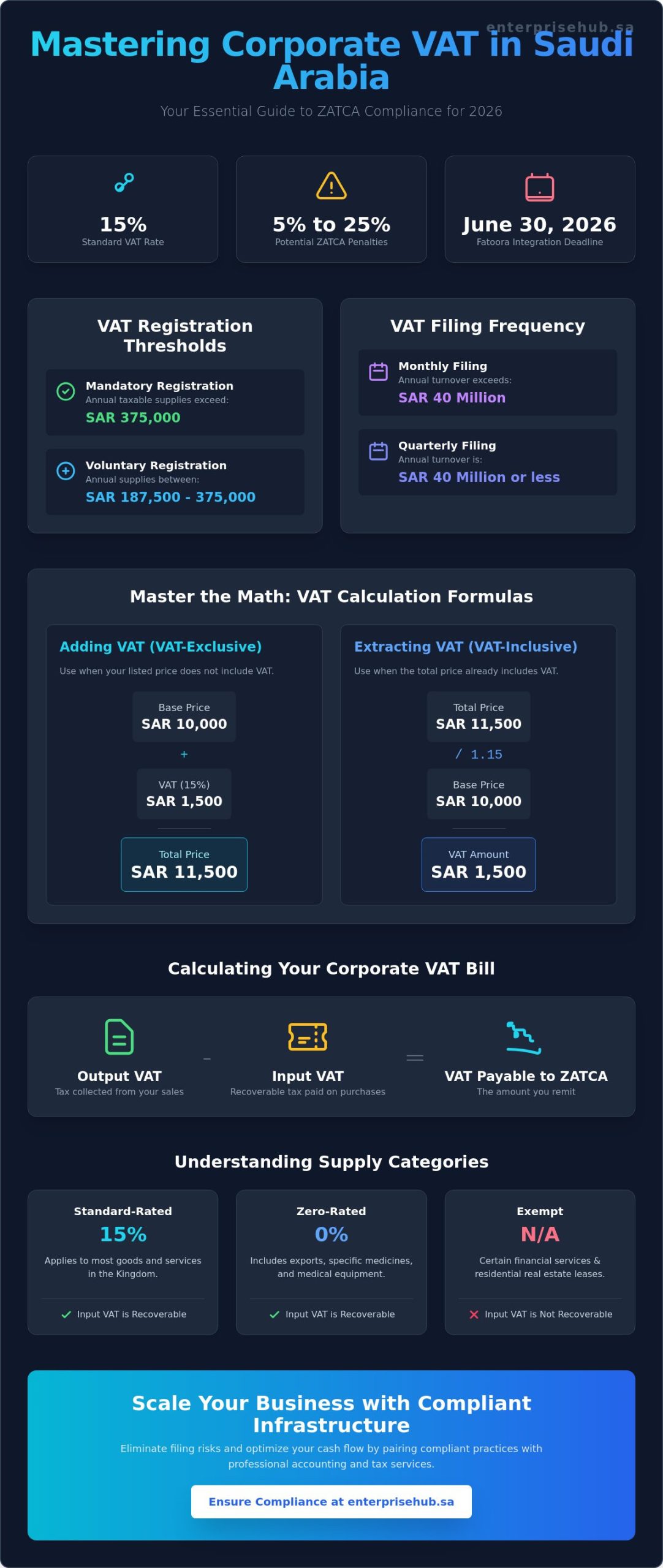
A solid grasp of the Saudi tax landscape is the first step toward long-term financial stability. In the Kingdom, a Value-Added Tax (VAT) functions as an indirect tax applied to the consumption of most goods and services. As a business owner, you act as a vital intermediary in this process. You collect the tax from your customers and remit it to the government, while also recovering the tax you’ve paid to your suppliers. For the 2026 fiscal year, the standard VAT rate remains at 15%. This rate has been consistent since July 2020 and applies to the majority of commercial transactions within the country.
Registration isn’t optional for everyone. You must register for VAT if your annual taxable supplies exceed SAR 375,000. If your supplies fall between SAR 187,500 and SAR 375,000, registration is voluntary. Many growing businesses choose voluntary registration to reclaim VAT on their startup expenses. It’s essential to distinguish between your role as the “Taxable Person” and your customer as the “End Consumer.” While the consumer pays the tax, your company is responsible for the administrative accuracy of the collection. Mastering how to calculate VAT for companies ensures you don’t accidentally absorb these costs into your own profit margins.
The Role of ZATCA in Corporate Tax Oversight
The Zakat, Tax and Customs Authority (ZATCA) serves as the primary regulator for tax compliance in Saudi Arabia. They’re responsible for issuing your Tax Identification Number (TIN), which is a unique identifier required for all your official invoices and filings. Your filing frequency depends entirely on your annual turnover. If your taxable supplies exceed SAR 40 million, you’re required to file VAT returns monthly. Companies with a turnover of SAR 40 million or less file on a quarterly basis. Staying on top of these deadlines is non-negotiable, as ZATCA uses these filings to audit your records and ensure the national economy remains transparent and robust.
Standard, Zero-Rated, and Exempt Supplies
Not every transaction is treated the same way under the law. Understanding these categories is fundamental when learning how to calculate VAT for companies accurately. Most commercial activities fall under the 15% standard rate. However, some supplies are “Zero-Rated” (0%). This includes exports of goods to outside the GCC and specific medicines or medical equipment. While the rate is 0%, you can still reclaim the VAT paid on related business inputs. On the other hand, “Exempt” supplies, such as certain financial services and residential real estate leases, don’t allow for input tax recovery. Distinguishing between these three categories prevents costly miscalculations during your return submissions.
Master the Math: VAT Calculation Formulas for Business Transactions
Precision in financial modeling is the cornerstone of a resilient business. When you master how to calculate VAT for companies, you move beyond simple compliance and start viewing tax as a manageable variable in your cash flow strategy. You must maintain a sharp distinction between VAT-inclusive and VAT-exclusive prices. Mislabeling these in your ledger doesn’t just cause accounting headaches; it can lead to under-collecting from clients or over-paying on your returns. The 15% multiplier serves as the primary constant for Saudi corporate tax math in all standard commercial transactions for 2026.
Understanding these formulas allows you to set your profit margins with confidence. If you’re building a new service offering, you need to know exactly how the tax will impact the final price your client sees. Conversely, when you’re auditing your own expenses, extracting the tax portion is the only way to ensure you’re claiming every riyal of recoverable input tax. This mathematical clarity is why many successful firms prioritize professional accounting and tax services to safeguard their financial integrity.
Calculating VAT-Exclusive (Adding VAT to Price)
This method is essential when you’re quoting prices to other businesses or setting up your sales catalog. You start with the net value of your product and add the tax on top. The formula is simple: [Base Price] x 0.15 = VAT Amount. For example, if your company provides a specialized service with a base cost of SAR 10,000, your VAT amount is SAR 1,500. To find the Total Gross Amount, you add the base price and the VAT amount together, resulting in SAR 11,500. This transparent breakdown is a requirement for standard tax invoices under ZATCA regulations.
Calculating VAT-Inclusive (Extracting VAT from Total)
You’ll use this calculation most often during expense tracking and when reviewing retail receipts. When a price is “inclusive,” the 15% tax is already baked into the total number you see. To find the tax portion, use this formula: [Total Price] x (15 / 115) = VAT Amount. You use 115 because the total price represents 115% of the original value (100% base plus 15% tax). If you receive a total bill for SAR 1,150, applying this formula reveals that exactly SAR 150 is the VAT component. Dividing the total price by 1.15 will also give you the net base price directly, which is SAR 1,000 in this scenario. Mastering this extraction ensures your internal records match your ZATCA filings perfectly.
Calculating the Corporate VAT Bill: Input Tax vs. Output Tax
Mastering the “netting” process is where true tax efficiency begins. While basic multiplication tells you the tax on a single invoice, understanding how to calculate VAT for companies at a corporate level requires a deep dive into the relationship between your sales and your purchases. Your total VAT liability isn’t just a percentage of your revenue; it’s the difference between the tax you collect and the tax you’ve already paid to others. This balance directly impacts your liquid capital and overall cash flow strategy.
Your Output VAT represents the 15% tax you charge customers on every taxable sale. This isn’t company revenue; you’re essentially holding these funds in trust for the government. Conversely, Input VAT is the tax you pay on business-related expenses, from office supplies to professional services. The core formula for your ZATCA filing is simple but powerful: Output VAT – Recoverable Input VAT = Net VAT Payable. If your input tax exceeds your output tax, you’ve earned a “Tax Credit,” which you can either claim as a refund or carry forward to offset future payments.
Identifying Recoverable Input Tax
You can’t reclaim every riyal of VAT spent. To qualify for recovery, an expense must be strictly for business purposes and supported by a valid tax invoice that includes your company’s Tax Identification Number (TIN). ZATCA maintains strict rules on non-recoverable items to prevent abuse. For instance, VAT paid on entertainment services, such as business lunches or sporting events, is generally not recoverable. Similarly, tax paid on restricted motor vehicles usually doesn’t qualify for a credit unless the vehicle is your primary business tool. If your company deals in both taxable and exempt supplies, you’ll need to apply a “Proportional Deduction” to ensure you only reclaim the percentage of tax related to your taxable activities.
Managing the VAT Return Cycle
Accuracy in your return depends on how well you aggregate totals from your Sales Ledger and Purchase Ledger. You shouldn’t rely on software alone. Regular reconciliation between your internal ledgers and your bank statements is the only way to catch discrepancies before they reach ZATCA’s auditors. Discrepancies often arise from timing differences or incorrectly categorized expenses. Managing these complexities while scaling a business can be a heavy administrative burden. Many successful investors choose to outsource these technical details to professional accounting and tax services to ensure their netting is precise and their compliance is absolute.
Calculation Accuracy in the Era of E-Invoicing (Fatoora)
Digital transformation has fundamentally changed the way businesses interact with tax authorities in Saudi Arabia. The Fatoora project isn’t just about moving from paper to PDF; it’s a real-time reporting ecosystem that makes manual errors nearly impossible to hide. Phase I, the Generation Phase, required businesses to issue and store electronic invoices. Now, as we navigate Phase II, the Integration Phase, your invoicing system must communicate directly with ZATCA’s platform for immediate validation. This shift ensures that the process of how to calculate VAT for companies is increasingly automated, but it also means your initial data entry must be flawless.
Relying on manual spreadsheets in this digital-first environment creates a massive compliance risk. If your system miscalculates a single riyal, ZATCA’s platform will flag the discrepancy instantly during the integration process. This transparency is designed to reduce tax evasion, yet it can inadvertently penalize businesses with sloppy record-keeping. To stay ahead of these requirements, you need a robust digital infrastructure. Our team can help you navigate these technical hurdles through our specialized government and accounting services, ensuring your systems are fully integrated and compliant.
Mandatory Fields for a Compliant Tax Invoice
A compliant tax invoice in 2026 requires more than just a list of items and a total. Under Phase II, every invoice must feature a unique QR code and a cryptographic stamp provided by ZATCA’s system. You’re required to explicitly list the VAT rate applied to each line item and the total VAT amount in Saudi Riyals (SAR). If you’re dealing with foreign currency transactions, you can’t just leave the total in USD or EUR. You must convert the tax amount to SAR using the official exchange rates at the time of the supply to remain compliant. These details are essential for the system to validate your “netting” correctly.
Common Calculation Pitfalls to Avoid
Even with advanced software, certain nuances can trigger errors. Rounding is a frequent culprit; ZATCA requires all VAT amounts to be calculated to exactly two decimal places. Another common mistake involves partial payments or deposits. In Saudi Arabia, VAT is generally due on the earlier of the payment date or the invoice date. If you receive a deposit, you must calculate and account for the VAT immediately rather than waiting for the final delivery. Finally, don’t forget the Reverse Charge Mechanism. When you import services from a foreign provider, your company is responsible for calculating and reporting the VAT on that purchase, essentially acting as both the supplier and the recipient for tax purposes.
Scaling Your Business with Compliant Financial Infrastructure
Growth demands more than a bold vision; it requires a financial framework that can handle high transaction volumes without compromising on accuracy. As you move toward 2026, the margin for error in your tax filings becomes virtually nonexistent due to ZATCA’s real-time integration requirements. If your internal process for how to calculate VAT for companies is still rooted in manual entries, you’re building on shaky ground. Accurate, automated calculation isn’t just a compliance box to tick. It’s a prerequisite for sustainable expansion that protects your profit margins from avoidable penalties.
Your physical location plays a vital role in your corporate tax profile. ZATCA expects companies to maintain a legitimate, verifiable presence within the Kingdom. A professional business address serves as a cornerstone of your tax residency, signaling to authorities that your operations are anchored in the local economy. Specialized business hubs provide this legitimacy while offering the technical infrastructure needed to maintain high-compliance standards. By centralizing your operations in a professional environment, you reduce the administrative burden of tax management and create a clear audit trail for regulators.
Positioning professional support as a tool for risk mitigation is a hallmark of successful investors. You don’t have to navigate the complexities of “netting” or the Reverse Charge Mechanism alone. Expert guidance acts as a shield, ensuring that your understanding of how to calculate VAT for companies remains current with the latest 2026 regulations. This strategic partnership allows you to focus on your core business goals while we handle the technical details of your financial compliance.
The Strategic Advantage of Integrated Business Services
Combining premium office space with expert accounting support creates a powerful synergy for your company. You can transition from manual spreadsheets to ZATCA-compliant systems with ease when your infrastructure is designed for integration. For those entering the Saudi market for the first time, leveraging comprehensive business setup services ensures that your tax registration and financial workflows are correct from day one. This integrated approach removes the guesswork from your operations and sets the stage for rapid, compliant growth.
Next Steps for Your Company
Securing your financial future in the Saudi market requires proactive steps. We recommend starting with a thorough audit of your current tax workflows to ensure they meet the 2026 standards. You must confirm that your E-invoicing software is fully integrated with ZATCA’s Phase II platform to avoid filing delays. Finally, consider partnering with a strategic expert who understands the local landscape. Contact Enterprise Hub today for comprehensive corporate support that empowers your team and secures your long-term success in the Kingdom.
Securing Your Financial Future in the 2026 Saudi Economy
Navigating the 15% VAT landscape requires more than just knowing the math; it demands a commitment to digital accuracy and strategic financial management. You’ve now seen how the interplay between input tax recovery and output tax collection defines your liquid capital. By integrating Fatoora Phase II requirements directly into your daily operations, you eliminate the risks associated with manual filing errors. Mastering how to calculate VAT for companies is the foundation of a compliant and scalable business model that can thrive under ZATCA’s rigorous oversight.
Your journey toward national growth is a shared mission. We provide the ZATCA-compliant accounting support and strategic business setup expertise you need to lead with confidence. Whether you’re refining your tax workflows or establishing a new presence in the Kingdom, we offer comprehensive corporate services designed to remove administrative barriers. Streamline your company’s compliance with Enterprise Hub’s professional services and focus your energy on high-level strategic expansion. Your success is our priority, and we’re ready to support your vision every step of the way.
Frequently Asked Questions
How do I calculate VAT if the price is already inclusive?
You can extract the tax amount by multiplying the total price by 15 and then dividing by 115. For instance, if a bill totals SAR 1,150, the calculation results in exactly SAR 150 of VAT. This formula is essential for identifying the tax portion within gross receipts for your records.
Can I reclaim VAT on all business expenses in Saudi Arabia?
No, recovery is limited to expenses used strictly for taxable business activities supported by a valid tax invoice. ZATCA specifically prohibits reclaiming VAT on entertainment services, catering, and certain restricted motor vehicles. Always verify that the expense is not on the non-recoverable list before filing your return.
What happens if my company miscalculates its VAT return?
Miscalculations typically result in financial penalties ranging from 5% to 25% of the unpaid tax amount. ZATCA also has the authority to conduct detailed audits of your financial records to ensure compliance. Learning how to calculate VAT for companies correctly from the start is the best way to avoid these costly regulatory setbacks.
Is the VAT rate in Saudi Arabia expected to change in 2026?
The standard VAT rate remains at 15% for the 2026 fiscal year based on current regulations. While the government monitors economic trends, no official decree has been issued to alter this rate. You should continue to use the 15% multiplier for all your sales and purchase projections until an official announcement says otherwise.
Does a foreign company need to register for VAT in Saudi Arabia?
Yes, any non-resident person or company making taxable supplies in the Kingdom must register for VAT immediately. Unlike local businesses, foreign entities don’t have a minimum turnover threshold like the SAR 375,000 mandatory limit. Registration is required from the very first taxable transaction made within Saudi borders.
What is the difference between zero-rated and exempt VAT?
Zero-rated supplies are taxed at 0%, allowing you to still reclaim the VAT you paid on your business inputs. Exempt supplies are not subject to VAT at all, but they don’t allow you to recover any input tax on related costs. Exports are a common example of zero-rated items, while residential real estate leases are typically exempt.
How does the Reverse Charge Mechanism affect my VAT calculation?
This mechanism requires you to act as both the supplier and the recipient for tax purposes when importing services from abroad. You calculate the 15% VAT on the service value and record it as Output VAT in your return. If the service is for taxable business use, you can simultaneously record the same amount as Input VAT to offset the cost.
Do I need a specific software to calculate VAT for ZATCA?
You must use an electronic invoicing solution that complies with ZATCA’s Fatoora requirements for Phase II integration. This software automates how to calculate VAT for companies and ensures your invoices include mandatory QR codes and cryptographic stamps. Manual spreadsheets are no longer sufficient for meeting the real-time validation standards required in 2026.