
What if the most complex part of your 2026 budget wasn’t the total cost, but the strategic advantage hidden within the fee structure? You’re likely feeling the pressure of balancing ambitious growth with the fear of escalating regulatory costs. It’s common to feel confused by the overlap between one-time setup fees and recurring annual levies, especially when navigating the complexities of the Saudi Business Center (SBC) unified portal. We understand that clarity is the foundation of any successful investment. That’s why we’ve mapped out the government service fees for companies 2026 to ensure your financial projections are both accurate and optimized for the current regulatory climate.
You’ll gain a line-item understanding of the 2026 landscape, including the significant impact of the MISA license fee suspension and the specific costs for Commercial Registration and labor permits. We’ll also share strategic advice on minimizing administrative friction to keep your operations lean and efficient. From initial licensing to annual compliance, this roadmap prepares you to lead your company with confidence in Saudi Arabia’s thriving digital economy. Let’s explore the exact figures and trends that will define your financial strategy this year.
Key Takeaways
- Understand how the Saudi Business Center (SBC) has unified the regulatory landscape to streamline fee collection and administrative processes.
- Navigate the updated registration costs and the current suspension of MISA license fees to accurately project your government service fees for companies 2026.
- Break down recurring operational expenses, including Iqama renewals and the Expat Levy, to maintain a precise and sustainable workforce budget.
- Ensure full compliance with ZATCA’s e-invoicing Integration Phase by identifying the necessary digital and tax-related financial obligations.
- Learn how strategic choices, such as utilizing virtual offices, can minimize municipality levies and reduce your overall administrative overhead.
The 2026 Saudi Corporate Fee Landscape: A Vision 2030 Perspective
Saudi Arabia has redefined the cost of doing business. In 2026, we see a fundamental shift away from traditional, opaque levies toward a digital, service-based fee structure. This transformation isn’t just about collecting revenue. It’s about building a competitive, world-class ecosystem where transparency acts as a catalyst for growth. Understanding the government service fees for companies 2026 requires looking beyond the numbers. You must see the strategic intent behind them. The Kingdom has replaced complexity with clarity, ensuring that every riyal spent on compliance contributes to a more efficient operating environment.
The Unified Portal: Saudi Business Center (SBC) in 2026
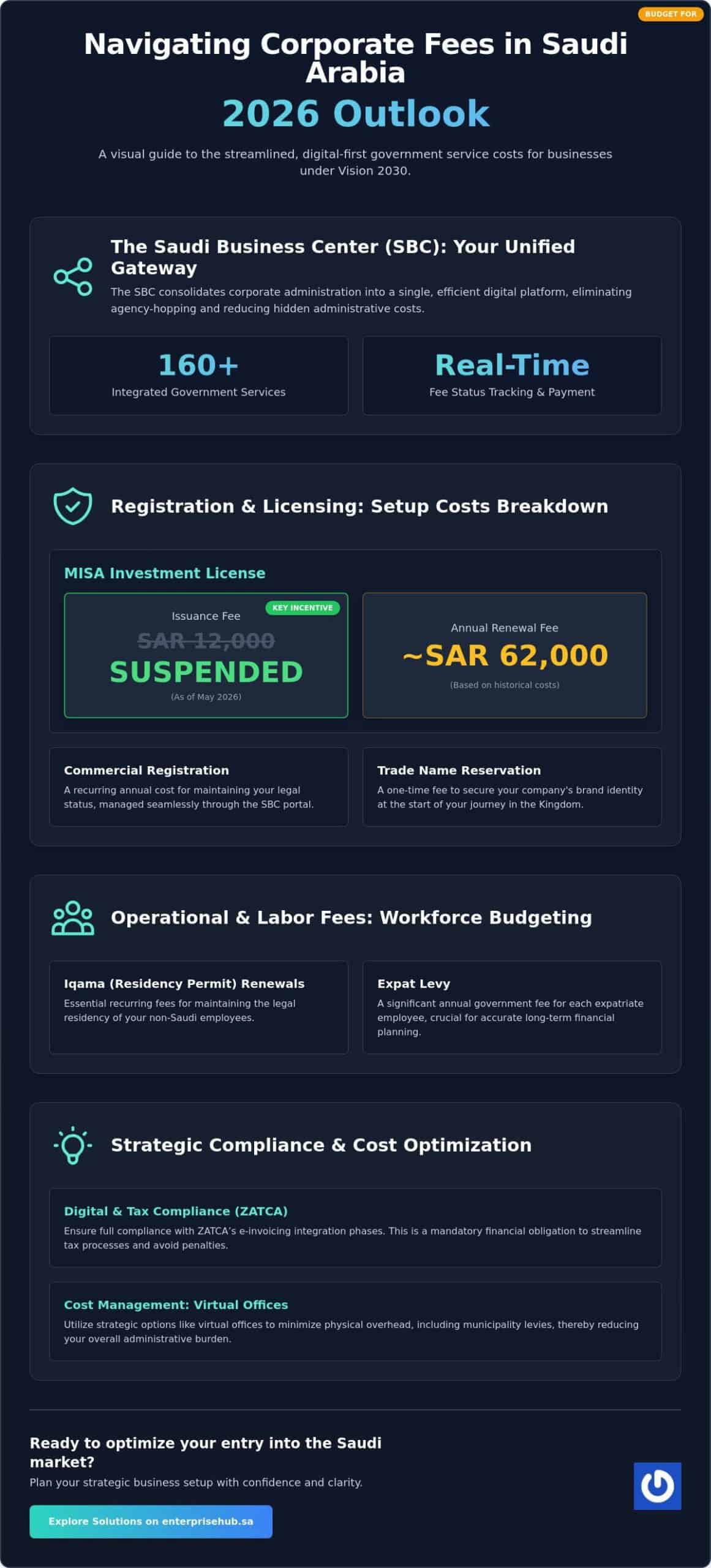
The Saudi Business Center (SBC) now serves as the heartbeat of corporate administration. It functions as a single point of contact, eliminating the need to interact with dozens of separate agencies. By 2026, the SBC has successfully integrated over 160 government services into one streamlined interface. This digital integration does more than save time. It drastically reduces the hidden administrative costs that once plagued financial projections. You can now track your fee status in real time. This visibility allows for precise corporate financial planning. It ensures that no unexpected compliance cost disrupts your cash flow or stalls your expansion plans.
Vision 2030 and Fee Incentives for New Sectors
This evolution is directly tied to the goals of Saudi Vision 2030, which aims to diversify the economy and empower the private sector. To support this, the Kingdom has introduced significant fee incentives. The suspension of MISA license issuance fees as of May 2026 demonstrates a clear commitment to attracting foreign investment. These aren’t just temporary measures. They represent a long-term outlook for corporate fee stability. The Digital Government Authority (DGA) plays a critical role here by standardizing costs across platforms. They ensure that government services are priced fairly based on the value they provide to the business rather than arbitrary benchmarks.
Transparency is the core pillar of this new climate. The Kingdom has moved toward a model where fees are predictable and directly linked to operational efficiency. This approach empowers you to allocate resources toward innovation rather than administrative survival. We view these changes as a strategic partnership. As the regulatory landscape matures, your company gains access to a more organized, data-driven environment. This environment rewards compliance and fuels sustainable expansion across the Kingdom. You aren’t just paying for a permit. You’re investing in a system designed to accelerate your success.
Registration and Licensing: One-Time vs. Recurring Setup Costs
Establishing a presence in the Kingdom requires a clear distinction between initial entry costs and the annual obligations that sustain your legal standing. In 2026, the structure of government service fees for companies 2026 has become more dynamic, rewarding early movers with significant incentives. You must categorize your expenses into one-time setup fees, such as trade name reservation, and recurring costs like Commercial Registration renewals. This clarity allows you to protect your initial capital while ensuring your operational budget remains resilient against regulatory shifts.
MISA License: The Gateway to the Saudi Market
The Ministry of Investment (MISA) has taken a bold step to lower entry barriers. As of May 2026, the issuance fees for new MISA licenses remain suspended. This move encourages global firms to enter the market without the heavy upfront burden of the previous SAR 12,000 issuance fee. However, you should prepare for the renewal phase. While the first year is currently incentivized, subsequent renewals historically carried a significant cost of approximately SAR 62,000. It’s vital to coordinate your strategic business setup in Saudi Arabia with these timelines to maximize your financial efficiency. Once approved, you typically have 15 business days to settle any determined service charges through the unified portal.
Commercial Registration and Trade Name Fees
Your journey with the Ministry of Commerce involves several specific line items. Reserving a trade name is your first step toward brand security. Following this, the Commercial Registration (CR) fee for a Limited Liability Company (LLC) stands at approximately SAR 1,200 annually. If you’re establishing a Joint Stock Company (JSC), the initial registration fee is fixed at SAR 5,000. Foreign company branches face a higher registration fee of SAR 12,000. Don’t forget the mandatory publication fee for the Articles of Association (AoA), which is a one-time cost of SAR 500. These figures represent the baseline for legal compliance in the Kingdom.
Beyond the CR, your company’s classification impacts your Chamber of Commerce subscription. Listed companies or those with a capital exceeding SAR 1 million fall into the First Category, incurring an annual fee of SAR 5,000. Smaller entities with capital between SAR 375,000 and SAR 1 million belong to the Second Category, with fees adjusted accordingly. Finally, your physical presence dictates your Municipality (Baladiya) permit costs. These permits range from SAR 1,000 to SAR 10,000 depending on your specific business activity and the size of your office. To navigate these initial requirements smoothly, you might consider how our expert services for company formation can simplify the registration process for you.
Strategic planning in 2026 means looking at the total cost of ownership for your license. By understanding which fees are one-time and which are recurring, you can build a more accurate five-year projection. The Kingdom’s focus on transparency ensures that these costs are clearly stated, but the timing of payments remains critical. Proper management of these registration milestones prevents delays and keeps your focus on market growth rather than administrative hurdles.
Operational and Labor Fees: Managing Your Workforce Budget
Managing human capital in the Kingdom requires a meticulous approach to recurring expenses. In 2026, your workforce budget is defined by more than just salaries. It’s shaped by a structured system of levies and permit costs. Understanding the government service fees for companies 2026 is essential for maintaining healthy cash flow, especially when scaling your operations. These costs are predictable but require careful timing to avoid late penalties or compliance bottlenecks. By integrating these line items into your long-term projections, you transform labor costs from a variable burden into a manageable strategic asset.
The annual work permit levy, or Maqabel, remains a significant factor for entities employing foreign talent. In 2026, this fee stands at SAR 9,600 per year for each expat employee, typically billed at SAR 800 monthly. When combined with the annual Iqama renewal fee of SAR 650, the baseline cost for maintaining an international professional is clear. You must also account for the SAR 400 monthly dependent fee if your executives bring their families. These figures, while substantial, support a highly regulated and skilled labor market that benefits your company’s overall stability.
The Qiwa Platform and Labor Compliance
Labor management has shifted entirely to digital ecosystems. The Qiwa platform is now the primary hub for contract authentication and work permit issuance. Subscription tiers for Qiwa are based on your total headcount, ensuring that SMEs aren’t overcharged for services they don’t use. Your Nitaqat (Saudization) rating directly influences these costs. Companies in higher Nitaqat tiers often enjoy streamlined processes and faster visa approvals. Additionally, you must budget for the Mudad system to handle payroll compliance and the Zakat, Tax and Customs Authority (ZATCA) requirements for financial transparency. This integration ensures your labor records match your tax filings, reducing audit risks.
Visa and Immigration Costs for International Talent
Acquiring global expertise involves specific upfront costs. Issuing a new work visa in 2026 carries a government charge of SAR 2,000. If your business requires frequent travel for consultants or partners, business visit visas are processed through the unified portal with varying fees based on duration. For your resident staff, exit and re-entry visas are a recurring operational necessity. These are typically priced at SAR 200 for a single trip or SAR 500 for multiple entries over three months. For C-suite executives seeking long-term stability, the Premium Residency options offer a path to bypass certain expat levies, though they require a higher initial investment.
Beyond permits, mandatory medical insurance is a non-negotiable expense. Depending on the age and coverage level of the employee, these annual premiums range from SAR 2,000 to SAR 10,000. Finally, don’t overlook GOSI (General Organization for Social Insurance) contributions. For non-Saudi employees, companies typically pay a 2% contribution for occupational hazards. For Saudi nationals, the rates are higher to support the national pension scheme. Balancing these diverse labor-related government service fees for companies 2026 ensures your workforce remains compliant and your budget remains intact.
Digital and Tax Compliance: ZATCA and DGA Standards
Operational success in 2026 hinges on your digital maturity. The Kingdom has moved beyond simple periodic reporting into a realm of real-time fiscal transparency. This shift means that government service fees for companies 2026 now include the technical costs of staying connected to national systems. You’re no longer just filing paperwork; you’re maintaining a constant digital handshake with the authorities. While direct registration with tax bodies is often free, the financial impact of maintaining these standards is a critical line item in your strategic roadmap. We view these requirements not as hurdles, but as the infrastructure for a more secure and efficient marketplace.
E-Invoicing (Fatoora) Compliance Costs
Phase 2 of the e-invoicing initiative, known as the Integration Phase, is now the standard for all established entities. This requires your internal accounting systems to integrate directly with ZATCA’s platform for real-time clearance of invoices. The costs here are primarily technical, involving the procurement of ZATCA-compliant software and secure hardware. However, the true financial risk lies in non-compliance. Penalty fees for failing to issue electronic invoices or storing them incorrectly can be substantial, often starting at several thousand riyals for first-time offenses. By investing in the right digital infrastructure early, you eliminate the threat of these administrative drains on your capital.
Corporate Income Tax and Zakat Administration
The fiscal landscape remains clear and structured. Foreign-owned companies and shareholders in mixed-ownership entities are subject to a flat corporate income tax rate of 20% on net adjusted profits. For Saudi and GCC-owned companies, a 2.5% Zakat levy applies to the Zakat base. While these rates are stable, the administrative side requires precision. You may encounter fees for specific services, such as requesting formal tax rulings or obtaining official ZATCA certificates for government tenders. If disputes arise, the cost of administrative appeals must also be factored into your long-term contingency planning.
Managing these obligations requires more than just software; it demands expert oversight. Ensuring your filings are accurate and timely is the only way to avoid the steep penalties associated with late VAT returns or incorrect Zakat declarations. To protect your bottom line, consider leveraging professional accounting and tax support to navigate these complex requirements. Our team acts as your strategic partner, ensuring that your digital and tax compliance remains a pillar of strength rather than a source of friction. We help you turn these regulatory mandates into a streamlined part of your business excellence.
Finally, keep in mind the evolving standards set by the Digital Government Authority (DGA). In 2026, companies engaging in digital services or government contracts must meet specific cybersecurity and data privacy certifications. While the DGA doesn’t charge for consulting, the third-party audits required to meet these national standards carry their own costs. Integrating these certifications into your 2026 budget ensures you remain eligible for high-value opportunities within the Kingdom’s expanding digital economy. Staying ahead of these standards is the hallmark of a truly resilient enterprise.
Strategic Cost Management: Optimizing Your 2026 Fee Structure
Maximizing your return on investment in the Kingdom requires more than just knowing the numbers. It demands a sophisticated approach to how those costs are triggered. In 2026, your physical or digital footprint is the primary lever for controlling your regulatory expenses. By making calculated decisions about your corporate presence, you can significantly influence your government service fees for companies 2026. Strategy isn’t about avoiding compliance; it’s about choosing the most efficient path through the Kingdom’s advanced digital ecosystem. We focus on empowering you to align your operational setup with your long-term financial goals.
Your choice of location directly impacts your municipality (Baladiya) levies. These fees are often tied to the square footage and specific activity of your office space. Selecting a location that matches your current scale, rather than over-committing to unnecessary square footage, prevents capital leakage. Additionally, leveraging prestigious business addresses allows you to satisfy MISA’s local address requirements while maintaining a high-tier corporate image. This approach ensures you meet all legal standards without the immediate burden of high-cost commercial leases.
The Virtual Office Advantage in 2026
For many modern enterprises, virtual offices in Saudi Arabia offer a transformative solution for cost optimization. These setups satisfy the legal requirement for a registered address, allowing you to obtain your Commercial Registration and MISA license with minimal overhead. When you compare the government fee burden, virtual models often trigger lower municipality levies than large physical facilities. This flexibility is vital for companies in their initial growth phase. It allows your address to grow alongside your revenue, ensuring your fee commitments remain proportionate to your market presence.
Partnering for Compliance: Enterprise Hub Solutions
Managing a complex fee schedule requires localized expertise and constant vigilance. Errors in filing or missed renewal windows can lead to administrative penalties that disrupt your financial projections. Our government services team acts as an extension of your company, meticulously managing every milestone from MISA renewals to CR updates. We don’t just provide a desk; we provide a comprehensive compliance shield. By outsourcing your government relations (GRO) to experts who understand the 2026 regulatory climate, you minimize friction and eliminate the risk of costly oversights.
We integrate our office solutions with full support for government service fees for companies 2026, providing a seamless bridge between your business and the authorities. This partnership ensures that as regulations evolve, your company is already positioned to adapt. Whether you need private offices, shared workspaces, or virtual solutions, we tailor our services to protect your bottom line. You gain the freedom to focus on innovation and market leadership, while we handle the intricacies of the Saudi Business Center and ZATCA compliance. Together, we ensure your journey in the Kingdom is defined by growth and strategic clarity.
Mastering Your Saudi Financial Roadmap for 2026
The 2026 fiscal landscape represents a significant shift toward a more transparent and digitally integrated business environment. By understanding the specific government service fees for companies 2026, you’ve moved from uncertainty to a position of strategic advantage. You now recognize that initial setup incentives, like the current MISA license fee suspension, are just the beginning of a larger roadmap that includes digital compliance and optimized workforce budgeting. Success in this market isn’t just about paying fees; it’s about leveraging the Kingdom’s unified portals to drive operational efficiency.
We’re here to ensure that every regulatory requirement becomes a stepping stone for your growth. Our team provides the strategic location you need for MISA compliance and full-spectrum government relations support to handle every administrative detail. With our deep expertise in Vision 2030 regulatory shifts, we help you eliminate friction and focus on your core mission. Streamline your 2026 Saudi market entry with Enterprise Hub government services and secure your place in the Kingdom’s future. Your journey toward excellence starts with a partner who understands the value of your time and the importance of your vision. Let’s build your success story together.
Frequently Asked Questions
What is the total estimated cost of MISA licensing in 2026?
As of May 2026, the initial MISA license issuance fee is suspended, though you should prepare for renewal costs that have historically reached SAR 62,000. Total registration costs for a new company typically range from SAR 45,000 to SAR 150,000 depending on your specific business activity. This range includes work visas, Commercial Registration, and mandatory insurance requirements.
Are there any government fee waivers for foreign startups in 2026?
The Kingdom currently offers significant incentives, such as the suspension of MISA license issuance fees, to attract foreign investment. While specific waivers for startups are often tied to priority sectors under Vision 2030, the overall trend is toward reducing entry barriers. You’ll find that these incentives are designed to help you allocate more capital toward innovation and market growth.
How often do Commercial Registration (CR) fees need to be paid?
Commercial Registration fees are paid on an annual basis to maintain your company’s legal standing in the Kingdom. For a Limited Liability Company, this annual cost is approximately SAR 1,200. Staying on top of these government service fees for companies 2026 ensures your business remains active and compliant without the risk of late penalties or operational halts.
Does a virtual office satisfy the municipality (Baladiya) license requirements?
Yes, a virtual office satisfies the legal address requirements for your license and commercial registration. This setup is a strategic way to manage your workforce budget as it typically reduces the municipality fees compared to large physical spaces. You’ll still need to ensure your virtual provider is fully licensed to host businesses and provides the necessary documentation for your permit.
What are the 2026 penalties for late ZATCA e-invoicing integration?
Penalties for failing to integrate with the ZATCA e-invoicing system can be substantial, often starting at several thousand riyals for a first offense. These fines scale based on the severity of the non-compliance and how many times the violation occurs. Maintaining real-time integration is the only way to protect your capital from these administrative drains and ensure full fiscal transparency.
Can I pay all my government service fees through a single portal?
You can pay the majority of your corporate levies through the Saudi Business Center (SBC) unified portal. This platform integrates over 160 services, consolidating payments for licenses, registrations, and municipality permits into one streamlined interface. This centralization simplifies your financial planning and significantly reduces the time spent on multiple government interfaces across different ministries.
How do labor fees change if my company reaches a higher Saudization tier?
Reaching a higher Saudization (Nitaqat) tier often lowers your administrative friction rather than the direct per-head levy. While the per-employee levy remains fixed, companies in higher tiers enjoy faster visa processing and improved access to government tenders. Improving your rating is a strategic move that enhances your overall operational efficiency and long-term stability in the market.
Is the Expat Levy still mandatory for all foreign companies in 2026?
The Expat Levy remains mandatory for foreign companies in 2026, with the annual cost currently set at SAR 9,600 per foreign employee. This figure is a standard line item in your government service fees for companies 2026 and is typically billed in monthly installments of SAR 800. While certain exemptions exist for very small businesses, most corporate entities must include this in their financial projections.