
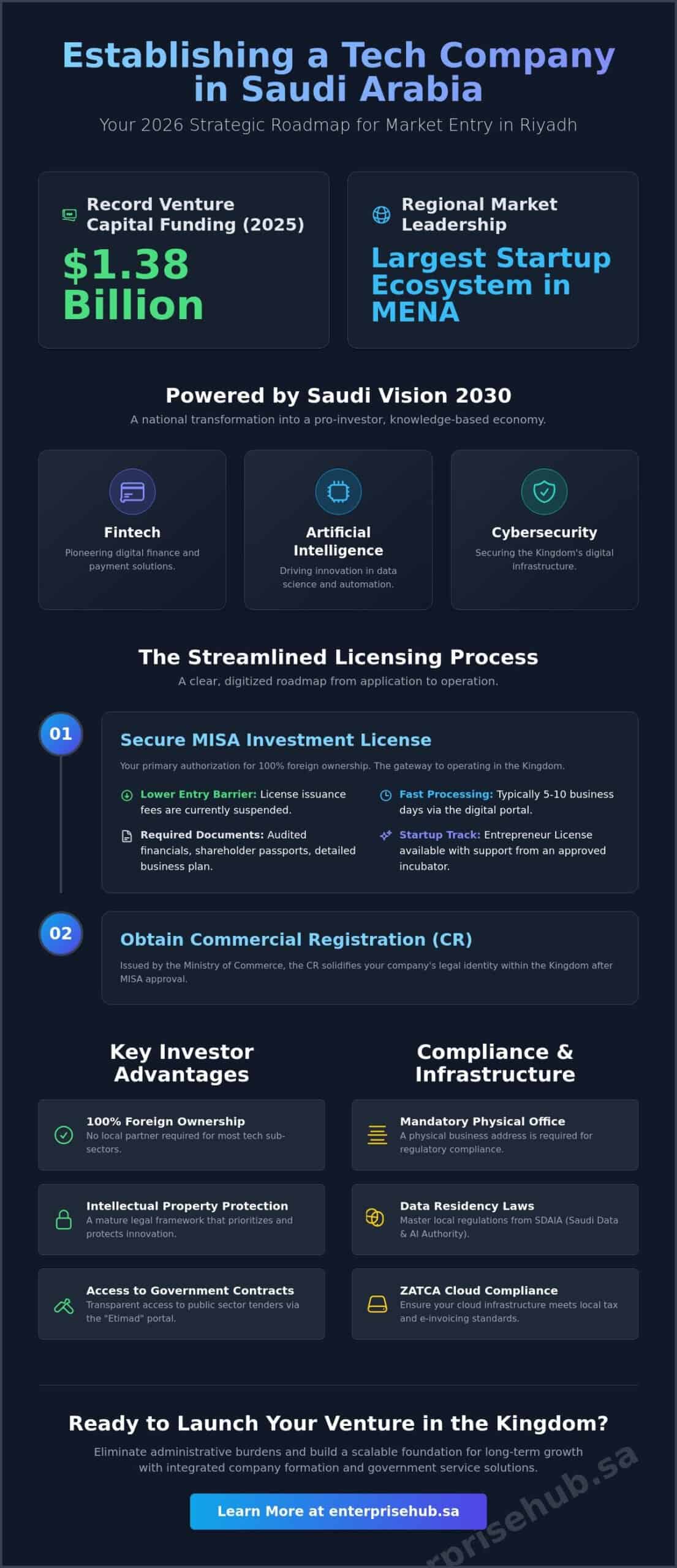
Did you know that venture capital funding in Saudi Arabia reached a record $1.38 billion in 2025, making it the largest startup ecosystem in the MENA region? This surge in capital makes establishing a tech company in Riyadh one of the most strategic moves an entrepreneur can make this year. You’re likely aware of the massive opportunities within the Kingdom, but the prospect of navigating MISA licensing and securing mandatory physical office space can feel like a daunting barrier to entry. It’s natural to feel concerned about balancing local compliance with the need for rapid scaling.
We’ve designed this 2026 strategic guide to give you a comprehensive roadmap for a seamless market entry. You’ll discover how to leverage the current suspension of MISA license fees and the benefits of the specialized Entrepreneur License to minimize your initial costs. We’ll also detail the steps for obtaining your Commercial Registration and setting up a prestigious business address that meets all regulatory standards. From ZATCA cloud compliance to building a scalable infrastructure, this guide ensures your venture is built on a foundation of professional excellence and long-term growth.
Key Takeaways
- Understand how Vision 2030 has transformed the Kingdom into a pro-investor hub with specific growth categories for digital innovation.
- Follow a clear roadmap for establishing a tech company in Riyadh, covering everything from MISA applications to Commercial Registration.
- Identify the mandatory infrastructure requirements and evaluate the strategic benefits of private versus virtual office solutions.
- Ensure operational compliance by mastering local data residency laws and the latest regulations from the Saudi Data and AI Authority (SDAIA).
- Learn how to eliminate administrative burdens through integrated company formation and government service solutions designed for rapid scaling.
The Evolution of the Tech Sector in the Kingdom under Vision 2030
Riyadh’s skyline reflects more than just architectural growth; it represents a fundamental shift toward a knowledge-based economy. The city has transformed into a global magnet for innovation, acting as the heartbeat of a regional digital revolution. This transformation is driven by Saudi Vision 2030, a strategic roadmap that has dismantled old bureaucratic barriers to welcome foreign investment. For entrepreneurs, establishing a tech company in Riyadh means entering a market where digital transformation is the national priority rather than a secondary goal.
The Ministry of Investment (MISA) works in tandem with the Ministry of Communications and Information Technology (MCIT) to provide a streamlined experience for new entrants. They’ve categorized the tech sector into specific, high-growth pillars including Fintech, Artificial Intelligence, and Cybersecurity. These aren’t just labels; they’re supported by a robust ecosystem of incubators and accelerators. By 2026, the Kingdom aims to position itself as a top-tier global tech hub. The momentum is already visible in the data. In 2025, venture capital funding in Saudi Arabia reached $1.38 billion, making it the largest and fastest-growing startup ecosystem in the MENA region.
Defining Your Tech Business Activity
Choosing the right activity is your first step toward long-term success. You must distinguish between software development and IT consulting by selecting the correct ISIC code during the application process. This choice isn’t merely administrative. It directly impacts your minimum capital requirements and the specific incentives you can access from the government. When you’re establishing a tech company in Riyadh, aligning your core business with the Kingdom’s digital goals ensures you’re viewed as a strategic partner. It’s about more than just a license; it’s about fitting into a larger national narrative of progress.
Strategic Advantages for Tech Investors
Investors today benefit from a pro-investor legal framework that prioritizes intellectual property and transparency. You gain direct access to the “Etimad” portal, a centralized digital platform for government tenders that opens doors to massive public sector contracts. This level of access was once difficult to navigate, but it’s now a transparent part of the operational landscape. The regulatory environment has matured to protect innovation while encouraging rapid scaling. The MISA tech license serves as the primary gateway for 100% foreign ownership in 2026, removing the need for a local partner in most technology sub-sectors.
The Step-by-Step Licensing Process for Tech Entities
Moving from a strategic concept to an operational reality requires a precise understanding of the Kingdom’s regulatory roadmap. The licensing phase isn’t just about paperwork; it’s the process of securing your legal standing within a market that rewards compliance and transparency. By following the established digital workflows, you can move through the setup phase with confidence. This journey begins with the Ministry of Investment and culminates in a fully integrated business identity recognized by all national authorities.
The efficiency of this process is a direct result of Saudi Arabia’s Vision 2030, which has digitized the majority of investor interactions. Today, entrepreneurs establishing a tech company in Riyadh benefit from a unified portal that connects various government agencies, reducing the time spent on administrative hurdles. This streamlined approach allows you to focus your energy on product development and market penetration rather than bureaucratic delays.
Securing Your MISA Investment License
The MISA Investment License is your primary authorization to operate as a foreign-owned entity. As of May 2026, the government has suspended license issuance fees to lower the entry barrier for global investors. To apply, you’ll need to prepare several key documents, including your company’s audited financial statements, passport copies of shareholders, and a detailed business plan. The digital portal typically processes these applications within five to ten business days. If you’re an innovation-driven startup, you should consider the Entrepreneur License, which requires a letter of support from an approved incubator but offers even greater flexibility during your initial years of growth.
Completing the Commercial Registration (CR)
Once your MISA license is active, you must obtain your Commercial Registration (CR) from the Ministry of Commerce. This document serves as your official legal identity. The annual fee for a Limited Liability Company is approximately SAR 1,200, with an additional one-time fee of SAR 500 for publishing your Articles of Association. You cannot finalize your CR without a verified physical business address. This address must be registered as your National Address, which is then linked to the Wasel system for all official government correspondence. Ensuring this link is correct is vital for receiving legal notifications and tax documents on time.
After securing your CR, you must complete your registration with the Chamber of Commerce. For tech startups with capital under SAR 375,000 and fewer than five employees, the annual subscription fee is SAR 5,000. Finally, you’ll need to register with the Ministry of Labor through the Qiwa and Muqeem platforms to manage your workforce and open a corporate bank account with a local Saudi institution. If you want to ensure every document meets the latest standards, our experts in establishing companies can guide you through each submission to avoid common pitfalls.
Meeting Infrastructure Requirements: Private and Virtual Offices
Securing your license is a major milestone, but establishing a tech company in Riyadh requires a tangible base to anchor your operations. The Ministry of Investment (MISA) and the Ministry of Commerce mandate a physical lease or a registered address to issue your Commercial Registration (CR). This requirement ensures that every business operating in the Kingdom has a verifiable point of contact for official correspondence and regulatory inspections. Choosing the right type of space depends on your operational scale and your long-term growth strategy within the capital’s competitive tech landscape.
A prestigious business address in Riyadh’s primary financial hub acts as a silent partner in your brand building. It signals stability to local clients and government entities alike. While traditional office costs can start from approximately SAR 35,000 per year for a modest space, modern flexible solutions offer a more agile path to entry. Your physical presence is often the first point of evaluation for potential partners who value a commitment to the local market and a professional setting for high-level negotiations.
The Private Office Advantage
For established firms, Private Offices provide the privacy and professional atmosphere needed to manage sensitive data and high-level operations. These spaces offer more than just a desk; they provide a dedicated environment where your corporate culture can thrive. Having access to fully equipped Meeting Rooms is essential for presenting your software solutions or pitching to venture capital funds. Scalability is a key factor here. You can start with a small executive suite and expand into a larger floor as your team grows, ensuring your infrastructure always matches your current needs without the friction of a complete relocation.
Virtual Offices and Compliance
Startups looking for a lean entry point often find that Virtual Offices in Saudi Arabia are the ideal solution. This model allows you to satisfy MISA and CR physical address requirements without the overhead of a full-time physical lease. It’s a strategic choice for international companies testing the Saudi market. You receive a verified National Address to manage government mail and official communications remotely. This ensures you remain 100% compliant with ZATCA and MISA regulations while maintaining maximum financial flexibility. It’s a powerful way to jumpstart the process of establishing a tech company in Riyadh while keeping your initial burn rate low and your focus on innovation.
Navigating Tech-Specific Regulations and Operational Scaling
Operational success in the Kingdom requires more than just a valid license; it demands deep alignment with specialized regulatory bodies. While the initial setup focuses on the Ministry of Investment, your long-term growth depends on how well you integrate with entities like the Saudi Data and AI Authority (SDAIA) and the Saudi Central Bank (SAMA). Establishing a tech company in Riyadh places you at the center of a highly regulated yet supportive ecosystem where compliance is viewed as a mark of corporate maturity and reliability.
If your venture falls within the fintech space, you’ll find that SAMA offers a unique regulatory sandbox. This environment allows you to test your innovative financial products under a lighter regulatory touch before moving to full-scale operations. This proactive approach by the Kingdom ensures that innovation isn’t stifled by bureaucracy, provided you maintain transparency. Balancing these tech-specific requirements with general business laws is the key to scaling without friction in 2026.
Data Sovereignty and Cloud Compliance
The 2026 standards for data residency are clear: sensitive personal and government-related data must remain within the Kingdom’s borders. This means your cloud hosting strategy must prioritize local providers or international giants with established Saudi data centers. Working with local cloud providers isn’t just about legal safety; it also ensures lower latency for your local user base. SDAIA acts as the primary regulator for data privacy and artificial intelligence ethics, ensuring all tech entities maintain high standards of digital governance. Failure to comply with these residency laws can lead to significant operational disruptions, so it’s vital to audit your data architecture early in the process.
Workforce and Saudization (Nitaqat)
Scaling your team involves navigating the Nitaqat system, which tracks your ratio of Saudi employees to foreign talent. The tech sector enjoys specific classifications that recognize the need for specialized international developers, but you must still meet your “Saudization” targets to maintain a high Nitaqat color grade. A higher grade, such as Platinum or Green, grants you easier access to visa quotas and faster processing through the Qiwa platform. You can leverage government-backed training programs to attract and upskill local tech talent, which often includes subsidies for salaries. Balancing your international expertise with a strong local workforce is the most sustainable way of establishing a tech company in Riyadh while contributing to national economic goals.
Managing these complex regulatory layers can be time-consuming for any growing team. To ensure your entity remains fully compliant while you focus on product development, consider how our government services can streamline your interactions with SDAIA, SAMA, and the Ministry of Labor.
Integrated Solutions for Modern Tech Enterprises
Launching a venture in the Kingdom’s capital is a bold step that requires more than just a physical desk. The final and perhaps most critical piece of the puzzle is finding an ecosystem that absorbs administrative friction. Establishing a tech company in Riyadh is most successful when you partner with a provider that offers a unified platform for your operational needs. By consolidating your workspace, government relations, and financial compliance into a single strategic partnership, you free your leadership team to focus on innovation and market capture.
Operating from a premier financial hub like the King Abdullah Financial District (KAFD) provides an immediate boost to your corporate profile. This isn’t just about aesthetics; it’s about being where the capital and the decision-makers reside. In a market that values prestige and long-term commitment, your business address serves as a powerful signal of stability to both local investors and international clients. Choosing a partner that understands the nuances of talsis alsharikat ensures your entity is built correctly from day one.
Beyond the Office: Strategic Support
Modern tech startups face a rigorous compliance environment, particularly with the Zakat, Tax and Customs Authority (ZATCA). The FATOORA e-invoicing mandate is now a standard requirement for all VAT-registered businesses. Having integrated accounting and tax services means your financial reporting remains audit-ready at all times. Additionally, dedicated government relations services (GRO) handle the ongoing complexities of license renewals, visa processing, and labor law updates. This high-tier support extends to the community itself. When you operate within a professional hub, you gain organic access to a network of like-minded innovators and potential venture capital partners who are already active in the Riyadh ecosystem.
Getting Started in the Kingdom’s Financial Heart
The 2026 regulatory landscape is designed to reward efficiency and digital-first operations. Selecting a base of operations that offers 100% compliance with MISA and CR requirements is the fastest way to bridge the gap between registration and first revenue. A KAFD-based address doesn’t just meet a legal requirement; it builds a foundation of trust. It shows you’re serious about your role in the Kingdom’s digital future. If you’re ready to move from planning to execution, you can establish your tech company with Enterprise Hub and leverage a suite of solutions designed for rapid, scalable growth in the heart of Riyadh.
Building Your Future in the Heart of Riyadh
Riyadh has evolved into a global tech powerhouse where innovation meets strategic opportunity. Success in this market depends on more than just a great product; it requires a deep understanding of the Kingdom’s regulatory shifts and a commitment to a professional physical presence. You’ve seen how Vision 2030 has paved the way for growth through streamlined licensing and specialized support for sectors like fintech and AI. Establishing a tech company in Riyadh is a strategic journey that rewards those who prioritize local compliance and premium infrastructure from day one.
By securing a prestigious address and aligning with data residency laws, you position your brand for sustainable growth. We’re ready to ensure your market entry is seamless and efficient. From our location in the heart of KAFD, we offer full MISA and CR support alongside premium private offices and meeting rooms. You don’t have to navigate these administrative hurdles alone. Launch your tech venture with Enterprise Hub today and join a community of leaders. The Kingdom’s digital future is bright, and your business belongs at its center.
Frequently Asked Questions
Can a foreigner own 100% of a tech company in Saudi Arabia in 2026?
Yes, foreign investors can maintain 100% ownership of their tech entities through a MISA investment license. This regulatory framework eliminates the need for a local Saudi partner in the majority of technology sub-sectors. It’s a cornerstone of the Kingdom’s strategy to attract global innovation and expertise into the local market while providing investors with full operational control.
What is the minimum capital requirement for a tech startup in the Kingdom?
There is often no minimum capital requirement for startups applying under the specialized Entrepreneur License. For standard MISA licenses, the required capital depends on the specific ISIC activity you select during the application. It’s essential to verify your business activity early as this determines the financial thresholds your entity must meet to secure approval.
Is a physical office mandatory for obtaining a Commercial Registration (CR)?
Yes, you must provide a verified physical address or a registered virtual address to obtain your Commercial Registration. This address is registered as your National Address and is used by all government agencies for official correspondence. You can’t finalize your legal identity in the Kingdom without this verified infrastructure in place to anchor your operations.
How long does it take to establish a tech company from start to finish?
The process of establishing a tech company in Riyadh typically takes between four to eight weeks. This timeline depends on the readiness of your audited financial statements and shareholder documentation. Once your MISA license is issued, the subsequent steps for Commercial Registration and Chamber of Commerce membership move quickly through integrated digital portals.
What are the benefits of setting up a tech entity in a specialized financial hub?
Operating within a hub like KAFD provides immediate access to a high-tier corporate network and proximity to key regulators. This environment fosters trust with potential investors and clients who value a prestigious business address. It also places your team in a collaborative ecosystem designed for rapid scaling and high-level networking within the Kingdom’s financial heart.
What is the difference between a MISA license and a standard commercial license?
A MISA license is the primary investment permit required for any company with foreign ownership to operate in the Kingdom. The Commercial Registration (CR) is the secondary document issued by the Ministry of Commerce that establishes your legal identity. Both documents are mandatory for international entrepreneurs to operate legally and open corporate bank accounts.
How does the Nitaqat system affect small tech startups?
The Nitaqat system tracks your “Saudization” level, which is the ratio of local employees to foreign talent in your workforce. Small startups with fewer than six employees often fall into a simplified category with reduced initial requirements. As you grow, maintaining a high color grade is vital for securing future visa quotas for specialized international developers.
Can I use a virtual office to register my tech company for a MISA license?
Yes, you can use a registered virtual office address to satisfy the physical address requirements for both MISA and the Ministry of Commerce. This is a highly cost-effective solution for establishing a tech company in Riyadh during the early market-entry phase. It ensures full compliance with the National Address system while keeping your initial operational overhead low.