
What if the biggest barrier to your Saudi expansion isn’t the government fees you’ve already budgeted for, but the invisible infrastructure costs that catch most investors off guard? We understand that calculating the true تكلفة تأسيس شركة في السعودية can feel like moving through a maze of MISA regulations, Ministry of Commerce requirements, and shifting workspace mandates. It’s natural to feel overwhelmed by the complexity of compliance and the fear of unexpected hidden costs in office leasing. You aren’t just looking for a list of fees; you’re looking for a strategic entry point into a market valued at over 1.3 trillion dollars.
This guide provides a comprehensive breakdown of every financial line item you’ll encounter in 2026, from the standard 1,200 SAR Commercial Registration fee to the strategic nuances of MISA licensing. We’ll show you exactly how to minimize initial capital expenditure while ensuring full regulatory compliance. You’ll gain a clear roadmap for both legal and physical establishment, allowing you to focus on growth rather than paperwork. We’ll explore how flexible infrastructure can reduce setup costs, giving you a transparent budget to launch your venture with total confidence.
Key Takeaways
- Decode the 2026 regulatory landscape to distinguish between core licensing fees and the critical infrastructure costs required for a legal presence.
- Secure a clear breakdown of MoC and MISA registration requirements to ensure your initial تكلفة تأسيس شركة في السعودية remains within your projected budget.
- Evaluate the financial impact of workspace mandates and identify how flexible office solutions can eliminate hidden leasing expenses like fit-outs and maintenance.
- Master the timeline for post-incorporation compliance, including ZATCA filings and labor platform subscriptions, to maintain operational standing.
- Discover strategic ways to consolidate your legal, accounting, and office needs into a single integrated package to accelerate your market entry.
Understanding the Economic Landscape of Saudi Business Setup in 2026
Saudi Vision 2030 isn’t just a blueprint; it’s the engine driving a massive reduction in entry barriers. By 2026, the Economic Landscape of Saudi Arabia has matured into a highly efficient, pro-investor environment. Entering the market now means you’re benefiting from years of regulatory refinement. This maturity directly impacts the تكلفة تأسيس شركة في السعودية by replacing bureaucratic delays with predictable, digital-first processes.
We categorize setup expenses into three pillars: Licensing, Infrastructure, and Compliance. While government fees are often fixed, infrastructure and compliance costs are where strategic choices make the difference. Foreign investors face a different structure via MISA compared to local entities, primarily due to higher licensing fees and mandatory physical presence requirements that require careful planning. Understanding these distinctions is the first step toward a lean and successful launch.
The Shift from Traditional to Digital Setup
The Saudi Business Center has revolutionized how we launch companies. It acts as a unified portal, drastically cutting down administrative overhead. In the past, you’d pay heavy consultancy fees just to manage multiple government interactions. Today, these digital-first services allow you to handle registrations with minimal external help. As of 2026, Saudi Arabia’s Ease of Doing Business index ranking reflects a top-tier global position for speed and transparency in starting a commercial venture.
Choosing Your Legal Structure: Cost Implications
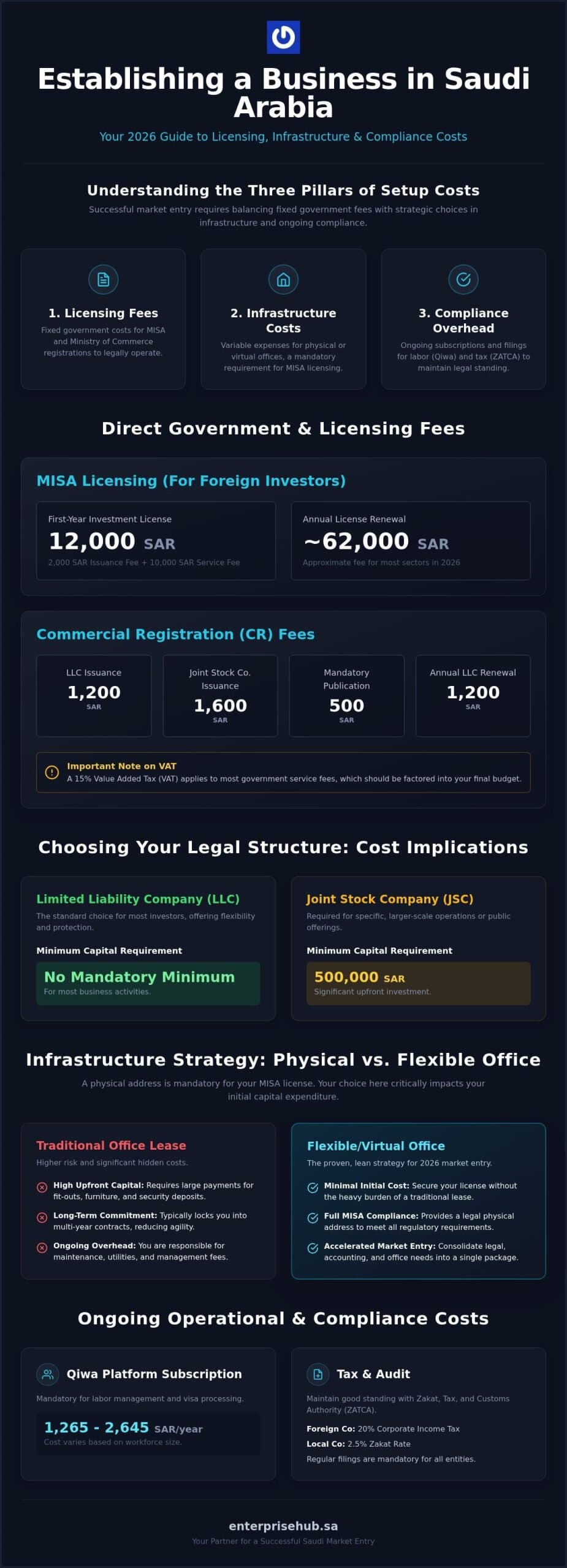
Your choice of entity is the most significant lever for your budget. For most, a Limited Liability Company (LLC) is the standard choice because it no longer requires a mandatory minimum capital for many activities. In contrast, a Joint Stock Company requires a minimum of 500,000 SAR. Professional companies, which focus on specialized services, often have different fee variations compared to standard commercial entities. These decisions fundamentally shape your initial تكلفة تأسيس شركة في السعودية and your ongoing overhead.
It’s vital to look beyond day one. Your legal structure dictates your long-term tax obligations and audit requirements. For instance, foreign companies face a 20% corporate income tax, while local entities handle a 2.5% Zakat rate. Choosing the right path early prevents costly restructuring later. If you’re looking to satisfy MISA’s physical office requirements while keeping initial costs low, exploring virtual office packages or flexible workspaces is a proven strategy for 2026. This approach allows you to secure your license without the heavy burden of traditional long-term leases.
Direct Government Fees and Licensing Costs for 2026
Navigating the financial requirements for a new venture begins with understanding the fixed levies collected by the state. The 2026 fee structure is designed for transparency, yet it requires a precise approach to avoid redundant payments. The primary تكلفة تأسيس شركة في السعودية centers on your Commercial Registration (CR) and sector-specific licenses. For a local Limited Liability Company (LLC), the standard issuance fee for the CR is 1,200 SAR. If you’re establishing a Joint Stock Company, this fee rises to 1,600 SAR. You must also budget 500 SAR for the mandatory publication of your company’s establishment details.
Beyond the initial registration, you’ll need to account for annual confirmation fees and mandatory platform subscriptions. For instance, an LLC pays 1,200 SAR annually to maintain its CR status. Additionally, every business must subscribe to the Qiwa platform for labor management, which costs between 1,265 SAR and 2,645 SAR depending on your workforce size. It’s also important to remember that a 15% VAT applies to most government service fees, which can subtly increase your total تكلفة تأسيس شركة في السعودية if not calculated upfront.
MISA Licensing for Foreign Investors
Foreign investors must secure a license from the Ministry of Investment (MISA). For the first year, expect an issuance fee of 2,000 SAR combined with a 10,000 SAR service center fee. While the entry cost is manageable, the annual renewal fee for most sectors in 2026 is approximately 62,000 SAR. You’ll also encounter Ministry of Foreign Affairs (MOFA) attestation costs for your parent company documents, which typically range from 100 to 300 SAR per page for certified translation. A strategic tip for 2026: bundle related business activities under a single license where possible to consolidate these administrative commitments. If you’re unsure which license category fits your model, you can speak with our licensing specialists for a tailored breakdown.
Municipality and Civil Defense Requirements
Your physical office footprint directly dictates your municipality fees. The “Balady” license is calculated based on the square footage of your premises and the nature of your business activity. You cannot finalize your registration without a valid rental contract (Ejar) and a Civil Defense safety certificate. This certificate proves your workspace meets national fire and safety standards. While these costs vary, startups in specialized tech zones or specific industrial sectors may qualify for fee exemptions during their first three years of operation. Chamber of Commerce membership is another mandatory cost, ranging from 2,000 SAR to 10,000 SAR annually based on your company’s capital classification.
Infrastructure and Workspace Requirements: Virtual vs. Physical Offices
Every company in the Kingdom must have a registered business address to finalize its commercial registration and obtain a municipality license. This is a non-negotiable part of the تكلفة تأسيس شركة في السعودية. While government fees are fixed, your choice of workspace is where you’ll find the most significant budget variability. Traditional commercial leases often come with a “consultancy trap” of hidden costs that aren’t immediately apparent. You aren’t just paying rent; you’re funding fit-outs, high-speed internet installation, utility deposits, and ongoing maintenance. For many new entrants, these upfront capital requirements can consume a significant portion of their initial investment before the business even begins operations.
Choosing between a serviced office, a co-working space, or a traditional lease requires a clear cost-per-employee analysis. A managed workspace often proves more economical because it bundles utilities, cleaning, and reception services into a single predictable monthly fee. This eliminates the need for a dedicated office manager and reduces the administrative burden on your core team. By shifting from a traditional 5-year lease to a flexible managed solution, you preserve liquidity and maintain the agility needed to respond to market shifts in 2026.
The ROI of Virtual Offices in Saudi Arabia
For many investors, virtual office packages represent the most efficient way to fulfill legal requirements at a fraction of the cost of a physical lease. This strategy completely eliminates Capex. There’s no need to invest in furniture or manage utility contracts before you’ve even hired your first local employee. It’s a MISA-compliant solution that allows you to secure your license while maintaining the flexibility to scale. As your operations expand, you can seamlessly transition from a virtual presence to private offices without the headache of changing your registered address or re-filing municipality documents.
Shared Spaces and Co-working Economics
Small teams and startups often find that co-working flexi desks provide the best balance of professionalism and price. Instead of committing to a rigid traditional lease, managed workspaces offer annual or monthly agreements that better suit a growing business. This model provides access to premium meeting rooms and event spaces without the overhead of a dedicated boardroom that sits empty most of the time. When calculating the total تكلفة تأسيس شركة في السعودية, factor in that managed spaces include high-speed internet and security in their baseline cost, making your monthly burn rate highly predictable and easier to manage.
Indirect and Ongoing Operational Costs to Anticipate
Incorporation marks the beginning of your journey, not the end. The true تكلفة تأسيس شركة في السعودية involves a cycle of recurring regulatory expenses that keep your business in good standing. Once your legal entity is active, you must immediately register with the General Organization for Social Insurance (GOSI) and the Muqeem portal for residency management. Workforce costs are often the largest variable in an operational budget. For instance, the annual work permit fee for a foreign employee is 9,600 SAR. You must also factor in mandatory medical insurance, which typically costs between 1,000 and 3,000 SAR per person, and a one-time Iqama issuance fee of 650 SAR. These figures make human resource planning a central pillar of your long-term financial strategy.
Tax compliance is another critical area that requires consistent attention. The Zakat, Tax and Customs Authority (ZATCA) requires most businesses to register for VAT, and the 15% rate applies to almost all commercial transactions. Quarterly filings are mandatory. The implementation of the FATOORA e-invoicing system means your accounting software must be fully compliant with national standards. Neglecting these filings leads to steep penalties that can quickly eclipse your initial setup savings. Maintaining a lean operation in 2026 requires a proactive approach to these indirect costs, ensuring your capital is spent on growth rather than avoidable fines.
Compliance and Government Relations (GRO)
Managing the Nitaqat system is a strategic necessity for any growing team. Your company’s nationalization color, such as Platinum or Green, dictates your ability to obtain new visas and renew existing ones. While some firms hire a dedicated internal Government Relations Officer, many SMEs find it more cost-effective to outsource these services. This eliminates the salary and benefits of a full-time hire while ensuring that all commercial permits and professional licenses are renewed before they expire. Budgeting for these annual renewals is essential to prevent operational disruptions that could damage your market reputation.
Accounting, Tax, and Financial Auditing
Bookkeeping isn’t optional; it’s a legal requirement from the first day of your establishment. Limited Liability Companies are mandated to submit annual audited financial statements to the Ministry of Commerce. These audits must be conducted by certified firms to ensure transparency and compliance with local regulations. Utilizing integrated accounting and tax services is a proven way to streamline this process. It ensures your records are always audit-ready and prevents expensive late-filing penalties. To secure your company’s financial health, you can consult with our financial experts to establish a compliant and efficient accounting framework today.
Optimizing Setup Costs with Integrated Business Solutions
Managing the various components of a new venture separately often leads to the “Consultancy Trap.” This occurs when an investor pays multiple independent providers for legal advice, office leasing, and accounting services. Each provider works in a silo, leading to overlapping fees and communication gaps that inflate the total تكلفة تأسيس شركة في السعودية. Consolidating these requirements under a single provider creates a “Business Hub” advantage. It allows you to align your licensing timeline with your office activation and tax registration, ensuring no capital is wasted on services you aren’t yet ready to use.
Leveraging local expertise is particularly crucial in 2026 as the Kingdom introduces new incentives and rebates for specific sectors. A strategic partner who understands the current regulatory climate can help you identify these savings early. To help you plan your first year, follow this financial roadmap:
- Months 1-3: Focus on MISA and Ministry of Commerce registration while securing a compliant address.
- Months 4-6: Complete GOSI and Qiwa registrations and finalize initial staff visas.
- Months 7-9: Implement ZATCA-compliant e-invoicing and begin quarterly VAT filings.
- Months 10-12: Prepare for the first annual audit and renew mandatory Chamber of Commerce memberships.
Strategic Outsourcing vs. In-house Management
Many investors mistakenly believe that hiring internal staff for government relations is the most secure path. However, the salary, benefits, and training costs for a full-time expert often outweigh the price of managed services. Utilizing a national business hub provides you with a team of experts for a fraction of the cost. This approach is especially effective for foreign investors who need to navigate local nuances without the overhead of a large internal department. For a more tactical breakdown of these phases, refer to our guide to establishing companies in Saudi Arabia.
Maximizing Value with Flexible Office Solutions
The most effective way to control your initial تكلفة تأسيس شركة في السعودية is to delay heavy infrastructure spending. You can use virtual addresses to satisfy the initial MISA license requirements, allowing you to establish your legal presence first. This strategy lets you test the market and build revenue before committing to a physical office footprint. Once you reach your growth milestones, you can scale into private offices or shared spaces. This flexibility ensures your workspace costs always match your current business needs. You can schedule a consultation with Enterprise Hub to build your customized setup budget and start your journey with a clear, optimized financial plan.
Launch Your Vision in the Kingdom Today
The roadmap to a successful market entry in 2026 requires a balance between regulatory precision and financial agility. We’ve explored how identifying the true تكلفة تأسيس شركة في السعودية goes beyond initial government fees, encompassing strategic choices in workspace infrastructure and long-term compliance. By distinguishing between mandatory CR costs and the flexible ROI of virtual or managed offices, you can preserve the capital needed to drive your core business growth. Navigating this evolving landscape doesn’t have to be a solo venture that drains your resources or focus.
Don’t let the complexity of MISA licensing or the “consultancy trap” of fragmented services slow your progress. Our team provides comprehensive MISA setup support, premium business addresses across the Kingdom, and all-in-one accounting and government relations to ensure your transition is seamless. We’re here to act as your strategic partner, turning regulatory hurdles into a clear path for sustainable expansion and prosperity. Start your Saudi business journey with Enterprise Hub today and build your presence in one of the world’s most dynamic economies with absolute confidence. Your success is part of a shared national vision, and we’re ready to help you achieve it.
Frequently Asked Questions
What is the minimum capital required to start a company in Saudi Arabia in 2026?
For most activities, there’s no mandatory minimum capital for a Limited Liability Company (LLC) in 2026. However, we recommend a starting capital of at least 100,000 SAR to demonstrate financial stability to authorities and banks. Specific industries or entities like Joint Stock Companies still require a minimum of 500,000 SAR. This flexibility allows you to align your initial investment with your actual operational needs rather than arbitrary regulatory thresholds.
Can an expat own 100% of a company in Saudi Arabia?
Yes, foreign investors can now achieve 100% ownership in the vast majority of commercial sectors. This landmark reform, driven by Saudi Vision 2030, eliminated the previous requirement for a local Saudi partner in most industries. While certain strategic sectors like oil and gas or military services may still have restrictions, the open-market policy has significantly lowered the barriers to entry for global entrepreneurs looking to scale their operations within the Kingdom.
Is a physical office mandatory for obtaining a MISA license?
Foreign entities generally require a physical office with a verified rental contract (Ejar) to finalize their commercial registration and MISA licensing. This physical presence is a strict requirement for most license types to ensure accountability and operational legitimacy. However, you can satisfy this mandate efficiently by using serviced offices or managed workspaces, which provide the necessary documentation without the heavy capital expenditure of a long-term traditional lease or fit-out.
How much does it cost to renew a Commercial Registration (CR) annually?
The annual fee to confirm and renew your Commercial Registration (CR) is 1,200 SAR for a Limited Liability Company (LLC). If your entity is structured as a Joint Stock Company, the renewal fee is 1,600 SAR. These costs are part of the standard تكلفة تأسيس شركة في السعودية that you must budget for annually. Keep in mind that a 15% VAT applies to these government fees, and you’ll also need to renew your Chamber of Commerce membership.
Are there hidden fees in the Saudi company formation process?
While government fees are transparent, many investors overlook secondary costs like document translation, notarization, and mandatory platform subscriptions. Translation of foreign documents can cost between 100 and 300 SAR per page. Additionally, annual subscriptions to the Qiwa platform (up to 2,645 SAR) and municipality “Balady” licenses are recurring expenses. Integrated business solutions help you identify these line items early, preventing the “consultancy trap” where unexpected administrative costs suddenly inflate your setup budget.
How long does the company establishment process take from start to finish?
The entire process typically takes between three to six weeks, depending on the complexity of your business activity and the speed of document attestation. Digital platforms like the Saudi Business Center have significantly accelerated the timeline for obtaining a CR and MISA license. However, post-incorporation steps such as opening a local bank account and securing municipality permits can add time. Planning your documentation in advance is the best way to ensure a swift launch.
What are the ongoing tax obligations for new businesses in the Kingdom?
Foreign-owned companies are subject to a 20% corporate income tax on net profits, while Saudi or GCC-owned entities pay a 2.5% Zakat on their Zakat base. All businesses exceeding the mandatory threshold must also manage a 15% VAT on goods and services. Compliance with ZATCA’s e-invoicing requirements is mandatory from day one. Proper bookkeeping and quarterly filings are essential to avoid penalties that could negatively impact your overall تكلفة تأسيس شركة في السعودية.
Can I use a virtual office address for my Saudi business license?
Virtual offices are permissible for specific license categories and are an excellent cost-saving entry point for startups. They allow you to fulfill the requirement for a registered business address without the high overhead of a private suite. However, foreign investors under MISA must verify if their specific activity allows for a virtual setup, as many sectors still mandate a physical office footprint. We can help you determine the most compliant and cost-effective address solution for your needs.