
Establishing your presence in the King Abdullah Financial District is no longer just a prestige play; it’s the most decisive move for any multinational aiming to meet the strict 2026 Regional Headquarters (RHQ) mandates. With FDI inflows surging by 44% in early 2025, the competition for a foothold in this strategic financial district is intensifying. You’re likely feeling the pressure of the June 30, 2026, deadline to have 90% of employee contracts documented on Qiwa, all while weighing the high costs of premium office space against your projected ROI.
We understand that navigating the shift to a “Registration-First” model and managing the SAR 62,000 MISA renewal fees can feel overwhelming. Enterprise Hub provides this expert-led roadmap, simplifying the business setup in KAFD Riyadh for foreign investors, showing you exactly how to secure 100% ownership and unlock the 30-year tax incentive package. We’ll preview the critical regulatory changes ahead, including the July 1, 2026, GOSI rate increase to 23.5% for Saudi staff, so you can integrate into the Saudi financial ecosystem with total confidence and operational excellence.
Key Takeaways
- Discover why KAFD serves as the mandatory anchor for Regional Headquarters (RHQ) compliance and long-term tax incentives.
- Master the end-to-end roadmap for business setup in KAFD Riyadh for foreign investors to ensure 100% ownership and legal security.
- Learn how to navigate the technical link between physical office leases and mandatory National Address certification.
- Identify critical 2026 deadlines for digital compliance on government platforms like Qiwa and ZATCA to maintain operational status.
- Explore integrated solutions that combine MISA licensing with premium corporate infrastructure to accelerate your market entry.
Why KAFD is the Strategic Choice for Foreign Investors in 2026
KAFD isn’t just a collection of skyscrapers; it’s the physical manifestation of Saudi Arabia’s financial future. As we move through 2026, the King Abdullah Financial District has evolved into the primary gateway for global capital. It serves as a sophisticated regulatory sandbox where fintech and professional service firms test innovations under the guidance of the Saudi Central Bank (SAMA). For any entity looking at business setup in KAFD Riyadh for foreign investors, this district offers more than just square footage. It offers immediate credibility. Holding a KAFD address has become a silent prerequisite for securing high-value government contracts, as it signals a long-term commitment to the Kingdom’s economic transformation. With FDI inflows having surged by 44% in 2025, the window for securing prime positioning is narrowing.
The 2026 Regional Headquarters (RHQ) Context
MNCs face a clear choice in the current regulatory environment. Establishing an RHQ in KAFD unlocks a renewable 30-year tax incentive package, featuring a 0% corporate income tax rate on eligible activities. We’ve seen a massive shift since the initial mandates. KAFD is the preferred destination because it centralizes the decision-makers. It’s where the talent is. Specialized international professionals choose KAFD for its lifestyle and prestige, making recruitment for your Saudi operations significantly easier. If you want to attract the world’s best financial minds, you have to be where they want to work.
A “City Within a City” Ecosystem
Efficiency is the currency of 2026. KAFD is a sustainable, smart-city hub optimized for 24/7 business operations. Unlike traditional business districts that shut down after 5:00 PM, it integrates commercial life with high-end retail and luxury residential zones. The Riyadh Metro and a network of climate-controlled pedestrian skywalks eliminate the friction of city traffic. This connectivity ensures that your team stays productive and mobile regardless of the weather. You aren’t just renting an office. You’re plugging into a seamless operational environment that supports growth from day one. We help you navigate this ecosystem to ensure your transition is as smooth as the district’s infrastructure.
The district’s maturity in 2026 means that all essential services, from world-class dining to government liaison offices, are within walking distance. This proximity reduces operational overhead and fosters a culture of spontaneous networking. In a market where relationships drive deals, being at the heart of the action is a strategic necessity, not a luxury.
The regulatory environment for business setup in KAFD Riyadh for foreign investors has undergone a digital revolution. By 2026, the Ministry of Investment (MISA) has fully transitioned to a “Registration-First” model that prioritizes speed and transparency. This shift is designed to support the massive influx of global firms fulfilling the RHQ mandate we discussed in the previous section.
Choosing the right legal structure is your first critical decision. Most foreign entities opt for a Limited Liability Company (LLC) because it allows for 100% foreign ownership in the financial and professional service sectors. Alternatively, a Branch of a Foreign Company is a viable path if you prefer to maintain a direct legal link to your parent entity. Regardless of the structure, your activities must align strictly with the latest ISIC-4 classifications. Misalignment at this stage can cause significant delays in your ZATCA and GOSI registrations later.
The Investment License Application
The 2026 application process requires a clear set of legalized documents, including your parent company’s commercial registration and audited financial statements. These must be translated into Arabic by certified local translators to meet Saudi standards. Firms choosing KAFD as their base benefit from a dedicated “Fast-Track” licensing stream in 2026, often reducing the issuance of the initial MISA license to just a few business days. This license carries an initial fee of approximately SAR 12,000, which includes the first-year service subscription.
Post-Licensing Compliance
Securing your MISA license is just the beginning. You must immediately apply for a Commercial Registration (CR) through the Ministry of Commerce, which costs roughly SAR 1,200 annually. Following this, registration with ZATCA is mandatory for tax compliance. If your annual revenue is expected to exceed SAR 375,000, you must also register for VAT, currently set at 15%. Keep in mind that while the initial MISA fee is relatively low, the annual renewal fee after the first year increases to between SAR 60,000 and SAR 62,000 depending on your specific sector.
Finally, you must establish your presence in the National Address system. While new companies are exempt for their first year, the annual fee for an LLC is SAR 1,000. This registration is technically linked to your physical lease in KAFD, creating a verified digital footprint for your business. If these steps seem complex, our team can manage your tasees and government services
Infrastructure and the National Address Requirement
A physical office is far more than a logistical necessity. It is the cornerstone of your legal presence. For anyone pursuing business setup in KAFD Riyadh for foreign investors, the lease agreement is the primary document that triggers your National Address registration with Saudi Post (SPL). Without this verified address, your Commercial Registration remains incomplete. Your ability to interact with government portals like Qiwa or Muqeem is essentially frozen until this link is established. KAFD’s infrastructure is designed to bridge this gap instantly. Unlike traditional commercial zones where address verification can take weeks, KAFD’s integrated systems ensure that your “Ejar” lease is recognized by the Ministry of Commerce immediately.
Comparing private offices in Riyadh within the district to traditional long-term leases reveals a significant speed advantage. Traditional leases often require months of fit-out work and municipal inspections before they are deemed compliant for a MISA license. In contrast, serviced executive suites in KAFD are pre-certified. They meet every technical requirement from day one, allowing you to focus on growth rather than construction permits.
Ready-to-Use vs. Custom Fit-Outs
Market entry in 2026 favors the agile. Serviced suites allow you to bypass the complexities of fire safety inspections and interior design approvals. These spaces are built to the highest global standards, featuring Tier 4 data centers and district-wide fiber optics that support high-frequency trading and data-heavy fintech operations. Sustainability is also a core focus. Most buildings in the district hold LEED Gold or Platinum certifications, aligning your corporate presence with the environmental goals of Vision 2030. This ensures your business setup in KAFD Riyadh for foreign investors meets both local regulations and global ESG standards.
Banking and Financial Setup
Opening a local corporate bank account is the final hurdle in your setup. Saudi banks have strict “Know Your Customer” (KYC) protocols, and they prioritize businesses located in recognized financial hubs. A KAFD address acts as a trust signal. It simplifies the verification process, often accelerating account activation by 30% compared to firms in less regulated areas. By 2026, the synergy between financial district residency and capital repatriation ease ensures that your profits can move as quickly as your business grows. This operational fluidity is essential for maintaining liquidity and investor confidence in a fast-moving market.
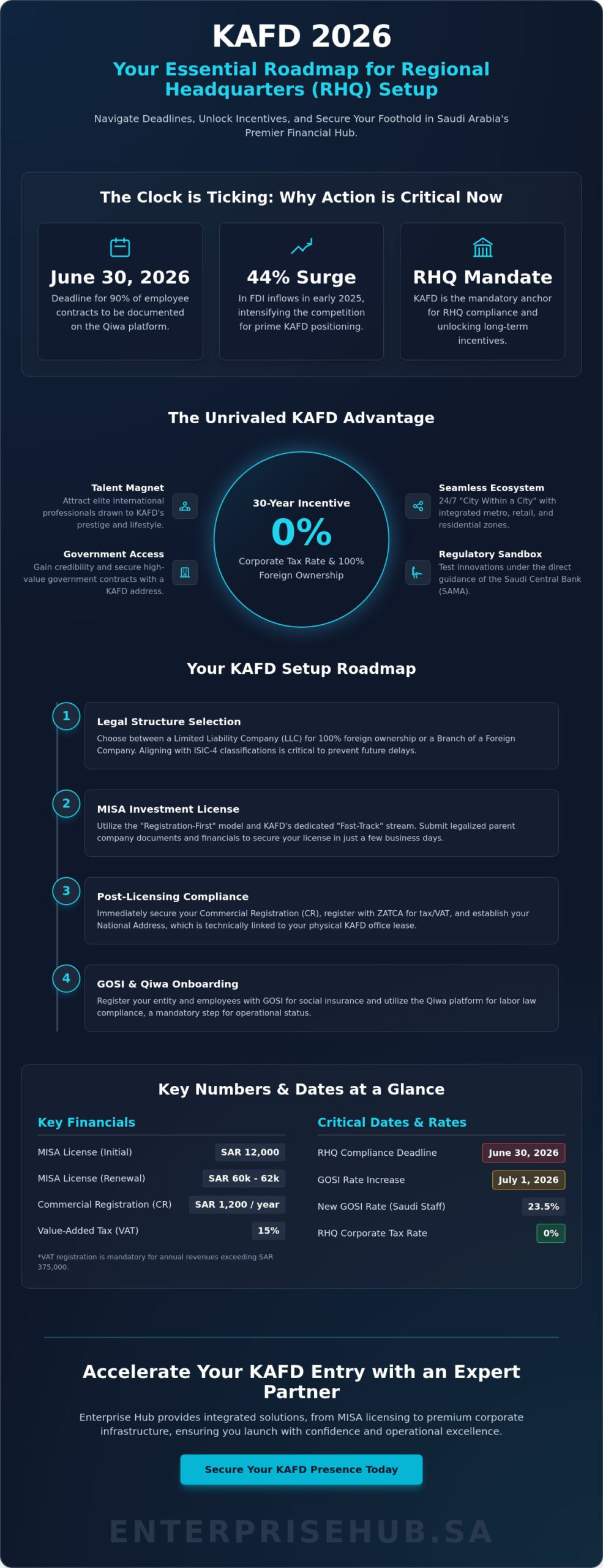
Executing the Setup: A 5-Step Roadmap for 2026
Successfully navigating business setup in KAFD Riyadh for foreign investors requires a precise sequence of actions. By 2026, the integration between government portals has become instantaneous, meaning a mistake in step one will halt your progress in step four. We’ve refined this roadmap to ensure your entry into the Saudi financial ecosystem is both swift and compliant with the latest Vision 2030 standards.
- Step 1: Secure MISA Investment License and Name Reservation. This is your foundational approval. For most service and commercial sectors, the initial license cost is SAR 12,000, which includes the first-year service subscription.
- Step 2: Sign a Lease for a Compliant KAFD Office Space. As established in the previous section, your physical lease is the catalyst for your National Address. It must be documented through the “Ejar” system to be recognized by other government entities.
- Step 3: Issue the Commercial Registration (CR) and Articles of Association. Once your lease is verified, you’ll issue your CR through the Ministry of Commerce. This step costs approximately SAR 1,200 and officially births your Saudi legal entity.
- Step 4: Register with Labor (Qiwa), Social Insurance (GOSI), and Interior (Muqeem). This is where digital compliance is non-negotiable. By June 30, 2026, you must have 90% of your Saudi employee contracts documented on the Qiwa platform to maintain your Saudization status.
- Step 5: Finalize ZATCA Tax Registration and Open Bank Accounts. You’ll register for VAT (if revenue exceeds SAR 375,000) and integrate with the “Fatoora” e-invoicing system. This step concludes with opening your corporate bank account to facilitate capital injection.
Managing Government Relations
The complexity of 2026 regulations makes a skilled Government Relations Officer (GRO) indispensable. They act as your liaison, managing the nuances of the “Qiwa” platform for international talent recruitment and ensuring your work permits are processed without delay. Bureaucratic friction can be costly. Leveraging professional business setup in Riyadh services allows you to outsource this complexity, ensuring your team remains focused on market growth rather than administrative hurdles.
Ongoing Operational Compliance
Your responsibilities don’t end at incorporation. Annual audits are mandatory for foreign-owned LLCs to ensure transparency and tax accuracy. You must also maintain your Nitaqat (Saudization) ratios. Remember that as of April 2026, any Saudi employee counted toward your quota must earn a minimum monthly wage of SAR 4,000. Additionally, stay prepared for the July 1, 2026, GOSI contribution increase, where the total rate for Saudi employees will rise to 23.5%. Keeping your National Address updated and your MISA license renewed (at the year-two rate of SAR 60,000 to SAR 62,000) is vital for uninterrupted operations. To simplify these ongoing requirements, start your KAFD journey today with a partner who understands the 2026 landscape.
Enterprise Hub: Your Strategic Partner in KAFD
Choosing the right partner is as critical as choosing the right district. At Enterprise Hub, we don’t just provide office space; we act as your strategic anchor in the Saudi market. We understand that business setup in KAFD Riyadh for foreign investors involves high stakes and tight deadlines. Our mission is to remove every administrative hurdle, allowing you to focus on your core growth while we manage the complexities of the 2026 regulatory landscape. From securing your initial MISA license to providing premium meeting rooms in Riyadh, our integrated solutions are designed for immediate operational excellence.
Speed to market is a decisive factor in 2026. Traditional setups can take months, but our ready-to-use executive workspaces allow your team to be productive from day one. We’ve built an ecosystem that addresses the specific needs of the financial and professional services sectors. This includes expert accounting and tax services that ensure you stay compliant with ZATCA’s “Fatoora” requirements and the latest GOSI contribution rates. We take the guesswork out of Saudi regulations, providing you with a clear, data-driven path to success.
The Enterprise Hub Advantage
Our direct presence within KAFD gives you a distinct edge. You’ll be located within walking distance of major financial institutions and government entities, fostering a level of networking that is impossible from outside the district. We offer a specialized “Soft Landing” package tailored for international firms and CFOs. This package simplifies the transition by handling everything from National Address registration to the technical integration of your payroll on the Qiwa platform. Enterprise Hub bridges the gap between global corporate standards and local Saudi expertise, ensuring your brand maintains its prestige while operating with local efficiency.
Next Steps for Your Expansion
The 2026 economic landscape in Riyadh moves fast. Delaying your setup could mean missing out on prime locations or facing tighter scrutiny as the RHQ deadlines approach. We invite you to schedule a consultation with our experts to develop a customized market entry strategy that aligns with your specific business goals. Whether you need a private headquarters or a flexible workspace to test the market, we have the infrastructure to support your vision. You can also request a private tour of our KAFD executive suites to see the quality of our facilities firsthand. Contact Enterprise Hub today to launch your KAFD headquarters and secure your place in the future of Saudi finance.
Accelerate Your Market Entry in the Heart of Saudi Finance
The financial landscape of 2026 demands more than just presence; it requires strategic positioning and absolute regulatory precision. By choosing KAFD, you’re not just renting an office. You’re securing a renewable 30-year tax incentive and positioning your firm at the center of the Kingdom’s economic transformation. Success hinges on mastering the technical links between your physical lease, your National Address, and the mandatory digital platforms like Qiwa and ZATCA. Navigating the business setup in KAFD Riyadh for foreign investors doesn’t have to be a solitary journey.
Enterprise Hub, established in 2022, provides the deep local expertise and premium KAFD business address your brand deserves. We offer integrated MISA and government service support to ensure your transition is seamless and fully compliant with all 2026 mandates. We’ve helped hundreds of firms bridge the gap between global standards and local requirements with our specialized soft-landing packages. Launch Your Saudi Business in KAFD with Enterprise Hub and join a community of global leaders shaping the future of the region. Your success story in Riyadh starts here.
Frequently Asked Questions
Is 100% foreign ownership available for businesses in KAFD?
Yes, 100% foreign ownership is standard for most sectors, including financial and professional services. You don’t need a local Saudi partner to establish a Limited Liability Company (LLC) or a branch office. This autonomy is a cornerstone of the Kingdom’s strategy to attract global firms and ensures you maintain full control over your strategic operations and corporate governance.
What is the minimum capital requirement for a MISA investment license in 2026?
There is generally no minimum capital requirement for standard service or commercial LLCs in 2026. While you must declare a capital amount in your Articles of Association, you aren’t required to deposit it in a local bank to receive your initial MISA license. However, specific regulated sectors like insurance or specialized finance may have higher capital thresholds set by SAMA or MISA.
How does the Regional Headquarters (RHQ) program affect business setup in KAFD?
The RHQ program makes KAFD the most strategic location for multinationals because it centralizes the decision-making ecosystem. Establishing an RHQ here is mandatory for firms seeking to win government contracts and unlocks a 30-year tax incentive package. This makes business setup in KAFD Riyadh for foreign investors the primary path for achieving long-term fiscal efficiency and regulatory compliance in the Kingdom.
Do I need a local Saudi partner to establish a company in the financial district?
No, you don’t need a local Saudi partner to register your business. The current investment laws allow foreign entities to own 100% of their Saudi subsidiaries in the vast majority of service-based and commercial activities. This simplifies the incorporation process and allows for a more straightforward integration into your global corporate structure without the complexities of local sponsorship.
How long does the business setup process in KAFD typically take?
The complete setup process typically takes 4 to 6 weeks to move from initial application to full operational status. While a MISA license can be issued in as little as 3 business days through the “Fast-Track” stream, subsequent steps like Commercial Registration (CR), ZATCA registration, and corporate bank account opening require more time. Planning for a 45-day window is recommended for a smooth entry.
Can I use a virtual office for my initial MISA license application?
No, a virtual office is not sufficient for a MISA license or a Commercial Registration. Saudi regulations require a physical office with a verified “Ejar” lease agreement to complete your business setup in KAFD Riyadh for foreign investors. This physical presence is technically linked to your National Address, which is a mandatory requirement for hiring staff on Qiwa and opening local bank accounts.
What are the main tax incentives for companies operating within KAFD in 2026?
Qualifying firms in the RHQ program benefit from a 0% corporate income tax rate for 30 years and a 0% withholding tax on specific payments to non-residents. For companies not under the RHQ umbrella, the standard corporate tax rate is 20% on profits. Additionally, all businesses with annual revenues exceeding SAR 375,000 must register for the 15% Value Added Tax (VAT).
How do I register my company in the Saudi National Address system?
You register your company with Saudi Post (SPL) immediately after your physical lease is documented in the Ejar system. While new companies are exempt from the fee for their first year, the annual renewal fee for an LLC is SAR 1,000. This registration is a prerequisite for all government portals and ensures your business is officially recognized in the Kingdom’s digital infrastructure.