
What if the biggest obstacle to your company’s growth in the Saudi market isn’t your competition, but the very walls you’re working within? For many ambitious leaders, the dream of a premium business address often comes with the nightmare of rigid five year lease contracts and crushing upfront costs for furniture and fit-outs. You likely feel that a traditional commercial lease is a necessary sign of stability, but in 2026, it’s often just an expensive anchor that drains capital. Finding viable alternatives to expensive traditional offices has become a strategic priority for those who value agility over overhead.
We understand that you want a prestigious presence without the administrative burden of managing utilities and maintenance. This guide helps you discover how modern businesses are trading high fixed costs for flexible, high-impact workspace solutions that drive real results. You’ll learn how to leverage private offices, coworking spaces, and virtual setups to scale your team size instantly while accessing the Kingdom’s most elite business hubs. We’ll preview the shift toward a distributed infrastructure that empowers your team and protects your bottom line, ensuring your workspace is a catalyst for your next phase of success.
Key Takeaways
- Identify the hidden capital expenditures of traditional real estate and learn why savvy investors are shifting toward smarter alternatives to expensive traditional offices.
- Discover how to secure a prestigious business address and professional presence through virtual office solutions that eliminate physical overhead.
- Evaluate the strategic benefits of private serviced offices versus coworking spaces to match your team’s requirements for privacy and collaboration.
- Map your workspace strategy to your business maturity, ensuring you have the scalability to grow or pivot within the Saudi market without penalty.
- Leverage integrated business ecosystems that combine high-impact workspaces with essential government and accounting support for a truly future-proof operation.
The Hidden Costs of Traditional Commercial Real Estate
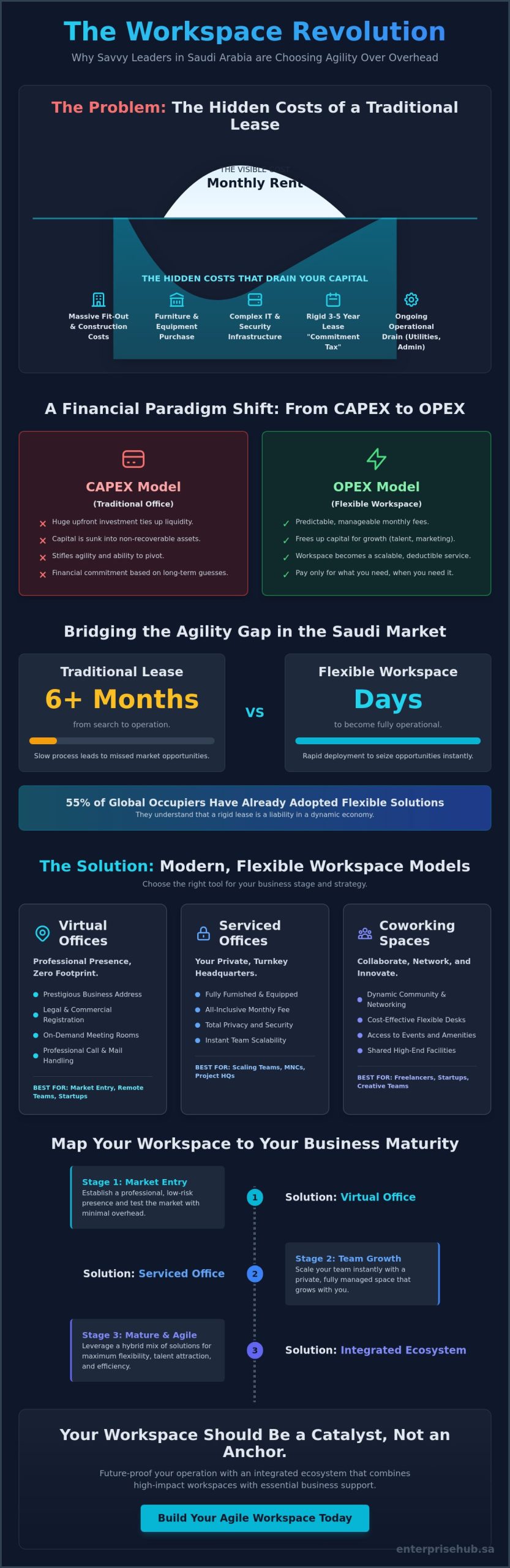
Traditional real estate often looks like a safe bet on paper. You sign the lease, get the keys, and start working. But the reality is far more complex. The true cost of a traditional office is like an iceberg; the rent is just the tip you see above the water. Beneath the surface lies a massive accumulation of capital expenditure (CAPEX) that can cripple a growing business’s liquidity. Fit-outs, custom furniture, and complex IT infrastructure require massive cash injections before you even welcome your first client. In a market where agility is the ultimate currency, these sunken costs represent a significant risk. Smart leaders are now prioritizing alternatives to expensive traditional offices to keep their capital working for them, not stuck in drywall and carpeting.
Sunken costs kill momentum. When you commit to a three-year lease, you’re betting that your business won’t change, but in a high-growth environment, that’s a dangerous wager. This “Commitment Tax” stifles your ability to pivot. If your team doubles in size or your market strategy shifts, you’re trapped in a space that no longer fits. Beyond the lease, the operational drain is relentless. Managing cleaning schedules, security protocols, and utility payments consumes hours of leadership time. This administrative friction distracts you from your core mission. A Serviced office provides a turnkey solution that bypasses these hurdles entirely, allowing for deployment in days rather than the months required for traditional construction.
CAPEX vs. OPEX: A Financial Paradigm Shift
Moving from a CAPEX-heavy model to an OPEX strategy is a game-changer for your balance sheet. Instead of losing millions in non-recoverable fit-out costs, you pay predictable monthly fees. This shift frees up capital for marketing, talent acquisition, and product development. While 2026 tax regulations for W-2 employees have tightened, businesses still find significant advantages in deducting operational workspace expenses. Alternatives to expensive traditional offices allow you to treat your workspace as a scalable service rather than a stagnant asset. It’s about financial precision and maximizing every riyal spent.
The Agility Gap in the Saudi Market
Rapid market entry is critical under current national economic goals. The Saudi economy moves fast, and waiting six months for an office build-out means missing opportunities. There’s a massive risk in miscalculating your space needs. If you over-estimate, you pay for empty desks; if you under-estimate, you’re cramped and unproductive. Flexible models bridge this agility gap. You can scale your footprint up or down instantly. In 2026, 55% of global occupiers have already adopted flexible solutions because they understand that a traditional lease can quickly become a liability in a fluctuating economy. We empower you to stay lean and responsive.
Virtual Offices: Professional Presence Without the Physical Footprint
Establishing a business presence doesn’t always require four walls and a long-term commitment. A virtual office provides the professional infrastructure your brand needs without the overhead of a physical lease. It’s more than a mailing address; it’s a strategic asset for building trust with local clients and partners. By utilizing a prestigious business address, you project stability and professionalism from day one. This approach ranks among the smartest alternatives to expensive traditional offices for companies testing the waters or operating with distributed teams. You get the branding benefits of a prime location while maintaining total financial flexibility.
Beyond the address, you gain access to on-demand meeting rooms and specialized administrative support. High-end reception services ensure that every call and visitor is handled with the same care as a Fortune 500 headquarters. This allows you to maintain professional optics while your core team works from anywhere, optimizing your resource allocation for growth rather than rent. It’s about appearing established before you’ve even hired your tenth employee.
Legal Compliance and Commercial Registration
In the Saudi market, a physical footprint isn’t just about desk space; it’s often a regulatory necessity. Securing a registered address is essential for government portals, banking, and obtaining your Commercial Registration (CR). Many international firms use virtual solutions to satisfy MISA requirements during their initial setup phase. For a comprehensive look at how this works, read our Virtual Offices in Saudi Arabia guide. This strategic move ensures you remain compliant while keeping your entry costs low, allowing you to focus on market penetration rather than paperwork.
The Hybrid Model: Virtual Address with Physical Access
Modern leadership understands that rigid office mandates often backfire. Research shows that successful return-to-office plans don’t have to undermine employee autonomy. A hybrid model allows your team to work remotely while using a central hub for periodic high-stakes meetings and collaboration. This setup provides a seamless transition path. As your team grows, you can easily shift from a virtual presence to physical desks or private offices within the same ecosystem. If you’re ready to establish your footprint, exploring our flexible office solutions can help you find the right balance between digital agility and physical presence.
Serviced Offices vs. Coworking: Choosing Your Level of Privacy
Beyond the digital anchor of a virtual address, your business will likely need a physical environment to drive daily productivity. Deciding between a serviced office and a coworking space is a pivotal step in your real estate strategy. Both models act as agile alternatives to expensive traditional offices, yet they cater to distinct operational requirements. For firms handling sensitive data or high-stakes negotiations, the choice often comes down to the balance between acoustic privacy and social synergy. You must evaluate whether your team thrives in an open, collaborative ecosystem or requires the quiet focus of a private suite.
A serviced office provides a fully managed, corporate-grade environment where every detail is handled for you. It’s a plug-and-play solution that mirrors the prestige of a traditional headquarters without the burden of facility management. Conversely, coworking spaces thrive on collaboration and shared energy. They offer a dynamic ecosystem for smaller teams and innovators who prioritize networking over total isolation. In 2026, the “Managed” model has emerged as the preferred choice for enterprises that require a private, secure perimeter within a larger hub of professional services.
The Managed Office: Corporate Standards, Flexible Terms
Serviced offices function as private suites that provide your team with a dedicated, secure perimeter. Unlike basic rentals, these include comprehensive IT support, high-speed fiber internet, and daily maintenance as part of a single monthly fee. You don’t have to worry about broken printers or utility bills. Branding is another critical advantage. Many providers allow you to customize the signage and layout of your suite. This makes the space feel like your own while you benefit from the building’s shared infrastructure. It’s the ultimate way to maintain professional standards while utilizing alternatives to expensive traditional offices.
Coworking for High-Growth Startups
High-growth startups often choose coworking to immerse themselves in a community of diverse innovators. It’s a strategic move for market entry. You share the costs of premium amenities like designer lounges, high-end coffee bars, and networking events. This model allows you to access a world-class environment at a fraction of the cost of a private lease. When it’s time for high-stakes presentations or board meetings, you can easily transition to professional Meeting Rooms for Rent. This flexibility ensures your team remains agile while your outward-facing image stays flawless.
Strategic Selection: Matching Workspace to Business Maturity
Selecting the right workspace is a strategic exercise in timing. Your choice should reflect your current operational reality while leaving room for tomorrow’s growth. In 2026, the most successful firms don’t just look for space; they look for flexibility that aligns with their business lifecycle. By viewing alternatives to expensive traditional offices through the lens of maturity, you avoid over-committing resources during fragile growth phases. This approach ensures that your real estate costs remain a driver of success rather than a burden on your balance sheet.
Phase 1: Market Entry. Use virtual offices for low-risk testing. This allows you to secure a presence and test local demand without a heavy financial footprint. It’s the ideal way to establish credibility while you finalize your market strategy. Phase 2: Operational Launch. Transition to coworking for agile, small teams. This fosters a high-energy environment where 74% of members report being more productive since joining a shared space. Phase 3: Established Presence. Move into serviced offices to gain privacy and prestige. This signals maturity to your clients while maintaining the ability to scale your headcount without moving buildings.
The “Location Factor” is no longer a permanent trap. You can occupy a premium address in the heart of a business district for a year, then move as your strategy dictates. You aren’t anchored by a 10-year lease that no longer serves your goals. This fluidity is essential in a fast-moving economy where new business hubs emerge every season.
The Multinational Corporation (MNC) Strategy
Large firms use flexible models to bypass lengthy, rigid procurement cycles. Instead of waiting months for board approval for a multi-million dollar real estate purchase, they deploy satellite offices. This strategy allows MNCs to attract talent in diverse regions without building a central campus. It mitigates long-term risk during economic shifts, as they can shrink or expand their footprint within weeks. Alternatives to expensive traditional offices provide the enterprise-grade security they require with the speed they demand.
The Local SME and Startup Framework
For local SMEs, cash flow is a survival mechanism. Avoiding massive deposits and fit-out costs allows you to reinvest in your core product or marketing efforts. Outsourcing office management, from cleaning to IT, lets your team focus on their core competencies. If you’re navigating the early stages of growth, consult our guide on Business Setup in Saudi Arabia for a full roadmap. Choosing a solution that matches your current maturity level is the first step toward long-term stability. To find the right fit for your team, explore our comprehensive office packages today.
Future-Proofing with Enterprise Hub: Integrated Business Ecosystems
The true value of a modern workspace isn’t found in square footage, but in the ecosystem that surrounds it. In 2026, a desk is just the foundation; the real competitive advantage lies in the support systems that allow you to focus on your core mission. As we’ve explored, alternatives to expensive traditional offices offer more than just cost savings. They provide a platform for rapid scaling and operational excellence. Choosing a partner like Enterprise Hub means moving beyond the limitations of a simple landlord-tenant relationship and entering a strategic partnership designed for the Saudi market’s unique pace.
Future-proofing your business requires a workspace that evolves as quickly as the national economy. With 55% of global occupiers now utilizing flexible office solutions, the shift away from rigid infrastructure is a verified global standard. We provide access to premium corporate environments with zero fit-out time, ensuring your team is productive from the moment they arrive. This agility is essential for meeting the 2026 vision of a diversified, high-growth economy where speed to market determines success. You aren’t just renting a room; you’re plugging into a high-performance business hub.
Integrated Services: Accounting, Legal, and Government
Administrative friction is the silent killer of growth. When you choose your office provider, you should also be selecting your business setup partner. We integrate essential corporate functions directly into your workspace experience. Handling VAT, payroll, and licensing in the same location where you conduct your board meetings eliminates the need for multiple vendors and complex coordination. This centralized approach reduces the time spent on back-office logistics, allowing your leadership team to prioritize market penetration and innovation. It’s about creating a seamless path from commercial registration to daily operations.
Next Steps for Your Business
Transitioning from a legacy lease to a flexible model doesn’t have to be disruptive. The first step is evaluating your current team size and your growth projections for the next 12 to 24 months. Whether you require the total privacy of our private offices or the dynamic energy of our coworking spaces, the goal is to match your infrastructure to your ambition. We invite you to experience the difference that a premium, managed environment can make for your brand’s reputation and your team’s morale.
Don’t let a traditional lease anchor your potential. You can Consult with Enterprise Hub experts today to design your ideal workspace strategy and book a tour of our facilities. Discover how our integrated solutions provide the stability you need with the flexibility you demand. It’s time to trade high overheads for high impact and join the ranks of the most agile businesses in the Kingdom.
Scaling Your Vision with Agile Infrastructure
The shift toward flexible infrastructure is no longer a trend; it’s a fundamental requirement for success in the 2026 Saudi market. By moving away from rigid commercial leases and embracing alternatives to expensive traditional offices, you unlock the capital and agility needed to lead your industry. You’ve seen how virtual addresses establish trust and how managed offices provide the privacy required for high-stakes operations. The most successful firms are those that view their workspace as a tool for growth rather than a fixed liability.
Enterprise Hub stands ready as your strategic partner to facilitate this transition. Our solutions are fully compliant with Saudi commercial regulations, ensuring your business remains on solid legal ground from day one. You’ll benefit from zero CAPEX required for premium fit-outs and the convenience of integrated government and accounting support within a single ecosystem. This comprehensive approach allows you to focus entirely on your market impact while we handle the operational complexity.
Secure Your Strategic Business Base with Enterprise Hub and position your brand for sustainable prosperity. Your next phase of growth starts with a workspace that works as hard as you do. Let’s build your success story together in an environment designed for excellence.
Frequently Asked Questions
Are flexible office alternatives legally recognized for business licensing in Saudi Arabia?
Yes, these models are fully recognized by the Ministry of Investment (MISA) and the Ministry of Commerce. Providers ensure that their spaces meet all regulatory requirements for safety and municipal standards. This makes them legitimate alternatives to expensive traditional offices for both local and international companies seeking a valid commercial presence.
How much can a business save by switching from a traditional to a serviced office?
Savings primarily come from the total elimination of upfront capital expenditure on fit-outs, furniture, and IT setups. You also avoid the ongoing costs of hiring dedicated office managers, cleaners, and security personnel. While exact figures depend on your team size, businesses often report a significant reduction in monthly operational overhead by paying a single, all-inclusive fee.
Do serviced offices include furniture and IT infrastructure?
Yes, they provide a complete plug-and-play environment. Each suite comes equipped with ergonomic furniture and high-speed fiber-optic internet. You also gain access to shared printer stations and secure server rooms without having to purchase or maintain the hardware yourself, allowing your team to start working immediately.
Can I use a virtual office address for my MISA or CR registration?
Yes, a virtual office address is a standard solution for securing initial Commercial Registration (CR) and MISA licenses. It serves as your official legal address for government portals and banking. This is a common strategy for international firms entering the market before they’re ready to deploy a physical team on the ground.
What is the minimum lease term for a flexible office alternative?
Flexibility is the core advantage of these models. Unlike traditional leases that demand three to five year commitments, flexible options often start with monthly or quarterly terms. This allows you to test the market or adjust your footprint without the risk of long-term financial penalties or rigid contracts.
Are meeting rooms and secretarial services included in the monthly fee?
Basic reception and secretarial services, such as mail handling and call answering, are typically included in the standard package. Meeting room access is often provided through a monthly credit system or on an on-demand basis. This ensures you only pay for high-stakes space when you actually need to host clients or partners.
Is it possible to scale from a single desk to a private suite within the same provider?
Yes, scalability is a primary reason firms choose alternatives to expensive traditional offices. You can start with a single coworking desk and move into a private suite as your headcount increases. This transition is usually seamless and doesn’t require you to change your business address or update your legal registration.
How does the Zakat and Tax compliance work when using a managed office provider?
The office provider manages all property-related taxes and municipal fees. Your business remains responsible for its own corporate Zakat and VAT filings based on its commercial activities. Many managed providers offer integrated accounting services to ensure your filings stay compliant with the latest Zakat, Tax and Customs Authority (ZATCA) regulations.