
Why spend SAR 300,000 on a prime commercial office lease before you’ve even issued your first invoice? It’s a common frustration for international investors who find that traditional entry costs and complex municipality licensing requirements often stall their momentum. You want the prestige of a local presence without the rigid financial burden of a long-term commercial lease. We understand that your priority is growth, not managing a half-empty office while you test the waters.
Understanding the strategic benefits of a virtual office in Saudi Arabia is essential for any business looking to navigate this high-growth market efficiently in 2026. This guide will show you how to secure a compliant business address and a verified Ejar contract, allowing you to meet legal requirements for your Commercial Registration (CR) at a fraction of the cost of physical real estate. You’ll discover how to accelerate your market entry, ensure full regulatory compliance with MISA and ZATCA, and maintain the flexibility needed to scale your operations. We’ll explore how this modern setup bridges the gap between your global ambitions and the Kingdom’s dynamic economic landscape.
Key Takeaways
- Reduce market entry risks by significantly lowering initial capital expenditure through flexible workspace solutions instead of traditional long-term leases.
- Master the legal benefits of a virtual office in Saudi Arabia to secure a certified Ejar contract and issue your Commercial Registration (CR) with ease.
- Align your business with Saudi Vision 2030 by utilizing digital-first office solutions that meet 2026 municipality and MISA licensing standards.
- Evaluate the strategic differences between virtual, coworking, and private offices to determine the best fit for your current operational scale and budget.
- Leverage integrated support services, including tax and government relations, to ensure your business remains compliant across all digital regulatory portals.
Virtual Offices in Saudi Arabia: Why Essential in 2026?
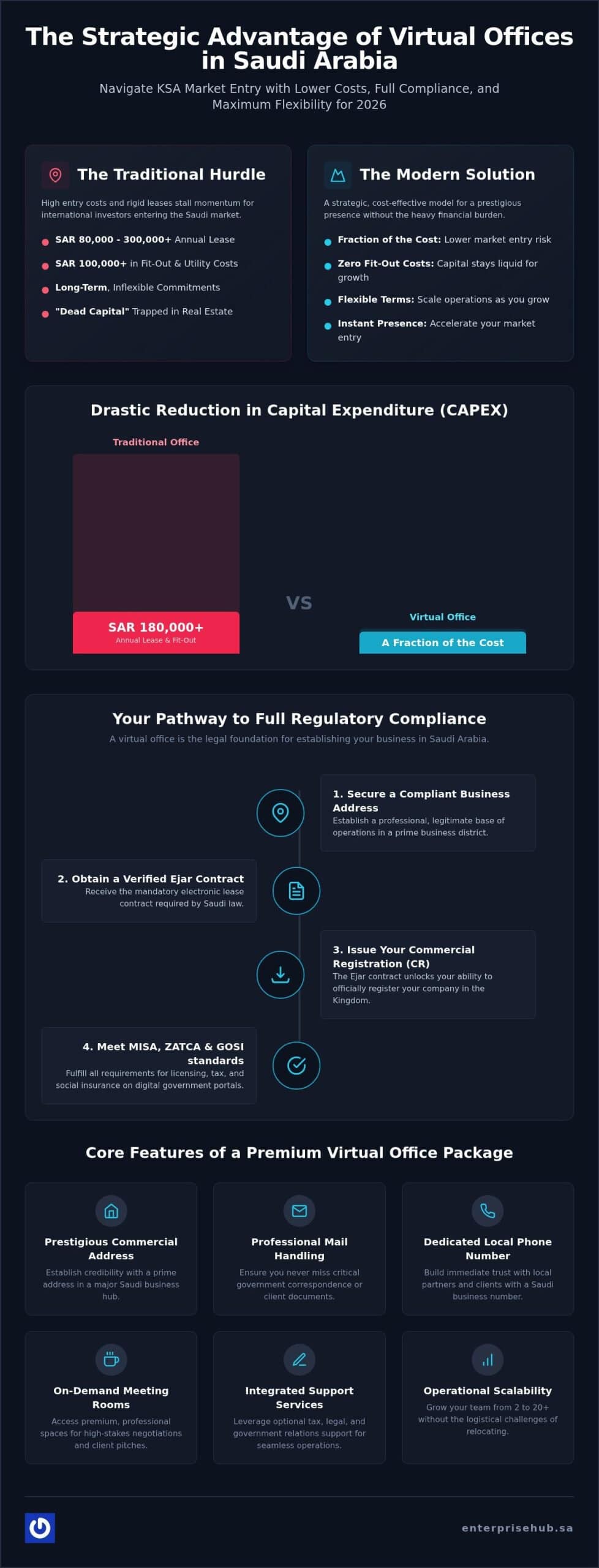
Establishing a professional presence in a new market is a high-stakes endeavor. Understanding what is a virtual office is the first step for any modern entrepreneur. In the Saudi context, it’s a strategic tool that offers a prestigious commercial address and administrative support without the SAR 80,000 to SAR 300,000 annual costs associated with traditional Riyadh real estate. It’s the ideal solution for those who need a legitimate base of operations while keeping capital liquid for growth.
By 2026, the Saudi business landscape has fully embraced a digital-first regulatory ecosystem. Government portals like Qiwa, Mudad, and ZATCA have streamlined compliance, making physical presence secondary to digital legitimacy. For startups and international firms, virtual offices are no longer just a cost-saving measure; they’re a standard operational model. This shift allows you to maintain a professional image in prime business districts while your team works flexibly or remotely.
The Role of Virtual Offices in the Saudi Business Ecosystem
Saudi Vision 2030 aims to increase foreign direct investment and simplify the setup process. Virtual offices directly support this by lowering entry barriers for new participants. While the Regional Headquarters (RHQ) program requires a physical office within one year, many firms use virtual setups to secure their initial MISA license and begin hiring under the Nitaqat system. One of the primary benefits of a virtual office in Saudi Arabia is its ability to provide the mandatory Ejar contract required for Commercial Registration (CR) issuance without the commitment of a multi-year lease. A compliant virtual address serves as the legal foundation for meeting MISA licensing requirements while maintaining the operational agility needed for rapid market expansion.
Key Features of a Premium Virtual Office Package
The benefits of a virtual office in Saudi Arabia extend to your daily operations through professional mail handling and forwarding. This service ensures you never miss critical government correspondence or client documents. A high-tier virtual office package includes a dedicated local business number and professional call answering, which builds immediate trust with local partners. When it’s time for high-stakes negotiations, you can book premium meeting rooms to host face-to-face pitches in a professional environment that reflects your brand’s ambition.
Foreign entities find these solutions particularly valuable during the market-testing phase. Instead of sinking capital into a permanent space, you can use these resources to establish a legal footprint, recruit local talent through Qiwa, and bid for contracts. This lean approach allows you to pivot your strategy based on real-time market feedback without being tied down by a fixed location. It’s the most efficient way to scale your operations in line with actual demand.
The Top Financial and Operational Benefits of a Virtual Office
One of the most immediate benefits of a virtual office in Saudi Arabia is the drastic reduction in capital expenditure (CAPEX). Traditional leases in Riyadh’s King Abdullah Financial District or Jeddah’s business hubs often require massive upfront payments and heavy deposits. By choosing a virtual path, you eliminate SAR 100,000 or more in fit-out costs and utility overheads. This lean financial model aligns with the goals of Saudi Vision 2030, which promotes a more agile and competitive private sector.
You don’t need to hire a full-time receptionist or pay for a dedicated lobby to maintain a professional front. Virtual packages provide professional call-handling services, ensuring your business stays responsive while you focus on high-level strategy. If your team grows from two to twenty, your address stays the same. You scale your presence instantly without the logistical nightmare of relocating physical furniture or renegotiating leases.
Cost Optimization for Startups and SMEs
Small and medium enterprises often struggle with the “dead capital” trapped in physical real estate. A traditional office lease is a fixed liability that drains resources regardless of performance. In contrast, understanding the benefits of a virtual office in Saudi Arabia helps you turn that liability into a flexible asset. You can redirect the thousands of Riyals saved each month into performance marketing or product development. You also avoid the hidden costs of office maintenance, high-speed internet contracts, and premium furniture. This shift from fixed costs to variable expenses provides the financial cushion needed during the critical first 24 months of market entry.
Enhancing Brand Authority and Professional Image
In the Saudi market, perception is reality. A prestigious business address in a recognized commercial tower signals stability and commitment to local clients. It builds immediate authority that a home office or a residential address simply cannot match. This professional image extends to your interactions with government entities, who view a verified commercial presence as a sign of a legitimate enterprise. When you need to close high-value contracts, having access to meeting rooms in a prime location allows you to host stakeholders in an environment that reflects your brand’s excellence. It’s about showing your partners that you’re here to stay.
If you’re ready to optimize your operational costs while maintaining a premium image, you can speak with our consultants today to find the right fit for your business.
Leveraging Virtual Offices for Regulatory Compliance and Licensing
Compliance isn’t just a hurdle; it’s the foundation of your legitimacy in the Kingdom. One of the most critical benefits of a virtual office in Saudi Arabia is how it unlocks the door to essential legal documentation. To obtain a Commercial Registration (CR), the Ministry of Commerce requires a certified electronic Ejar contract. Professional providers bridge this gap by offering a legally recognized address that satisfies municipality (Baladiya) requirements. This ensures your business remains in good standing with the Ministry of Investment (MISA) from day one.
Beyond the initial license, your virtual address serves as the primary point of contact for the General Organization for Social Insurance (GOSI) and the Muqeem portal. These platforms are vital for managing your workforce and residency permits. Without a verified commercial location, you’ll find it impossible to navigate the digital-first regulatory ecosystem that governs Saudi business life. It’s about more than just a desk; it’s about maintaining a seamless link with the authorities.
Simplifying the Business Setup Journey
Integrating your address with comprehensive business setup services can significantly reduce your time-to-market. Instead of juggling multiple vendors, you can manage your licensing, legal notices, and official government correspondence through a single, reliable partner. This centralized approach ensures you meet the local ‘physical presence’ requirements digitally while you focus on building your team through the Nitaqat system. It’s the fastest way to transition from a foreign entity to a fully operational local player.
Administrative Support and Government Relations
Time is a luxury when dealing with government documents. Professional mail management ensures that time-sensitive notices from the Ministry of Commerce or Labor are handled with the urgency they deserve. You gain access to on-site support teams who understand the nuances of local administrative tasks, from handling physical inspections to managing legal filings. A verified commercial address is the non-negotiable anchor for ZATCA registration, ensuring your business is recognized as a taxable entity within the Kingdom’s fiscal framework. This level of support turns a simple address into a powerful tool for long-term operational success.
Strategic Comparison: Virtual Office vs. Coworking vs. Private Office
Selecting the wrong workspace model can drain your startup capital before you’ve secured your first client. While the benefits of a virtual office in Saudi Arabia are unmatched for speed and cost, other models serve specific operational needs as your team grows. A virtual office provides the legal foundation for your Commercial Registration (CR) at a fraction of the price of physical space. It’s the leanest way to secure a prestigious address without being tied to a single desk.
Coworking spaces offer a middle ground for those who need a physical spot to work occasionally. In Riyadh, a shared desk typically costs between SAR 1,000 and SAR 2,000 per month; a dedicated desk might reach SAR 3,000. This model is ideal for solo entrepreneurs or small teams that thrive on networking. However, if you’re managing a large team or need to meet the one-year physical office requirement for the Regional Headquarters (RHQ) program, a private office becomes necessary. Private offices in premium coworking hubs often range from SAR 3,000 to SAR 5,500 per month, providing the privacy and permanent on-site operations that established firms require.
Many successful companies adopt a ‘Hybrid Model’ to balance costs and presence. They maintain a virtual office for their primary legal address and compliance, then book meeting rooms or coworking desks only when face-to-face collaboration is essential. This approach ensures you aren’t paying for empty square footage while your team works remotely or travels between regions.
When to Choose a Virtual Office
If your business is in the ‘market discovery’ phase, the virtual model is your strongest asset. It allows you to build a local presence and handle administrative tasks while your core team remains remote. It’s perfect for businesses with a remote-first workforce that doesn’t need a daily physical hub. Understanding the benefits of a virtual office in Saudi Arabia helps you prioritize your budget for hiring and marketing. You can browse our virtual office packages to see how this flexibility supports your initial growth phase.
Transitioning to Physical Workspace
Your transition to a private office should be data-driven. Key indicators include reaching a team size that requires daily on-site collaboration or the need for a dedicated space to host frequent client consultations. A flexible provider allows you to upgrade your plan seamlessly, keeping your prestigious address while expanding your physical footprint into new regions like Jeddah or Dammam. This ensures your brand authority remains consistent even as your operational needs evolve.
Not sure which model fits your current growth stage? Contact our strategic advisors for a customized market entry plan.
Maximizing Your Saudi Market Entry with Enterprise Hub
Success in the Kingdom requires more than just a presence; it demands a partner who understands the intricate pulse of the local economy. While the benefits of a virtual office in Saudi Arabia provide a lean foundation, Enterprise Hub elevates this model by offering an integrated ecosystem. We don’t just provide an address. We deliver a comprehensive suite of services including business setup, accounting, and tax support, ensuring your transition into the Saudi market is as seamless as possible. Our premium facilities are designed to reflect the high ambition of your brand, providing a prestigious backdrop for your regional operations.
In the fast-paced environment of 2026, agility is your greatest competitive advantage. Our flexible contracts are specifically tailored to the dynamic nature of the Saudi economy, allowing you to adapt your workspace requirements as your business scales. By joining Enterprise Hub, you aren’t just renting a service; you’re becoming part of a community of like-minded innovators and strategic leaders. This network provides a fertile ground for collaboration and growth, positioning you at the heart of the Kingdom’s transformation.
A Partner in Your Success
Enterprise Hub acts as a bridge, simplifying the regulatory and operational complexities that often challenge international firms. We understand that navigating municipality requirements and labor portals like Qiwa can be daunting. Having a single partner handle both your workspace and your compliance journey eliminates the friction of managing multiple vendors. International brands entering the Kingdom have found that this integrated approach significantly reduces their time-to-market. Our expertise ensures that every administrative detail, from mail management to government relations, is handled with the precision your business deserves.
Start Your Journey Today
Securing your strategic business address shouldn’t take weeks. Our streamlined process allows you to select your plan and establish your virtual presence in a matter of minutes. We recommend consulting with our experts to ensure your chosen virtual office package aligns perfectly with your specific MISA requirements and long-term growth targets. This proactive planning prevents compliance bottlenecks and sets the stage for a successful launch. Don’t let administrative hurdles slow your momentum in one of the world’s most exciting markets.
Take the first step toward your regional expansion and contact Enterprise Hub to secure your strategic business address today. We’re ready to help you turn your Saudi vision into a commercial reality.
Scale Your Saudi Vision with Strategic Agility
Market entry in 2026 demands a sophisticated balance of speed, cost-efficiency, and absolute compliance. We’ve seen how a virtual setup serves as the primary gateway to the Kingdom’s diversifying economy. It’s about more than just saving on high commercial rents; it’s about building a legal foundation that meets MISA and ZATCA standards from the moment you launch. By leveraging the benefits of a virtual office in Saudi Arabia, you secure a prestigious address that builds immediate trust with local partners and government entities alike.
Your journey toward sustainable growth depends on having a partner who understands the local regulatory pulse. Enterprise Hub provides the expert MISA and CR compliance support needed to navigate the digital-first ecosystem with confidence. Our flexible, 2026-ready workspace solutions ensure your brand maintains a premium image while you focus on winning high-value contracts. You don’t have to manage the complexities of municipality licensing alone.
Secure your prestigious Saudi business address with Enterprise Hub today. Let’s work together to transform your regional ambitions into a thriving commercial reality. We’re here to support your success every step of the way.
Frequently Asked Questions
Is a virtual office legal for a MISA license in Saudi Arabia?
Yes, a virtual office is a legally recognized solution for obtaining an initial investment license from the Ministry of Investment (MISA). It allows foreign entities to establish their legal presence and begin the setup process without immediately committing to a large physical footprint. However, businesses under specific programs, such as the Regional Headquarters (RHQ) initiative, must establish a physical office within one year of their license issuance.
Can I use a virtual office address for my Commercial Registration (CR)?
Yes, you can use a virtual office address for your Commercial Registration (CR) as long as the provider issues a certified electronic Ejar contract. This contract is a mandatory requirement for the Ministry of Commerce and serves as proof of your business location. It’s essential to ensure your provider’s address meets the specific 2026 municipality requirements for your chosen business activity to avoid delays in the registration process.
What is the difference between a virtual office and a registered address?
A registered address is primarily a legal requirement for receiving official government correspondence and legal notices. In contrast, one of the main benefits of a virtual office in Saudi Arabia is the inclusion of professional operational services. These typically include mail management, a dedicated local business number, and access to physical meeting rooms, providing a more comprehensive professional image than a simple registered address.
Can I host meetings at my virtual office location?
Yes, premium virtual office packages provide you with the ability to book professional meeting rooms and event spaces at the same prestigious address. These facilities are equipped with modern technology, allowing you to host face-to-face client pitches or board meetings in a high-tier corporate environment. This on-demand access gives you the flexibility to maintain a physical presence only when your business operations require it.
How much does a virtual office cost in Saudi Arabia for 2026?
In 2026, the annual cost for a basic virtual office address in prime business districts typically ranges between SAR 5,000 and SAR 15,000. For more comprehensive monthly packages that include a dedicated receptionist and phone answering services, prices in Riyadh generally fall between SAR 1,100 and SAR 1,600. These costs are significantly lower than traditional private office leases, which often exceed SAR 80,000 annually in similar locations.
Do virtual offices include phone answering services?
Yes, many professional virtual office providers include dedicated local business numbers and professional call answering as part of their premium tiers. A local receptionist handles your incoming calls in your company’s name, providing a seamless experience for your clients. This service helps build immediate trust in the local market and ensures you never miss a critical inquiry while focusing on your core business strategy.
Can I upgrade from a virtual office to a physical office later?
Yes, the benefits of a virtual office in Saudi Arabia include the ability to scale your workspace as your team grows. You can seamlessly transition from a virtual setup to a dedicated desk or a private office within the same facility. This upgrade path is ideal for companies that have completed their market-testing phase and are ready to establish a permanent on-site team without changing their registered address.
What documents are required to set up a virtual office in Saudi Arabia?
To set up your virtual office, you generally need to provide a copy of your passport or national ID and your company’s Articles of Association. Foreign investors will also need to present their MISA investment license during the application process. Once these documents are verified, your provider will issue the certified Ejar contract required for your Commercial Registration and subsequent registrations with ZATCA and the Chamber of Commerce.