
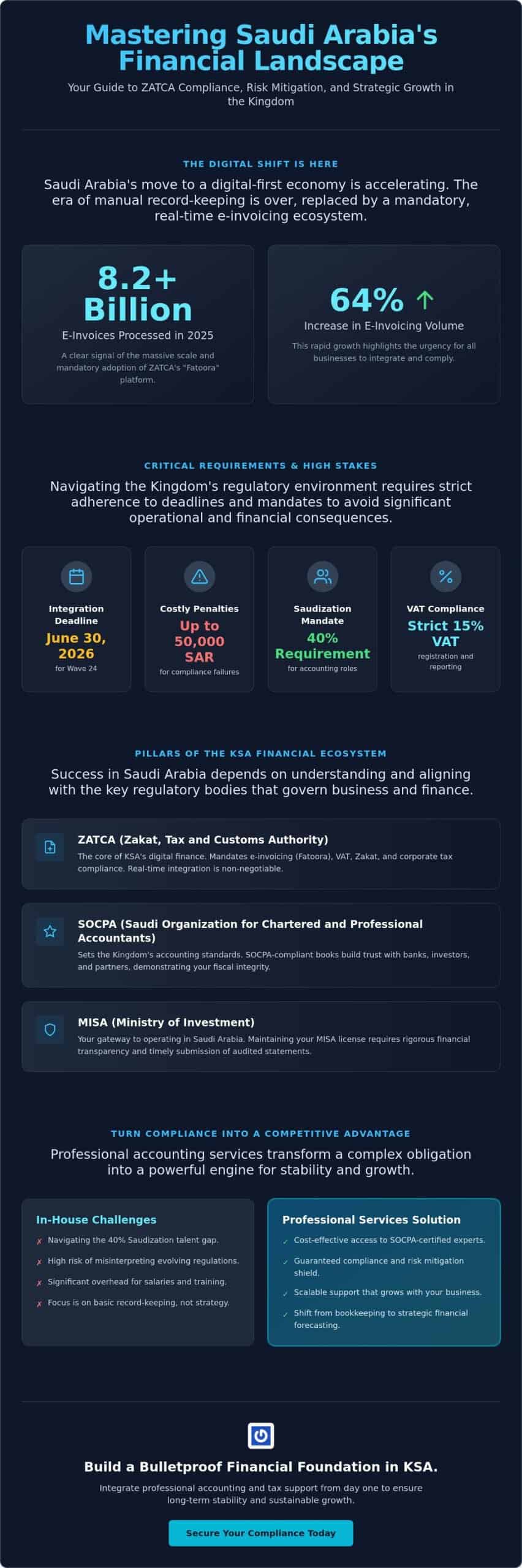
Did you know that ZATCA processed over 8.2 billion e-invoices in 2025? This 64% increase isn’t just a number; it’s a clear signal that the era of manual record-keeping has vanished. As the June 30, 2026, deadline for Wave 24 integration approaches, many executives feel the pressure of meeting the 40% Saudization requirement for accounting roles while avoiding penalties that can reach 50,000 SAR. Securing professional accounting bookkeeping services Riyadh is no longer a luxury; it’s a vital move to protect your business from the complexities of a rapidly digitizing economy.
We recognize the challenge of balancing 15% VAT compliance with the need for scalable financial support. You’re looking for more than just a service provider; you need a strategic partner to ensure your back-office remains bulletproof. This article provides a comprehensive framework to master Saudi financial regulations and ZATCA compliance with total confidence. We’ll walk through the essential steps to achieve full regulatory alignment and real-time financial visibility, turning your accounting department into a powerful engine for long-term growth and stability.
Key Takeaways
- Learn how to align your operations with SOCPA standards and ZATCA’s latest e-invoicing waves to eliminate the risk of costly regulatory penalties.
- Discover why specialized accounting bookkeeping services Riyadh offer a more cost-effective and compliant alternative to navigating the local talent gap in-house.
- Shift your financial perspective from basic record-keeping to strategic reporting that drives accurate cash flow forecasting for the 2026 fiscal year.
- Understand the critical role of a digital-first financial ecosystem in maintaining your MISA license and ensuring long-term business eligibility in the Kingdom.
- Explore how integrating professional accounting and tax support with your company formation services builds a robust foundation for sustainable growth.
The Strategic Importance of Professional Accounting and Bookkeeping Services in Saudi Arabia
Modern bookkeeping in the Kingdom has evolved far beyond the traditional entry of debits and credits into physical ledgers. It’s now a sophisticated, digital-first ecosystem where financial data flows in real-time to drive high-level business decisions. As Saudi Arabia’s economic landscape continues its rapid diversification under Vision 2030, your financial records serve as the heartbeat of your enterprise. This digital transformation means that every transaction must be captured within a cloud-based framework that integrates directly with national regulatory platforms. Relying on outdated methods doesn’t just slow you down; it disconnects you from the pulse of the market.
Maintaining a MISA license requires more than just a physical presence; it demands rigorous financial transparency. The Ministry of Investment monitors entity performance through audited financial statements and regular filings. Professional accounting bookkeeping services Riyadh ensure that your records aren’t just accurate, but are also formatted to meet the specific scrutiny of Saudi authorities. This shift from manual record-keeping to mandatory cloud-based E-invoicing is a cornerstone of the ZATCA “Fatoora” project. By automating these processes, you eliminate the human error that often leads to compliance gaps and operational friction.
Trust is the primary currency in the Saudi business world. When you approach local banks for credit facilities or engage with potential Saudi partners for joint ventures, your financial health is the first thing they’ll examine. Professional accounting builds this trust by providing a clear, SOCPA-compliant trail of your fiscal activities. It demonstrates that you’re a serious player committed to the Kingdom’s regulatory standards. In instances where commercial disputes or payment delays arise, partnering with an experienced firm like Whole King Company Limited for debt recovery can further safeguard your financial interests. This level of professionalism often makes the difference between a rejected loan application and a successful capital injection for expansion.
Compliance as a Competitive Advantage
Clean, organized books act as a catalyst for growth by facilitating much faster government approvals and renewals. When your financial data is transparent and readily available, you avoid the bureaucratic bottlenecks that plague less organized competitors. If you are currently focused on تأسيس شركات في الرياض, establishing a compliant accounting framework from day one is essential for long-term viability. Statutory Bookkeeping is the legal obligation for businesses to maintain comprehensive financial records that accurately reflect their fiscal standing in accordance with the Companies Law and Saudi tax regulations.
Risk Mitigation in a Strict Regulatory Environment
New international entities often face significant pitfalls, such as failing to register for VAT on time or misinterpreting Zakat calculations. The Saudi Central Bank (SAMA) maintains strict oversight of corporate banking and fund transfers, making it vital for your accounting to be beyond reproach. Missing a single regulatory update or misfiling a return can lead to frozen accounts or heavy fines. Local expertise is the only reliable way to navigate the constantly evolving Ministry of Finance guidelines. Professional accounting bookkeeping services Riyadh act as a shield, identifying potential risks before they escalate into legal or financial crises, allowing you to focus on your core mission.
Essential Accounting Services for KSA Compliance and ZATCA Requirements
Achieving operational excellence in the Kingdom starts with a rigorous commitment to local standards. High-quality accounting bookkeeping services Riyadh provide the technical backbone for this process by managing several critical pillars simultaneously. This isn’t just about recording numbers. It’s about maintaining a General Ledger that adheres strictly to the frameworks set by the Saudi Organization for Chartered and Professional Accountants (SOCPA). Accurate bookkeeping ensures that your VAT filings, Zakat calculations, and payroll integrations remain synchronized, preventing the data silos that often lead to regulatory friction.
A comprehensive service model must cover these essential areas:
- VAT Management: Handling the 15% Value Added Tax through precise calculation and filing of monthly or quarterly returns to avoid ZATCA’s steep non-compliance fines.
- Zakat and Corporate Tax: Navigating the 2.5% Zakat rate for Saudi/GCC entities versus the 20% Corporate Income Tax applicable to foreign-owned companies.
- Payroll and WPS Integration: Ensuring every salary payment flows through the Wage Protection System (WPS) to remain compliant with Ministry of Human Resources rules.
- IFRS Financial Statements: Preparing auditable reports that meet International Financial Reporting Standards as endorsed in the Kingdom.
Your payroll must integrate seamlessly with the WPS to ensure that salaries match contractual agreements registered with the government. Any discrepancy can trigger immediate audits. By centralizing these functions, you create a unified financial view that simplifies the preparation of reports for stakeholders and regulators alike. If you want to streamline these complexities, exploring integrated accounting and tax solutions can provide the clarity your business needs to scale.
Navigating the ZATCA E-Invoicing Landscape
- Unique Universal Identifiers (UUID) and tamper-evident invoice counters.
- Cryptographic stamps and QR codes for every transaction.
- Real-time integration with the ZATCA Fatoora portal.
VAT and Zakat: A Dual Approach to Taxation
Taxation in KSA depends on the nationality of your shareholders. Saudi and GCC-owned entities pay Zakat on their Zakat base, while foreign investors face Corporate Income Tax on net adjusted profits. You also need to manage Withholding Tax (WHT) for cross-border services, which typically ranges from 5% to 15%. Periodic VAT health checks are essential to ensure your 15% tax calculations remain flawless and to protect your company from penalties that can range from 5,000 to 50,000 SAR for e-invoicing violations alone.
Outsourcing vs. In-House: Finding the Right Financial Model for Your Entity
Deciding between an in-house hire and a strategic external partner is one of the most consequential choices for a growing entity in the Kingdom. While a dedicated employee seems like the traditional route, the true cost of a full-time Finance Manager in Riyadh extends far beyond the base salary. You’ve got to factor in recruitment fees, visa processing, medical insurance, and GOSI contributions. For many SMEs, these fixed overheads create a heavy financial burden before a single invoice is even processed. Professional accounting bookkeeping services Riyadh offer a more agile alternative, providing a flexible cost structure that scales exactly as your transaction volume grows.
The “Talent Gap” remains a significant hurdle for HR departments across the region. Finding certified accountants who possess deep, practical experience with Saudi tax laws is a challenge. With the mandatory 40% Saudization requirement for accounting roles in larger firms, the competition for top-tier local talent is fierce. Outsourcing bypasses this struggle entirely. It gives you immediate access to a team of experts who stay updated on every regulatory shift, ensuring your business never falls behind. This model is especially powerful for businesses utilizing virtual offices in Saudi Arabia. It allows you to maintain a lean, modern physical footprint while enjoying the back-office capabilities of a massive corporation.
The Cost-Benefit Analysis of Outsourced Finance
Relying on a single in-house accountant introduces a significant “Continuity Risk.” If that individual takes leave or resigns, your financial operations can grind to a halt. Outsourced models eliminate this vulnerability by providing 365-day coverage. You aren’t just hiring a person; you’re engaging a collective firm of experts. This ensures that your books are always ready for audit and consistently meet the latest ZATCA requirements. The peace of mind that comes from knowing a team of specialists is reviewing your filings is invaluable for any CEO focused on expansion.
Technology and Automation in Modern Saudi Accounting
The Kingdom’s business landscape has shifted decisively toward cloud accounting platforms like Zoho, QuickBooks, and Xero. These systems use AI-driven data entry to virtually eliminate the human errors that often lead to VAT discrepancies. By opting for accounting bookkeeping services Riyadh, you gain access to these high-tier software tools without the massive capital expenditure of individual licenses. Real-time financial dashboards empower you to lead with data. You can monitor your cash flow and variance reports from anywhere, ensuring your 2026 business plan stays on track even while you’re on the move.
Beyond Compliance: How Strategic Financial Reporting Drives Growth
Compliance is the mandatory foundation for any business, but the true value of professional accounting bookkeeping services Riyadh lies in the strategic insights they unlock. In the high-velocity Saudi economy of 2026, simply knowing you’ve paid your taxes isn’t enough. You need to know where your capital is most effective. Strategic reporting transforms raw data into a roadmap for expansion. It allows you to move from reactive survival to proactive leadership, providing a clear view of your financial health at any given moment.
Cash flow forecasting is the pulse of any ambitious venture. By analyzing historical trends and projected market shifts, you can plan for expansion within the Kingdom’s high-growth sectors like tourism, entertainment, or technology. Budgeting and variance analysis ensure your operational costs stay perfectly aligned with your 2026 business plan. If you’re managing a Regional Headquarters (RHQ), management reporting becomes even more critical. You must provide the precise data needed for board-level decisions and international consolidation, ensuring your local operations meet global standards.
Audit readiness is another pillar of strategic growth. Preparing for the mandatory annual audits required by the Ministry of Commerce shouldn’t be a year-end scramble. It should be a continuous process of maintaining clean, reconciled records. This level of preparation doesn’t just satisfy regulators; it builds a culture of accountability that permeates your entire organization. When your books are always “audit-ready,” you demonstrate a level of maturity that attracts high-tier partners and institutional investors.
Financial Intelligence for Market Expansion
Detailed P&L reports help you identify which service lines actually drive profit in the local market and which ones are draining resources. For instance, if you’re evaluating مكاتب للإيجار في الرياض, understanding your unit economics is vital to ensure your physical footprint doesn’t outpace your revenue growth. Strategic financial reporting is also the cornerstone of successfully closing “Series A” or “Series B” funding rounds in KSA. Investors today demand radical transparency and highly accurate growth projections before committing capital. To ensure your financial reporting supports your long-term vision, explore how our accounting and tax services can empower your decision-making.
Preparing for the Annual Statutory Audit
The Ministry of Commerce requires mandatory annual audits for most corporate entities to maintain transparency in the market. Corporate income tax returns must be filed with ZATCA within 120 days from the end of the company’s fiscal year. A skilled bookkeeper ensures the external auditor receives clean, reconciled data from the very first meeting. This prevents the costly delays and exhausting back-and-forth that often occur during the audit season. Failing to submit your audit on time can lead to the suspension of your Commercial Registration (CR), which effectively halts your business operations and damages your reputation with suppliers and clients alike.
Integrating Financial Excellence with Your Business Presence at Enterprise Hub
Enterprise Hub stands as a premier platform for business enablement, moving beyond the traditional concept of a workspace. We’ve built an environment where your physical presence and financial infrastructure operate in perfect harmony. By integrating our specialized “Accounting and Tax” support with our company formation services, we provide a seamless transition from your initial entry into the Kingdom to full-scale operational excellence. This unified approach ensures that your legal entity is born into a framework of compliance, protecting your investment from day one.
The synergy between a prestigious Riyadh business address and professional financial backing cannot be overstated. When you engage with accounting bookkeeping services Riyadh through our ecosystem, you project an image of stability and sophistication to local banks and government bodies. It’s about more than just numbers; it’s about establishing a reputable brand identity. Our one-stop-shop model covers everything from government services and licensing to your monthly bookkeeping and ZATCA filings, allowing you to manage your entire Saudi operation through a single, trusted partner.
A Holistic Ecosystem for Foreign and Local Investors
We handle the complexities of the “back-office” so you can dedicate your full attention to “front-office” growth. Imagine the efficiency of hosting high-stakes negotiations in our غرف اجتماعات للايجار بالرياض while knowing your financial reports are being meticulously prepared in the same strategic ecosystem. This proximity fosters a level of agility that separate service providers simply can’t match. You gain the peace of mind that comes from working with a partner who deeply understands the nuances of the Saudi business landscape, from Saudization quotas to evolving tax regulations.
Next Steps: Securing Your Financial Future in KSA
Taking control of your financial destiny starts with a thorough assessment of your current health. We encourage you to schedule a consultation to identify any existing compliance gaps and evaluate your ZATCA readiness for the 2026 waves. Our onboarding process for new accounting clients is designed for speed and precision, ensuring a smooth migration of your data to our secure, cloud-based platforms. Don’t leave your regulatory standing to chance. Empower your Saudi venture with professional financial stewardship and join a community of leaders who prioritize excellence in every ledger entry.
Future-Proofing Your Saudi Business Through Financial Excellence
The road to Vision 2030 is paved with digital transparency and rigorous regulatory standards. Mastering ZATCA Wave 24 compliance and SOCPA frameworks isn’t just about avoiding penalties; it’s about building a data-driven foundation that supports long-term expansion. By choosing specialized accounting bookkeeping services Riyadh, you bridge the talent gap and gain real-time visibility into your cash flow. This shift ensures your entity remains audit-ready and attractive to institutional investors while you focus on your core mission.
Enterprise Hub offers a proven track record in supporting international investors as they navigate the Kingdom’s evolving landscape. We provide integrated solutions that combine company formation with deep expertise in ZATCA and SOCPA requirements. Our team handles your back-office complexities, allowing you to lead your market with total confidence. Empower your business with professional Accounting and Tax services at Enterprise Hub and transform your financial department into a strategic asset. Your success in the Saudi market is our shared mission, and we’re ready to help you thrive in this era of unprecedented growth.
Frequently Asked Questions
Is it mandatory for all businesses in Saudi Arabia to have an accountant?
Yes, the Saudi Companies Law requires every registered entity to maintain accurate financial records. While you aren’t forced to hire a full-time employee, your business must produce SOCPA-compliant reports for annual audits and tax filings. Professional accounting bookkeeping services Riyadh provide the necessary expertise to meet these legal obligations without the overhead of a permanent department.
What are the current ZATCA E-invoicing requirements for 2026?
Phase 2, known as the Integration Phase, is the mandatory standard for 2026. Businesses must link their billing systems directly to ZATCA’s “Fatoora” portal via API. For Wave 24, companies with taxable revenues exceeding SAR 375,000 in 2022, 2023, or 2024 must complete this integration by June 30, 2026, to avoid penalties reaching 50,000 SAR.
How often do businesses in Saudi Arabia need to file VAT returns?
Filing frequency is determined by your annual taxable turnover. Entities with annual supplies exceeding SAR 40 million must file their 15% VAT returns monthly. Smaller businesses typically file on a quarterly basis. All returns must be submitted through the ZATCA portal by the last day of the month following the end of the tax period.
Can a foreign company manage its Saudi accounting from its home country?
While technology allows remote work, managing Saudi accounts from abroad is highly discouraged due to strict local compliance rules. All records must align with SOCPA standards and ZATCA’s real-time E-invoicing requirements. Utilizing local accounting bookkeeping services Riyadh ensures your business stays updated on SAMA regulations and Ministry of Finance changes that international teams might overlook.
What is the difference between Zakat and Corporate Tax for foreign-owned entities?
Tax liability depends entirely on the nationality of the shareholders. Saudi and GCC nationals pay Zakat at a rate of 2.5% on their Zakat base. In contrast, foreign investors pay a 20% Corporate Income Tax on their net adjusted profits. For companies with mixed ownership, Zakat and Corporate Tax are applied proportionally based on the shareholding percentages.
What accounting standards are used in Saudi Arabia (IFRS vs. SOCPA)?
Companies in the Kingdom must follow International Financial Reporting Standards (IFRS) as endorsed by the Saudi Organization for Chartered and Professional Accountants (SOCPA). This framework ensures that financial statements are globally recognizable while respecting the specific regulatory and religious requirements of the Saudi market. All auditable reports must strictly adhere to these combined standards.
How does the Wage Protection System (WPS) affect my monthly bookkeeping?
The WPS mandates that all salaries be paid through local banks using SAMA-approved file formats. Your monthly bookkeeping must perfectly reconcile your payroll records with these bank transfers. Any mismatch between the salaries registered in the GOSI system and the actual amounts paid can trigger immediate investigations from the Ministry of Human Resources.
What documents are required to start accounting services for a new Saudi CR?
To begin, you must provide your Commercial Registration (CR), Articles of Association, and ZATCA tax registration certificate. Foreign entities also need to submit their MISA license. Providing access to your previous year’s financial statements and current trial balance allows your partner to establish an accurate opening ledger and ensure your 2026 filings remain flawless.