
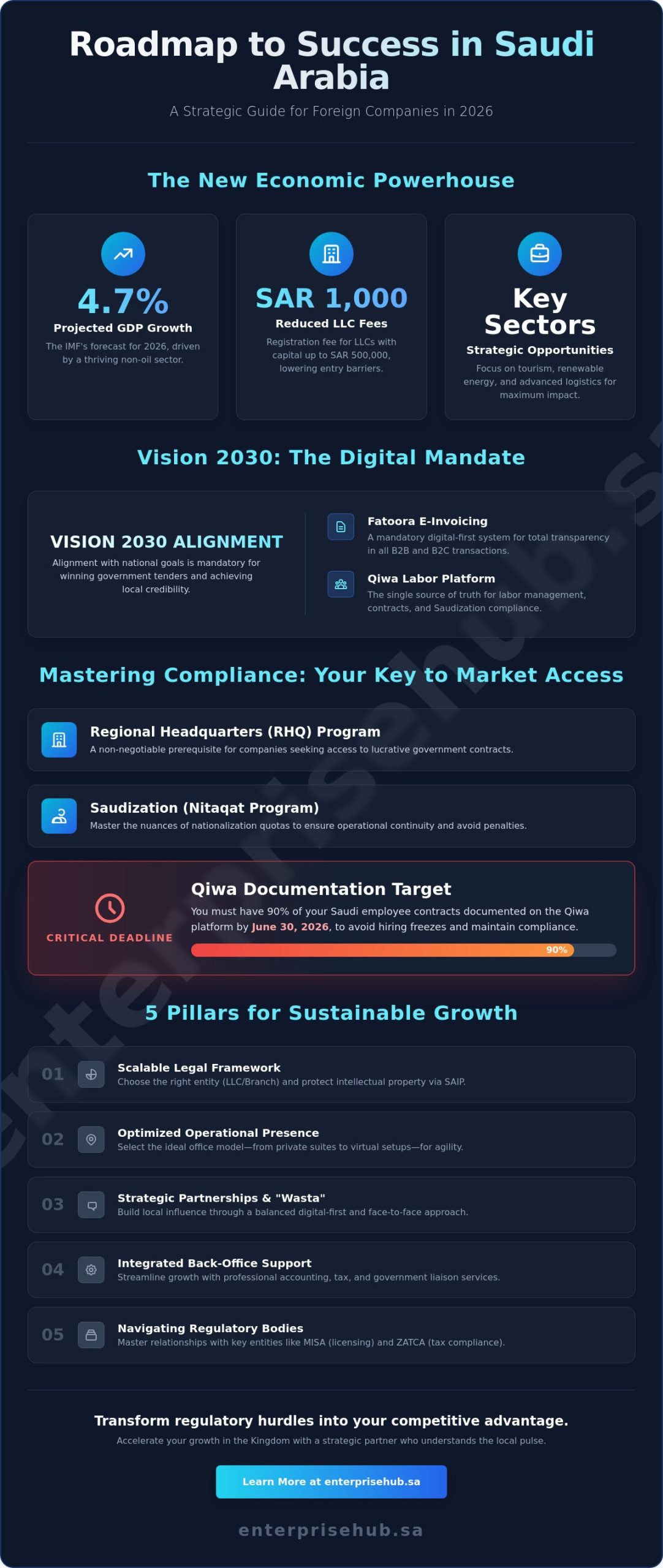
If you’re still treating the Saudi market as just another regional branch, you’re likely missing the massive 4.7% GDP growth projected for 2026. Success in the Kingdom has shifted from mere presence to localized operational excellence. Many leaders feel the pressure of opaque regulatory changes and the high costs of maintaining a physical footprint. You aren’t alone in finding the Regional Headquarters (RHQ) requirements or the strict new Qiwa documentation targets challenging to manage. We understand that while the opportunity is vast, the path to sustainable growth requires more than just capital; it requires a strategic partner who understands the local pulse.
This article provides the essential tips for foreign companies to grow in the Saudi market by mastering the complexities of a rapidly evolving economy. You’ll gain actionable insights into navigating Saudization quotas, ensuring compliance with the latest tax laws, and integrating into the local culture with confidence. We’ll preview ten strategic pillars, from optimizing your operational support to accessing a professional business ecosystem that accelerates your scale. Let’s transform these regulatory hurdles into your competitive advantage and build a roadmap for your long-term success in the Kingdom.
Key Takeaways
- Learn actionable tips for foreign companies to grow in the Saudi market by aligning your business strategy with the 2026 Vision 2030 transformation goals.
- Navigate the latest regulatory requirements, including the Regional Headquarters (RHQ) program and mandatory electronic contract documentation on the Qiwa platform.
- Scale your operations efficiently by selecting the ideal office model—from private suites to virtual setups—to establish a prestigious local presence.
- Build influential strategic partnerships and “Wasta” through a balanced approach of digital-first operations and traditional face-to-face relationship building.
- Streamline your growth by integrating essential back-office support, including professional accounting, tax compliance, and dedicated government service liaisons.
Understanding the Saudi Economic Landscape in 2026
2026 represents a landmark era for the Kingdom. With the IMF projecting an annual growth rate of approximately 4.6%, the shift toward a non-oil dependent economy has moved from a future vision to a present reality. For those seeking tips for foreign companies to grow in the Saudi market, the first step is recognizing that the “pioneer” phase has passed. The current environment rewards sophistication, localized value, and deep integration into the national fabric. The non-oil sector is the primary engine of this expansion, contributing significantly to the overall GDP growth seen in the early quarters of the year.
The “Pro-Investor Ecosystem” is a deliberate framework designed to lower entry barriers while raising operational standards. We’ve seen registration fees for Limited Liability Companies with capital up to SAR 500,000 reduced to just SAR 1,000, signaling a clear invitation for agile firms to enter. However, this accessibility comes with a requirement for total transparency. Understanding Saudi Arabia’s Economic Landscape means recognizing that your bottom line is now directly tied to how well you navigate high-growth sectors like tourism, renewable energy, and advanced logistics.
The Role of Vision 2030 in Market Expansion
The National Transformation Program has created an unprecedented demand for specialized foreign expertise. You’ll find that government tenders and private contracts now prioritize vendors who align their corporate goals with the Kingdom’s strategic objectives. For firms in technical sectors, partnering with a multidisciplinary consultancy like Global Engineering Office can help bridge the gap between international standards and local architectural requirements. This isn’t just about selling a product; it’s about contributing to a digital-first economy. Mandatory systems like the Fatoora e-invoicing and the Qiwa platform for labor management are proof that the Kingdom expects high-tech, compliant operations from every partner. Success requires you to adopt these tools not as hurdles, but as the foundation of your local credibility.
Strategic Analysis of the Kingdom’s Business Landscape
The 2026 investment climate is a mature, regulated, and hyper-competitive landscape. To stay ahead, you must conduct a thorough strategic analysis of the Kingdom’s business landscape to identify where sector-specific shifts create new openings. You’ll need to maintain close coordination with key regulatory bodies. The Ministry of Investment (MISA) manages your licensing, while the Zakat, Tax and Customs Authority (ZATCA) oversees your fiscal compliance. Mastering these relationships is one of the most vital tips for foreign companies to grow in the Saudi market, ensuring you remain agile in a fast-moving economy.
Establishing a Compliant and Scalable Legal Framework
Establishing a legal foundation in the Kingdom is no longer a “check-the-box” exercise. It’s a strategic move that dictates your access to high-value opportunities. The Regional Headquarters (RHQ) Program is now a non-negotiable prerequisite for any company eyeing lucrative government contracts. If you want to scale, you can’t ignore this requirement. Compliance also means mastering the nuances of Saudization through the Nitaqat program. As of mid-2026, the Qiwa platform is the only source of truth for labor compliance. You must have 90% of your Saudi employee contracts documented on Qiwa by June 30, 2026, to maintain your status and avoid hiring freezes. These are the practical tips for foreign companies to grow in the Saudi market that separate successful firms from those facing operational delays.
Protecting your intellectual property is equally vital. Saudi laws have evolved to align with international standards, providing robust frameworks for patents and trademarks through the Saudi Authority for Intellectual Property (SAIP). If you’re transitioning from a representative office to a full-scale commercial entity, do it with speed. Delays in this phase often lead to missed tender deadlines and increased overhead. Ensuring your legal structure is both compliant and scalable allows you to pivot as the market matures.
Choosing the Right Entity for Long-term Growth
Deciding between a Limited Liability Company (LLC) and a Branch office depends on your tax strategy and liability preferences. LLCs with capital up to SAR 500,000 now benefit from a reduced registration fee of just SAR 1,000, making them highly attractive for agile firms. Meanwhile, the RHQ license offers a 30-year tax holiday, making it the gold standard for multi-national scaling. To navigate these choices without technical bottlenecks, utilizing professional company formation services in Saudi Arabia ensures your setup is compliant from day one. Our team specializes in تأسيس الشركات to help you bypass common administrative hurdles and launch with confidence.
Taxation and Financial Compliance Standards
Your financial framework must be airtight. The Zakat, Tax, and Customs Authority (ZATCA) has fully integrated Phase 2 of the Fatoora e-invoicing system. This isn’t optional. Every transaction must be recorded digitally in real-time to avoid heavy penalties. Understanding withholding tax rates is also crucial for your cash flow. Dividends and technical services carry a 5% rate, while management fees are set at 20%. Managing these costs while ensuring efficient profit repatriation requires a proactive approach to fiscal planning. Following these tips for foreign companies to grow in the Saudi market will keep your capital working for you, rather than being tied up in regulatory disputes.
Optimizing Operational Presence for Market Agility
Establishing your legal entity is only half the battle. To truly thrive, you must build a physical or operational footprint that reflects your brand’s commitment to the Kingdom. One of the most practical tips for foreign companies to grow in the Saudi market is to match your workspace strategy to your current growth stage. Whether you need a high-profile corporate suite or a flexible desk, your choice of location sends a powerful signal to local clients and partners. For those also managing assets in neighboring hubs, Chainex Real Estate serves as a professional resource for high-tier property needs. A prestigious business address in a hub like Riyadh or Jeddah enhances your credibility and places you within reach of key decision-makers and regulatory bodies.
Traditional long-term leases often involve heavy CAPEX and administrative burdens that distract from your core mission. Fully managed workspace solutions allow you to bypass the complexities of municipality licenses (Baladiya) and utility setups. By choosing an environment that is already optimized for business, you can redirect your capital toward market expansion and talent acquisition. This agility is essential in a fast-moving economy where opportunities wait for no one. You need a setup that allows you to scale up or down without the friction of traditional real estate hurdles.
Virtual vs. Physical: Finding the Right Balance
Testing the waters doesn’t require a ten-year commitment. For many, starting with virtual offices in Saudi Arabia provides a low-risk entry point for market testing while maintaining a professional local image. As your team grows and requires high-level security or privacy for sensitive negotiations, you can seamlessly transition to private offices. Managed workspaces offer a superior cost-benefit ratio compared to traditional leases, giving you the flexibility to adapt your footprint based on real-time performance and project needs.
Infrastructure and Connectivity Requirements
In a digital-first economy, your connectivity is your lifeline. You need Tier-1 digital infrastructure to ensure seamless global communication and compliance with local electronic systems like ZATCA’s e-invoicing. Investing in premium offices in the Kingdom provides “plug-and-play” readiness, allowing your team to hit the ground running from day one. For high-stakes partner negotiations or board-level discussions, utilizing on-demand meeting rooms for corporate strategy ensures you have the right environment to close deals. These operational tips for foreign companies to grow in the Saudi market ensure that your physical presence is a strategic asset, not an anchor.
Mastering Local Business Etiquette and Strategic Partnerships
While previous sections established the legal and physical foundations of your entry, the true engine of sustainable expansion in the Kingdom is interpersonal trust. Cultivating “Wasta”—the strategic influence and connections born from genuine relationship building—remains one of the most vital tips for foreign companies to grow in the Saudi market. You cannot scale through digital correspondence alone. Even in a market that leads the region in digital transformation, face-to-face meetings are the primary currency of high-level negotiations. Building a local presence shows you’re invested in the Kingdom’s long-term success, which is a prerequisite for winning major contracts.
Adapting your marketing and sales strategy to reflect local cultural values is equally critical. This involves more than just translating documents into Arabic; it requires a deep understanding of local nuances and social expectations. Collaborating with established local partners can significantly shorten your learning curve, especially when navigating the complexities of government procurement. These partners provide the essential bridge between your international standards and the specific requirements of Saudi authorities. If you need a professional environment to host these high-stakes discussions, our غرف الاجتماعات provide the prestigious setting necessary to close major deals.
The Human Factor in Saudi Business
In the Saudi business ecosystem, long-term commitment is valued far more than transactional speed. Decision-makers often spend several meetings getting to know their counterparts before discussing technical details. “In Saudi Arabia, the contract is the result of the relationship, not the beginning of it.” You must also respect the social and religious calendar. Business activity shifts during Ramadan and national holidays, requiring flexibility in your project timelines. Demonstrating patience and cultural awareness during these periods builds a level of respect that no legal contract can replicate.
Leveraging Local Talent and Knowledge
Hiring Saudi nationals is not just a regulatory requirement; it’s a strategic advantage. Young, tech-savvy Saudis bring invaluable market insights and help bridge the gap between your corporate culture and local expectations. For instance, marketing roles now have a 60% localization requirement, with a minimum monthly wage of SAR 5,500 for those positions to count toward your Nitaqat quotas. By developing a sustainable CSR strategy that aligns with Vision 2030 goals, you demonstrate your role as a partner in the Kingdom’s national transformation. This alignment creates a powerful narrative that resonates with both the government and the local consumer base, driving organic growth and brand loyalty.
Leveraging Integrated Support Ecosystems for Sustainable Growth
Sustainable growth in the Kingdom requires more than just a successful launch. It demands an operational structure that evolves with the market. One of the final tips for foreign companies to grow in the Saudi market is to move away from fragmented support systems. Managing separate vendors for your office space, accounting, and government relations often leads to communication gaps and compliance risks. By consolidating these back-office functions through an integrated provider, you ensure your fiscal reporting remains transparent and your permits are renewed long before they expire. This holistic approach allows your leadership team to focus on core revenue-generating activities while a local strategic partner manages the operational “red tape.”
Scaling your footprint dynamically is another hallmark of a mature expansion strategy. As your team grows, the friction of relocation can stall your momentum. Choosing an ecosystem that offers a variety of workspace models—from virtual setups for testing to private offices for established teams—ensures you never outgrow your environment. Utilizing dedicated government service liaisons further streamlines this process. They manage the complexities of labor visas and municipality requirements so you don’t have to. This level of support transforms a standard office into a launchpad for long-term prosperity. You aren’t just renting a desk; you’re securing a path to scale.
The “One-Stop-Shop” Advantage
Enterprise Hub provides the definitive “One-Stop-Shop” advantage by integrating premium office space with essential business services. We understand that time-to-market is a critical metric for foreign investors. By outsourcing PRO and government relations tasks to our experts, you can bypass the steep learning curve of local administrative processes. Maintaining financial transparency is equally simple when you utilize our integrated المحاسبة والضرائب services, which are fully aligned with ZATCA’s 2026 standards. This integration ensures every aspect of your business, from your physical desk to your tax filings, is managed with professional precision.
Future-Proofing Your Expansion
Your success depends on a 5-year growth plan that accounts for shifting regulatory landscapes. The Kingdom’s economy is dynamic. Staying ahead requires constant vigilance regarding new labor laws or investment incentives. Flexibility in office leasing is a strategic necessity to adapt to potential market volatility. Our final tips for foreign companies to grow in the Saudi market is simple: choose a partner that offers more than just four walls. Choose an ecosystem that empowers your ambition. By aligning with a partner that provides الخدمات الحكومية and scalable workspaces, you ensure your business remains resilient, compliant, and ready for whatever the future of Vision 2030 holds.
Accelerate Your Growth in the Kingdom
The path to success in Saudi Arabia’s 2026 economy is defined by a blend of regulatory precision and cultural depth. You’ve seen that mastering the Regional Headquarters requirements and prioritizing labor compliance on the Qiwa platform are no longer optional. These fundamental tips for foreign companies to grow in the Saudi market ensure your business remains resilient against shifting policies. By choosing a flexible operational model and investing in genuine local partnerships, you position your brand as a long-term contributor to the Kingdom’s Vision 2030 goals.
We’re here to simplify this transition for you. Whether you need a prestigious business address or a partner to manage complex government relations, our ecosystem provides the tools you need to excel. You don’t have to navigate the operational red tape alone. Explore Strategic Business Solutions at Enterprise Hub to access fully equipped offices in the heart of the business district, comprehensive business setup support, and flexible virtual or private office packages. Let’s build your success story together in one of the world’s most dynamic markets.
Frequently Asked Questions
What is the most important legal requirement for foreign companies in Saudi Arabia in 2026?
Obtaining a MISA investment license and ensuring ZATCA tax compliance are the foundational legal requirements for any entity. You must also prioritize the electronic documentation of all Saudi employee contracts on the Qiwa platform. These steps ensure your entity remains in the “Green” zone of the Nitaqat system, preventing hiring freezes or license suspensions. Staying compliant is one of the most essential tips for foreign companies to grow in the Saudi market while avoiding administrative penalties.
How does the Regional Headquarters (RHQ) program affect my growth?
The RHQ program is a mandatory prerequisite for any foreign company seeking to bid on government contracts with Saudi agencies or institutions. Beyond contract eligibility, the program offers a 30-year holiday on corporate income tax and withholding tax for RHQ-related activities. This strategic move allows multi-national firms to centralize their regional management in Riyadh, leveraging a pro-business environment to drive long-term expansion across the Middle East.
Can a foreign company operate with a virtual office in Saudi Arabia?
You can use a virtual office for market testing and initial registration, but a physical presence is often required for full operational licensing. While a virtual setup provides a prestigious business address and lowers initial overhead, certain activities and bank account openings demand a verified physical lease. We recommend starting with a flexible model and transitioning to a private office as your team and regulatory requirements grow more complex.
What are the main challenges for foreign firms scaling in the Saudi market?
Navigating rapid regulatory shifts and managing the high costs of a physical presence are the primary hurdles. Many firms also struggle with the nuances of localized operational support and the strict documentation targets set by the Ministry of Human Resources. Success requires a proactive approach to compliance and a deep understanding of local business etiquette. Relying on an integrated ecosystem for back-office support can significantly reduce the friction of scaling.
How does Saudization impact foreign company hiring strategies?
Saudization requires you to meet specific localization quotas based on your industry and company size. For example, marketing roles carry a 60% localization requirement with a minimum monthly wage of SAR 5,500 for those employees to count toward your targets. You must manage these quotas through the Qiwa platform to maintain operational agility. Integrating local talent isn’t just a rule; it’s a strategic way to gain deep market insights and cultural credibility.
What is the benefit of a premium business address for a foreign entity?
A premium business address in a major hub like Riyadh enhances your brand’s credibility with local clients and government entities. It signals a serious, long-term commitment to the Kingdom, which is essential for building “Wasta” and strategic influence. Proximity to regulatory bodies and financial centers also streamlines your daily operations. This physical positioning is one of the practical tips for foreign companies to grow in the Saudi market by fostering trust.
How can I access government contracts as a foreign firm?
The primary gateway to accessing government contracts is obtaining a Regional Headquarters (RHQ) license. The Saudi government restricts contracts with firms that don’t have their regional management based in the Kingdom. You’ll also need to register on the Etimad platform, which is the unified portal for all government tenders. Aligning your services with Vision 2030 objectives further increases your chances of winning high-value public projects.
Why is local accounting and tax support critical for growth?
Local accounting support is vital because of the strict Phase 2 e-invoicing requirements and the 15% VAT regulations overseen by ZATCA. Managing 20% corporate income tax on net adjusted profits requires precise, localized financial reporting to avoid costly audits. Professional tax support ensures that your profit repatriation and capital management stay within legal boundaries. Maintaining this financial transparency is a core pillar of sustainable growth and long-term investor confidence.