
In 2026, treating your tax filing as a mere administrative chore is the fastest way to drain your company’s potential. We understand that the evolving ZATCA regulations, from the 20% corporate income tax to the intricate Zakat base calculations, often feel like a moving target. It’s natural to feel concerned about heavy non-compliance penalties when you’re trying to scale a business in the Kingdom’s fast-paced economy. That’s exactly why professional zakat and income tax consulting for companies has evolved into a strategic necessity rather than an optional expense.
We believe that regulatory compliance shouldn’t be a burden that slows you down. Instead, it should be a source of confidence and a pillar of your institutional trust. This guide provides a professional framework to help you navigate the complexities of the current tax landscape while optimizing your financial positioning. We’ll preview the essential 2026 updates, including the mandatory Fatoora e-invoicing specifications and the tax amnesty initiative ending June 30, to ensure your business remains both compliant and competitive. By the end of this article, you’ll have a clear roadmap for integrating tax strategy into your broader business operations for long-term prosperity.
Key Takeaways
- Identify your specific tax profile based on ownership structures to accurately manage Zakat and corporate income tax duties for mixed and foreign entities.
- Leverage professional zakat and income tax consulting for companies to mitigate the risk of high penalties and uncover strategic financial exemptions.
- Follow a structured five-step roadmap to ensure full ZATCA compliance, starting from registration to the implementation of certified accounting systems.
- Align your fiscal strategy with Saudi Vision 2030 goals by embracing digital transparency and the latest electronic invoicing requirements.
- Integrate professional tax support with your business operations to foster a compliant, transparent, and growth-oriented corporate environment.
The Evolving Landscape of Zakat and Income Tax in Saudi Arabia (2026)
Saudi Arabia’s fiscal environment has reached a pivotal milestone in 2026. The Zakat, Tax and Customs Authority (ZATCA) now operates as a high-tech, data-centric regulator that prioritizes absolute transparency. This shift is a direct result of Saudi Vision 2030, which aims to diversify the economy and build a robust, non-oil revenue stream. For your company, compliance isn’t just about filing forms; it’s a strategic asset. Maintaining a clean tax record is now a mandatory prerequisite for securing government contracts and renewing MISA licenses. Businesses that fail to align with these standards find themselves sidelined in a market that rewards institutional trust and fiscal discipline.
The complexity of these regulations means that standard accounting often falls short. This is why professional zakat and income tax consulting for companies has become a vital part of the corporate ecosystem. Expert consultants don’t just calculate numbers; they ensure your business logic matches ZATCA’s digital expectations. With the tax amnesty initiative ending on June 30, 2026, the window for correcting past errors without heavy penalties is closing. Now is the time to solidify your framework and ensure your operations are fully optimized for the current regulatory climate.
ZATCA’s Digital Shift and E-Invoicing Integration
Phase 2 of the Fatoora e-invoicing system is now fully operational across all business tiers. This means your accounting software must communicate directly with ZATCA’s platforms in real-time. Every transaction is recorded and verified instantly, leaving no room for manual entry errors or delayed reporting. You need synchronized accounting systems that can handle this volume of data without disrupting your daily operations. This level of digital integration allows ZATCA to perform “Full Tax Intelligence” audits, where discrepancies are flagged the moment they occur. Investing in zakat and income tax consulting for companies ensures your digital infrastructure is compliant and your data stays accurate.
National Economic Goals and Corporate Responsibility
In the Saudi context, tax and Zakat serve different but equally vital purposes. Zakat remains a fundamental pillar of the national social fabric, redistributing wealth to support social welfare and community development. On the other hand, the 20% corporate income tax on foreign ownership interests drives the Kingdom’s infrastructure and non-oil GDP. Your company’s compliance directly impacts your “National Content” or Local Content score. A high score proves you’re a committed partner in the nation’s growth, making your company far more attractive to local partners and government agencies alike. We view your compliance as a contribution to a shared journey of prosperity.
Decoding Zakat vs. Corporate Income Tax: Who Pays What?
Understanding your company’s fiscal profile starts with a clear look at your cap table. Saudi Arabia operates a dual system where your obligations are determined by the nationality of your shareholders. If your company is owned by Saudi or GCC nationals, you’re subject to Zakat. If you have foreign shareholders, those specific shares are subject to corporate income tax. It sounds simple, but “Mixed Companies” with both local and international investors face a more complex reality. These entities must calculate both Zakat and income tax proportionally, which requires a sophisticated approach to ledger management. This is exactly where professional zakat and income tax consulting for companies proves its worth by preventing overlapping calculations and ensuring every riyal is accounted for correctly.
The Zakat, Tax and Customs Authority (ZATCA) maintains strict guidelines on what qualifies as a deductible expense. While most business-related costs like salaries and rent are deductible, others, such as excessive entertainment expenses or non-business related travel, are often disallowed. Misclassifying these items is a common trigger for audits. To stay protected, you need to ensure your internal accounting aligns with ZATCA’s specific definitions of adjusted net profit and the Zakat base.
Zakat Requirements for Saudi and GCC-Owned Companies
Zakat isn’t just a tax on profit; it’s an assessment of your company’s overall financial strength. The Zakat “pool” or base includes your capital, long-term liabilities, and retained earnings, minus your fixed assets and certain long-term investments. Many business owners mistakenly believe Zakat only applies to liquid cash, but it actually encompasses the entire wealth-generating capacity of the firm. The 2.5% Zakat rate is applied to the Zakat base for 2026. Because the Zakat base can be much higher than your annual profit, accurate calculation is essential to maintaining your company’s financial health without overextending your cash flow.
Income Tax Obligations for Foreign Investors
For the non-Saudi or non-GCC share of a business, the corporate income tax rate is set at 20% of the adjusted net profit. This is a direct tax on performance rather than capital. Additionally, foreign entities must be mindful of Withholding Tax (WHT) on payments made to non-residents, which ranges from 5% to 20% depending on the service provided. For example, technical and consulting services now benefit from a reduced 5% WHT rate, a move designed to attract global expertise. If you’re planning a corporate restructuring, you must also account for capital gains tax, which applies to the disposal of shares in a Saudi entity by a non-resident. Managing these layers of taxation requires precision, which is why we offer comprehensive accounting and tax support tailored to the needs of modern Saudi enterprises.
By partnering with experts in zakat and income tax consulting for companies, you can navigate these ownership-based complexities with confidence. Whether you’re a local startup or a mixed-ownership corporation, having a clear tax strategy ensures you remain compliant while focusing on your core mission of growth and innovation.
The Strategic Value of Zakat and Income Tax Consulting
Many business leaders view fiscal compliance as a secondary administrative task. In the current 2026 regulatory environment, this perspective is a significant risk. Professional zakat and income tax consulting for companies transforms a mandatory obligation into a strategic advantage. It isn’t just about avoiding penalties; it’s about institutional resilience. When your filings are precise, you secure “Clean Certificates” from ZATCA, which are essential for renewing licenses, bidding on government projects, and securing corporate financing. Without these, your operations can grind to a halt at the most critical moments of your growth cycle.
The financial stakes are higher than ever. With the Zakat, Tax and Customs Authority (ZATCA) utilizing real-time data through the Fatoora system, errors are identified instantly. Missing the 120-day filing deadline after your financial year end, such as the April 29 deadline for companies closing their books on December 31, triggers immediate financial repercussions. Expert consulting helps you navigate these timelines with ease. It also identifies legitimate opportunities for optimization, such as applying the reduced 5% withholding tax rate on technical services instead of the standard 15%, directly impacting your bottom line.
Beyond Compliance: Tax Planning and Strategy
Proactive planning is the difference between a stable cash flow and a sudden financial crisis. We help you look ahead to ensure your tax liabilities don’t consume your working capital. This includes structuring inter-company transactions to meet increasingly strict Transfer Pricing rules, which ZATCA monitors to prevent profit shifting. If you’re currently in the phase of company formation in Saudi Arabia, integrating a tax-efficient structure from day one is vital. A well-planned corporate hierarchy can significantly reduce long-term Zakat and income tax burdens while remaining fully compliant with the law.
Handling ZATCA Audits with Confidence
An audit notice shouldn’t cause panic. In 2026, ZATCA audits are highly targeted and data-driven. Having zakat and income tax consulting for companies means you have a shield between your business and the regulator. Consultants prepare the necessary documentation and evidence, ensuring that every figure in your declaration is backed by compliant records. If a dispute arises, we guide you through the General Secretariat of Tax Committees (GSTC). This structured objection process allows you to challenge assessments professionally, protecting your company’s interests through a logical, evidence-based approach rather than emotional reactions.
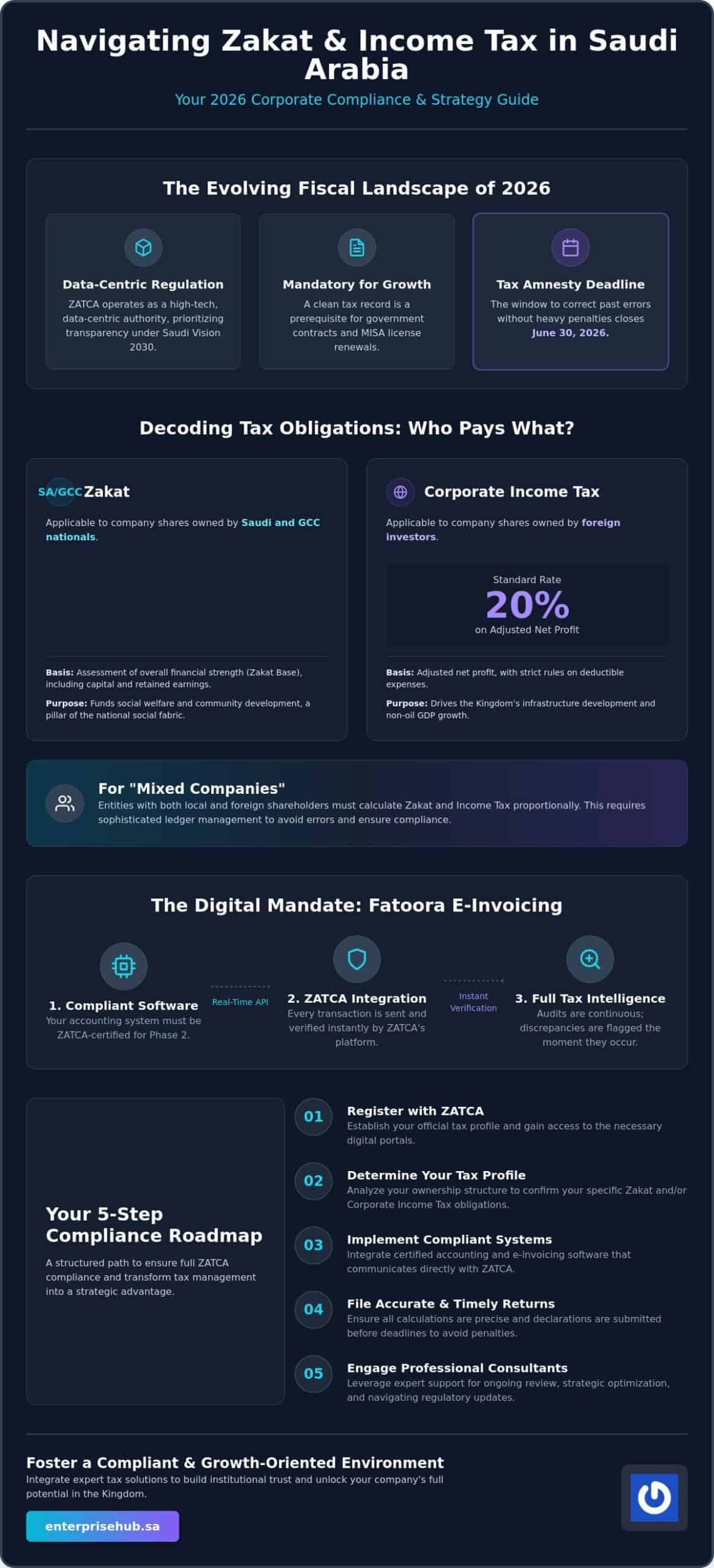
A 5-Step Compliance Roadmap for Saudi Companies
Establishing a clear chronological path to compliance is the only way to ensure your business remains resilient in the face of ZATCA’s rigorous standards. While the regulations are complex, they become manageable when broken down into a logical sequence. We see compliance as a continuous cycle of data integrity rather than a year-end rush. By following this structured roadmap, you can shift your focus from avoiding penalties to driving growth. Engaging in zakat and income tax consulting for companies provides you with the expert oversight needed to validate each step and ensure no detail is overlooked.
Step 1: Registration and TIN Management
Your journey begins with obtaining your Tax Identification Number (TIN) via the ZATCA portal. Whether you’re operating as an LLC, a branch of a foreign company, or a Joint Stock Company (JSC), your registration must accurately reflect your current legal form and ownership structure. If you’ve recently increased your capital or changed shareholders, these updates must be reflected in the system immediately. For many modern businesses, integrating this registration with a virtual office in Saudi Arabia setup is a smart way to maintain a professional presence while ensuring all official ZATCA correspondence reaches your team without delay.
Steps two and three focus on the engine of your compliance: record-keeping and reconciliation. You must implement accounting software that’s fully compatible with the Fatoora e-invoicing system to record transactions in real-time. We recommend conducting quarterly reviews to reconcile your VAT filings with your general ledger. This proactive approach ensures that when it’s time for your annual filing, your data is already consistent and verified, significantly reducing the risk of being flagged for an audit.
Step 4: The Filing Process and Documentation
The annual filing is the most critical phase of the roadmap. For 2026, you must determine if your company requires audited financial statements based on ZATCA’s current capital and revenue thresholds. Beyond the balance sheet, companies with related-party transactions must complete the ‘Transfer Pricing Disclosure Form’ to prove their dealings are at arm’s length. Remember that the deadline is strictly set within 120 days of your fiscal year-end. For a standard December 31 closing, this means your submission is due by April 29. Missing this window isn’t just an administrative error; it’s a financial risk that can impact your company’s standing.
The final step is the submission of your return and the issuance of your Zakat or Tax certificate. This document is your passport to business in the Kingdom, required for everything from visa renewals to contract biddings. To ensure your roadmap leads to a successful finish, we invite you to explore our specialized accounting and tax services designed to streamline every phase of your Saudi business operations.
With zakat and income tax consulting for companies, you gain a partner who understands the nuances of the 2026 landscape. We don’t just help you file; we help you build a foundation of transparency that supports your long-term success in the Saudi market.
Enterprise Hub: Integrated Solutions for Your Saudi Expansion
Expanding into the Saudi market is a bold move that requires more than just ambition; it demands a synchronized support system. We’ve designed Enterprise Hub to be that strategic partner, blending high-end workspace solutions with essential professional services. By centralizing your operations, we eliminate the friction between your physical office management and your fiscal obligations. Our specialized zakat and income tax consulting for companies ensures that your financial health is monitored with the same precision we apply to our workspace excellence. We don’t just provide four walls; we provide a launchpad where your compliance and growth are handled as a single, integrated priority.
Our approach to Zakat and tax is rooted in transparency and strategic foresight. We understand that in 2026, the margin for error in ZATCA filings has vanished. That’s why we coordinate your government services, accounting, and tax declarations under one roof. This seamless integration means your data flows directly from your daily operations into your tax returns, reducing the risk of discrepancies that trigger audits. We empower your brand to focus on its core mission while we navigate the complexities of the Saudi fiscal landscape on your behalf.
A Holistic Ecosystem for Success
Establishing tax residency is a critical step for any entity, and it often requires a verified physical presence. Our premium offices for rent provide the professional foundation needed to satisfy regulatory requirements while offering a world-class environment for your team. By integrating zakat and income tax consulting for companies into your broader setup strategy, we ensure you’re compliant from the moment you receive your TIN. You’ll gain immediate access to a network of experts who are deeply familiar with Saudi regulations, ensuring your business structure is optimized for both local Zakat and foreign income tax obligations.
Get Started with Enterprise Hub
We recognize that every business has unique needs depending on its size and sector. Whether you’re a local startup or an international firm entering the Kingdom for the first time, our customized consulting packages are tailored to your specific goals. We provide direct support for global entities, helping them navigate the 20% corporate tax on foreign shares and the complexities of withholding tax on cross-border services. Our goal is to make your expansion as smooth as possible. We invite you to contact us today for a comprehensive Zakat and tax health check. Let’s work together to ensure your company is fully prepared for the fiscal year ahead, allowing you to contribute to and benefit from the Kingdom’s thriving economy.
Empower Your Business for the Saudi Future
Mastering the 2026 fiscal landscape is about more than just avoiding ZATCA penalties; it’s about positioning your company as a trusted, transparent leader in the Saudi market. By understanding the nuances of your ownership-based tax profile and following a structured compliance roadmap, you turn a complex regulatory burden into a clear path for expansion. The digital integration of the Fatoora system and the evolving Zakat base calculations require a level of precision that internal teams often find challenging to maintain alone.
Expert zakat and income tax consulting for companies provides the institutional resilience needed to thrive under Vision 2030. At Enterprise Hub, we serve as your strategic partner, offering a unique blend of high-end workspaces, integrated accounting, and deep expertise in the latest ZATCA 2026 regulations. Whether you’re a local firm or an international investor, our team ensures your operations remain seamless and your financial health stays optimized. Secure your business future with expert Zakat and tax consulting at Enterprise Hub. Let’s build your success story together in the Kingdom’s vibrant economy.
Frequently Asked Questions
What is the difference between Zakat and Income Tax in Saudi Arabia?
Zakat applies to the share of Saudi and GCC nationals at a rate of 2.5% of the Zakat base, while Corporate Income Tax targets the non-Saudi ownership share at 20% of adjusted net profits. Mixed companies must manage both obligations proportionally. This dual system ensures that your fiscal responsibility aligns with your ownership structure, making professional zakat and income tax consulting for companies essential for accurate calculations.
Which companies are required to pay Corporate Income Tax in the Kingdom?
Any entity with non-Saudi or non-GCC ownership interests must pay Corporate Income Tax on the foreign share of profits. This includes foreign branches, limited liability companies with international partners, and joint ventures. Companies operating in the oil and hydrocarbon sector face different rates, ranging from 50% to 85%, depending on the specific nature of their investment and the size of their capital investment.
What are the penalties for late Zakat or Tax filing in 2026?
Late filings trigger financial penalties that can significantly drain your working capital. Beyond direct fines, failing to meet the 120-day deadline results in the suspension of your Zakat certificate, which halts government contract biddings and visa processing. Thankfully, the current tax amnesty initiative has been extended until June 30, 2026, allowing companies to correct past errors and cancel certain fines before the regulator begins stricter enforcement.
Do foreign-owned companies need to pay Zakat?
Foreign-owned companies are exempt from Zakat but are instead subject to a 20% Corporate Income Tax on their net adjusted profits. If your business has a mix of Saudi and foreign partners, you’ll pay Zakat on the Saudi portion and Income Tax on the rest. It’s a precise calculation that requires a deep understanding of your cap table to ensure you don’t overpay or accidentally trigger ZATCA audits.
How often should a company conduct a tax health check?
We recommend conducting a tax health check at least quarterly to stay synchronized with ZATCA’s real-time digital reporting requirements. Regular reviews allow you to reconcile VAT data with your annual Zakat base before the final filing season arrives. This proactive approach ensures that your zakat and income tax consulting for companies identifies potential issues early, preventing cash flow disruptions and ensuring your institutional records remain flawless.
Can a company appeal a ZATCA tax assessment or penalty?
You can absolutely appeal an assessment through the General Secretariat of Tax Committees (GSTC) if you believe a ZATCA ruling is incorrect. The process involves a structured objection period where you must present clear, evidence-based documentation to support your case. Having professional representation during this phase is vital, as the committee follows strict legal protocols that require precise technical arguments rather than general complaints.
What documents are needed for annual Zakat and Income Tax filing?
You’ll need audited financial statements if your company meets the specific 2026 revenue or capital thresholds set by ZATCA. Additionally, you must provide a detailed trial balance, a general ledger, and a completed Transfer Pricing Disclosure Form if you deal with related parties. Accurate shareholder records are also essential to prove the nationality of each partner, as this directly dictates whether you’re paying Zakat or Income Tax.
Is Transfer Pricing mandatory for all Saudi companies?
Transfer Pricing is mandatory for any Saudi company that engages in transactions with related parties, such as parent companies or subsidiaries. You must submit a disclosure form with your annual return and maintain a Master File and Local File if your transactions exceed specific thresholds. ZATCA uses these documents to ensure all dealings are at arm’s length, preventing artificial profit shifting and ensuring fair tax practices across the Kingdom.