
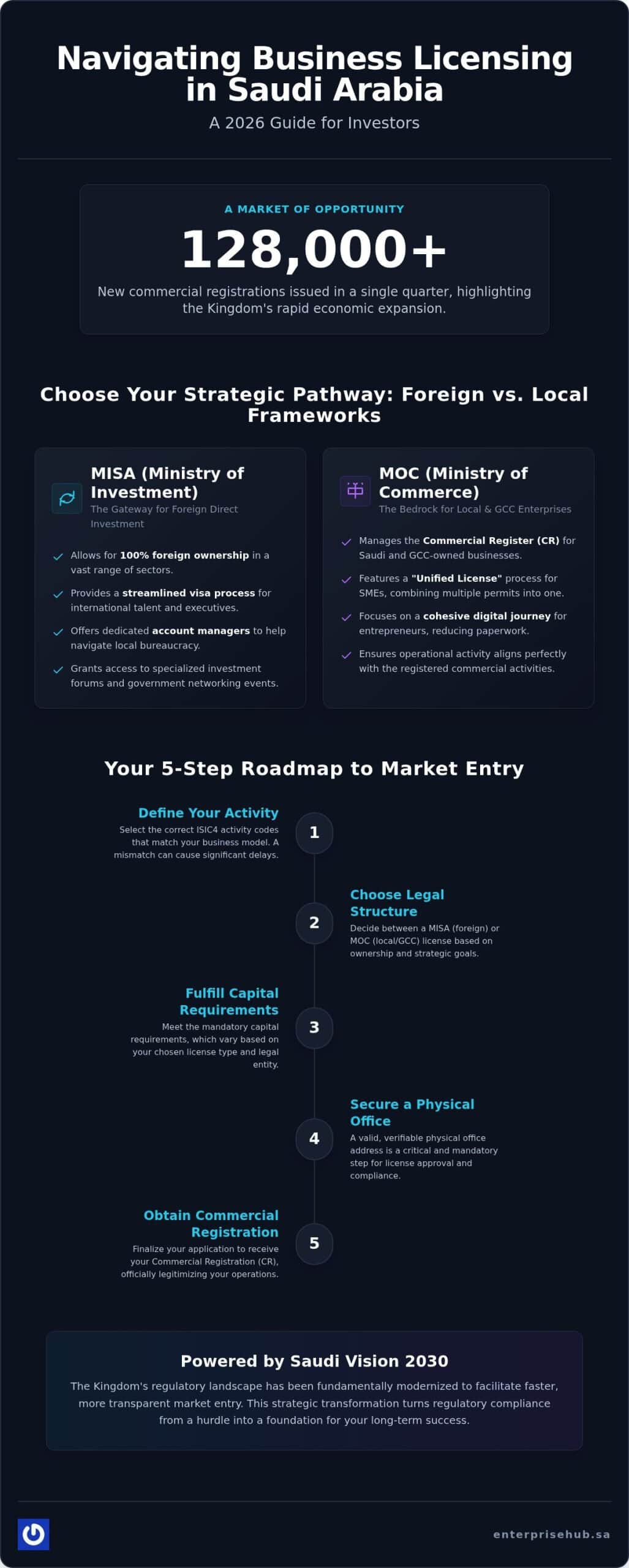
Did you know that over 128,000 new commercial registrations were issued in a single quarter of 2025? This surge highlights a market brimming with opportunity, yet for many investors, the initial excitement is often dampened by the complexities of identifying the correct أنواع التراخيص التجارية في السعودية. You might find yourself caught between the specific requirements of the Ministry of Investment (MISA) and the Ministry of Commerce, or perhaps you’re uncertain about how physical office mandates affect your compliance. It’s natural to feel that the path to entry is cluttered with administrative hurdles that could delay your strategic progress.
We understand these challenges and believe that choosing your legal structure should be a strategic advantage, not a source of stress. This guide offers a comprehensive analysis of Saudi business licenses to help you identify the optimal legal framework for your market entry and expansion. We’ll clarify the distinct license categories, outline the 2026 roadmap for setup, and show you how to navigate office logistics and administrative requirements with ease. By the end of this article, you’ll have the clarity needed to transform regulatory compliance into a foundation for your long-term success in the Kingdom.
Key Takeaways
- Understand how the Saudi Vision 2030 framework has modernized the regulatory landscape to facilitate faster and more transparent market entry.
- Identify the specific أنواع التراخيص التجارية في السعودية that align with your business model by correctly navigating the latest ISIC4 activity codes.
- Explore the 2026 eligibility criteria for 100% foreign ownership and compare the strategic advantages of various legal structures.
- Learn about the mandatory capital requirements and the critical role of a valid physical office address in securing your commercial permit.
- Discover how professional business establishment services can streamline administrative logistics and ensure total compliance with national regulations.
Navigating the Saudi Commercial Licensing Landscape in 2026
The transformation of the Saudi market under Vision 2030 has turned the Kingdom into a global business magnet. It’s no longer just about basic compliance; it’s about strategic positioning. Your choice among the various أنواع التراخيص التجارية في السعودية determines your access to government tenders, local talent, and specialized financial incentives. By 2026, the regulatory framework has become highly digitized, reducing the time from application to operation significantly. Holding a formal license in this evolving Economic Landscape of Saudi Arabia grants your business legitimacy and opens doors to a market with over 1.7 million active commercial registrations. This isn’t just a legal hurdle. It’s the foundation of your corporate identity in one of the world’s fastest-growing economies.
The Role of MISA in Foreign Direct Investment
For international companies, the Ministry of Investment (MISA) acts as the primary gateway. MISA’s mandate focuses on attracting and supporting foreign capital by offering licenses that allow for 100% foreign ownership in a vast range of sectors. In 2026, MISA-licensed entities enjoy significant perks, including streamlined visa processes for international talent and dedicated account managers who help navigate the local bureaucracy. Choosing a MISA license signals a long-term commitment to the Saudi market. It provides a robust legal framework that protects your assets while offering access to specialized investment forums and government-backed networking events. We view these international players as strategic partners in the Kingdom’s journey toward economic diversification.
Ministry of Commerce (MOC) and Local Business Frameworks
While MISA handles foreign investment, the Ministry of Commerce (MOC) remains the bedrock for Saudi-owned and GCC-owned enterprises. The MOC has successfully integrated the Commercial Register (CR) with specific activity licenses, creating a cohesive digital journey for entrepreneurs. This integration is vital when selecting between the different أنواع التراخيص التجارية في السعودية, as it ensures your CR matches your operational reality. For small and medium enterprises (SMEs), the ‘Unified License’ process has been a major breakthrough. This system combines multiple municipal and commercial permits into a single digital certificate. It ensures that your business stays compliant without the need to manage various physical applications. This level of administrative efficiency allows you to focus on growth rather than paperwork.
Effective licensing strategy requires more than just picking a category. It demands a clear understanding of how your business activity aligns with national goals. Whether you’re considering virtual office packages to satisfy initial address requirements or need a full physical headquarters, the right license is your ticket to the table. We see this as a partnership where your success contributes to the broader national prosperity. Every step you take toward formalizing your business is a step toward a more stable and profitable future.
Comprehensive Breakdown of License Types by Industry Activity
Selecting the right framework among the different أنواع التراخيص التجارية في السعودية begins with the ISIC4 classification system. This international standard categorizes every possible business activity into specific codes. It’s a critical step because your chosen code determines which government departments will oversee your operations. In 2026, the alignment between your business model and these codes is tighter than ever. A mismatch can lead to delays in customs clearance or issues with employee visa quotas. We recommend a thorough review of your primary and secondary activities before submitting your application to ensure full strategic alignment.
Commercial and Trading Licenses
Trading licenses are the backbone of the retail and wholesale sectors. If your business involves buying and selling physical goods, this is your path. These permits now offer seamless integration with customs systems, facilitating faster import and export processes. To secure this license, you’ll need to demonstrate a valid warehouse or inventory management plan. Saudi authorities have standardized these requirements to ensure that all trading entities maintain high safety and logistical standards. It’s a robust framework that supports everything from local shops to massive distribution networks.
Industrial and Manufacturing Licenses
The “Made in Saudi” initiative has transformed the manufacturing sector. Industrial licenses are now prioritized for investors who contribute to local value chains. These licenses provide access to specialized industrial cities where utility rates are often subsidized to encourage growth. However, compliance standards for environmental impact and worker safety are strictly enforced in 2026. You can explore the latest manufacturing incentives and sector-specific data on the Ministry of Investment (MISA) website. This license type is ideal for long-term investors looking to build a physical production presence in the region.
Professional and Service Licenses
Consultancies, tech firms, and legal practices typically opt for service or professional licenses. These are currently the most popular choice for digital-first businesses. Unlike trading licenses, service licenses often focus more on the qualifications of the individuals involved than on physical inventory. Notably, the current Companies Law has removed the minimum capital requirement for Limited Liability Companies, making this path even more accessible for lean startups. This ensures that the professional landscape remains competitive and high-quality. If you’re looking to identify which category best supports your specialized expertise, our experts are ready to guide your market entry. Understanding these أنواع التراخيص التجارية في السعودية ensures you build your business on a compliant and scalable foundation.
Strategic Licensing Pathways for Foreign vs. Local Ownership
The regulatory environment in 2026 has fundamentally changed the conversation around business ownership. Gone are the days when a local partner was a mandatory requirement for every international venture. Today, the أنواع التراخيص التجارية في السعودية available to global investors include 100% ownership in most retail, wholesale, and service sectors. This shift allows you to maintain total control over your corporate strategy and operations. While full ownership is the new standard, some firms still opt for a Joint Venture model. A local partner can offer deep market intelligence and established networks that might otherwise take years to build. Your decision should depend on whether you value absolute autonomy or the accelerated market entry that a strategic partnership provides.
GCC nationals and residents also operate under a modified framework that facilitates easier cross-border investment. Residents can now apply for investment licenses under specific criteria, effectively bridging the gap between local and foreign investment pathways. It’s vital to consult the latest activity lists on the official portal of Saudi Arabia’s Ministry of Investment (MISA) to verify if your specific business niche qualifies for full foreign ownership. This transparency ensures that you can plan your market entry with total confidence in your legal standing.
The Regional Headquarters (RHQ) License Advantage
The RHQ license is a premium strategic tool for multinational corporations looking to dominate the MENA region. To qualify, your firm must establish a center in the Kingdom that supervises and directs your regional branches. The incentives are unparalleled. You’ll benefit from an exclusive 30-year tax exemption and receive priority status in government procurement contracts. However, this isn’t a “brass plate” arrangement. The license requires a genuine executive presence and a commitment to specific employee ratios. It’s a high-level commitment that positions your brand at the center of regional decision-making.
Entrepreneurial and Startup Licenses
Innovation is the lifeblood of the current economic landscape. MISA-approved entrepreneurs can now access specialized startup licenses that feature significantly reduced capital requirements. These pathways are deeply integrated with the ‘Monsha’at’ ecosystem, providing direct links to venture capital and mentorship programs. Whether you’re launching a fintech platform or a biotech lab, these أنواع التراخيص التجارية في السعودية are designed for speed and agility. Many startups choose to begin their journey with virtual office packages, which provide the prestigious business address required for licensing while keeping overhead low during the initial growth phase.
Essential Requirements: From Capital to Physical Office Space
Securing one of the أنواع التراخيص التجارية في السعودية isn’t just a matter of paperwork; it’s a multi-layered integration process. While the current Companies Law has removed the minimum capital requirement for Limited Liability Companies (LLCs) to encourage entrepreneurship, specific MISA licenses, particularly in the industrial sector, may still require verified capital injections. Beyond capital, your documentation must be airtight. You’ll need a notarized Articles of Association and a valid Power of Attorney to represent your firm during the registration phase. This documentation forms the basis for your integration with key national systems like GOSI for social insurance and ZATCA for tax compliance.
Once your license is issued, the Ministry of Human Resources links your file to your employee visa quotas. Every step is interconnected. Failing to synchronize these accounts can lead to operational freezes. We emphasize a holistic approach to setup because your legal identity and your operational capacity are two sides of the same coin. Your journey through the أنواع التراخيص التجارية في السعودية concludes only when all government portals are active and your business is ready to trade.
Choosing the Right Office Solution for Your License
Your office choice is dictated by your license type and regulatory mandates. For instance, a private office is frequently a non-negotiable requirement for trading or industrial permits where physical oversight is mandatory. Conversely, many professional service providers successfully utilize virtual offices to satisfy initial MISA requirements without the overhead of a large facility. For those seeking a balance, co-working spaces provide a compliant environment that meets ‘Ejar’ registration standards while offering the networking benefits of a shared ecosystem.
The ‘Ejar’ System and Commercial Registration
The Ejar system serves as the unified national portal that validates commercial lease agreements to ensure every business entity operates from a verified and compliant location in 2026. This platform is now directly linked to your Commercial Registration (CR). Without a valid, Ejar-registered lease, you cannot renew your license or obtain municipal permits from Balady. Your chosen space must also adhere to civil defense and municipal safety codes to pass the ‘Salamah’ certification. This ensures that your business operations are backed by a safe and legitimate physical presence that regulators can verify at any time.
Ready to secure a compliant address and streamline your setup? Contact our experts today to find the perfect office solution for your license.
Streamlining Your Market Entry with Enterprise Hub Solutions
Market entry in Saudi Arabia is a high-stakes endeavor where the details matter as much as the overall strategy. We’ve seen many investors grasp the theoretical differences between the various أنواع التراخيص التجارية في السعودية, only to struggle with the practical execution of their setup. Enterprise Hub bridges this critical gap by transforming legal requirements into operational reality. We don’t just provide a desk. We provide the institutional knowledge required to navigate the Kingdom’s sophisticated digital government ecosystem. Our business establishment services are designed to remove the friction from your expansion, allowing you to focus on your core objectives from day one.
A prestigious business address is often the final piece of the licensing puzzle. Regulators look for stability and legitimacy when reviewing your application. We provide that foundation through our network of high-tier office solutions, ensuring that your choice among the أنواع التراخيص التجارية في السعودية meets the highest standards of municipal and ministerial scrutiny. Beyond the initial setup, we remain your strategic partner through integrated accounting, tax support, and government relations services. This long-term commitment ensures that your business remains compliant as regulations continue to evolve under Vision 2030.
Comprehensive Support for New Enterprises
Managing a new team in a foreign market involves complex administrative tasks that demand local expertise. We handle the essential Muqeem and Absher registrations for your staff, ensuring that your workforce is legally documented and ready to perform. Our financial compliance team takes the weight of VAT and accounting off your shoulders, providing the accuracy required by ZATCA. When it’s time to make high-level decisions or host international partners, our premium meeting rooms offer the professional environment needed for successful executive board sessions and strategic planning.
Next Steps for Your Saudi Expansion
Your journey begins with a focused consultation to select the optimal license type for your specific business goals. We analyze your intended activities against the latest ISIC4 codes and ownership regulations to ensure a perfect match. The timeline for setup typically moves from initial application to a fully operational office in a matter of weeks. We invite you to reach out to our team today for a tailored market entry roadmap that secures your place in the Kingdom’s future and turns your vision into a measurable success.
Launching Your Strategic Vision in Saudi Arabia
Navigating the diverse أنواع التراخيص التجارية في السعودية is the first critical step toward establishing a resilient presence in one of the world’s most dynamic markets. By 2026, the alignment between your ISIC4 activity codes and your physical office address through the Ejar system has become the cornerstone of regulatory compliance. Whether you’re pursuing 100% foreign ownership via MISA or a local partnership through the Ministry of Commerce, your success depends on a foundation of administrative accuracy and strategic foresight. We’ve seen that the most successful investors are those who prioritize a prestigious address and integrated government relations from day one.
We believe that the complexities of licensing shouldn’t slow your momentum. Enterprise Hub stands as your strategic partner, offering specialized MISA and MOC licensing support alongside premium business addresses that ensure total regulatory compliance. Our full-service accounting and government relations teams handle the administrative burden, so you don’t have to worry about the finer details of setup. Start your Saudi business journey today with Enterprise Hub’s integrated setup solutions and turn your corporate ambitions into a tangible reality. The Kingdom’s growth story is unfolding now, and we’re here to ensure you’re a leading part of it.
Frequently Asked Questions
What is the difference between a MISA license and a regular commercial license?
A MISA license is specifically designed for international firms and foreign investors, whereas a regular commercial license from the Ministry of Commerce is typically reserved for Saudi or GCC nationals. MISA licenses are essential for accessing the various أنواع التراخيص التجارية في السعودية that permit 100% foreign ownership. While the Ministry of Commerce handles the legal identity of all businesses, MISA acts as the preliminary regulator that grants foreign capital the right to operate within the Kingdom’s economic framework.
Can a foreign investor own 100% of a company in Saudi Arabia in 2026?
Yes, foreign investors can own 100% of their companies in a wide range of sectors as of 2026. This includes major industries such as retail, wholesale, and various professional services. The Saudi government has expanded these permissions to attract global expertise and capital under the Vision 2030 initiative. You should verify your specific business activity against the latest MISA guidelines, as a few restricted sectors still require a local strategic partner to ensure total regulatory compliance.
Is a physical office required to obtain a commercial license?
A physical office address is a mandatory prerequisite for securing and maintaining a commercial license. The national Ejar system integrates directly with the Ministry of Commerce and MISA portals to verify that your business has a legitimate base of operations. While certain professional permits allow for virtual office solutions, most trading and industrial licenses require a private workspace. This ensures every entity holding one of the أنواع التراخيص التجارية في السعودية meets national safety and municipal standards.
What are the costs associated with issuing a commercial license in Saudi Arabia?
Issuing a commercial license involves several standardized government fees. For a Limited Liability Company (LLC), the Commercial Registration fee is 1,200 SAR plus 500 SAR for publication, while a sole proprietorship costs 500 SAR. Foreign investors must also budget for the annual MISA service fee, which is currently 10,000 SAR plus a 2,000 SAR initial issuance fee. All these government charges are subject to a standard 15% Value Added Tax (VAT), so accurate financial planning is essential for your market entry.
How long does it take to get a commercial license for a new business?
The Saudi government’s digital transformation has significantly reduced the time required to obtain a commercial license. You can often secure a Commercial Registration (CR) within a few business days through the Ministry of Commerce’s online portal. For foreign investors, the MISA licensing process is also highly streamlined, typically taking between one to two weeks if all documentation is complete. We’ve seen that having a pre-verified office address and ready-to-submit Articles of Association are the primary factors in accelerating your expansion.
Can I change my business activity after the license is issued?
You can change or add to your business activities after your license is issued, provided the new activities align with your legal structure and ownership type. This process is managed through the Ministry of Commerce or MISA digital portals and requires updating your Commercial Registration. It’s important to ensure that any new activity matches your current office’s municipal permit. Some changes may require you to upgrade your physical workspace to meet specific safety or environmental codes to remain fully compliant.
Do I need a local Saudi partner for a professional service license?
In 2026, you don’t necessarily need a local Saudi partner for a professional service license in many sectors. Recent regulatory updates allow for 100% foreign ownership in consultancies, IT services, and engineering firms. However, certain highly regulated professions, such as law or specialized medical services, may still have specific practitioner requirements or partnership mandates. It’s always best to consult with a business establishment expert to determine the exact ownership rules for your specific professional niche before beginning the application process.
What is the Regional Headquarters (RHQ) program and who is it for?
The Regional Headquarters program is a strategic initiative designed for multinational corporations that manage their MENA operations from within Saudi Arabia. It offers a powerful set of incentives, including a 30-year corporate income tax exemption and priority in government procurement contracts. To qualify, a firm must supervise at least two foreign branches and maintain a genuine executive presence. It’s an ideal pathway for global brands looking to centralize their regional decision-making and benefit from the Kingdom’s growing economic influence.