
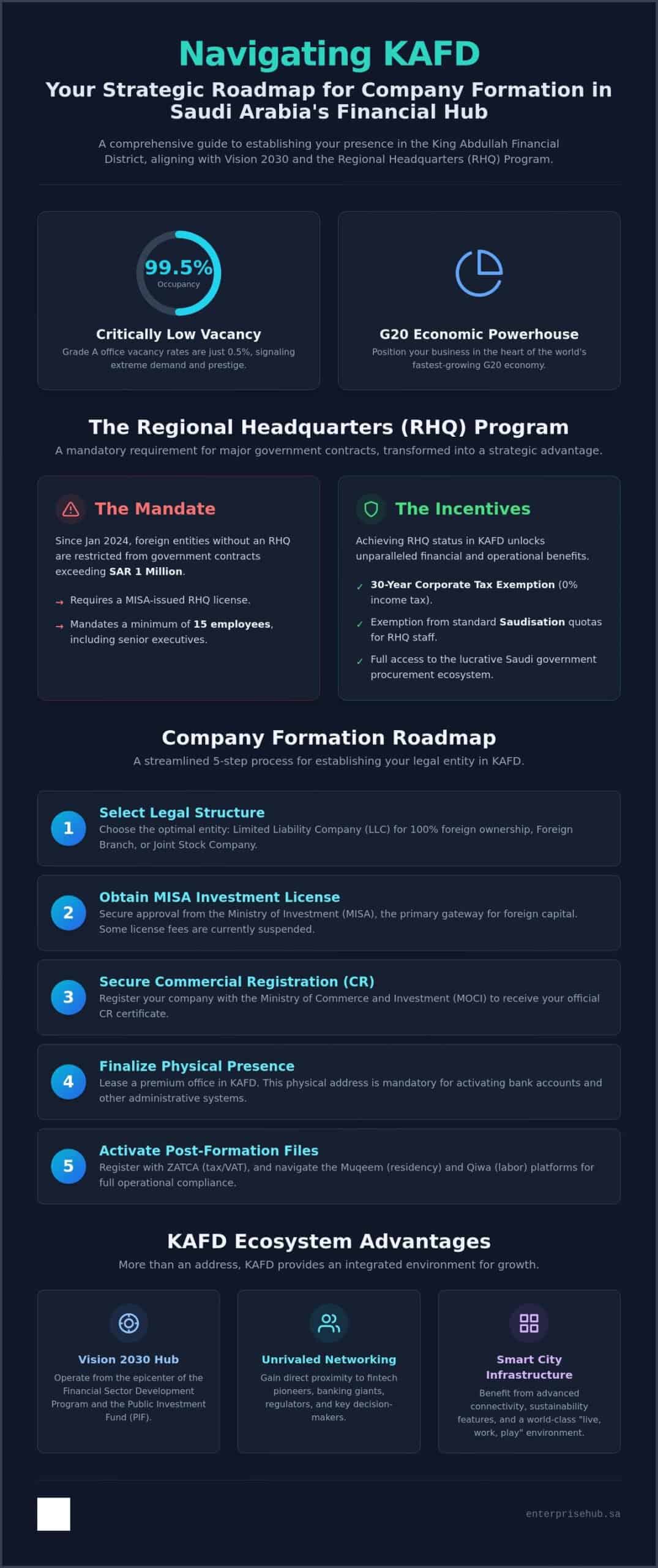
With Grade A office vacancy rates in Riyadh hitting a staggering 0.5%, the race to secure a foothold in the King Abdullah Financial District has never been more competitive. You’re likely aware that since January 2024, foreign entities without a regional headquarters are restricted from government contracts over SAR 1 million. This reality makes company formation in KAFD not just a prestige play, but a fundamental requirement for long-term growth in the Saudi market. We understand that managing MISA licensing and the 15-employee requirement for RHQ status can feel like an intense challenge against shifting regulations and high entry costs.
We’re here to transform that complexity into a clear path for your business. This strategic guide provides a comprehensive roadmap for domestic and international investors to establish their presence and scale effectively by 2026. You’ll learn how to capitalize on the 30-year corporate tax exemption, meet the latest Saudisation quotas for engineering and marketing, and access a high-tier financial ecosystem. From understanding the current suspension of certain MISA fees to securing a premium business address, we’ll preview the essential steps to ensure your operations thrive in the region’s most prestigious district.
Key Takeaways
- Understand why a KAFD address serves as a vital trust signal for global partners and regulators under Saudi Vision 2030.
- Identify the most effective legal structures and MISA licensing requirements to ensure a seamless entry into the Saudi market.
- Learn how strategic company formation in KAFD facilitates compliance with the 2026 Regional Headquarters mandate and unlocks exclusive tax incentives.
- Explore premium office solutions that provide the physical presence necessary for activating corporate bank accounts and administrative systems.
- Gain clarity on essential post-formation operations, including ZATCA tax compliance and navigating the Muqeem and Qiwa platforms.
The Strategic Value of Company Formation in KAFD for 2026
Establishing a presence in the King Abdullah Financial District (KAFD) isn’t just about renting office space. It’s a calculated move to place your business at the heart of the world’s fastest-growing G20 economy. By 2026, this district has become the definitive epicenter of the Saudi financial landscape, serving as the operational base for the Public Investment Fund (PIF) and the Kingdom’s most influential regulators. Choosing this location signals to the market that your company is ready to compete at the highest level.
Company formation in KAFD acts as a powerful trust signal. When international partners or local government agencies see a KAFD address on your MISA license, they recognize a commitment to the highest standards of corporate excellence. It’s a badge of credibility that simplifies due diligence and accelerates partnership discussions. With Grade A occupancy rates reaching 99% in 2026, being one of the entities within these walls proves your firm’s elite standing in the market. You aren’t just in Riyadh; you’re in the region’s premier business destination.
Vision 2030 and the Financial Sector Development Program
KAFD is the physical manifestation of the Financial Sector Development Program, a core pillar of Vision 2030. It’s designed to attract foreign direct investment, which reached SAR 26.6 billion in the first quarter of 2026 alone. The district provides the infrastructure necessary to support the Kingdom’s goal of becoming a top-ten global economy. KAFD stands as the essential strategic hub for the 2026 economic landscape, offering a regulatory and physical environment that mirrors global financial centers like London or Singapore.
Networking and Ecosystem Advantages
The density of decision-makers within the district is unparalleled. Your neighbors aren’t just other businesses; they’re the fintech pioneers, banking giants, and media leaders shaping the region’s future. This proximity fosters a natural networking environment where a casual meeting can quickly evolve into a strategic alliance. You’ll find yourself minutes away from the entities that drive policy and capital flow in the Middle East.
Beyond networking, the smart city integration provides tangible operational benefits that support long-term ROI. These include:
- Operational Efficiency: Advanced connectivity ensures zero downtime for high-frequency financial operations and data-heavy tasks.
- Sustainability: Automated waste management and district cooling systems reduce overheads and align with global ESG standards.
- Talent Retention: Integrated mixed-use spaces help with hiring by offering a world-class “live, work, play” environment for your executives.
Strategic company formation in KAFD ensures your business isn’t just observing the Saudi transformation but actively leading it from the front row. We help you bridge the gap between global ambition and local execution in this high-tier financial ecosystem.
Legal Framework and Steps for Business Setup in KAFD
Establishing a legal entity in the district requires a precise sequence of approvals. While the process has been streamlined under Saudi Arabia’s Vision 2030, investors must choose the right vehicle to match their operational goals. Limited Liability Companies (LLCs) remain the preferred choice for those seeking 100% foreign ownership. Foreign branches are ideal for multinationals wanting to maintain their parent identity, while Joint Stock companies cater to large-scale capital projects requiring complex governance. In 2026, the Ministry of Commerce and Investment (MOCI) has digitized nearly every step, yet the sequence of filings remains critical to avoid delays.
Company formation in KAFD typically follows a three-week timeline if documentation is prepared correctly. You’ll first secure a MISA license, followed by the Commercial Registration (CR), and finally, the activation of tax and labor files. While the government has significantly reduced barriers, the specific zoning requirements within KAFD mean your physical office lease must be finalized before certain government portals allow for final activation. It’s a structured journey that rewards those who plan their legal architecture early, often with the support of a dedicated legal partner like شركة علي المسردي للمحاماة.
Obtaining a MISA Investment License
The Ministry of Investment (MISA) serves as the primary gatekeeper for international capital. As of July 2026, MISA has continued its policy of waiving primary license fees for both entrepreneurs and general licenses to stimulate market entry. To qualify, you’ll need to provide board resolutions, audited financial statements, and a copy of the parent company’s registration, all attested by the Saudi Embassy in your home country. Aligning your business activity with the correct ISIC codes is vital. A mismatch here can lead to license rejection or restricted access to the high-tier financial activities permitted within the district.
The Commercial Registration (CR) Process
Once MISA grants your license, the focus shifts to MOCI for your Commercial Registration. You’ll reserve a unique trade name and draft your Articles of Association. In 2026, the annual CR fee remains approximately SAR 1,200, with Chamber of Commerce fees ranging between SAR 1,000 and SAR 3,000 depending on your capital and activity. You’ll also need to register with ZATCA for tax and GOSI for social insurance. If you’re exploring options across the capital, you can find more details in our guide on تأسيس شركات في الرياض. Successful company formation in KAFD concludes with the Muqeem and Qiwa registrations, allowing you to sponsor international talent. Our team at Enterprise Hub can manage these administrative hurdles, ensuring your focus stays on your strategic launch.
KAFD as the Hub for the Regional Headquarters (RHQ) Program
The 2026 business landscape in Riyadh is defined by the full maturity of the Regional Headquarters (RHQ) program. For any multinational corporation aiming to secure government contracts exceeding SAR 1 million, establishing an RHQ is no longer optional. KAFD has emerged as the premier destination for this mandate, offering an environment that perfectly aligns with the Ministry of Investment’s (MISA) rigorous standards. Choosing this district for your headquarters isn’t just about compliance; it’s about positioning your leadership team in the center of the Kingdom’s economic decision-making power.
Strategic company formation in KAFD provides a direct path to satisfying the RHQ requirements while gaining immediate prestige. Government entities and state-owned enterprises prioritize KAFD-based HQs because the district represents a commitment to the “Center of Excellence” model. This model requires that your regional office serves as the primary management hub for your Middle Eastern operations. By locating here, you’re placing your senior executives within walking distance of the Public Investment Fund (PIF) and major regulatory bodies, facilitating the high-level coordination that the RHQ program demands.
Criteria for RHQ Licensing in 2026
To qualify for an RHQ license, your company must employ at least 15 full-time staff within the first year of operation. This team must include at least three senior-level executives who manage regional functions. MISA requires that these roles provide strategic direction, budgetary control, and operational oversight for your branches in other countries. For a deeper look at how this fits into the broader national strategy, you can explore our analysis of how to Invest in Saudi Arabia in the current year. We’ve seen that companies that clearly define their regional management functions during the initial application process experience significantly faster approval times.
Strategic Benefits of an RHQ in KAFD
The incentives for establishing an RHQ are among the most competitive globally. Entities that meet the criteria enjoy a 30-year exemption from corporate income tax on eligible RHQ activities. This long-term fiscal certainty is a cornerstone of company formation in KAFD for 2026. Beyond tax holidays, RHQ companies benefit from specific Saudization exemptions and streamlined visa processing for international talent. These perks are designed to help you scale your regional operations quickly without the standard administrative friction. In a district where Grade A office space is effectively fully committed, having your headquarters here ensures you have the infrastructure to support these high-value management functions while enjoying world-class smart city solutions.
Infrastructure and Office Solutions: Defining Your Presence
The success of your company formation in KAFD depends heavily on selecting an office solution that satisfies both regulatory mandates and operational needs. While the legal paperwork is essential, Saudi banks and government regulators require a verified physical address before they’ll fully activate your corporate accounts. In 2026, where Grade A office vacancy in Riyadh is a razor-thin 0.5%, securing this footprint is a strategic priority. KAFD’s infrastructure sets a global benchmark, featuring smart building management systems and high-speed fiber connectivity that ensure your operations remain uninterrupted. You should also account for the fixed master and community service charge of SAR 440 per square meter, which supports the district’s world-class maintenance standards.
Investors often struggle to choose between high-cost private suites and leaner alternatives. We’ve seen that the right choice depends on your specific growth stage and whether you’re pursuing RHQ status. Each solution offers a different balance of prestige and flexibility.
Comparing Private Offices vs. Virtual Addresses
For entrepreneurs in the early stages of company formation in KAFD, a virtual office provides the necessary MISA-compliant address to secure an investment license without the overhead of a large floor plate. It’s an efficient entry point for those testing the market or managing remote teams. However, established corporate teams and those meeting RHQ mandates often find that private offices are non-negotiable. These spaces provide the privacy required for sensitive financial operations and the physical presence that Saudi banks scrutinize during KYC procedures. You can learn more about these options in our Virtual offices in Saudi Arabia guide.
Meeting Rooms and Collaborative Spaces
High-level board meetings and investor presentations require a setting that mirrors the prestige of the district. Shared amenities within premium business centers allow you to access world-class meeting rooms for rent without the long-term cost of maintaining your own large-scale boardroom. These collaborative spaces reduce your operational overhead by providing on-demand access to high-end technology needed for global video conferencing and secure presentations. Leveraging these shared resources allows you to focus your capital on core business activities while maintaining an elite corporate image.
At Enterprise Hub, we provide the flexible office solutions and on-the-ground expertise you need to secure your place in KAFD. Contact our team today to find the perfect space for your business.
Operational Excellence: Post-Formation Support in KAFD
Receiving your Commercial Registration is a significant milestone, but it’s only the start of your journey in the Kingdom. In 2026, maintaining operational excellence requires a proactive approach to a regulatory landscape that rewards precision. Success in the district depends on your ability to integrate seamlessly with national systems like ZATCA for tax and Qiwa for labor management. Since company formation in KAFD places you in a high-visibility environment, local authorities expect immediate and total compliance with all post-incorporation mandates from your first day of operation.
Managing these requirements can be taxing for international teams focused on rapid market growth. We’ve seen that the most successful firms are those that treat administrative compliance as a strategic function rather than a secondary task. By offloading the burden of government relations and financial reporting to experts—including specialized services like a רואה חשבון לחברות for global corporate accounting—you ensure your leadership team stays focused on high-value operations within the region’s premier financial hub.
Government Services and GRO Support
Navigating the Muqeem and Qiwa platforms is essential for managing your workforce effectively. As of 2026, specific Saudization quotas are in full effect, including a 60% requirement for marketing roles and a 30% localization quota for engineering professions in firms with five or more engineers. Our Government Relations Officers (GRO) act as your on-the-ground advocates, handling everything from residency permits (Iqamas) to work visa renewals. Having a dedicated team physically present in the district allows us to resolve bureaucratic hurdles with municipality licenses or Commercial Registration updates much faster than remote providers. This direct access is vital for maintaining the momentum of your business.
Accounting and Tax Compliance
ZATCA’s Phase 2 e-invoicing integration is now a standard requirement for all entities operating in the district. You’ll need to ensure your accounting systems are fully linked with government portals to avoid penalties and ensure smooth transaction processing. While the standard corporate income tax rate for foreign investors is 20% on net adjusted profits, your VAT filings must be submitted quarterly with absolute precision. Audit requirements for LLCs and foreign branches remain strict, necessitating transparent financial records that meet Saudi standards. Company formation in KAFD demands a level of financial rigor that only local tax expertise can provide for global firms. At Enterprise Hub, we integrate these essential accounting and government services into a single, comprehensive support model, ensuring your business remains compliant and competitive from the moment you open your doors.
Secure Your Strategic Future in Saudi Arabia’s Financial Heart
The business landscape of 2026 demands more than just a presence in Riyadh; it requires a strategic foothold in the Kingdom’s premier financial district. We’ve explored how company formation in KAFD serves as the ultimate trust signal for global partners and stands as the essential gateway for the Regional Headquarters program. Navigating the 30-year tax exemption and evolving Saudisation quotas requires a blend of local wisdom and operational agility. By securing a physical office and integrating with systems like Qiwa and ZATCA early, you position your business to lead within this high-tier ecosystem.
You don’t have to navigate this complex journey alone. Establish your strategic presence in KAFD with Enterprise Hub to access our MISA-compliant office solutions and specialized on-site government and GRO support. We provide the premium KAFD business address and administrative expertise needed to turn your corporate vision into a measurable success. It’s time to build your legacy in the heart of Riyadh’s most prestigious district.
Frequently Asked Questions
How long does company formation in KAFD take in 2026?
Standard setup typically takes three weeks to complete provided all attested documents are submitted correctly. This period covers the issuance of the MISA license, the Commercial Registration from the Ministry of Commerce, and initial tax registrations. Complex financial activities may require additional time for sectoral approvals from the Saudi Central Bank or other regulatory bodies.
Can a 100% foreign-owned company operate in KAFD?
Yes, international investors can maintain 100% ownership of their entities within the district. This is typically achieved through a Limited Liability Company or a foreign branch structure under a MISA investment license. It allows for full control of operations and profits without the requirement for a local partner, aligning with the Kingdom’s open investment policies.
What is the minimum capital required for setup in the financial district?
For a standard service-based LLC, the minimum capital is generally SAR 100,000; however, capital requirements are strictly sector-specific. Financial services and insurance entities often face significantly higher thresholds. It’s essential to verify the specific requirement for your ISIC code with MISA before drafting your Articles of Association to ensure your capital meets the current 2026 mandates.
Is a physical office mandatory for a MISA license in KAFD?
A physical address or a verified business center lease is essential for obtaining a MISA license and opening a corporate bank account. While you don’t necessarily need a full floor plate immediately, a MISA-compliant address is the foundation for all subsequent government activations and labor sponsorship. Regulators require this footprint to verify the legitimacy of your local operations.
What are the specific tax benefits for companies located in KAFD?
Companies that establish a Regional Headquarters in the district benefit from a 30-year corporate income tax holiday on eligible activities. Beyond this specific program, the standard corporate tax rate is 20% on net adjusted profits. Recent reforms have also lowered the withholding tax on technical services to 5%, significantly improving the fiscal environment for international firms operating in the Kingdom.
Can I use a virtual office address for my Commercial Registration?
You can use a verified virtual office address for your Commercial Registration if it’s provided by a licensed business center within the district. This is a strategic way to initiate company formation in KAFD while managing initial entry costs. It provides the MISA-compliant address needed to begin the legal setup before transitioning to a larger physical space as your team scales.
What government entities are involved in the KAFD formation process?
The process primarily involves MISA, the Ministry of Commerce, ZATCA, and the Ministry of Human Resources and Social Development. These bodies oversee your investment license, trade name, tax compliance, and labor quotas through the Qiwa platform. Coordinating with these entities is a standard part of the formation journey, ensuring your business meets all national regulatory and social insurance standards.
How does the Regional Headquarters (RHQ) program affect setup in KAFD?
The RHQ program makes company formation in KAFD a strategic necessity for multinationals wanting to sign government contracts exceeding SAR 1 million. It requires a commitment to employ 15 full-time staff and three senior executives within the first year of operation. This mandate has turned the district into the primary hub for global firms seeking the program’s associated tax and labor incentives.