
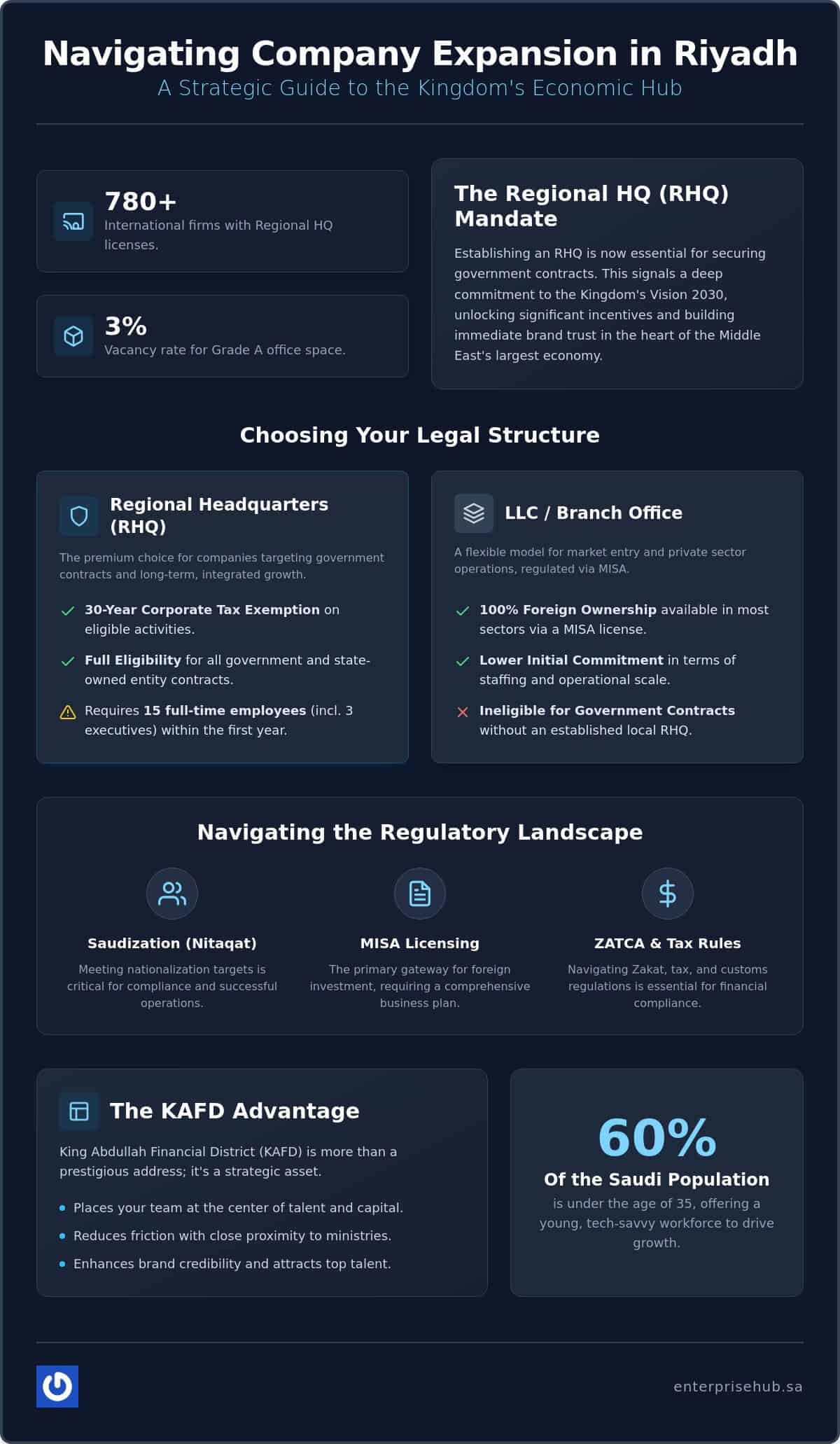
Over 780 international firms have already secured their licenses under the Regional Headquarters (RHQ) program as of early 2026. You likely recognize that establishing a presence in the heart of the Middle East’s largest economy is essential for global growth. However, implementing successful company expansion strategies in Riyadh often feels like a race against shifting regulations and high overhead costs. We understand that managing 90% Qiwa documentation targets while searching for a prestigious address in a market with 3% vacancy rates creates significant operational pressure.
You aren’t alone in seeking a path that balances speed with long-term compliance. This guide provides the data-driven insights and infrastructure solutions you need to scale your business with confidence. We’ll explore how integrating flexible office spaces in districts like the King Abdullah Financial District (KAFD) with professional accounting and government support simplifies your journey. From mastering Nitaqat requirements to securing a strategic foothold in the Kingdom, you’re about to learn how to turn logistical hurdles into a streamlined roadmap for national success.
Key Takeaways
- Understand why Riyadh is the non-negotiable hub for government contracts and how Vision 2030 shapes the current investment landscape.
- Identify the most effective legal structures, including the Regional Headquarters (RHQ) model, to ensure eligibility for government procurement.
- Learn how to implement agile company expansion strategies in Riyadh by leveraging flexible private offices that meet MISA requirements.
- Navigate complex Saudization (Nitaqat) targets and ZATCA tax regulations through integrated government relations and accounting support.
- Discover how a prestigious KAFD address enhances your brand’s credibility while providing the scalable infrastructure needed for rapid growth.
The Strategic Importance of Company Expansion Strategies in Riyadh for 2026
Riyadh is no longer just a regional capital. It’s the heartbeat of a global economic transformation. As we move through 2026, the city has solidified its position as the primary destination for multinational corporations seeking a foothold in the Middle East. Success here requires more than just a presence. It demands sophisticated company expansion strategies in Riyadh that align with the broader goals of Saudi Vision 2030. This national framework is the foundational context for every business decision in the Kingdom. It has successfully shifted the economic weight toward non-oil sectors, creating massive opportunities in technology, finance, and infrastructure.
The Regional Headquarters (RHQ) Mandate
The mandate prohibiting government agencies from contracting with foreign firms without a local RHQ changed the landscape forever. While the policy began in 2024, the 2026 environment shows its full impact. Firms with an RHQ enjoy a 30-year corporate tax exemption on eligible activities. This status does more than provide financial incentives. It builds immediate brand trust. When you establish an RHQ, you signal a deep commitment to the Kingdom’s future. This commitment is often the deciding factor in securing major government tenders and high-value contracts with state-owned entities.
Riyadh as the National Economic Engine
Riyadh is where the decisions happen. Strategic proximity to ministries and regulatory bodies reduces the friction of doing business. The city’s infrastructure, particularly the King Abdullah Financial District (KAFD), represents the pinnacle of this growth. With Grade A office vacancy rates near 3% in early 2026, the demand for premium space is intense. KAFD isn’t just an address. It’s a strategic asset that places your team in the center of a high-density environment of talent and capital. Your strategy must account for this competitive environment. Accessing the right talent is easier when your office is located in the city’s commercial core. With over 60% of the Saudi population under the age of 35, the capital offers a young, tech-savvy workforce ready to drive your company’s growth.
Evaluating Legal Entry and Expansion Models
Your choice of legal entity serves as the foundation for all company expansion strategies in Riyadh. Selecting the wrong structure can lead to unnecessary tax liabilities or restrict your ability to hire essential talent. In 2026, the regulatory environment has evolved to offer more flexibility, but it requires a precise understanding of which model aligns with your commercial objectives. Whether you choose a Limited Liability Company (LLC), a Branch, or the Regional Headquarters (RHQ) model, each path offers distinct advantages for national growth.
MISA Licensing and Foreign Investment
The Ministry of Investment (MISA) remains the primary gateway for international firms. Obtaining a MISA investment license is a critical first step. It allows for 100% foreign ownership in most commercial sectors, a significant draw for global brands. The Invest Saudi platform provides a transparent overview of how these reforms have lowered barriers to entry. While the license issuance fees have seen recent adjustments to encourage investment, you’ll still need to account for annual Commercial Registration renewals, which typically cost around SAR 1,200. Successful expansion requires preparing a comprehensive file that includes your parent company’s financial statements and a clear business plan that demonstrates value to the local economy.
The RHQ Program vs. Traditional Branching
The decision to pivot to an RHQ model is often driven by the desire to access government contracts. Unlike a traditional branch, an RHQ must employ at least 15 full-time employees within its first year, including three senior executives. This commitment is rewarded with substantial incentives. You’ll benefit from a 30-year exemption on corporate income tax and withholding tax for eligible activities. Additionally, RHQs enjoy a 10-year exemption from mandatory local hiring quotas, providing much-needed flexibility during the initial scaling phase. If your goal is to compete for major projects in the capital, the RHQ is no longer optional; it’s a strategic necessity.
Aligning your legal structure with your long-term vision ensures that you don’t outgrow your framework within two years. If you’re looking for guidance on the most efficient way to structure your entity, our team at Enterprise Hub offers specialized support for company formation to help you navigate these choices. We focus on providing the clarity needed to move from registration to full operational status without delay. This proactive approach allows you to focus on market penetration while we handle the technical complexities of local compliance.
Optimizing Your Physical Footprint: Flexible Workspace Strategies
Securing the right legal structure is only half the battle. To maintain your MISA investment license and satisfy Ministry of Commerce regulations, you must demonstrate a physical operational presence. In 2026, the traditional model of signing 10 year leases and spending months on fit-outs is becoming a liability. Grade A office vacancy rates in the capital hovered near 3% in early 2026; this scarcity makes traditional leasing a slow, expensive process. Modern company expansion strategies in Riyadh now favor flexible infrastructure that allows for immediate occupancy without the burden of multi-year fit-out projects.
The Institute of International Finance highlights a Favorable Economic Outlook for the Kingdom, driven by a robust non-oil sector. This growth validates the need for a physical presence that can scale as quickly as the market evolves. By choosing flexible solutions, you preserve capital and maintain the agility required to pivot as your local team grows. This approach ensures your physical footprint supports your commercial goals rather than draining your resources during the critical first year.
Private Offices in KAFD: A Strategic Asset
Establishing your team in the King Abdullah Financial District (KAFD) provides more than just a place to work. It offers a direct line to the nation’s financial and regulatory heartbeat. A premium address in this district signals stability to government partners and builds immediate trust with local clients. Fully equipped private offices eliminate the technical delays of setting up IT infrastructure or furniture. If you’re looking for the most efficient way to secure a prestigious workspace, explore our options for مكاتب للإيجار في الرياض. These spaces are designed to meet the high standards of global brands while providing the scalability needed for national growth.
Virtual Offices and Shared Workstations
Not every market entry requires a large-scale suite on day one. Virtual offices provide a compliant business address that satisfies regulatory requirements while you test specific market segments. This model is particularly effective for firms in the early stages of implementing their company expansion strategies in Riyadh. As your operations gain traction, you can seamlessly transition from a shared workstation to a dedicated private suite. For a deeper look at how this model supports modern business needs, consult our guide on Virtual Offices in Saudi Arabia. This flexibility ensures you stay compliant with local laws while keeping your operational costs aligned with your actual market performance.
Navigating the Regulatory Landscape: Compliance and Growth
Compliance isn’t just a legal hurdle; it’s a competitive advantage that protects your investment. In the 2026 market, your ability to navigate the Zakat, Tax and Customs Authority (ZATCA) requirements determines how smoothly you scale. Effective company expansion strategies in Riyadh must integrate regulatory adherence from the first day. This means moving beyond reactive paperwork to a proactive model where financial and labor compliance support your commercial momentum. When you align with national standards, you reduce operational friction and build a reputation for reliability with local authorities.
Tax and Accounting for Expanding Firms
Foreign-owned companies face a 20% corporate income tax on profits, alongside a 15% VAT for businesses exceeding the revenue threshold of SAR 375,000. Managing these filings while scaling requires absolute precision. Errors in tax documentation don’t just lead to fines; they can damage your standing with government partners. Many successful firms choose to outsource these functions to local experts who understand the nuances of the Saudi tax code. This ensures financial transparency and allows your leadership to focus on high-level growth rather than administrative details. Maintaining clean records is essential for future audits and for demonstrating the financial health of your national operations.
Government Services and Talent Management
The labor market is strictly regulated through platforms like Qiwa and Muqeem. As of April 30, 2026, employers must have 85% of Saudi employee contracts documented electronically on the Qiwa platform. This target rises to 90% by June 30, 2026. Compliance with “Saudization” or Nitaqat requirements is non-negotiable. To receive full credit for a Saudi employee in your Nitaqat quota, they must earn a minimum monthly salary of SAR 4,000. Specific roles have even higher thresholds. For instance, marketing and sales roles require a 60% Saudization rate with a minimum salary of SAR 5,500. Engineering roles demand a 30% rate with a SAR 8,000 minimum. Managing these variables requires constant monitoring of your establishment’s status on the Gosi platform.
For firms in the early stages, following a structured دليل تأسيس شركات في الرياض is essential for maintaining legal compliance across all departments. Integrating your workspace with professional government relations services simplifies this entire process. We help you manage visas, labor contracts, and tax filings in one unified ecosystem. If you’re ready to secure your operations and ensure long-term growth, let our team handle your accounting and government services so you can focus on building your brand in the Kingdom.
Scaling with Enterprise Hub: Your National Expansion Partner
Scaling a business in a foreign market is a test of operational agility. We’ve seen that the most effective company expansion strategies in Riyadh are those that minimize the time between registration and revenue generation. Enterprise Hub serves as the primary gateway for global brands entering the King Abdullah Financial District (KAFD). By providing a ready-made ecosystem, we remove the friction of setting up a physical presence. You aren’t just renting a desk; you’re gaining a strategic foothold in the Kingdom’s most influential business hub. This partnership allows you to navigate the local market with the confidence of a seasoned player.
Our location in KAFD provides immediate credibility. When you invite government officials or local partners to your office, the address itself speaks to your commitment to the Saudi market. We understand that prestige must be balanced with practicality. That’s why our packages are fully customizable, allowing you to start with a virtual office and scale into a full private suite as your team grows. This flexibility is vital in a high-demand market where prime space is scarce. We act as your local eyes and ears, ensuring your infrastructure is always one step ahead of your growth.
A Comprehensive Ecosystem for Success
We believe that a workspace should do more than house employees. It should drive performance. Our facility combines premium private offices with state-of-the-art Meeting Rooms for Rent in Riyadh, perfect for high-stakes negotiations or strategic planning sessions. Beyond the walls, we provide direct access to in-house legal and accounting expertise. This integration means your VAT filings, corporate tax compliance, and payroll management happen in the same building where you work. It’s a unified approach that ensures your financial and operational health remains transparent and secure from day one.
Seamless Integration into the Saudi Market
Time-to-market is the ultimate metric for success. We’ve designed our infrastructure to be ready the moment you arrive. From high-speed IT systems to fully managed receptionist services, every detail is handled. Our team provides ongoing support for administrative and regulatory hurdles, including managing your Qiwa documentation and Muqeem accounts. We don’t just help you enter the market; we help you thrive within it. If you’re ready to transform your vision into a national success story, Partner with Enterprise Hub for your Saudi expansion today. We’re here to ensure your journey from market entry to sustainable scaling is seamless, compliant, and prestigious.
To further bolster your growth through data-driven digital advertising, you can also check out יהודה מילוסלבסקי – WMI for specialized Google Ads management.
Securing Your Strategic Foothold in the Kingdom
Success in the Saudi market requires a precise blend of legal compliance and operational agility. You’ve seen how selecting the right entity structure and mastering local labor regulations form the foundation of sustainable growth. By prioritizing a prestigious physical presence in the King Abdullah Financial District, your brand gains immediate credibility with the nation’s key decision-makers. Implementing robust company expansion strategies in Riyadh ensures you aren’t just entering the market, but actively shaping its future.
We’re here to turn your expansion roadmap into a reality. Our ecosystem provides fully equipped private offices in the heart of KAFD, backed by comprehensive MISA and government service support. With flexible terms designed for growing international enterprises, we remove the traditional barriers to entry. Launch your Saudi expansion with Enterprise Hub in KAFD today and join the ranks of global leaders driving the vision of 2030. Your path to national growth starts with the right partner by your side.
Frequently Asked Questions
What are the main company expansion strategies in Riyadh for 2026?
Modern expansion strategies prioritize the Regional Headquarters (RHQ) model to unlock government procurement opportunities and utilize flexible workspace solutions. Successful firms integrate their legal setup with ready-to-use infrastructure in prime districts like KAFD to ensure rapid market entry. This combined approach allows businesses to scale operations while maintaining full compliance with the latest Ministry of Investment (MISA) regulations.
How does the Regional Headquarters (RHQ) program affect my expansion?
The RHQ program is a mandatory requirement for any foreign firm seeking to sign contracts with Saudi government agencies or state-owned entities. It provides significant incentives, including a 30-year exemption from corporate income tax and a 10-year exemption from mandatory local hiring quotas. To maintain this status, your company must employ at least 15 full-time staff members, including three senior executives, within the first year of operation.
Do I need a physical office to expand my business in Saudi Arabia?
Yes, a physical office address is a legal requirement for obtaining a MISA investment license and a Commercial Registration (CR). Because Grade A office vacancy rates in Riyadh reached 3% in early 2026, many international firms choose flexible private offices. This strategy allows you to meet regulatory standards immediately without the delays associated with traditional long-term leases and office fit-outs.
What is the role of MISA in company expansion?
MISA acts as the primary regulator and facilitator for foreign investment, issuing the necessary licenses that allow for 100% foreign ownership in most sectors. They streamline the entry process by coordinating with other government bodies, making them a central partner in your company expansion strategies in Riyadh. Their oversight ensures that international businesses align with the economic diversification goals of Vision 2030.
How can a virtual office help my initial expansion strategy?
A virtual office provides a compliant, prestigious business address required for initial registration and licensing while keeping overhead costs low. It’s an ideal solution for testing specific market segments before committing to a larger physical footprint. This model allows you to establish a professional presence in the capital and manage administrative requirements while you finalize your long-term company expansion strategies in Riyadh.
What are the benefits of locating my business in KAFD?
Locating in the King Abdullah Financial District (KAFD) places your team at the center of the Kingdom’s financial and regulatory decision-making. The district offers world-class infrastructure and a high density of potential partners and clients, which significantly boosts brand trust. It’s the most prestigious address for firms aiming for RHQ status, providing the high-quality environment expected by global executives and government officials.
How do I manage Saudization requirements during expansion?
Compliance is managed primarily through the Qiwa platform, where you must document all employee contracts electronically. You’ll need to hit a 90% documentation target by June 30, 2026, to remain in good standing with the Ministry of Human Resources and Social Development. Remember that a Saudi national must earn a minimum of SAR 4,000 per month to count as a full employee toward your Nitaqat quota.