
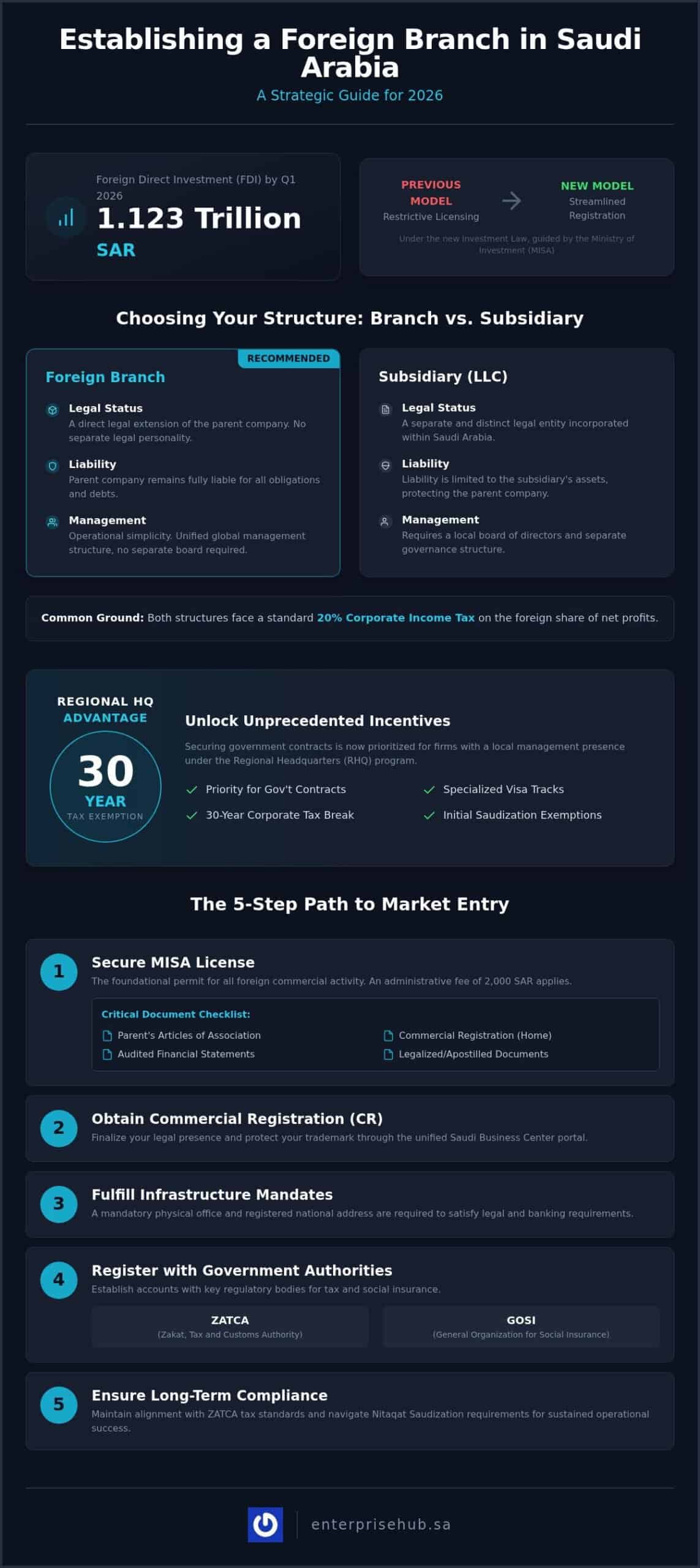
With foreign direct investment hitting 1.123 trillion SAR by the first quarter of 2026, Saudi Arabia isn’t just growing; it’s rewriting the rules of global commerce. This 12% increase reflects a market that rewards those who move quickly and correctly. Understanding the current شروط فتح فرع شركة أجنبية في السعودية is the first step to becoming part of this historic economic shift under the Kingdom’s updated Investment Law.
You probably feel the weight of the shift toward a unified registration model or the pressure of the updated April 2026 Nitaqat requirements. It’s common to feel uncertain about physical office mandates or the strict deadlines for ZATCA and social insurance compliance. We recognize these challenges and aim to provide the strategic clarity you need to navigate the bureaucratic landscape with absolute confidence and precision.
This guide empowers you to master the legal, financial, and operational mandates of the Kingdom for the 2026 calendar year. We’ll walk you through a comprehensive document checklist, the streamlined MISA registration process, and the infrastructure solutions that satisfy regulatory auditors. You’ll gain everything necessary to establish a compliant, high-performing branch that stands the test of time in a competitive market.
Key Takeaways
- Identify the strategic differences between a foreign branch and a subsidiary to select the optimal legal structure for your Kingdom-wide expansion.
- Master the updated شروط فتح فرع شركة أجنبية في السعودية for 2026, including sector-specific capital requirements and the shift toward a streamlined registration model.
- Follow a precise, step-by-step roadmap for securing your Commercial Registration and protecting your brand’s trademark through the Saudi Business Center.
- Recognize the mandatory physical office requirements and learn how strategic workspace solutions fulfill essential legal and banking mandates.
- Ensure long-term operational success by aligning with ZATCA tax standards and navigating the complex landscape of government service compliance.
The Evolution of Foreign Investment Models in Saudi Arabia
Saudi Arabia’s business environment reached a pivotal turning point with the full implementation of the 2025 Investment Law. This landmark legislation shifted the Kingdom from a restrictive licensing system to a streamlined registration model. The change has simplified how international entities enter the market, putting them on a more equal footing with local companies. For many global leaders, mastering the current شروط فتح فرع شركة أجنبية في السعودية is no longer just a legal hurdle; it’s a strategic necessity for regional growth.
Under the guidance of Saudi Arabia’s Ministry of Investment (MISA), the registration process is now almost entirely digital. This efficiency supports the Kingdom’s goal of increasing Foreign Direct Investment (FDI) stock, which reached 1.123 trillion SAR by early 2026. Choosing between a branch and a subsidiary depends on your long-term operational goals and how you intend to manage liability within the Saudi market.
Branch vs. Subsidiary: A Strategic Comparison
A foreign branch operates as a direct legal extension of the parent company. It doesn’t possess a separate legal personality. This means the parent company remains fully liable for the branch’s obligations in the Kingdom. While this requires a high level of parental responsibility, it also offers significant operational simplicity. You won’t need to form a separate board of directors, and you can maintain a unified global management structure.
Taxation is a critical factor in this comparison. Both models face a standard 20% corporate income tax on the foreign share of net profits. However, the branch model often simplifies profit repatriation, provided all ZATCA and GOSI compliance mandates are met. Service-sector firms and specialized contractors often prefer the branch model because it allows them to leverage the parent company’s global track record and financial history when bidding for massive infrastructure projects.
The Impact of the Regional Headquarters (RHQ) Mandate
The Regional Headquarters (RHQ) program has fundamentally changed how large enterprises approach the شروط فتح فرع شركة أجنبية في السعودية. To encourage companies to move their core management functions to the Kingdom, the government offers a 30-year exemption from corporate income tax for qualifying RHQ activities. This mandate is especially relevant for firms looking to secure government contracts, as state entities now prioritize companies with a significant local management presence.
Aligning your branch registration with the RHQ program can unlock unprecedented incentives. These include specialized visa tracks and exemptions from certain Saudization quotas during the initial setup phase. You can explore how these shifts fit into the broader national strategy in our detailed guide on Invest in Saudi Arabia 2026. By moving strategic decision-making to the Kingdom, your business becomes a partner in the national transformation rather than just a participant in the market.
Core Legal and Financial Requirements for a MISA License
The MISA license serves as the foundational permit for all foreign commercial activity within the Kingdom. Since the introduction of the new Investment Law in February 2025, the process has transitioned toward a unified registration model. This shift streamlines entry, but the شروط فتح فرع شركة أجنبية في السعودية remain rigorous to ensure only viable entities enter the local economy. As of August 2026, the administrative fee for license issuance is 2,000 SAR, while the annual service fee remains waived for most general licenses, providing a significant cost advantage for early-stage expansion.
Document Checklist for Foreign Branch Applicants
Accuracy is non-negotiable. To secure approval, you must submit a comprehensive dossier that proves the parent company’s legal standing and financial health. This includes certified copies of the parent company’s Articles of Association and a valid Commercial Registration (CR) from your home country. You’ll also need audited financial statements for the previous fiscal year to demonstrate solvency. A critical step often overlooked by competitors is the authentication process; all documents must be legalized at the Saudi Embassy in your home country or through an Apostille if applicable. If you find the documentation phase overwhelming, you can consult with our setup experts to ensure every file meets the latest regulatory standards.
- Board resolution approving the branch establishment in Saudi Arabia.
- Appointment of a General Manager with a notarized Power of Attorney (POA).
- Valid passport copies for the proposed branch manager.
Sector-Specific Licensing Considerations
The شروط فتح فرع شركة أجنبية في السعودية vary depending on your industry. While service-sector branches enjoy a relatively straightforward path, industrial and professional sectors like engineering or consulting require additional approvals. For instance, engineering firms must often gain clearance from the Saudi Council of Engineers. MISA currently targets a digital approval timeline of three to five business days, provided all professional certifications are pre-verified. Industrial licenses often require a minimum capital of 1 million SAR and a detailed plan for local manufacturing or value-add activities.
Financial Solvency and Capital Proof
While the 2025 law emphasizes registration over licensing, proving financial stability is still vital for banking and operational credibility. For a standard branch of a foreign company, an allocated capital of 500,000 SAR is typically expected. However, specific sectors require much higher thresholds; for example, 100% foreign-owned retail and wholesale entities must demonstrate 30 million SAR in capital. You can track these shifting requirements and explore sector-specific incentives through the official Invest Saudi platform. Securing a local bank account is the final hurdle in this phase, often requiring a physical office lease to be finalized before the account becomes fully operational.
The Step-by-Step Commercial Registration (CR) Process
Securing your MISA license is a major milestone, but it doesn’t grant you immediate permission to trade. You must now transition to the Ministry of Commerce (MC) to obtain your Commercial Registration (CR). This document acts as your branch’s official birth certificate in the Kingdom. During this phase, aligning with the شروط فتح فرع شركة أجنبية في السعودية ensures that your branch name adheres to strict naming conventions. Usually, a branch must carry the exact name of its parent company, often followed by “Branch of a Foreign Company” to maintain transparency in the local market.
You can initiate this process through the Ministry of Investment (MISA) portal, which integrates directly with the Saudi Business Center. This digital ecosystem simplifies the interaction between different government bodies. It’s during this step that you’ll also secure your Unified National Number. This number is a critical identifier for all future government and banking transactions, serving as the link between your license and your operational activities.
Finalising the Commercial Registration
The transition to the Ministry of Commerce requires the payment of specific administrative fees. As of April 2026, the annual CR fee is approximately 1,200 SAR. Additionally, you must register with the Chamber of Commerce. These fees range from 2,000 to 10,000 SAR, depending on your company’s capital and classification. This registration isn’t just a formality; it provides the necessary certification to authenticate documents for export, visas, and other essential business activities.
Post-Registration Regulatory Compliance
Once your CR is issued, your focus must shift to immediate operational compliance. Registering with the National Address system is mandatory. This requires a verified physical lease agreement. For many international firms, virtual office packages serve as a strategic starting point for initial registration steps, though a tangible workspace is ultimately required for full banking privileges. Opening a local corporate bank account is a sequential step that demands your new CR and proof of a physical address.
Compliance also extends to your workforce and tax obligations. You must enroll in the General Organization for Social Insurance (GOSI) and the Zakat, Tax and Customs Authority (ZATCA). Under the new Nitaqat phase that began on April 26, 2026, you’ll need to meet specific Saudization percentages for your sector. Remember that a Saudi employee must earn at least 4,000 SAR per month to count as a full unit in your quota. Managing these شروط فتح فرع شركة أجنبية في السعودية correctly from day one prevents costly delays and ensures your branch remains in good standing with all regulatory bodies.
Infrastructure Mandates: Meeting Physical Office and Address Standards
A physical presence is a non-negotiable legal requirement for full operational status. It’s the bridge between your MISA license and your Commercial Registration. Without a verified physical address, you can’t open a corporate bank account or pass GOSI inspections. The شروط فتح فرع شركة أجنبية في السعودية specify that this address must be registered in the National Address system and backed by a valid lease agreement. Regulatory bodies use this address to monitor compliance. For instance, the General Organization for Social Insurance (GOSI) may conduct field visits to verify that employees are working from the registered location. This link to physical infrastructure is why choosing the right workspace is a strategic decision rather than a simple administrative task.
An “approved” address must be located within a commercial-zoned building and clearly identifiable by local authorities. MISA and the Ministry of Commerce review lease validity during the annual renewal process. A mismatch between your registered address and your actual location can lead to fines or the suspension of your CR. We help you avoid these pitfalls by providing workspaces that are pre-approved for all government registrations, ensuring your branch remains in good standing from day one.
Choosing Between Private Offices and Coworking
For long-term compliance and professional standing, private offices remain the industry standard. They provide the privacy and dedicated space required for sensitive operations and meet all criteria for “approved” business addresses. If you’re in the early stages of market testing, flexi-desks offer a cost-effective alternative. These spaces provide high-speed internet, meeting facilities, and IT support while maintaining a professional image. We ensure all our office solutions are fully equipped to meet the technical and legal mandates of the Kingdom. This flexibility allows you to scale your physical footprint as your team grows without the burden of traditional long-term leases.
Virtual Offices as a Strategic Entry Point
Many international firms utilize virtual office packages as an initial entry point. This allows you to secure your MISA registration and manage administrative tasks before committing to a full-scale physical setup. However, it’s vital to understand the limitations. While a virtual address facilitates the first steps of registration, specific visa applications and the finalization of corporate bank accounts typically require a transition to a physical presence. This transition is a natural part of the scaling process as your operational needs increase and you begin to hire local talent.
If you’re ready to secure a compliant address that satisfies all regulatory auditors, contact us to explore our premium workspace options today.
Accelerating Market Entry with Strategic Business Support
Navigating the final operational phase of the شروط فتح فرع شركة أجنبية في السعودية requires more than just legal knowledge; it demands localized agility. A strategic partner acts as your guide through the “Government Services” maze, ensuring your branch moves from registration to revenue without unnecessary delays. By outsourcing accounting and tax compliance, you maintain a lean operation while staying perfectly aligned with ZATCA’s 15% VAT and 20% corporate tax mandates. Professional setup services don’t just handle paperwork. They provide the institutional wisdom needed to thrive in a market that reached 32.6 billion USD in net FDI inflows during 2025.
Accuracy saves time. By integrating your branch into the local ecosystem through professional support, you reduce your time-to-market and avoid the common pitfalls of DIY registration. You won’t regret the investment in expert guidance when your branch is fully operational weeks ahead of schedule.
Managing Local Administrative Burdens
The digital transformation of Saudi business means your compliance is now tracked in real-time. You must master the Muqeem portal for resident management and the Qiwa platform for employment contracts. As of April 15, 2026, only electronically documented contracts on Qiwa count toward your Saudization ratios. Regular filing for Zakat and VAT is essential to avoid penalties that can impact your branch’s credit rating. For firms still in the planning phase, our guide on Virtual Offices in Saudi Arabia provides a roadmap for establishing a digital footprint before scaling to a physical site.
Engaging local stakeholders also requires a physical touchpoint that reflects your brand’s prestige. Utilizing premium meeting rooms for board presentations or government liaison meetings builds the trust necessary for long-term growth. These facilities provide high-spec technology and support, allowing you to focus on strategy while we handle the infrastructure. Trust is the currency of the Kingdom.
Your Next Steps: From Planning to Launch
A successful launch starts with a robust feasibility study and a deep dive into the 2026 Nitaqat quotas for your specific profession. Once your market analysis is complete, your priority should be securing a compliant workspace that satisfies both your team’s needs and MISA’s strict address mandates. Follow this checklist to stay on track:
- Review sector-specific capital requirements for the 2026 fiscal year.
- Finalize your document authentication through the Saudi Embassy in your home country.
- Select an office solution that offers integrated government service support.
- Consult with a setup expert to initiate the MISA application process.
Establishing a foreign branch is a journey toward mutual prosperity. By following the latest شروط فتح فرع شركة أجنبية في السعودية and leveraging professional support, you position your business as a key player in the Kingdom’s economic transformation. A compliant, high-spec setup is more than a legal requirement; it’s your competitive advantage in the region’s most dynamic economy.
Building Your Legacy in the Kingdom’s New Economic Era
Saudi Arabia’s 2026 landscape offers unprecedented opportunities for global firms ready to align with the Kingdom’s strategic vision. Mastering the updated شروط فتح فرع شركة أجنبية في السعودية is your first step toward securing a foothold in a market that reached 1.123 trillion SAR in FDI stock by early 2026. Success relies on more than just paperwork; it requires a physical address that satisfies MISA auditors and a digital strategy that keeps you compliant with Qiwa and ZATCA standards from day one.
Success in the Kingdom isn’t a solo journey. It’s a partnership between your vision and the right local infrastructure. As an approved workspace provider for foreign entities, we offer end-to-end government service support and flexible office solutions for every growth stage. We remove the bureaucratic friction, allowing you to focus on your core business objectives while we handle the operational mandates.
Start your compliant Saudi expansion with Enterprise Hub setup services and turn your ambitious growth targets into a localized reality. The Kingdom’s future is being built today, and we’re here to ensure your business is part of it.
Frequently Asked Questions
Can a foreign company own 100% of its branch in Saudi Arabia?
A foreign company can maintain 100% ownership of its branch in the Kingdom. Unlike other legal structures that might require local partners, the branch model operates as a direct extension of the parent entity. This allows for full control over operations and strategic direction. You must ensure you meet the specific شروط فتح فرع شركة أجنبية في السعودية regarding capital and sector-specific licensing to qualify for this status while maintaining compliance with all local laws.
What is the minimum capital required to open a foreign branch?
For most foreign company branches, an allocated capital of 500,000 SAR is typically required. These requirements vary by sector. Wholesale and retail trade entities with 100% foreign ownership must demonstrate 30 million SAR. It’s vital to check the latest 2026 mandates for your specific industry to ensure your financial statements align with MISA expectations. This financial proof is a core part of the شروط فتح فرع شركة أجنبية في السعودية that you must satisfy before launch.
How long does the entire process of opening a branch take in 2026?
The timeline for establishing a branch has improved with the digital transformation of government services. Obtaining a MISA investment registration typically takes three to five business days. The subsequent steps, including Commercial Registration and ZATCA enrollment, usually extend the total timeline to three to six weeks. Factors like document authentication and local bank account opening can influence the final speed. We help you navigate these steps to ensure the fastest possible market entry.
Is a physical office mandatory for obtaining a MISA license?
A verified physical address is mandatory for obtaining your final Commercial Registration. While you can use a virtual office for the initial MISA registration steps, a tangible workspace is required for banking and GOSI compliance. We offer private offices that meet all regulatory standards for foreign entities. This infrastructure ensures your branch satisfies the legal شروط فتح فرع شركة أجنبية في السعودية while providing an environment that supports your team’s productivity and growth.
What are the main differences between a branch and a representative office?
The primary difference lies in the ability to generate revenue. A foreign branch is a commercial entity permitted to execute contracts, issue invoices, and generate profits within the Kingdom. In contrast, a representative office is restricted to non-commercial activities such as market research and technical support for the parent company. If your goal is to trade and expand your market share directly, the branch model is the necessary legal structure for your operational and commercial success.
Can I change my branch manager after registration?
You can change your branch manager at any time after the initial registration. This process requires a formal board resolution from the parent company and an updated Power of Attorney for the new representative. You must update these details through the MISA and Ministry of Commerce portals to ensure your Commercial Registration remains accurate. Keeping these records current is vital for maintaining valid signing authorities for banking, government transactions, and ongoing operational compliance in the Kingdom.
What are the tax obligations for a foreign branch in the Kingdom?
Foreign branches face a 20% corporate income tax on net adjusted profits. Most goods and services are subject to a 15% Value Added Tax. You must also comply with withholding tax requirements on payments to non-resident entities, which range from 5% to 20%. Our accounting and tax services help you navigate these ZATCA requirements. This ensures your branch avoids penalties while maintaining high standards of financial transparency and compliance within the Kingdom’s regulatory framework.
Does the RHQ program apply to all foreign branches?
The Regional Headquarters (RHQ) program is a specialized initiative for multinational companies moving their core management functions to the Kingdom. While any company can open a branch, only those meeting specific RHQ criteria access incentives like the 30-year corporate tax exemption. We assist large enterprises in evaluating whether their operations qualify for this program. This allows you to unlock strategic advantages and long-term fiscal benefits that align with the Kingdom’s national economic transformation goals.