
Did you know that while global tax averages often fluctuate, the 20% rate for foreign investors in the Kingdom has remained a stable pillar of growth for nearly two decades? Mastering corporate tax in Saudi Arabia is no longer just a checkbox for compliance; it’s a strategic move that separates market leaders from those who struggle to scale. As we approach 2026, the intersection of ZATCA regulations and MISA licensing demands a proactive approach to fiscal management. Success depends on your ability to align with the national vision while protecting your bottom line.
We understand that the dual Zakat and Corporate Income Tax system feels daunting, especially when the fear of non-compliance penalties looms over your expansion plans. You want to focus on growth, not get lost in the nuances of balance sheet calculations or withholding tax treaties. This guide provides the comprehensive breakdown you need to move forward with confidence. We’ll explore exactly how the 20% CIT applies to your foreign owned shares, the critical steps for ZATCA registration, and how your chosen business structure dictates your total tax liability. By the end of this article, you’ll have the clarity to turn tax compliance into a competitive edge for your Saudi operations.
Key Takeaways
- Understand how the 20% standard rate applies to foreign-owned shares to build a sustainable fiscal strategy for 2026.
- Distinguish between Zakat obligations and corporate tax requirements to ensure precision in mixed-ownership financial reporting.
- Identify the essential steps for ZATCA registration and e-invoicing to stay ahead of mandatory compliance for corporate tax in Saudi Arabia.
- Recognize the critical link between your Commercial Registration and your ability to fulfill national tax filing obligations.
- Explore how strategic office placement and professional accounting support protect your tax residency and long-term operational stability.
Understanding the Corporate Tax Landscape in Saudi Arabia
Saudi Arabia’s economic transformation under Vision 2030 has turned the Kingdom into a global hub for innovation and investment. As the market matures, the regulatory environment has become more sophisticated, making a deep understanding of corporate tax in Saudi Arabia essential for long-term success. Tax compliance isn’t just a legal obligation here; it’s a badge of credibility. It demonstrates to government bodies and local partners that your business is a transparent, committed participant in the nation’s growth. We’ve seen that companies prioritizing early alignment with these standards often find smoother paths to government contracts and strategic partnerships.
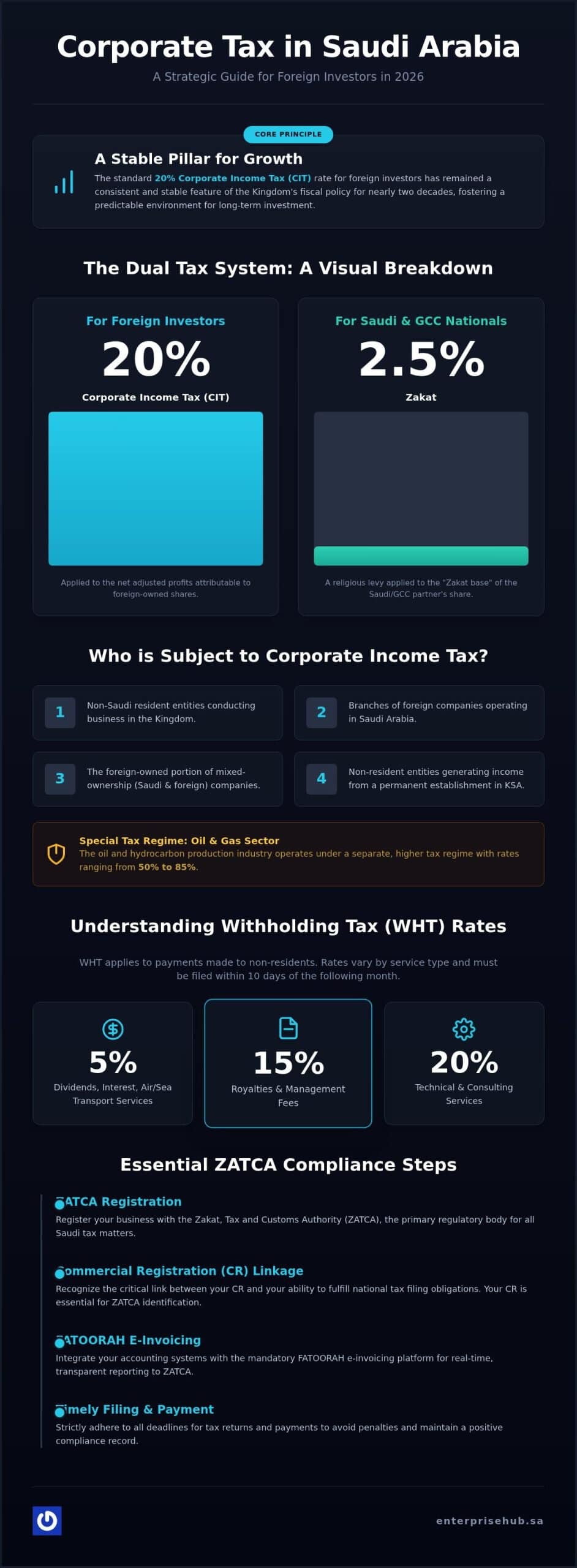
The Kingdom operates a unique dual tax system that distinguishes between the origins of capital. Foreign investors generally pay a 20% Corporate Income Tax (CIT) on their share of a company’s net adjusted profits. In contrast, Saudi and GCC nationals contribute Zakat, a 2.5% charge on their share of the Zakat base. If you’re operating a mixed-ownership entity, your tax liability is calculated proportionally based on the percentage of ownership held by each group. This structure ensures that the fiscal system remains equitable while remaining competitive with global averages.
The Scope of Corporate Income Tax
In 2026, the 20% CIT applies to several specific entity types. This includes non-Saudi entities carrying out business in the Kingdom, branches of foreign companies, and the foreign-owned portion of mixed-ownership Saudi companies. Non-resident entities must also pay tax if they generate income through a permanent establishment within Saudi borders. While the standard rate remains stable for most sectors, the oil and gas industry operates under a separate, higher tax regime. Rates for hydrocarbon production can range from 50% to 85% depending on the level of capital investment and the nature of the project. We recommend identifying your specific entity classification early to avoid miscalculating your projected liabilities.
Regulatory Bodies: Working with ZATCA
The Zakat, Tax and Customs Authority (ZATCA) is the primary regulatory body for all Saudi tax matters. Formed by merging the General Authority of Zakat and Tax with the General Authority of Customs, ZATCA has lead the charge in digitalizing the Kingdom’s fiscal infrastructure. This evolution has introduced the FATOORAH e-invoicing system, which is now mandatory for all taxpayers subject to VAT. Businesses must integrate their accounting systems with ZATCA’s platform to ensure real-time reporting and transparency. We assist our partners in navigating these digital requirements by providing compliant virtual office packages and professional accounting support that ensures every digital filing meets the latest regulatory standards.
Core Tax Rates and Mandatory Compliance in 2026
Achieving fiscal efficiency starts with a clear grasp of the primary numbers. The cornerstone of corporate tax in Saudi Arabia is the standard 20% rate applied to the net adjusted profits of foreign shareholders. While this figure is straightforward, the calculation of “adjusted profit” requires meticulous accounting to ensure all deductible expenses align with the official ZATCA income tax regulations. Beyond annual profits, companies involved in corporate restructuring must account for capital gains tax. This typically applies at the same 20% rate on the disposal of shares in a resident company, making early planning vital for mergers or acquisitions.
Withholding Tax (WHT) Requirements
Management fees and royalties often catch new investors off guard. These payments to non-residents are subject to WHT, and the rates vary significantly based on the service type:
- 5% for dividends, interest, and air or sea transport services.
- 15% for royalties and management fees.
- 20% for technical and consulting services.
Double taxation treaties are key for international firms. Saudi Arabia has established over 100 such treaties that can lower these rates for qualifying entities. Compliance is time-sensitive; you must file WHT returns and pay the due amount within the first 10 days of the month following the payment. Missing these windows leads to unnecessary financial friction that can easily be avoided with disciplined reporting cycles.
Value Added Tax (VAT) and Corporate Strategy
Managing VAT alongside corporate tax in Saudi Arabia requires a unified approach to data. The standard VAT rate remains at 15% for the 2026 fiscal year. This tax isn’t just a transactional cost; it’s a reporting requirement that integrates directly with your annual corporate tax returns. Businesses with annual taxable supplies exceeding SAR 375,000 must register with ZATCA. Voluntary registration is available for those crossing the SAR 187,500 mark. We recommend aligning your VAT reporting cycles with your broader corporate tax strategy to avoid reconciliation errors during audits. If you’re unsure how these rates apply to your specific entity, our team can help you assess your tax position before your first filing deadline.
Navigating the Dual System: Zakat vs. Corporate Income Tax
Success in the Kingdom requires a clear understanding of its dual-track fiscal framework. Unlike many global jurisdictions where a single rate applies to all residents, corporate tax in Saudi Arabia is determined by the nationality of your shareholders. This system blends modern fiscal policy with long-standing religious principles, creating a unique environment where Zakat and Corporate Income Tax (CIT) coexist. For the international investor, this means your tax liability isn’t just about what you earn, but who you partner with.
Zakat is a mandatory religious contribution that has been integrated into the national fiscal system. It’s calculated at a rate of 2.5% on the Zakat base, which represents the company’s net worth and available liquidity. In contrast, CIT is a profit-based tax set at 20% for foreign-owned shares. We often see investors assume that a Saudi partner automatically grants total tax exemption. This is a misconception. The presence of a foreign shareholder triggers CIT on their specific portion of the profits, while the Saudi or GCC partner remains liable for Zakat on their share of the base.
Determining Your Tax Identity
Your primary tax obligation is dictated entirely by the residency and nationality of your equity holders. GCC nationals, including Saudis, are subject to Zakat. All other nationalities, including those from non-GCC Arab countries, fall under the CIT regime. This distinction is vital when structuring your entry strategy. For example, a mixed-ownership entity with 60% Saudi ownership and 40% foreign ownership will calculate its liabilities separately. The 40% foreign share is taxed at the 20% CIT rate on its portion of the adjusted net profit. Meanwhile, the 60% Saudi share is assessed for Zakat based on its portion of the Zakat base. Managing these two distinct calculations requires precise accounting to ensure neither party is overcharged or faces penalties for misreporting.
The Concept of the Zakat Base
Understanding the Zakat base is essential for regional expansion and long-term financial health. While CIT focuses on the income statement, Zakat is primarily a balance sheet calculation. The base includes capital, retained earnings, reserves, and certain provisions, minus fixed assets and other specific deductions. This means a company could technically have a Zakat liability even in a year where it doesn’t show a significant profit. Long-term investments can often be deducted from the Zakat base, providing a strategic advantage for firms that reinvest their capital into the Saudi market. We help our clients navigate these complexities by ensuring their corporate structures and strategic business addresses support a clean, compliant tax record from day one.
A Step-by-Step Guide to ZATCA Registration and Filing
Registration with the Zakat, Tax and Customs Authority (ZATCA) is the most critical milestone after you’ve secured your legal presence. You can’t initiate tax filings without a valid Commercial Registration (CR). Once your CR is issued, the clock starts ticking. You generally have a 30-day window to register your business on the ZATCA portal. This step bridges the gap between your legal entity and your fiscal identity, ensuring you’re recognized by the state as a compliant taxpayer. Managing corporate tax in Saudi Arabia requires this early alignment to avoid the administrative friction that often stalls new ventures.
Annual filing is where precision becomes your greatest asset. Companies subject to Corporate Income Tax must submit their returns within 120 days of the end of their fiscal year. For most firms, this means a deadline in late April. These filings aren’t just simple forms; they must be supported by audited financial statements from a licensed Saudi auditor. Accuracy is paramount because ZATCA’s auditing capabilities have become incredibly sophisticated. In the 2026 landscape, penalties for late filing or inaccurate reporting can reach 1% of the unpaid tax for every 30 days of delay, which quickly erodes your operational margins.
The Registration Process for New Entities
International firms must provide a specific set of documents to complete their profile. This includes your MISA investment license, articles of association, and proof of a physical business address. We ensure that your business setup in Saudi Arabia follows these national compliance standards from day one. Linking your MISA license directly to your ZATCA profile streamlines future government services and ensures that your tax residency is clearly established. This integration is the foundation of a clean tax record.
E-Invoicing and Digital Compliance
By 2026, Phase 2 of the FATOORAH e-invoicing system, known as the Integration Phase, is the standard for all businesses. This requires your accounting software to connect directly with ZATCA’s platform via an API for real-time validation. It’s no longer enough to just issue digital PDFs. Your system must meet strict technical standards for cryptographic stamps and anti-tampering features. This digital shift significantly reduces the risk of manual audit errors and simplifies the reconciliation of your VAT and corporate tax data. If you’re ready to secure your standing in the Kingdom, we can help you manage your ZATCA registration and ongoing compliance today.
Strategic Business Structuring for Long-Term Tax Efficiency
Long-term success depends on a foundation that satisfies both commercial and regulatory requirements. Strategic structuring involves more than picking an entity type; it requires establishing a physical presence that validates your tax residency. In the eyes of the Saudi authorities, a business must demonstrate substance to benefit from local tax treaties and avoid being classified as a shell entity. This physical foundation is the first step toward optimizing your corporate tax in Saudi Arabia. We’ve seen that investors who integrate their workspace strategy with their fiscal planning achieve much higher stability during their first three years of operation.
Establishing Tax Residency through Physical Presence
A registered business address is a non-negotiable prerequisite for both MISA and ZATCA compliance. This address serves as your official point of contact for all tax-related correspondence and audits. For many international firms, virtual office packages provide a cost-effective entry point. They allow you to secure a Commercial Registration without the overhead of a full-scale facility. However, as your operations grow, transitioning to private offices may become necessary to meet the specific substance requirements of your license. These physical spaces ensure that your management and control are exercised within the Kingdom. This is a critical factor in international tax planning and helps you avoid double taxation issues.
Leveraging Support Services for Compliance
Maintaining a clean tax record requires a proactive approach to accounting and governance. Integrated accounting services help you track deductible expenses and manage the monthly filing requirements effectively. Beyond the books, corporate governance plays a vital role in tax efficiency. Utilizing professional meeting rooms for board meetings and strategic reviews provides a documented audit trail of local decision-making. This evidence is invaluable during ZATCA reviews to prove that your entity is a genuine, active participant in the Saudi economy. It shows you aren’t just a name on a paper.
To ensure a tax-efficient launch, follow this final checklist:
- Secure a compliant business address that meets MISA requirements.
- Link your accounting software to the ZATCA e-invoicing platform.
- Establish a regular audit schedule with a licensed local partner.
- Maintain a clear record of all cross-border payments and applicable treaties.
We position ourselves as your strategic partner, providing the infrastructure and the professional support needed to thrive. By combining premium workspaces with expert tax and accounting guidance, we help you turn the complexity of corporate tax in Saudi Arabia into a manageable part of your growth story. Your success is our shared mission.
Mastering Your Fiscal Strategy for 2026 and Beyond
Success in the Kingdom’s evolving economy requires more than just market entry; it’s about a sophisticated approach to regulatory alignment. You’ve seen how the 20% rate for foreign investors and the 2.5% Zakat base calculation form the backbone of the dual system. Navigating corporate tax in Saudi Arabia successfully means embracing ZATCA’s digital transformation, from mandatory e-invoicing to precise annual filings. By establishing a physical presence that meets MISA’s substance requirements, you protect your tax residency and build long-term credibility with national authorities.
You don’t have to manage these complexities alone. We provide the strategic infrastructure you need to thrive, offering MISA-compliant business addresses and fully equipped professional workspaces that support your operational growth. Our team delivers expert accounting and tax support to ensure every filing is accurate and timely. Explore our business setup and workspace solutions at Enterprise Hub to streamline your expansion. Together, we can turn regulatory requirements into a clear path for sustainable prosperity in the Saudi market. Your vision for growth deserves a partner committed to your success.
Frequently Asked Questions
What is the corporate tax rate in Saudi Arabia for foreign companies in 2026?
The standard rate of corporate tax in Saudi Arabia for foreign companies is 20% of their net adjusted profits. This rate applies to the foreign owned share of mixed companies or the full profits of wholly foreign owned entities. It’s one of the most stable tax rates in the region, having remained consistent since 2006. Businesses must ensure their accounting practices align with ZATCA regulations to calculate these profits accurately and avoid compliance risks.
Is there a personal income tax for employees in Saudi Arabia?
No, there’s currently no personal income tax for individuals or employees in Saudi Arabia. This applies to both Saudi nationals and expatriate workers. While businesses must manage corporate tax in Saudi Arabia and social insurance contributions through GOSI, employees take home their full gross salary. This lack of personal taxation is a major strategic advantage for companies looking to attract top tier international talent to support their Kingdom based operations.
How does Zakat differ from Corporate Income Tax?
Zakat and Corporate Income Tax differ primarily in their calculation base and target audience. Corporate Income Tax is a 20% charge on the net profits of foreign shareholders. Zakat is a 2.5% religious obligation calculated on the Zakat base, which includes the net worth and capital of Saudi or GCC shareholders. Mixed companies calculate their liabilities proportionally. Understanding this dual system is essential for structuring partnerships that remain fiscally efficient for all parties involved.
What are the penalties for late corporate tax filing with ZATCA?
Penalties for late corporate tax filing with ZATCA are strictly enforced to ensure market transparency. If you miss the 120 day filing window after your fiscal year ends, you’ll face a fine of 1% of the unpaid tax for every 30 days of delay. Additionally, fines for inaccurate reporting can range from 5% to 25% of the tax difference. We recommend maintaining rigorous digital records to ensure your filings are both timely and precise.
Do foreign companies need a local auditor for their tax returns?
Yes, all foreign companies and mixed entities must have their annual tax returns certified by a licensed local auditor. ZATCA requires audited financial statements to verify the accuracy of the reported net adjusted profits. This requirement ensures that your business follows national accounting standards and maintains the high level of transparency expected in the Saudi market. Partnering with a professional firm helps you manage this process while securing your corporate standing.
Can a virtual office be used for tax registration in Saudi Arabia?
Yes, you can use a virtual office to obtain the registered address required for ZATCA and MISA registration. This is an excellent solution for businesses during their initial market entry phase. A virtual office provides a compliant legal address without the immediate cost of a full physical facility. As your operations scale, you can transition to more permanent workspaces to meet the increasing substance requirements often associated with larger government contracts or specific licenses.
What is the Withholding Tax rate for technical services paid to non-residents?
The Withholding Tax rate for technical and consulting services paid to non-residents is 20%. This is the highest rate in the Kingdom and applies to cross border payments for specialized expertise. Other services, like management fees, typically attract a 15% rate, while dividends and interest are taxed at 5%. It’s vital to check for applicable double taxation treaties, as these can often reduce the effective rate for international service providers.
Are there tax incentives for companies participating in Vision 2030 projects?
Saudi Arabia offers significant tax incentives for companies aligning with Vision 2030, particularly those establishing Regional Headquarters (RHQ). Qualifying RHQs can benefit from a 30 year corporate income tax exemption on their qualifying activities. Additionally, companies operating within designated Special Economic Zones may access customs duty deferrals and specific tax reliefs. These incentives are designed to reward long term investment and encourage global firms to make the Kingdom their primary regional hub.