
Saudi Arabia is experiencing an unprecedented entrepreneurial surge, with a dynamic startup ecosystem flourishing nationwide. While this growth is exciting, it brings a complex web of regulatory requirements that can’t be ignored. Many founders find themselves caught between the drive to scale and the fear of massive fines for ZATCA non-compliance. Securing professional accounting services for startups across the Kingdom is no longer a luxury; it’s a critical safety net for your business’s future.
You likely started your venture to innovate, not to get lost in the nuances of the 20% corporate tax environment or the latest SOCPA amendments. At Enterprise Hub, we recognize that disconnected financial reporting often leads to frustration and missed milestones. This guide will show you how to partner with a strategic accounting office that ensures total ZATCA compliance while fueling your business growth across the Kingdom. We’ll preview the path to 100% e-invoicing accuracy and investor-ready data within a seamless support ecosystem. Let’s explore how to transform your financial management into a strategic advantage that aligns with the nation’s ambitious Vision 2030 goals.
Key Takeaways
- Understand the shift from traditional bookkeeping to real-time financial intelligence to stay competitive in the 2026 national economic landscape.
- Master the technical integration requirements for ZATCA Phase 2 E-invoicing and navigate the latest 2026 Corporate Tax regulations with confidence.
- Evaluate the cost-benefit ratio of different provider models to select the most effective accounting services for startups in Riyadh for your specific growth stage.
- Identify the essential verification steps for SOCPA and ZATCA licensing to ensure your partner possesses the necessary authority to represent your interests.
- Discover the operational efficiency of merging premium workspace management with strategic financial support within a single, integrated business hub.
Evolution of Riyadh Startup Accounting Services 2026
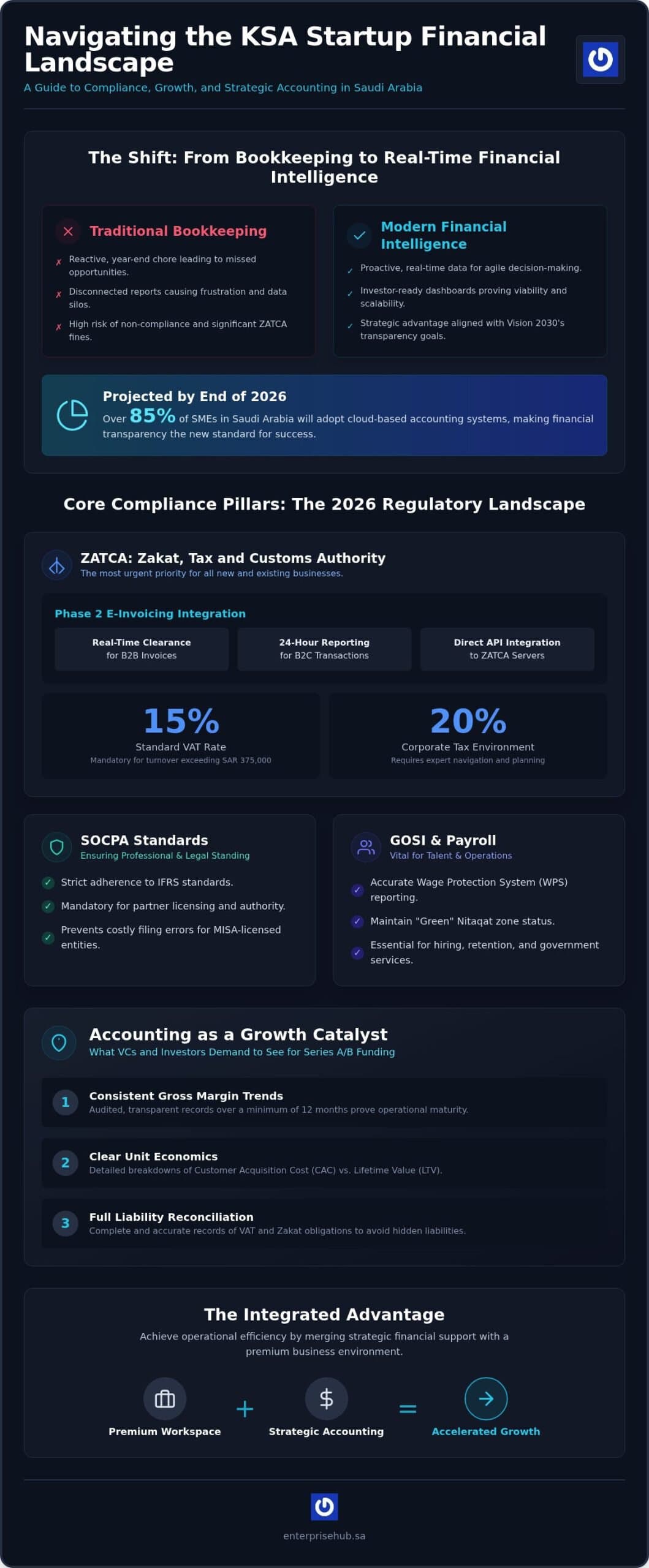
The days of treating financial records as a year-end chore are over. For modern founders, accounting services for startups in Riyadh have evolved into a sophisticated engine for real-time financial intelligence. This shift is driven by a 2026 economic environment that demands agility. While Saudi startups raised $1.72 billion in 2025, the 2026 market correction has made investors far more selective. They don’t just want to see your product. They want to see your margins, burn rate, and tax health reflected in accurate, live dashboards.
Achieving the goals of Vision 2030 requires a level of transparency that traditional methods can’t provide. Proactive financial planning is now a prerequisite for any business looking to integrate with the broader Economy of Saudi Arabia. By adopting cloud-based systems, which are projected to be used by over 85% of SMEs by the end of 2026, you build immediate trust with local banks and venture capitalists. Financial transparency isn’t just about following rules; it’s about proving your startup’s viability in a competitive national market.
Why National Market Expertise is Non-Negotiable
Operating in the Kingdom involves navigating a specific set of nuances within the Saudi commercial code. MISA-licensed entities, in particular, face rigorous reporting standards that differ from local commercial registrations. A partner who understands these differences prevents costly filing errors. You need an expert who speaks the technical language of local regulators and understands the cultural context of Saudi business. This expertise ensures your financial statements are not just accurate, but also compliant with the latest SOCPA standards implemented in January 2026. Without this local lens, global accounting templates often fail to capture specific Zakat or Saudi labor law requirements.
Accounting as a Growth Enabler
Accurate financial data acts as a catalyst for expansion. When you prepare for Series A or B funding rounds, having audited, transparent records is your strongest negotiation tool. It proves your scalability and operational maturity. VCs specifically look for:
- Consistent gross margin trends over a minimum of 12 months.
- Clear breakdowns of customer acquisition costs versus lifetime value.
- Full reconciliation of VAT and Zakat obligations to avoid hidden liabilities.
Beyond funding, precise bookkeeping accelerates your interactions with the state. Whether you’re applying for GOSI certifications or renewing your commercial registration, organized data removes the friction from government service applications. To streamline your operations further, Explore our business support services and see how integrated solutions empower your journey.
Core Compliance Standards: ZATCA, SOCPA, and the 2026 Regulatory Landscape
Mastering the technical requirements of ZATCA Phase 2, also known as the Integration Phase, is the most urgent priority for new businesses. It’s no longer enough to simply issue a digital invoice. Your systems must now facilitate real-time clearance of B2B invoices and report B2C transactions within 24 hours. Professional accounting services for startups in Riyadh ensure your financial software communicates directly with the Zakat, Tax and Customs Authority (ZATCA) servers. This level of technical integration prevents the manual entry errors that often trigger audits or significant fines.
Beyond tax technology, the January 2026 SOCPA amendments have fundamentally changed how professional services are regulated. The Saudi Organization for Chartered and Professional Accountants now holds direct authority over professional licensing. This means your financial statements must adhere strictly to IFRS standards as endorsed by SOCPA to maintain legal standing. For startups aiming for longevity, managing GOSI and payroll compliance for a national workforce is equally vital. Accurate wage protection system (WPS) reporting ensures you remain in the “Green” Nitaqat zone, which is essential for hiring and retaining talent.
Zakat and Tax Excellence
Mitigating risk starts with automated, compliant VAT filing at the standard 15% rate. Startups must be diligent once their taxable turnover exceeds the SAR 375,000 threshold. Strategic tax planning is particularly complex for entities with mixed Saudi and foreign ownership, as it involves balancing Zakat and Corporate Tax obligations. Fortunately, the ZATCA penalty waiver initiative has been extended until December 31, 2026. This provides a critical window to correct past filing errors without facing late payment or registration penalties. If you’re unsure about your current standing, it’s wise to consult with a compliance expert to secure your position before this grace period ends.
Regulatory Reporting and Auditing
Annual renewals of commercial registrations now require SOCPA-certified financial statements that reflect total transparency. The Ministry of Commerce uses these reports to verify that startups are operating within the bounds of their specific license categories. This is especially true for MISA-licensed firms that must demonstrate clear capital flows and profit reporting. For startups with foreign investment, the corporate income tax rate is 20% on net adjusted profits. Maintaining organized digital archives isn’t just a recommendation; it’s a legal requirement that protects your startup during routine regulatory reviews. Precise auditing today builds the foundation for your enterprise’s reputation in the national financial heartland.
Comparing Accounting Providers: Finding the Right Fit for Your Startup’s Scale
Choosing the right accounting services for startups in Riyadh involves more than just comparing fee structures. You’re looking for a partner that matches your current scale while possessing the capacity to support your journey from seed funding to a potential IPO. Within the thriving startup ecosystem of the Kingdom, the options generally fall into three categories: global “Big 4” firms, specialist boutique agencies, and integrated business hubs. While global firms offer undeniable prestige, their high costs and standardized processes often lack the agility that a fast-moving tech venture requires.
Industry-specific expertise is the next critical filter. A fintech startup, for instance, requires a partner who understands the specific SAMA regulatory sandboxes and complex capital requirements. Similarly, a service-sector business needs streamlined VAT management for high transaction volumes. For international founders, bilingual support is a non-negotiable requirement. You need a team that can explain the nuances of Saudi commercial law in English while managing filings in Arabic with local authorities. This ensures no meaning is lost in translation during critical board meetings or investor due diligence.
When to Choose a Specialist Boutique Firm
Boutique firms excel at providing personalized attention and agile response times. They often act as an extension of your own team, offering deeper niche regulatory knowledge that generic providers might miss. Their fee structures are typically more accessible for early-stage companies. For example, professional VAT filing services for SMEs often range from SAR 2,000 to SAR 5,000 per quarter. These firms understand that a startup’s needs can change overnight, and they’re usually more willing to adapt their workflows to your specific software stack or reporting schedule.
The Rise of the Integrated Business Hub
The most significant trend in 2026 is the shift toward integrated business hubs. These centers bundle accounting services with workspace management, drastically reducing administrative friction. Instead of managing separate contracts for your office, your taxes, and your government relations, you benefit from a single point of contact. This holistic approach ensures that your financial reporting is always in sync with your physical operations. It’s an efficient model for founders who want to focus on product development rather than chasing different vendors. To see how this integration works in practice, Discover our premium private office solutions and explore how we merge high-end facilities with strategic financial support.
Selection Framework: Essential Questions for Evaluating Accounting Partners
Selecting accounting services for startups in Riyadh requires a rigorous vetting process that goes beyond a simple price comparison. You must verify that the firm holds active SOCPA and ZATCA licenses. This isn’t just a formality; it’s your protection against regulatory liability in a market where compliance is strictly enforced. Ask specifically about their experience with your MISA license category. International entities have distinct reporting requirements that local-only firms might struggle to meet. A partner who understands the nuances of foreign investment regulations will save you from costly restructuring later.
Modern startups need modern tools. Inquire about their technology stack and whether they support modern, cloud-based ERPs. With the Saudi accounting software market expected to grow at a CAGR of 11.2% through 2026, your partner should be at the forefront of this digital transformation. If they don’t support real-time integration, they’ll quickly become a bottleneck for your growth. Clear communication protocols are equally vital. You should expect a defined monthly reporting cycle that provides strategic insights rather than just basic data entries. Ask how they handle urgent queries and what their typical response time is during the busy tax season.
Technical and Regulatory Due Diligence
Start by confirming the firm’s track record with complex ZATCA Phase 2 E-invoicing integrations. This phase requires a seamless technical handshake between your billing system and the authority’s servers. Ask how they managed this transition for other clients and what fail-safes they have in place. Review their approach to the latest Saudi Corporate Tax implementation, specifically for foreign investors who face a 20% rate on net adjusted profits. A competent partner will provide case studies of startups they’ve helped scale nationally. These real-world examples prove they can handle the pressure of rapid expansion while keeping your financial house in order.
Operational Alignment
Does the firm truly understand the fast-paced nature of the national financial district? Startups move at a different speed than traditional enterprises. You need a partner who provides proactive rather than reactive advice. Reactive accounting is a recipe for missed opportunities and potential fines. They should help you Learn more about investing in the Kingdom by identifying tax incentives or structural efficiencies that align with your long-term goals. If you’re ready to secure a partner that matches your ambition, reach out to our expert team today for a tailored compliance consultation.
Enterprise Hub: Integrating Premium Workspace with Strategic Accounting Support
Successful market entry requires a foundation that is both physically prestigious and regulatory sound. Enterprise Hub redefines the traditional service model by merging world-class facilities with deep technical expertise. We understand that accounting services for startups in Riyadh shouldn’t exist in a vacuum. By housing your financial oversight within the same ecosystem as your physical operations, we eliminate the communication gaps that often lead to compliance errors. This integrated approach provides a “single source of truth” for your business, ensuring that your office management, government relations, and tax filings are perfectly synchronized.
Ambitious brands choose an integrated partner because they recognize the value of speed and accuracy. Located in the heart of the national financial district, our hub places you in the center of the Kingdom’s economic transformation. You aren’t just renting a desk; you’re gaining a strategic ally that handles the heavy lifting of Zakat, Tax, and Customs Authority (ZATCA) requirements. This holistic ecosystem allows founders to redirect their energy toward scaling their product while we maintain the integrity of their financial reporting and corporate standing.
A Seamless Path to Market Success
Innovation thrives when it isn’t bogged down by administrative friction. We empower you to focus on your core product while our bilingual team manages the intricate ZATCA and SOCPA details. Utilizing a prestigious business address in a prime financial district instantly boosts your credibility with both investors and local clients. This isn’t just about optics; it’s about demonstrating a long-term commitment to the Saudi market. Along with this, you gain direct access to a network of legal and government service experts who can navigate the complexities of MISA regulations and company formation on your behalf.
Scalable Solutions for Modern Enterprises
Your business needs in 2026 won’t be the same as they are today. We provide flexible packages that adapt as your financial and physical requirements evolve. Whether you’re a lean team needing a virtual presence or a growing enterprise requiring a full-floor private office, our support scales with you. It’s a significant benefit to have a partner who understands both local commercial laws and global business standards. This dual perspective ensures your startup remains compliant at home while staying ready for international expansion or investment. To find the right fit for your current stage, View our virtual office and setup packages and take the first step toward a more streamlined business operation.
Securing Your Vision in the Kingdom’s Financial Heartland
Securing your startup’s future in 2026 requires more than just meeting basic tax deadlines. It’s about transforming compliance into a strategic asset that attracts investors and satisfies the rigorous standards of the Zakat, Tax and Customs Authority. By prioritizing 100% ZATCA Phase 2 e-invoicing accuracy and SOCPA-certified reporting, you build a foundation of trust that is essential for scaling across the national market. This proactive approach ensures your venture remains agile and ready for the next funding round or expansion phase.
Choosing the right accounting services for startups in Riyadh is a decision that impacts every facet of your growth, from your operational burn rate to your broader market reputation. Enterprise Hub offers a holistic ecosystem trusted by international and local brands to navigate the complexities of the Saudi regulatory landscape. We are strategically located in the heart of the national financial district to ensure maximum business impact for our partners. Our team provides comprehensive support that covers everything from initial company setup and premium workspaces to ongoing tax excellence.
Empower your business with Enterprise Hub’s integrated accounting and workspace solutions.
The Kingdom’s economic transformation offers unprecedented opportunities for those who are prepared. We are ready to help you turn those opportunities into a lasting legacy of success as you contribute to the nation’s ambitious future.
Frequently Asked Questions
What are the legal requirements for an accounting office in Riyadh to operate?
An accounting office must be licensed by the Saudi Organization for Chartered and Professional Accountants (SOCPA). Following the 2026 regulatory updates, SOCPA now holds the primary authority for professional licensing and oversight. Firms must also be registered with the Ministry of Commerce and adhere to IFRS standards as endorsed by SOCPA. This ensures that every professional handling your books has the verified expertise to represent your business before national regulators.
Do startups in Saudi Arabia need an external audit every year?
Most startups are required to submit audited financial statements annually. This is a prerequisite for renewing your Commercial Registration (CR) and maintaining your MISA investment license. Audits provide the transparency that Saudi banks and venture capitalists demand before approving loans or equity investments. While small entities may have different thresholds, starting with an audit-ready mindset prevents legal complications during your annual regulatory filings with the Ministry of Commerce.
How has ZATCA E-invoicing Phase 2 changed startup accounting in 2026?
Phase 2 has shifted the focus from simple record-keeping to real-time technical integration. Your accounting systems must now connect directly with ZATCA’s servers for the instant clearance of B2B invoices. This change has made professional accounting services for startups in Riyadh essential for managing the API-driven requirements of the “Fatoora” system. It ensures that every transaction is reported within the mandatory 24-hour window, effectively eliminating the risks associated with manual data entry.
Is it better to outsource accounting or hire in-house for a new Saudi company?
Outsourcing is often the superior choice for new companies. It allows you to access a full team of bilingual experts for a fraction of the cost of hiring a single in-house senior accountant. This model is particularly effective in a fast-changing market like Saudi Arabia, where regulatory updates are frequent. You benefit from the collective wisdom of specialists who handle dozens of similar startups, ensuring your compliance is always current without internal overhead.
What is the difference between ZATCA compliance and SOCPA certification?
ZATCA compliance focuses on your tax and zakat obligations, including VAT filings and the e-invoicing mandate. SOCPA certification, however, relates to the professional standards and licensing of the accountants themselves. While ZATCA ensures you meet your duties to the state, SOCPA ensures that your financial reports are prepared with professional integrity according to national accounting standards. You need both to ensure your business remains in good legal standing across the Kingdom.
Can an accounting office assist with MISA license renewals and government filings?
Yes, a comprehensive accounting partner can manage your MISA license renewals and other government filings. They ensure your financial data reflects the capital requirements and operational transparency mandated by the Ministry of Investment. This integrated support is vital for international founders who need to reconcile their global business standards with specific Saudi commercial codes. It transforms your accounting from a back-office task into a strategic tool for maintaining your legal right to operate.
How does an integrated business hub improve accounting efficiency for startups?
An integrated business hub places your financial support and physical workspace in the same ecosystem. This proximity allows for more efficient accounting services for startups in Riyadh by ensuring your accountants are directly connected to your operational reality. It reduces the time spent on administrative back-and-forth and ensures that your government service applications are backed by accurate, real-time data. This holistic model is designed to support the rapid scaling of modern enterprises.
What are the typical costs for startup accounting services in the Kingdom?
Typical costs depend on the scale of your operations and the depth of support required. Industry data indicates that annual outsourced bookkeeping and financial reporting generally range between SAR 10,000 and SAR 30,000. Professional VAT filing services for SMEs often cost between SAR 2,000 and SAR 5,000 per quarter. Investing in these services is a small price to pay compared to the potential fines for non-compliance, which can be significantly higher under current ZATCA regulations.