
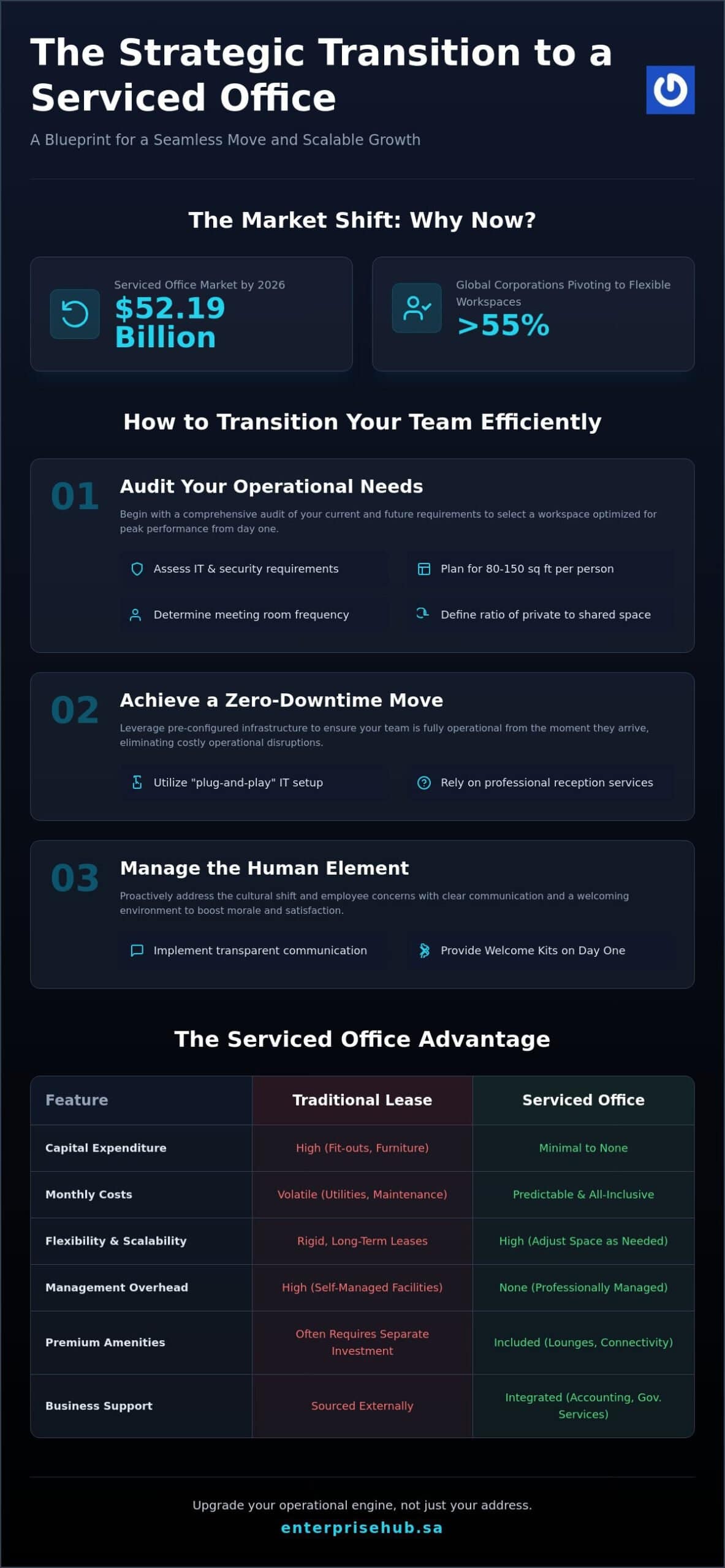
With the global serviced office market projected to reach $52.19 billion in 2026, more than 55% of global corporations have already pivoted from rigid leases to flexible, high-performance environments. You likely recognize that your current setup limits your strategic agility, yet the fear of operational downtime and hidden relocation costs often keeps you tethered to the status quo. It’s a valid concern; managing technical setup complexities while maintaining employee morale during a transition is a significant challenge for any ambitious leader.
We believe your workspace should be a catalyst for growth rather than a source of friction. This guide provides the strategic blueprint on how to transition your team to a serviced office without missing a single beat in your daily operations. You’ll learn how to master the logistics of a zero-downtime move, navigate the cultural shifts required for your staff, and leverage predictable operational costs for long-term scalability. We’ll explore the essential milestones that turn a potential disruption into a powerful operational upgrade for your entire organization.
Key Takeaways
- Understand the strategic shift toward flexible environments and how leveraging shared infrastructure significantly reduces your capital expenditure.
- Master the essential operational audit steps for how to transition your team to a serviced office without disrupting your core business activities.
- Learn the secrets to a zero-downtime move by utilizing pre-configured technical setups and professional reception services from day one.
- Discover practical methods to manage the human element of relocation, including the use of Welcome Kits to boost employee satisfaction.
- Explore how integrated business support, from government services to accounting, enables you to scale your operations seamlessly within a high-performance workspace.
Why Transitioning to a Serviced Office is a Strategic Move in 2026
The 2026 business landscape prioritizes speed and operational resilience over physical ownership. For many enterprises, the shift from traditional long-term leases to flexible environments isn’t just a trend; it’s a strategic necessity. By understanding what is a serviced office, leaders can see how these spaces provide instant access to high-tier business support services without the heavy burden of capital expenditure (CAPEX). Instead of sinking funds into fit-outs and furniture, you leverage shared premium infrastructure that’s already operational and optimized for performance.
When you analyze how to transition your team to a serviced office, you’re looking at a move that significantly enhances your employer brand. Modern talent expects a professionally managed workspace that reflects their ambition and supports their well-being. These environments are designed for rapid national scale, allowing you to expand into new markets or adjust your footprint with minimal friction. This agility is a cornerstone of future-proofing your business in a global economy where the only constant is change.
Aligning Workspace with Team Productivity
Environment design plays a critical role in managing cognitive load. Well-planned collaborative zones and dedicated quiet areas reduce daily stress and boost collaborative output. In 2026, flexible offices are the backbone of successful hybrid work models, providing a reliable hub for team synchronization. They offer your staff premium amenities, such as high-speed connectivity and ergonomic lounges, without you ever having to manage a facility team or handle maintenance tickets. This allows your leadership to focus entirely on output rather than infrastructure.
The Financial Logic of Serviced Solutions
Volatility in traditional office maintenance and utility costs can cripple a growing company’s budget. Serviced solutions offer predictable monthly costs that simplify financial planning and improve cash flow transparency. This stability allows you to redirect administrative resources and personnel toward your core business growth objectives. Utilizing professional office solutions means you’re investing in a scalable asset that evolves alongside your success, ensuring you never pay for more space than you actually need.
Transitioning isn’t just about moving desks; it’s about upgrading your entire operational engine. By choosing a serviced model, you’re choosing a partner that handles the background noise of office management, leaving you free to innovate and lead. It’s a calculated move that balances fiscal responsibility with a high-performance culture.
Step-by-Step: How to Transition Your Team Efficiently
Successful relocation requires more than just moving physical assets. It demands a shift in operational philosophy. When you’re planning how to transition your team to a serviced office, start with a comprehensive audit of your current and future requirements. This isn’t a weekend task; it’s a strategic maneuver that ensures your team lands in an environment ready for peak performance from the first hour. Your goal is to eliminate the friction that typically accompanies a move by selecting a workspace that offers both high-tier scalability and integrated support services.
Auditing Your Operational Needs
Begin by determining the precise ratio of private offices to collaborative coworking zones your team requires. In 2026, hybrid models often thrive with 80 to 150 square feet per person, but your specific bandwidth and security needs might dictate a more custom setup. Assess your IT requirements thoroughly, including private server needs and the high-speed connectivity required for AI-driven workflows. Don’t overlook the frequency at which you’ll need meeting rooms for rent. Identifying these patterns early prevents bottlenecks and ensures you only pay for the resources you actually use.
Transparent Communication Strategies
Employee resistance often stems from a lack of clarity. Address this by redefining the office’s purpose through transparent town halls and digital FAQs. Highlight the personal benefits for your staff, such as access to premium wellness zones and professionally managed facilities that remove daily administrative burdens. Establish a clear feedback loop during the first 30 days of the transition. This shows your team that their comfort and productivity are your top priorities as you settle into your new headquarters.
Coordination with your provider is the final technical hurdle. Work closely with their logistics team to integrate your existing digital infrastructure with their pre-configured systems. This ensures a “Day Zero” experience where every desk is powered and every connection is secure before the team arrives. If you want to see how these elements come together in a premium environment, you can explore our flexible office configurations designed for rapid business growth.
Launch your transition with a dedicated onboarding session. Familiarize the team with the shared facilities, meeting zones, and the local amenities of the “15-minute city” hubs often surrounding serviced workspaces. This proactive approach turns a potentially stressful move into an inspiring milestone for your organization. By managing the logistics and the human element with equal precision, you secure a transition that’s both seamless and empowering.
The Serviced Office Advantage: Eliminating Relocation Friction
Traditional office moves are notorious for operational “dark periods” where productivity stalls during technical installations and furniture assembly. A serviced model fundamentally changes this dynamic by providing a ready-to-use environment from the moment you receive your keys. When you evaluate how to transition your team to a serviced office, the primary benefit is the immediate continuity of your business. You aren’t just renting square footage; you’re stepping into an ecosystem where high-speed internet, security protocols, and ergonomic workstations are already fine-tuned for professional use.
This “plug-and-play” advantage extends beyond the physical desk. From day one, your organization benefits from professional reception services and sophisticated mail handling. You no longer need to manage a portfolio of third-party utility providers or maintenance contracts. Instead, these essential services are consolidated into a single, predictable agreement. This allows your leadership to navigate the return-to-office revolution with confidence, focusing on strategic objectives rather than troubleshooting air conditioning or Wi-Fi outages.
Infrastructure: Serviced vs. Traditional
The contrast in setup timelines is stark. A traditional office fit-out can easily consume four months of administrative time and capital. In contrast, a serviced workspace is typically ready for occupancy within 48 hours. This speed doesn’t come at the expense of quality. You gain access to enterprise-grade digital infrastructure and designer furniture that would require a massive upfront investment in a conventional lease. By leveraging these pre-installed assets, you protect your cash flow and ensure your team works in a space that reflects your brand’s high standards.
On-site Support and Professional Amenities
On-site management teams act as an extension of your own administrative department. They handle everything from greeting your clients to managing the technical requirements of your meeting rooms. These facilities often include premium coffee lounges and breakout areas that significantly boost team morale and foster spontaneous collaboration. For organizations with a distributed workforce, integrating virtual offices in Saudi Arabia ensures that remote members maintain a professional presence and access to physical facilities when needed. This comprehensive support structure removes the daily friction of office management, allowing your team to thrive in a focused, high-performance atmosphere.
The transition becomes less about moving boxes and more about unlocking a suite of professional tools designed to accelerate your success; for instance, you can explore 標準寄件箱 (600 x 400 x 360 mm) to manage your physical archives and equipment during the relocation.
Managing the Human Element: Ensuring a Seamless Day-One Experience
The physical relocation of your equipment is only half the battle. When you’re finalizing how to transition your team to a serviced office, the psychological “Day Zero” readiness defines your ultimate success. Employee resistance often stems from a fear of the unknown, so your primary objective is to replace uncertainty with a sense of empowerment and belonging. This begins with a comprehensive Welcome Kit. This document shouldn’t just be a list of rules; it’s a guide to their new professional life, outlining everything from high-speed Wi-Fi protocols to the best local cafes within the “15-minute city” hubs surrounding the workspace.
We recommend hosting an interactive tour of the shared facilities and meeting zones before the official move-in date. This allows your staff to visualize their new daily routines without the pressure of a full workload. To reduce friction, designate “Transition Ambassadors” within each department. These peers act as internal experts who can assist their colleagues with minor technical questions or navigation, allowing your leadership team to stay focused on high-level strategic goals. Clear guidelines for shared space etiquette and booking systems ensure that everyone understands the new operational rhythm from the first hour.
Onboarding for New Facilities
Modern serviced workspaces utilize smart-office features that may be new to your team. Ensure everyone is comfortable with room booking applications and digital access keys before they’re needed for a client meeting. Introduce your staff to the on-site community manager. This person is a vital resource for day-to-day support and acts as an extension of your own administrative team. Understanding security protocols and 24/7 access procedures is equally critical, especially for teams working across different time zones or those utilizing hybrid schedules. Clear communication here prevents “Day One” frustration and reinforces a culture of professional autonomy.
Establishing New Workplace Norms
Moving into a shared professional environment requires a redefined set of workplace norms. Clearly distinguish between “Quiet Zones” designed for deep work and “Collaboration Hubs” meant for team brainstorming. This helps manage the cognitive load on your employees and maintains high productivity levels. Encourage your team to utilize communal areas for cross-departmental networking, which can spark innovation and break down internal silos. While you’re utilizing a shared environment, maintaining your unique company culture remains a priority. Use your private office space to display brand elements and host internal rituals that keep your team’s identity strong. If you’re ready to see these high-performance environments in person, you can book a tour of our premium Riyadh facilities to experience the seamless integration of luxury and logic.
By focusing on these human-centric details, you transform a relocation into a team-building milestone. A well-managed transition doesn’t just move people; it elevates their work experience and reinforces their value to the organization. This proactive approach ensures that by the time the first morning coffee is poured, your team is already settled, inspired, and ready to perform.
Scaling Your Operations with Enterprise Hub Solutions
Scaling an organization in 2026 demands a level of agility that traditional leases simply cannot accommodate. When you understand how to transition your team to a serviced office, you realize that the physical space is merely the foundation of a much larger growth engine. Enterprise Hub facilitates this evolution by offering flexible office configurations that adapt to your success in real time. We don’t just provide a place to work; we provide a strategic platform where your workspace, legal compliance, and financial health are managed under one roof. This integrated approach allows you to focus on your core mission while we handle the complex operational details that often stall rapid expansion.
Flexible Private Offices for Growing Teams
In a volatile market, your team size might fluctuate significantly throughout the year. Our solutions allow you to adjust your footprint without the penalty of breaking a long-term contract. You can start with a focused team in one of our collaborative coworking zones and seamlessly upgrade to dedicated private suites as your headcount increases. This flexibility ensures you never pay for unused square footage, protecting your bottom line while maintaining a high-tier professional environment. We combine the benefits of short-term commitment with the long-term quality your brand deserves, ensuring your team always has the space they need to innovate.
Integrated Business Support Services
The true advantage of a premium serviced workspace lies in the support services that exist beyond the desk. We simplify the path to national and international growth by integrating your workspace with our professional accounting and tax services. Our on-site experts streamline payroll and VAT compliance, ensuring your financial operations are as efficient as your team. For new entities or those expanding their reach, we provide essential help with MISA licensing and commercial registration. By leveraging our deep expertise in government liaison and business setup, you bypass the bureaucratic hurdles that typically delay market entry.
Your workspace should be an extension of your brand identity, not a generic rental. We empower you to customize your private office to reflect your unique culture and professional standards. This personalization, combined with our comprehensive support suite, creates a sense of permanent ownership without the traditional overhead. By choosing a partner that understands how to transition your team to a serviced office as a part of a broader scaling strategy, you secure a competitive edge in the Saudi market. We are committed to your growth, providing the infrastructure and the expertise needed to transform your vision into a sustainable commercial reality.
Securing Your Competitive Edge with Modern Workspace Agility
The transition to a serviced environment is more than a change of address; it’s a strategic commitment to operational excellence. By prioritizing instant readiness and integrated business support, you eliminate the traditional barriers to rapid expansion. You’ve seen how mastering how to transition your team to a serviced office involves balancing technical logistics with a human-centric onboarding approach. This ensures your staff remains productive and inspired from day one while your leadership focuses on high-level growth objectives. Utilizing a partner that offers both high-performance space and essential Saudi business setup support provides a foundation for long-term resilience.
Your organization deserves a workspace that evolves as fast as the market does. With flexible scale-up options and on-site accounting expertise, you can navigate the complexities of the 2026 economy with complete confidence. It’s time to trade administrative friction for strategic momentum. Empower your team with a strategic workspace move to Enterprise Hub today. We’re here to ensure your next chapter is one of unprecedented growth and shared success. Let’s build your future together.
Frequently Asked Questions
How long does a typical transition to a serviced office take?
A typical transition can be completed in as little as 48 hours. Unlike traditional office leases that demand months of planning and fit-outs, serviced workspaces are operationally ready the moment you sign. This rapid turnaround is a primary reason why leaders choose to transition your team to a serviced office when they need to maintain strategic momentum without downtime.
Can I customize the layout of a private office in a serviced hub?
What IT security measures are standard in serviced office environments?
Standard security includes enterprise-grade firewalls, secure server racks, and private VLAN options. These environments are designed to meet high-level professional standards, providing dedicated bandwidth and encrypted connections. You don’t have to build a security stack from scratch, as the pre-configured digital infrastructure is built to protect sensitive corporate data from day one.
Is it possible to transition a fully remote team to a physical serviced office?
Transitioning a remote team is an excellent way to establish a professional anchor for your business. You can begin with a flexible coworking arrangement or a smaller private office to facilitate face-to-face collaboration. This move helps bridge the gap between remote autonomy and the high-performance benefits of a shared, professionally managed environment.
How do serviced offices handle mail and guest reception for my brand?
Professional reception teams act as a seamless extension of your organization. They greet your clients with a high level of hospitality and handle all incoming mail and logistics according to your instructions. This integrated service ensures your brand maintains a prestigious presence without you needing to hire or manage dedicated administrative staff yourself.
Are there hidden costs beyond the monthly membership fee?
The monthly membership fee is designed to be all-inclusive, covering utilities, maintenance, and core services. You won’t face the volatility of traditional office overheads. It’s always wise to check for optional add-ons, such as extra meeting room credits or specialized IT requests, to ensure your budget remains perfectly predictable as you scale.
What happens if my team grows faster than my current office space?
Scalability is a core feature of the serviced model. If your team size increases, you can quickly move to a larger suite or add more workstations within the same facility. This flexibility allows you to expand your footprint in real time, ensuring you never pay for unused space or feel restricted by a rigid lease.
Can I use a serviced office for government licensing and MISA requirements?
Yes, you can use a serviced office address for your commercial registration and government licensing needs. Many providers offer integrated support for MISA requirements and other regulatory filings. This simplifies the process of how to transition your team to a serviced office while ensuring your business remains fully compliant with all local Saudi regulations.