
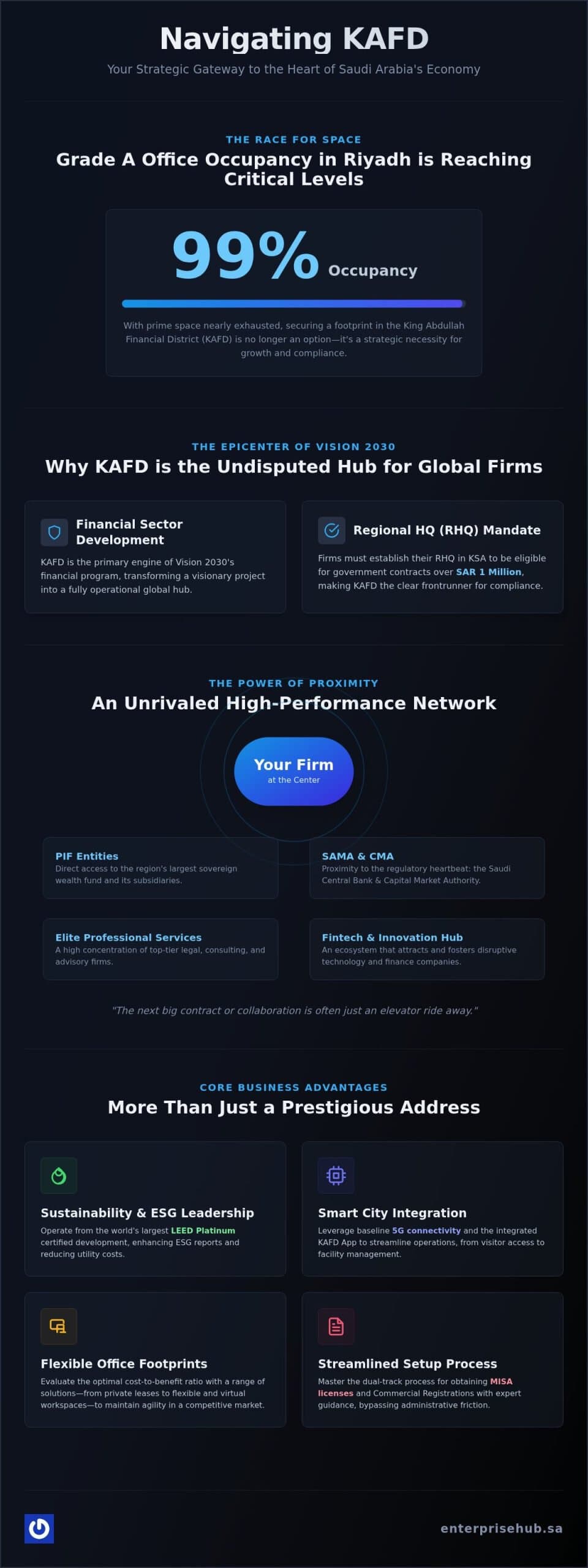
With Grade A office occupancy in Riyadh hitting a staggering 99% in early 2026, the race for a footprint in the capital’s financial heart has never been more intense. You’ve likely realized that doing business in KAFD isn’t just about finding a desk. It’s about securing your place within the PIF ecosystem while managing complex MISA licensing requirements and rising overhead costs. It’s a high-stakes environment where administrative friction can stall even the most ambitious growth plans.
We understand that as a strategic investor, your time is your most valuable asset. This guide provides the clarity you need to bypass these hurdles and establish a prestigious corporate presence with confidence. You’ll discover the specific regulatory benefits available to international firms, the unparalleled networking advantages of the district, and the practical steps to streamline your setup in Riyadh’s most competitive business hub. From navigating the latest Nitaqat updates to choosing the right office model, we’re here to ensure your transition into the heart of the Kingdom’s economy is both seamless and successful.
Key Takeaways
- Understand how KAFD has evolved into the central engine for Saudi Arabia’s Financial Sector Development Program under Vision 2030.
- Explore the specialized regulatory advantages and LEED Platinum infrastructure that make doing business in KAFD a strategic necessity for global firms.
- Master the dual-track setup process for obtaining MISA licenses and Commercial Registrations tailored to your specific entity type.
- Evaluate the cost-to-benefit ratio of flexible workspaces versus traditional leases to maintain agility in Riyadh’s most competitive office market.
- Discover how an integrated partner can provide a ‘soft landing’ through comprehensive business setup, accounting, and government service support.
The Strategic Importance of KAFD in the 2026 Saudi Economy
2026 marks a definitive shift for Riyadh’s skyline and its economic soul. The King Abdullah Financial District (KAFD) has moved beyond its phase as a construction marvel to become the beating heart of the Saudi financial sector. For global firms, doing business in KAFD is no longer a future possibility; it’s a present necessity. The district serves as the primary engine for the Financial Sector Development Program under Vision 2030, transforming from a visionary project into a fully operational global hub. With over 900,000 square meters of office space and a city-wide Grade A occupancy rate hitting 99%, the district represents the most competitive and prestigious business environment in the GCC.
Vision 2030 and the RHQ Program
The mandate for Regional Headquarters (RHQ) is a cornerstone of the Kingdom’s strategy to attract global investment. KAFD has emerged as the clear frontrunner for firms complying with this requirement because it offers the infrastructure and lifestyle amenities that international executives expect. By 2026, international companies must establish their regional headquarters in Saudi Arabia to remain eligible for government contracts exceeding SAR 1 million. This regulation has accelerated the district’s occupancy, with prime spaces seeing record demand as firms race to meet the deadline. Establishing your headquarters here isn’t just about compliance. It’s about positioning your brand at the center of the nation’s decision-making power.
The Ecosystem Effect: Banking, Fintech, and Beyond
Proximity is the ultimate currency in Riyadh. Being situated mere steps from the Saudi Central Bank (SAMA) and the Capital Market Authority (CMA) provides more than just a prestigious address. It grants your firm immediate access to the regulatory heartbeat of the Middle East. This “neighbor effect” has catalyzed a massive concentration of wealth and expertise, drawing in elite legal practices, management consultants, and fintech disruptors. Networking in this environment is organic and high-impact. The district’s smart-city infrastructure facilitates these connections, ensuring that doing business in KAFD means being part of a continuous flow of information and opportunity.
The concentration of Public Investment Fund (PIF) entities within the district further amplifies these B2B advantages. When the region’s largest sovereign wealth fund and its subsidiaries are your neighbors, the potential for strategic partnerships grows exponentially. You’re joining a high-performance network where the next big contract or collaboration is often just an elevator ride away. This ecosystem provides a level of market intelligence and networking density that simply cannot be found anywhere else in the region.
Key Benefits of Doing Business in the KAFD District
Doing business in KAFD offers more than just a premium office. It provides a specialized regulatory environment that simplifies operations for financial and professional entities. This address is Riyadh’s most iconic, instantly signaling stability and success to your global partners. You’re not just renting space; you’re buying into a ‘Live, Work, Play’ ecosystem that attracts the city’s most ambitious talent. The district’s design fosters a high-density networking environment where every corridor and coffee shop serves as a potential boardroom. Prestige is built-in here.
Sustainability and ESG Advantages
KAFD holds the distinction of being the world’s largest LEED Platinum-certified development. For modern corporations, this is a vital asset for ESG reporting and sustainability mandates. These certifications translate to tangible results, such as significantly lower utility costs through advanced energy and water efficiency standards. Beyond the balance sheet, the district’s focus on walkability and green spaces, like the central ‘Wadi,’ directly impacts employee well-being. Firms located here report higher retention rates because they offer a workspace that prioritizes health and environmental responsibility. It’s a clear statement that your company is future-ready.
Technology and Smart City Integration
The digital backbone of the district is designed for the high-speed demands of 2026. 5G connectivity is the baseline standard, ensuring your team stays connected without interruption. The KAFD App further streamlines the daily experience, managing everything from visitor access to facilities requests with a few taps. This level of integration reduces the administrative burden on your staff, allowing them to focus on core business objectives. Security is equally advanced, with world-class data protection and physical surveillance systems providing peace of mind for firms handling sensitive financial information. If you’re ready to experience this level of operational excellence, you can reach out to our team for a tailored workspace solution.
Seamless connectivity is another hallmark of the district’s infrastructure. The Riyadh Metro serves as a primary artery, linking KAFD to the rest of the city and the international airport. This integrated transport network means your clients and employees can bypass traffic, making your office easily accessible from any part of the capital. When you combine this accessibility with the concentration of PIF-owned entities and global banks, the strategic advantage becomes undeniable. Doing business in KAFD places you at the center of a frictionless, high-velocity economy where growth is the only direction.
Navigating the Licensing and Setup Process in KAFD
Establishing your corporate entity in Riyadh’s premier financial hub demands a clear understanding of the dual-track regulatory system. Doing business in KAFD requires you to first secure a MISA investment license before you can proceed to obtain your Commercial Registration (CR). This sequence is vital. While the process has become increasingly digital and efficient by 2026, the specific requirements differ significantly depending on your industry. Financial entities must navigate additional layers of approval from the Saudi Central Bank (SAMA) or the Capital Market Authority (CMA). Professional service firms, conversely, often experience a more direct path but must still ensure their activities align with the district’s specialized zoning and regulatory framework.
ZATCA, the Zakat, Tax and Customs Authority, also plays a central role in your ongoing operations. From the moment your CR is issued, your firm is visible to the national tax system. You’ll need to register for VAT and understand your Zakat or corporate tax obligations immediately. Having a local partner or an expert who understands these government portals is not just a convenience; it’s a strategic move to avoid administrative friction and potential penalties. Precision in these early stages ensures that your focus remains on growth rather than paperwork.
MISA Licensing for Foreign Investors
The Ministry of Investment (MISA) has streamlined the application process to support the influx of global firms. Your first step involves submitting a comprehensive application through the MISA portal, backed by your parent company’s constitutional documents and audited financial statements. In 2026, the initial combined first-year fee for a MISA license is SAR 12,000. Most licenses are now issued within a matter of business days once the documentation is verified. It’s important to remember that you cannot finalize your CR or open a corporate bank account without a verified office address. Many firms doing business in KAFD satisfy this requirement by securing a virtual office or a flexible workspace while they finalize their long-term physical strategy.
Local Compliance and Government Services
Post-licensing compliance is where the operational success of your firm is truly tested. You’ll need to master multiple government portals, including Qiwa for employment contracts and Muqeem for residency permits. GOSI registration for social insurance is also mandatory for all employees. Ensuring VAT and tax compliance through professional accounting services is the final piece of the puzzle. We help you transition smoothly into the market by handling these complexities on your behalf, allowing you to focus on your core business objectives. Learn about our business setup and government services to see how we can simplify your entry into the district.
Choosing Your Office Footprint: Private, Shared, or Virtual?
In a market where Grade A office vacancy has plummeted to 0.5% in early 2026, your strategy for securing a footprint must be agile. Traditional commercial leases in Riyadh often demand long-term commitments and significant upfront capital for fit-outs. For many international firms, this is a heavy anchor that slows market entry. Doing business in KAFD requires a more flexible approach, especially when you’re navigating the initial phases of the RHQ program or scaling a project-based team. Serviced offices and flexible workspaces have become the preferred choice for those who value speed and operational efficiency over the complexities of property management.
Scalability is the primary driver here. You might start with a handful of consultants requiring a dedicated suite and then expand to a full floor as your local operations grow. This transition should be frictionless. By choosing a flexible model, you bypass the months of negotiations and construction associated with traditional real estate. It’s about having the right amount of space at the right time, ensuring your overhead costs remain aligned with your actual growth. If you’re ready to secure your spot in the district, you can book a tour of our facilities today.
The Serviced Office Advantage
Opting for a serviced office eliminates the need for capital expenditure (CAPEX) on furniture, IT infrastructure, and utility setups. Your team can move into a fully equipped environment that’s ready for immediate operation. This includes high-speed 5G connectivity and professional support services as a standard. You can explore our private office solutions in KAFD to find a space that reflects your brand’s prestige. Additionally, having on-demand access to premium meeting rooms and event spaces ensures you’re always prepared for high-stakes negotiations without paying for underutilized square footage.
Virtual Presence and Coworking
For firms that don’t yet require a full-time physical suite, a virtual office is a strategic necessity. It provides the compliant KAFD address required for your MISA license and Commercial Registration while you work remotely or from abroad. When you do need to be on the ground, our coworking and flexi-desks foster collaboration in the heart of the financial hub. This hybrid model is particularly effective for fintech startups and consultants who need a prestigious base without the cost of a permanent office. For a deeper look at this strategy, read our sibling article: Virtual Offices in Saudi Arabia: The 2026 Strategic Guide.
Enterprise Hub: Your Strategic Partner in KAFD
Success in Riyadh’s financial district is defined by your ability to focus on high-level strategy while a trusted partner manages the operational logistics. Doing business in KAFD is a high-stakes endeavor where administrative delays can translate into missed market opportunities. Enterprise Hub isn’t just a workspace provider; it’s a comprehensive business enabler designed to facilitate a “soft landing” for international firms. Our presence in the heart of the district since 2022 has allowed us to refine a service model that removes the friction of market entry, allowing you to establish a functional, prestigious presence in days rather than months.
We provide more than just four walls and a desk. Our professional reception teams, mail handling services, and on-site support staff act as an extension of your own corporate identity. When a client walks into our facility, they experience the same level of sophistication and efficiency that defines the district’s global banks. This infrastructure ensures that your brand’s first impression is always one of stability and success. By leveraging our local expertise, you bypass the learning curve of the Riyadh market and step directly into a high-performance environment.
Integrated Business Support
Navigating the local regulatory landscape is often the most significant hurdle for new KAFD entrants. Outsourcing your accounting and tax services to our specialized team is vital for maintaining compliance with ZATCA and local labor laws from the outset. We manage the complexities of government relations and PRO services, handling everything from visa processing to portal management on Qiwa and Muqeem. This allows your leadership team to focus entirely on core growth objectives. Our all-in-one fee structure provides the budget predictability that international CFOs demand, combining premium office solutions with essential administrative and compliance support into a single, manageable cost.
Join the Enterprise Hub Community
Doing business in KAFD means being part of an elite circle of innovators and decision-makers. When you join the Enterprise Hub community, you gain immediate access to a network of like-minded professionals through our curated networking events and shared spaces. Firms that have scaled using our infrastructure frequently cite this community access as a primary driver of their B2B success. You’re not just renting an office; you’re joining an ecosystem where strategic partnerships are formed daily. If you’re ready to secure your place in the Kingdom’s financial heart, book a tour of our KAFD facilities today and see how we can empower your Saudi expansion.
Secure Your Future in Riyadh’s Financial Heart
Establishing your presence in the King Abdullah Financial District is a strategic move that places your firm at the epicenter of Saudi Arabia’s economic transformation. 2026 represents a pivotal year where regulatory compliance and physical location converge to determine your competitive edge. You now understand that the right office footprint, whether a private suite or a compliant virtual address, is the foundation of your success. Navigating the MISA landscape and ZATCA requirements doesn’t have to be a barrier to your growth. It’s about choosing a path that prioritizes speed, flexibility, and professional excellence.
By partnering with an expert who understands the local ecosystem, you ensure a seamless transition into the market. Enterprise Hub offers the infrastructure and administrative depth you need to thrive. Our strategic location in the heart of the Financial District provides you with fully equipped premium offices and expert business setup and government support. It’s time to stop navigating the complexities alone and start doing business in KAFD with a partner dedicated to your success. Secure your KAFD business address and office space with Enterprise Hub and join the most prestigious network in the Kingdom. We look forward to being part of your growth story.
Frequently Asked Questions
Is KAFD only for financial institutions and banks?
No, while the district is Riyadh’s financial heart, it’s a diverse ecosystem that welcomes technology firms, legal consultants, and management agencies. The infrastructure supports any business that benefits from high-density networking and proximity to the Saudi Central Bank (SAMA). You’ll find a concentration of fintech, AI, and sustainable energy firms doing business in KAFD alongside traditional global banking institutions.
Can a foreign company get a MISA license with a virtual office in KAFD?
Yes, foreign companies can use a virtual office address to secure their initial MISA investment license and Commercial Registration (CR). This is a common strategy for international firms doing business in KAFD who need to establish their legal entity while finalizing their long-term physical office strategy. A physical or virtual address is mandatory to open a corporate bank account and begin local operations.
What are the typical lease terms for a private office in Enterprise Hub?
We provide flexible lease terms that range from monthly agreements to annual contracts, allowing you to avoid the rigid multi-year commitments of traditional real estate. This model is designed to support your firm’s agility, enabling you to scale your workspace up or down as your project requirements change. All our offices come fully equipped with IT infrastructure and utilities included in the agreement.
Does KAFD offer any specific tax incentives for businesses in 2026?
Companies that establish their Regional Headquarters (RHQ) in the district are eligible for a 30-year tax relief program as part of the Kingdom’s investment incentives. For businesses focused on the private sector, the corporate income tax for foreign shareholders is 20% as of August 2026. These regulations are part of a broader strategy to make the district a competitive global destination for international capital.
How does the Riyadh Metro integration affect business operations in KAFD?
The Riyadh Metro offers direct, traffic-free connectivity to the district, linking it to the international airport and the city’s main commercial corridors. This integration significantly improves operational efficiency by reducing commute times for your staff and making client visits more convenient. It’s a vital component of the district’s smart-city infrastructure, ensuring that your business remains accessible in Riyadh’s fast-moving economy.
What government services are available on-site for KAFD tenants?
Tenants can access a wide range of government and administrative services through our in-house PRO and support teams. We handle the complexities of Qiwa, Muqeem, and GOSI registrations, along with ZATCA tax compliance. This integrated approach means you don’t have to navigate multiple government portals alone, as we provide the local expertise needed to keep your operations running smoothly and efficiently.
Is there a minimum employee requirement for setting up in the district?
There is no fixed minimum number of employees required to set up your corporate entity, but you must adhere to the Nitaqat (Saudization) targets. A new phase of this program began in April 2026, increasing targets for most economic activities. Compliance is essential for securing work visas and government contracts, so we recommend reviewing the latest requirements for your specific sector and company size.
How do I transition from a virtual office to a physical space in KAFD?
Transitioning is a straightforward process that allows you to upgrade your virtual office package to a physical coworking desk or a private suite without changing your address. This ensures that your Commercial Registration and bank account details remain consistent as you scale. Our team manages the logistical transition, providing a “soft landing” as your firm establishes a more permanent physical presence in the district.