
In 2026, a corporate bank account in Saudi Arabia is no longer just a place to store capital; it’s the ultimate digital handshake that validates your company’s legal existence in the Kingdom. You must master the specific corporate bank account requirements Saudi Arabia enforces to transition from a newly licensed entity to a fully operational market player. We understand that the path through SAMA regulations and rigorous KYC protocols often feels like an uphill battle against complex paperwork. Delays in account activation don’t just waste time; they stall your growth and complicate your integration with vital government payment systems.
This guide empowers you to navigate every essential documentation and regulatory step needed to secure your financial foundation. You’ll gain a clear, actionable checklist and a realistic look at current activation timelines. We also explore how strategic solutions, such as virtual offices, help you satisfy mandatory National Address requirements while ensuring your business remains compliant with the latest ZATCA and MISA standards for a successful launch and long term prosperity.
Key Takeaways
- Master the essential checklist of corporate bank account requirements Saudi Arabia mandates in 2026, from Commercial Registration to notarized Articles of Association.
- Learn how to navigate the Saudi Central Bank (SAMA) regulatory framework to ensure your business remains compliant with updated KYC and AML protocols.
- Compare the advantages of traditional banking institutions against the emerging digital-first corporate banks to find the best fit for your transaction volume.
- Gain a step-by-step roadmap for pre-verifying legal documents to prevent common delays during the bank application and activation process.
- See how integrated business solutions, like virtual offices, bridge the gap between securing a physical address and achieving full financial operationality.
The Strategic Importance of Corporate Banking in Saudi Arabia
Opening your business doors in the Kingdom requires more than just a license; it demands a financial anchor. A local corporate account serves as the essential gateway for any entity looking to scale within the Saudi market. Meeting the corporate bank account requirements Saudi Arabia has established is the primary way you’ll manage operational cash flow and demonstrate your company’s legal standing to local partners. Without this foundation, you’ll find it impossible to execute basic contracts or participate in the Kingdom’s growing procurement opportunities.
The Saudi Central Bank (SAMA) oversees all corporate onboarding to maintain a secure and transparent financial ecosystem. They’ve implemented strict digital onboarding rules in 2026 to streamline the process while maintaining high security. When selecting a partner, review the list of licensed banks in Saudi Arabia to ensure your chosen institution aligns with SAMA’s latest regulatory standards. This choice dictates how efficiently you’ll meet the corporate bank account requirements Saudi Arabia mandates for new investors.
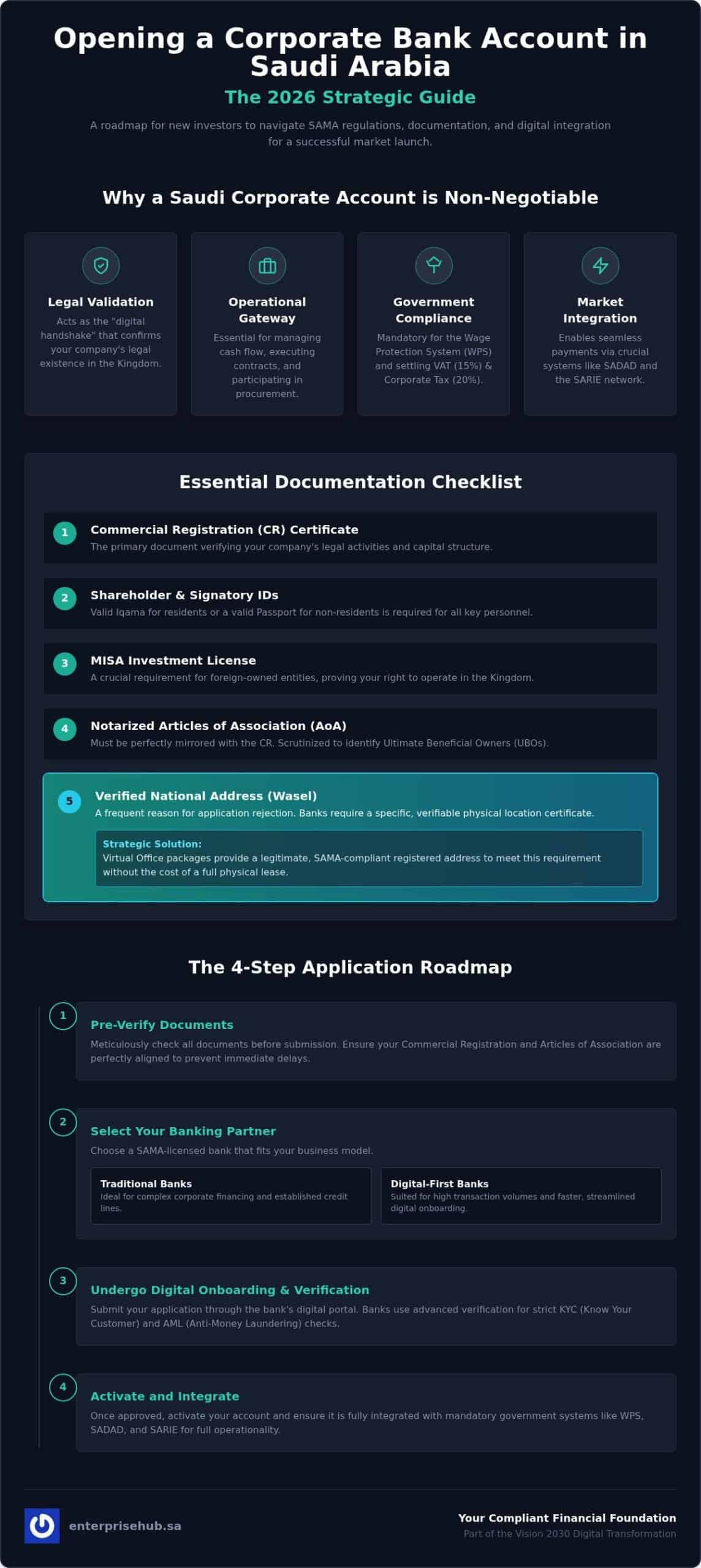
Your bank account is directly tied to the Wage Protection System (WPS). This mandatory system ensures that every employee receives their salary according to their contract, which is a non-negotiable requirement for labor law compliance. Additionally, your ability to settle the 15% VAT or the 20% corporate income tax applied to foreign-owned profits depends on a functional local account. Efficient banking ensures you don’t face penalties for late government payments or tax filings.
Compliance as a Competitive Advantage
Adhering to Anti-Money Laundering (AML) and Know Your Customer (KYC) standards isn’t just a hurdle; it’s a mark of corporate maturity. Banks in 2026 use advanced digital verification to scrutinize every application. Maintaining transparent financial records from day one makes your business a low-risk partner for future corporate financing and credit lines. This shift toward total transparency is a core pillar of the Vision 2030 digital banking transformation, which aims to make the Kingdom a global financial hub.
Mandatory Integrations: SADAD and Beyond
Success in the Saudi market requires your account to be fully integrated with local payment infrastructure. The SARIE system allows for instant local transfers, which is vital for maintaining healthy supplier relationships. You also need a seamless connection to SADAD to pay utility bills and government fees without manual intervention. SADAD acts as the central nervous system for corporate liquidity, enabling seamless settlement of government and utility obligations directly from your business balance.
Essential Documentation for Corporate Account Opening in 2026
Opening a business account in 2026 requires a high degree of precision in document preparation. You won’t get past the initial screening without a valid Commercial Registration (CR) certificate. Banks use this to verify your legal activities and capital structure. Shareholders and authorized signatories must provide valid identification, typically an Iqama for residents or a passport for non-residents. Meeting these corporate bank account requirements Saudi Arabia mandates is the first step toward establishing financial credibility in the local market.
For foreign-owned entities, the stakes are slightly higher. You’ll need to present a valid investment license, following the latest Ministry of Investment (MISA) guidelines to prove your right to operate in the Kingdom. Your Articles of Association (AoA) must also be notarized and include any recent amendments. Banks scrutinize these to identify the Ultimate Beneficial Owners (UBO), ensuring full compliance with international anti-money laundering standards. Any discrepancy between your CR and your AoA can lead to immediate delays, so it’s vital that these documents are perfectly mirrored.
The National Address Requirement
A frequent cause for application rejection is the lack of a verified Saudi address. Banks no longer accept vague location descriptions; they require a National Address (Wasel) certificate. This certificate links your business to a specific physical location, which is now heavily integrated with the digital Ejar system. If you aren’t ready for a full physical lease, utilizing virtual office packages provides a legitimate, SAMA-compliant registered address. This strategic move allows you to meet the address requirement without the immediate overhead of a traditional office. It’s a practical way to bridge the gap between your initial setup and long-term expansion.
Tax and Global Compliance Declarations
Your documentation stack must also address global transparency. You’ll be asked to complete FATCA and CRS declaration forms to help banks report financial data to relevant international authorities. Additionally, providing your VAT registration certificate from the Zakat, Tax and Customs Authority (ZATCA) is mandatory for most operational accounts in 2026. Finally, ensure you have a formal board resolution. This document must clearly authorize the account opening and name the specific individuals granted signing authority. It should be signed by the board members and stamped with the company seal. If you find the documentation phase overwhelming, you can consult with our registration experts to ensure your file is bank-ready from day one.
Digital vs. Traditional Banking: Selecting the Right Partner
Selecting the right financial partner is more than a convenience; it’s a strategic move that dictates your operational speed. While the corporate bank account requirements Saudi Arabia enforces remain standard across the board, the delivery of these services varies significantly between legacy institutions and digital newcomers. You need to weigh high-volume transaction efficiency against the personalized touch of a dedicated relationship manager. Your choice will ultimately impact how quickly you can react to market opportunities and manage your daily liquidity.
Modern platforms like SAB iCorp and SNB eCorp have revolutionized how businesses interact with their capital, offering 24/7 management capabilities. These systems allow you to handle payroll, international transfers, and government payments without ever visiting a branch. However, you must look beyond the user interface. Scrutinize the fee structures, specifically looking for costs associated with international transfers, account maintenance, and SARIE transaction fees. Hidden charges can quickly erode the margins of a growing enterprise if not accounted for during the selection phase.
Traditional ‘Big Four’ Banks
The “Big Four” banks offer stability and deep roots in the local economy, making them the preferred choice for large-scale enterprises. They provide access to complex trade finance, letters of credit, and significant credit facilities that digital-only players can’t yet match. These institutions operate under strict Saudi Central Bank regulations, ensuring your assets are protected by the highest level of oversight. If your business is cash-heavy or requires extensive physical branch access for deposits, a traditional bank remains your most reliable option. You’ll also benefit from a dedicated relationship manager who understands the nuances of the Saudi regulatory environment.
Digital Banking Solutions for SMEs
For agile startups and small-to-medium enterprises, digital-first banking is often the superior choice. These platforms prioritize speed, offering significantly faster onboarding times and lower monthly overheads compared to traditional counterparts. They integrate seamlessly with modern ERP and accounting software, which automates your financial reporting and reduces manual errors. This level of agility perfectly complements businesses utilizing co-working flexi desks and other flexible setups. By choosing a digital partner, you’re investing in a scalable infrastructure that grows alongside your business without the burden of legacy banking bureaucracy.
Step-by-Step Guide to a Successful Bank Application
The application process is where your meticulous preparation meets the bank’s final scrutiny. To fulfill the corporate bank account requirements Saudi Arabia enforces, you must first pre-verify your legal standing. Cross-reference your Commercial Registration (CR) against Ministry of Commerce records to ensure all data is current. Even a minor address mismatch can trigger an automatic rejection. Once verified, select your account type and primary currency. While the Saudi Riyal (SAR) is standard, many international firms also open USD sub-accounts to manage global trade without excessive conversion fees.
Submit your application through the bank’s secure corporate portal. Most institutions have moved to a fully digital onboarding workflow in 2026. However, certain complex entity types or high-capital LLCs may still require a brief in-person verification at a flagship branch. After the bank reviews your KYC profile, they’ll issue your IBAN. The final step is linking this account to the Wage Protection System (WPS) via the Mudad platform. This integration is mandatory to remain compliant with Saudi labor laws and avoid operational freezes.
Preparing the Authorized Signatories
Authorized signatories are the lifeblood of your corporate financial operations. Every individual listed on the board resolution must have an active and registered Absher account for digital authentication. You should define clear authorization limits within the banking portal to protect your capital. For instance, you might require dual authorization for any transfer exceeding SAR 100,000. As of 2026, all corporate banking transactions in Saudi Arabia require multi-factor digital signature verification through the unified national IAM portal.
Post-Opening Checklist
Your journey doesn’t end with an active IBAN. You’ll need to order corporate debit and credit cards to manage daily business expenses and travel. Set up automated e-statements and SMS notification services to maintain real-time oversight of your cash flow. To streamline your administrative tasks, connect your account to our meeting rooms and event spaces booking system for automated, hassle-free payments. If you’re ready to start your application with a bank-ready documentation file, contact our formation experts today to ensure a smooth transition.
Accelerating Your Market Entry with Enterprise Hub
Enterprise Hub acts as your strategic partner, ensuring that your physical presence and legal documentation align perfectly with the rigorous corporate bank account requirements Saudi Arabia mandates in 2026. We bridge the critical gap between securing a premium office space and achieving full financial compliance. Our specialized government services team works directly with you to ensure your Commercial Registration and MISA investment licenses are bank-ready. By refining these documents before they reach the bank’s compliance desk, we eliminate the common friction points that lead to application delays or rejections. This proactive approach saves you weeks of administrative back-and-forth.
Establishing a local presence is about more than a desk; it’s about building a credible institutional identity. Utilizing stand-alone shared offices provides the physical substance that banks look for during their site visit and verification phase. This level of professional infrastructure signals to financial institutions that your company is a stable, long-term player in the Saudi market. We also provide integrated accounting and tax support, ensuring your financial records remain compliant with ZATCA standards, which is vital for maintaining your account’s good standing. Our goal is to make your transition into the local market as seamless as possible.
Beyond Just a Workspace
A prestigious business address does more than impress clients; it significantly improves your bank approval rates. Banks perform deep ‘Know Your Business’ (KYB) checks, and having a verified, high-quality office location is a key metric in their risk assessment. Our consultants guide you through this KYB phase, helping you present a professional profile that meets the specific expectations of local and international banks. For a deeper look at the entire business lifecycle, explore our Saudi company formation guide to master the full setup journey. This resource helps you understand the broader regulatory landscape before you even approach a financial partner.
Customized Solutions for Every Stage
We offer solutions that scale with your ambitions. Startups can leverage our virtual office packages to secure a registered address for banking, while established enterprises can move into private suites for greater operational control. Beyond the initial setup, we provide ongoing support for VAT and Zakat filings to keep your account operational and free from regulatory holds. Our team understands that meeting corporate bank account requirements Saudi Arabia has in place is just the beginning of your success story. Contact Enterprise Hub today to streamline your business setup and banking journey with a partner that values your time and growth. We are committed to your long-term prosperity in the Kingdom.
Secure Your Financial Future in the Kingdom
Success in the Saudi market hinges on your ability to move capital with speed and transparency. You’ve seen that mastering the corporate bank account requirements Saudi Arabia mandates requires more than just filling out forms; it demands a strategic alignment of your legal, physical, and financial structures. From securing a verified National Address to ensuring your MISA license is perfectly mirrored in your bank application, every detail counts toward your final activation and operational freedom.
You don’t have to navigate these regulatory waters alone. Enterprise Hub provides the expert MISA licensing support and verified National Address solutions you need to build a bank-ready profile. We offer full ZATCA and SAMA compliance guidance to ensure your business remains operational and scalable from day one. Get Your Bank-Ready Business Setup with Enterprise Hub and turn your vision into a functional reality. The Kingdom’s economy is moving fast, and we’re here to ensure your business keeps pace with every opportunity.
Frequently Asked Questions
Can a foreigner open a corporate bank account in Saudi Arabia?
Yes, foreigners can open a corporate bank account in the Kingdom after securing a Ministry of Investment (MISA) license and a Commercial Registration certificate. Banks require these documents to verify your legal status as a foreign investor. You’ll also need to appoint an authorized signatory with a valid residency permit. This process ensures your business is fully integrated into the local financial system while adhering to all corporate bank account requirements Saudi Arabia enforces.
How long does it take to open a business bank account in KSA in 2026?
In 2026, opening a business bank account in KSA typically takes between 2 and 4 weeks. This timeline accounts for the stringent Know Your Customer (KYC) and Anti-Money Laundering (AML) checks conducted by local institutions. While digital onboarding has accelerated the initial submission, the verification of your global shareholders and ultimate beneficial owners remains a thorough process. Preparing your documentation perfectly before submission is the best way to avoid unnecessary delays.
Is a physical office required to open a corporate bank account in Saudi Arabia?
You don’t necessarily need a traditional physical lease, but a verified National Address (Wasel) is mandatory. Banks use this address to register your business in their systems and for official correspondence. If you aren’t ready for a large office, virtual office packages provide a legitimate, SAMA-compliant registered address. This solution allows you to satisfy the banking requirements while maintaining the flexibility of a modern, agile business setup without high overhead costs.
What is the minimum balance required for a Saudi corporate bank account?
While there’s no statutory minimum capital for all LLCs, most banks expect to see a balance between SAR 100,000 and SAR 500,000 to demonstrate financial viability. Certain sectors, like wholesale or retail with 100% foreign ownership, have much higher statutory capital requirements. It’s best to check with your specific bank as they’ll evaluate your projected transaction volume and business model to determine the appropriate initial deposit for your corporate account.
Do I need a MISA license before applying for a bank account?
Yes, you must secure your MISA investment license and Commercial Registration before applying for a corporate account. Banks cannot initiate the onboarding process without these foundational legal documents. The license proves your right to operate as a foreign entity, and the account opening is usually one of the final steps in the company formation journey. Our setup services include coordinating these documents to ensure they’re bank-ready when you apply.
What are the common reasons for corporate bank account rejection in KSA?
Rejections often stem from incomplete documentation or discrepancies between your Commercial Registration and Articles of Association. Banks also reject applications if the National Address isn’t verified or if they can’t clearly identify the Ultimate Beneficial Owners (UBO). Mismatched records in the Ministry of Commerce database or failing to meet strict KYC standards are other common hurdles. Ensuring all your records are perfectly synchronized across government platforms is vital for a successful application.
Can I open a Saudi corporate bank account online from abroad?
You can start the application process online through the bank’s corporate portal, but full activation often requires local authentication. Authorized signatories usually need a registered Absher account for digital verification through the national IAM portal. While many steps are now digitized in 2026, some banks still require an in-person visit or a local legal representative to finalize the process. It’s important to verify the specific digital onboarding rules for your chosen financial institution.