
A flawless business plan won’t guarantee success in the Kingdom if it lacks the pulse of local trust. While the technical process of establishing a commercial presence in Saudi Arabia is more streamlined than ever, your true entry fee is a blend of regulatory excellence and cultural depth. You aren’t just opening an office; you’re joining a national transformation where reputation is the most valuable currency.
We understand that the rapid pace of Vision 2030 reforms can feel daunting. Whether you’re concerned about the latest Nitaqat updates effective since April 2026 or the nuances of building social capital, you’re looking for more than just a certificate of registration. You want a roadmap to long-term credibility. This guide provides exactly that, bridging the gap between mandatory compliance and the elite corporate reputation your brand deserves.
We’ll explore the 2026 strategic landscape with precision. This includes everything from the 12,000 ﷼ MISA license requirements to the critical role of the Qiwa platform in managing your workforce. You’ll gain the clarity needed to align your goals with the Kingdom’s future and establish a presence that commands respect.
Key Takeaways
- Learn to integrate the dual pillars of ‘Amana’ and ‘Kafaa’ to move beyond transactional business and foster deep-rooted trust with local partners.
- Understand why flawless regulatory compliance is your first signal of legitimacy when establishing a commercial presence in Saudi Arabia.
- Discover the 2026 evolution of ‘Wasta’ and how to leverage modern professional networking to build influential social capital.
- Identify why a prestigious physical business address remains a non-negotiable trust signal for international firms in the Kingdom’s elite districts.
- Explore how aligning with strategic business communities can serve as a reputation accelerator for your brand’s long-term market success.
The Foundations of Corporate Reputation in the Kingdom
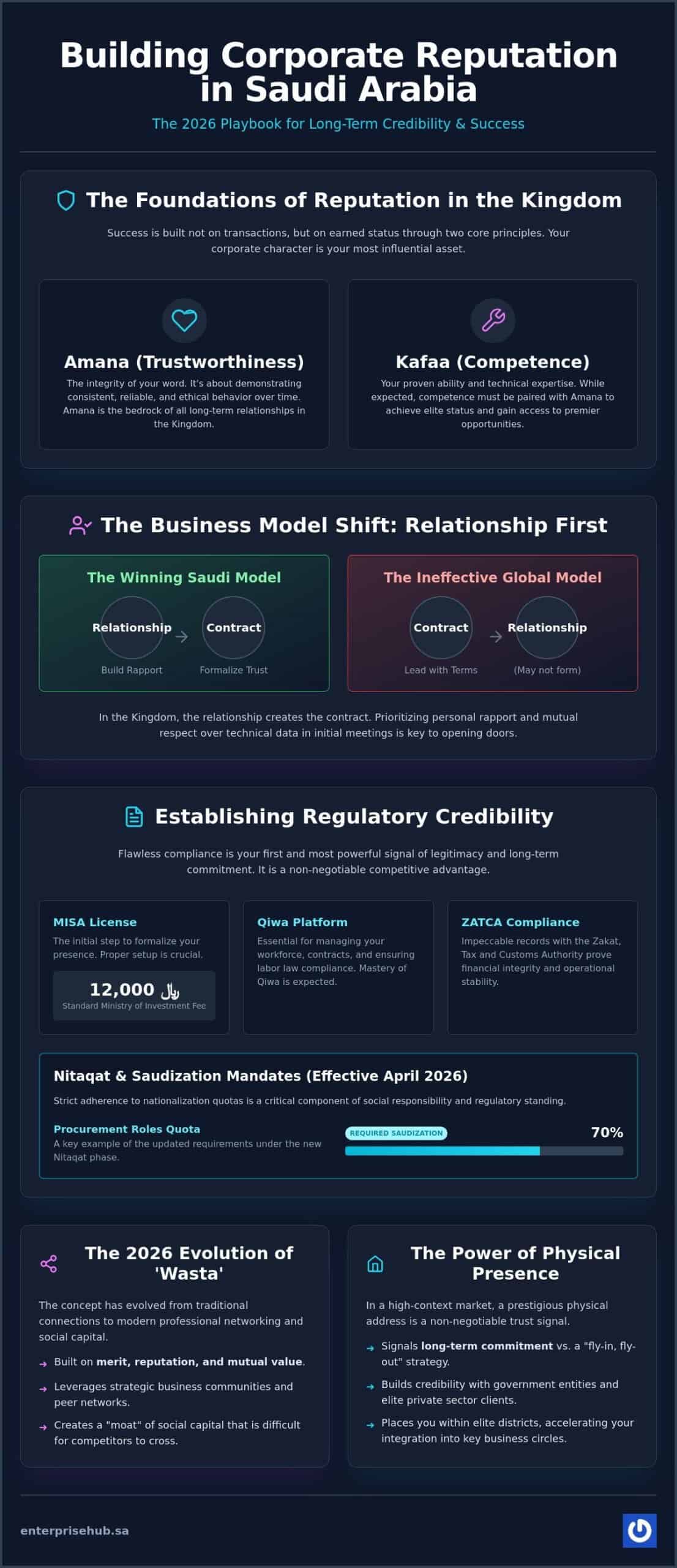
Reputation in the Saudi market isn’t a commodity you can purchase; it’s a status you earn through the dual pillars of Amana (trustworthiness) and Kafaa (competence). While technical expertise is expected, it’s the integrity of your word that determines your ceiling in the Kingdom. For companies establishing a commercial presence in Saudi Arabia, understanding this cultural framework is as vital as your financial projections. You’re entering an ecosystem that prizes long-term stability over short-term gains, making your corporate character your most influential asset.
The 2026 business environment has moved decisively away from purely transactional interactions. Success now hinges on how well your corporate values mirror the Kingdom’s national development goals. This alignment isn’t just about PR. It’s about demonstrating that your business is a stakeholder in the nation’s future. The recent regulatory reforms for entrepreneurship have made the technical entry easier, but the social entry still requires deep cultural intelligence.
Reputation is a non-buyable, long-term asset. In a world of digital shortcuts, the Saudi market remains refreshingly high-context. You can’t simply buy a top-tier reputation through aggressive advertising. Instead, it’s built through repeated, positive interactions with the local community, government entities, and private sector peers. This process takes time, but the resulting social capital is a moat that competitors cannot easily cross. It serves as a shield during market shifts and a bridge to new opportunities. To complement these organic interactions, many organizations also leverage professional content marketing to communicate their values effectively; to learn more about how localized media can drive this engagement, businesses should look at successful urban communication models.
Relational vs. Transactional Business Models
In many global markets, the contract creates the relationship. In Saudi Arabia, the relationship creates the contract. Initial meetings often focus on personal rapport rather than technical data. This requires a mindset shift toward long-term partnership. When establishing a commercial presence in Saudi Arabia, your ability to listen and show respect for local customs is just as important as your pitch deck. If you value the person across the table as much as the profit, you’ll find doors opening that remain closed to purely transactional competitors.
Consistency as a Trust Multiplier
Consistency is the only way to build a track record in a market that values word-of-mouth. The Majlis culture, where business leaders gather informally, means your reputation often precedes you. A fly-in, fly-out strategy signals a lack of commitment and damages credibility. By maintaining a steady presence, you show local stakeholders you’re here for the long haul. This consistency turns small wins into a robust corporate legacy. It proves that you’re an active participant in the local economy rather than a temporary observer.
Establishing Regulatory Credibility and Compliance
Legal transparency serves as your firm’s first signal of legitimacy when you’re entering the Kingdom. In a market where trust is paramount, your regulatory standing tells local partners exactly how much you value the opportunity. While the initial MISA license fee of 12,000 ﷼ is a standard entry cost, the true price of entry is a commitment to total transparency. For those establishing a commercial presence in Saudi Arabia, a clean record with the Ministry of Investment (MISA) and ZATCA isn’t just a legal requirement; it’s a competitive advantage that proves you’re a stable, long-term player.
Non-compliance carries heavy reputational risks that can take years to repair. If your firm is flagged for administrative delays or tax inconsistencies, word travels fast through local business circles. Gaining credibility in the Saudi market depends on your ability to meet these high standards from day one. By prioritizing proper company formation, you signal to government entities and private clients that your operations are built on a foundation of integrity and national alignment.
Licensing and Legal Frameworks
Selecting the correct license type is critical to reflecting your business’s true scale. Whether you choose a Foreign Company Branch with its reduced 12,000 ﷼ registration fee or an LLC, your choice impacts how you’re perceived by the “white-list” of preferred vendors for government contracts. Compliance also extends to social responsibility. The new Nitaqat phase that began on April 26, 2026, requires strict adherence to Saudization quotas, such as the 70% requirement for procurement roles. Meeting these targets on the Qiwa platform isn’t just about avoiding penalties; it’s a badge of honor that shows your brand is invested in the Saudi workforce.
Financial Transparency and Auditing
Trust with local financial institutions is built through the rigorous implementation of international accounting standards. Annual audits and ZATCA-compliant VAT filings (at the 15% rate) ensure your corporate standing remains unblemished. Utilizing professional accounting and tax services helps you avoid the administrative friction that can stall growth. When your financial records are beyond reproach, you’re positioned to secure better financing and form more meaningful partnerships with local stakeholders who value precision and reliability.
Mastering the Social Currency: Relationships and Wasta
Social capital remains the most liquid asset in the Saudi market. While digital transformation has revolutionized administrative processes, it hasn’t replaced the human element. For firms establishing a commercial presence in Saudi Arabia, the concept of ‘Wasta’ has evolved significantly by 2026. It’s no longer synonymous with old-school nepotism. Instead, it represents a sophisticated system of professional networking built on verified trust and mutual respect. It’s the social infrastructure that allows business to move at the speed of Vision 2030.
The modern Majlis remains the heartbeat of this ecosystem. These informal gatherings are where senior decision-makers evaluate your long-term potential. It’s a space where hierarchy is respected and seniority is honored. Demonstrating a deep understanding of these social structures isn’t just polite; it’s a strategic necessity. Shared meals and the rituals of hospitality, from the serving of Arabic coffee to the arrangement of seating, are high-stakes environments where your corporate character is under the microscope. If you can’t navigate a dinner, you’ll struggle to navigate a boardroom.
Building Trust Through Personal Connection
You’ll find that ‘small talk’ in the Kingdom isn’t filler. It’s a high-stakes assessment of your character. Local partners want to know who you are before they care about what you sell. This makes face-to-face interactions essential. While a video call might handle the logistics, a local dinner cements the partnership. You must balance international efficiency with local diplomacy. Patience isn’t a delay here; it’s a trust-building exercise that proves you aren’t just looking for a quick exit.
Cultural Etiquette and Professionalism
Professionalism in the Kingdom requires a nuanced approach to time and communication. Respecting local norms shows that your company is culturally intelligent and ready for a long-term commitment. Consider these key elements:
- Greeting Rituals: Use proper titles and wait for the host to initiate handshakes. A respectful “Salam” goes a long way.
- Prayer Times: Structure your professional scheduling around the five daily prayers. This shows you’ve integrated into the local rhythm of life.
- Indirect Communication: Learn to read between the lines. Saudi business culture is often high-context, where a polite deflection might mean “no” without causing loss of face.
Understanding these subtleties ensures your social capital grows alongside your revenue. It transforms you from a foreign entity into a trusted local partner, providing the foundation for establishing a commercial presence in Saudi Arabia that lasts for decades.
Presence and Perception: Physicality in a Digital Age
Physicality remains a cornerstone of corporate identity in the Kingdom. While digital tools manage the workflow, a prestigious business address functions as a critical trust signal for local partners. When you’re establishing a commercial presence in Saudi Arabia, your choice of location speaks volumes before you even speak a word. High-end commercial districts in cities like Riyadh and Jeddah have become the gold standard for international firms seeking to project stability and success. A premium address isn’t just a place to work; it’s a statement of your brand’s intent.
For startups or firms testing the waters, a virtual office in Saudi Arabia provides an immediate reputation boost. It grants you a legitimate foothold in the Kingdom’s most respected business hubs without the initial overhead of a long-term lease. This physical anchor is also deeply tied to your “Local Content” (SDR) score. Government buyers prioritize firms that demonstrate a tangible commitment to the local economy. A physical footprint is the most visible evidence of that commitment, helping you secure a place in the Kingdom’s ambitious procurement landscape.
The Prestige of a Dedicated Workspace
A physical office signals permanence. It tells local clients you aren’t just visiting; you’re staying. Modern, fully-equipped facilities impact how both employees and clients perceive your brand’s professionalism. Utilizing private offices allows you to host high-level local stakeholders in an environment that matches the gravity of your discussions. It provides the privacy and prestige required for cementing high-value partnerships. This dedicated space becomes the physical manifestation of your corporate culture, fostering trust through visibility and accessibility.
Aligning with Saudi Vision 2030
Reputation is amplified when your brand aligns with the Kingdom’s broader aspirations. Participating in local CSR initiatives builds significant brand equity by showing your company’s heart. It proves you’re contributing to social progress. Hiring and training local talent acts as a powerful reputation multiplier, directly supporting the goals of Vision 2030. By positioning your brand as a contributor to the Kingdom’s economic diversification, you transition from being a foreign entity to a valued local stakeholder. This alignment ensures your growth is woven into the national success story.
Leveraging Strategic Partnerships for Market Success
Success in the Kingdom isn’t a solo journey. It’s a collaborative effort that depends heavily on the company you keep. Establishing a commercial presence in Saudi Arabia becomes significantly more efficient when you align with a partner that already commands respect in the local market. Enterprise Hub functions as a reputation accelerator, placing your brand within an elite business community. By choosing a premier location and a sophisticated ecosystem, you inherit the credibility of your surroundings. This allows you to bypass the skepticism that often stalls international firms during their first year of operation.
The transition from being a newcomer to becoming a trusted local player requires more than just a license. It requires an infrastructure that reduces administrative friction. Strategic partnerships provide a buffer against the complexities of local regulations, allowing you to focus on high-level growth. When you’re part of a professional hub or engaging with specialized industry platforms like Construction Technology ConFeX KSA, you aren’t just renting space; you’re gaining access to a network of like-market entities and strategic support that understands the nuances of the 2026 business landscape. This collective strength is what turns a foreign investment into a national success story.
Integrated Business Support Services
Your brand’s image is reinforced by every interaction. Professional meeting rooms and high-end event spaces provide the necessary backdrop for high-stakes negotiations with local stakeholders. Beyond the physical environment, integrated support like expert accounting and tax services ensures your regulatory record remains spotless. You don’t want your growth hindered by administrative errors or ZATCA penalties. By streamlining government services through a dedicated partner, your team can focus on core strategy while the technical compliance is handled with precision. This holistic approach protects your reputation from the inside out.
Next Steps: Establishing Your Legacy
Moving from initial interest to full incorporation requires a partner that understands the delicate balance of local nuances and international standards. You aren’t just looking for a service provider; you’re looking for a strategic ally to help you build a lasting legacy. As you finalize your plans for establishing a commercial presence in Saudi Arabia, consider the long-term impact of your choices. The right partner will help you navigate the 12,000 ﷼ MISA license requirements and the 70% Saudization quotas with confidence.
Ready to secure your position in the Kingdom’s evolving economy? Don’t leave your reputation to chance. Consult with Enterprise Hub today to build your corporate legacy and join the elite ranks of businesses shaping the future of Saudi Arabia.
Your Future in the Kingdom Starts with Credibility
Success in the Saudi market is defined by the intersection of cultural intelligence and regulatory excellence. As we’ve explored, Amana and Kafaa form the bedrock of trust, while a prestigious address and transparent compliance act as non-negotiable trust signals. Establishing a commercial presence in Saudi Arabia in 2026 is no longer just about legal entry; it’s about securing your brand’s legacy within a high-growth, relationship-driven economy.
Enterprise Hub has been a strategic partner for international firms since 2022, providing comprehensive support that spans from company formation to specialized accounting and tax services. By joining our elite business community in the Kingdom’s premier commercial hub, you position your brand at the very center of innovation and influence. Scale your business reputation with Enterprise Hub’s premium workspace solutions and take the definitive step toward long-term prosperity. The Kingdom’s ambitious future is waiting for visionary partners like you.
Frequently Asked Questions
What is the most important factor in building a business reputation in Saudi Arabia?
The most important factor is the integration of Amana (trustworthiness) and Kafaa (competence) through consistent personal interactions. Saudi partners evaluate your character and reliability before they consider the technical details of a contract. You’ll find that prioritizing a relationship-first approach is the only way to secure long-term credibility in this high-context market.
How does ‘Wasta’ affect modern business in the Kingdom in 2026?
In 2026, Wasta has evolved from traditional nepotism into a sophisticated system of professional networking based on verified trust. It functions as social capital that helps you navigate the business ecosystem more efficiently. You can build this currency by participating in modern Majlis culture and demonstrating a proven track record within local business communities.
Is a physical office required to have a good reputation in Saudi Arabia?
Yes, a physical office remains a critical trust signal that demonstrates your company’s permanence and commitment to the Kingdom. While startups can use virtual offices as a legitimate entry point, moving to a private office in a premier commercial district is necessary for hosting high-level stakeholders. It proves you’re a stable player invested in the local economy.
How long does it typically take to establish trust with Saudi business partners?
Deep social trust usually takes several months of consistent face-to-face interaction to solidify. While the technical process of establishing a commercial presence in Saudi Arabia takes between one and three months, building a meaningful partnership requires multiple meetings and shared meals. You shouldn’t rush this phase, as patience is viewed as a sign of respect and long-term intent.
What role does Saudi Vision 2030 play in a company’s brand reputation?
Vision 2030 serves as the benchmark for corporate reputation, where alignment with national goals proves you’re a local stakeholder. Companies that actively contribute to economic diversification and meet Saudization targets, such as the 70% requirement for procurement roles, earn significant brand equity. Positioning your brand as a contributor to the nation’s success story makes you a preferred partner for government and private entities.
Can a foreign startup realistically compete with established local firms on reputation?
Foreign startups can compete effectively by maintaining flawless regulatory compliance and leveraging strategic partnerships. By establishing a commercial presence in Saudi Arabia within an elite business hub, a startup inherits an immediate boost in credibility. Success depends on showing cultural intelligence and a clear commitment to local content requirements, which allows smaller firms to build trust quickly.
How do I ensure my company remains compliant with evolving local regulations?
You can ensure compliance by utilizing integrated digital platforms like Qiwa for labor contracts and ZATCA for tax filings at the 15% VAT rate. Partnering with a professional service provider for accounting and government services is the most reliable way to stay ahead of regulatory shifts. Regular audits and a proactive approach to Nitaqat requirements will keep your corporate record unblemished.
What are common mistakes foreign companies make when trying to build trust?
The most common mistake is adopting a “fly-in, fly-out” strategy that signals a lack of genuine commitment to the market. Many firms also fail by prioritizing technical contracts over personal relationships or ignoring local norms like prayer times during scheduling. You’ll find that rushing the social phase of business often leads to administrative friction and missed opportunities for high-level networking.