
In the 2026 Saudi market, choosing the wrong legal structure doesn’t just slow you down; it can lock you out of the Kingdom’s most lucrative national incentives. We understand that deciphering the New Companies Law while trying to meet strict MISA licensing requirements feels like a high-stakes puzzle. It’s often frustrating when the gap between your legal paperwork and your physical office operations stalls your momentum before you’ve even started. You aren’t just looking for a permit; you’re looking for a strategic launchpad for long-term prosperity.
This guide simplifies the complex landscape by breaking down the modern types of business entities in Saudi Arabia, ensuring you select a structure that accelerates your growth rather than hindering it. You’ll gain access to a clear decision-making framework that aligns your legal setup with regulatory ease and prestigious physical infrastructure. We’ll explore how the right entity type streamlines your ZATCA compliance and provides a seamless path from initial registration to a fully operational, premium workspace. By the end of this article, you’ll have the clarity needed to bridge the gap between legal compliance and operational excellence.
Key Takeaways
- Leverage the flexibility of the New Companies Law to choose a governance structure that suits your specific 2026 growth goals.
- Evaluate the various types of business entities in Saudi Arabia to determine which model offers the best balance of liability protection and ease of setup.
- Connect your legal registration with a verified physical address in strategic locations like KAFD to secure your Commercial Registration faster.
- Navigate the latest MISA licensing requirements and capital thresholds to ensure full compliance for foreign-owned enterprises.
- Streamline your market entry by integrating company formation with essential operational services like accounting and government relations.
The 2026 Saudi Business Landscape: Navigating the New Companies Law
2026 marks a pivotal moment for any investor looking to capitalize on the Gulf’s most dynamic market. The New Companies Law, which replaced the 2015 framework, has matured into a sophisticated system that prioritizes corporate flexibility and investor protection. This isn’t just a minor update; it’s a total reimagining of how capital moves within the Kingdom. By removing traditional barriers, the Ministry of Investment (MISA) has made it easier than ever to align your corporate structure with the rapid diversification of the Economy of Saudi Arabia. Understanding the modern types of business entities in Saudi Arabia is your first step toward securing a foothold in a landscape defined by Vision 2030’s ambitious growth targets.
Key Regulatory Shifts for 2026
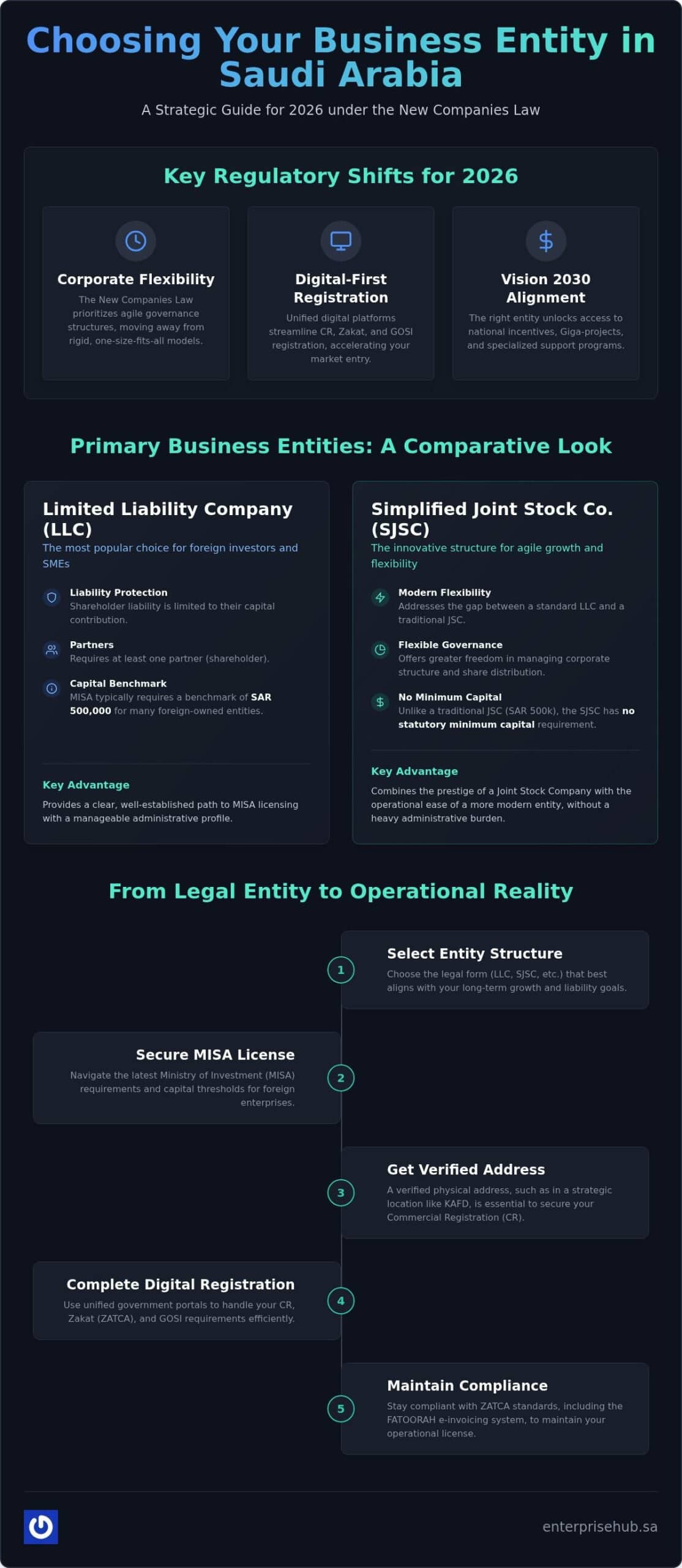
The transition toward agile legal forms has accelerated. We’ve seen a move away from rigid, one-size-fits-all structures toward modern entities like the Simplified Joint Stock Company, which offers the prestige of a JSC without the heavy administrative burden. Digital-first registration is now the standard. The integration of government portals means you can often handle your Commercial Registration (CR), Zakat, and GOSI requirements through unified digital platforms. This speed allows you to focus on your core operations rather than getting bogged down in paperwork. Staying compliant with the latest Zakat, Tax and Customs Authority (ZATCA) standards, including the FATOORAH e-invoicing system, is essential for maintaining your operational license and avoiding costly delays.
The National Investment Strategy
Saudi Arabia is aggressively pushing for economic diversification beyond oil, creating massive opportunities in tech, tourism, and manufacturing. Choosing the right legal structure is critical if you intend to bid on major government tenders or participate in the Kingdom’s “Giga-projects.” The Regional Headquarters (RHQ) program continues to be a major driver of corporate restructuring. If you’re looking to partner with government entities, having a formalized presence that meets specific RHQ mandates is often a prerequisite. We’ve observed that firms with a clear, compliant entity type find it significantly easier to navigate the MISA licensing process. This strategic alignment ensures your business isn’t just a foreign branch, but a recognized contributor to the local economy, unlocking access to national incentives and specialized support programs designed for high-growth sectors.
Primary Types of Business Entities in Saudi Arabia
The selection of a corporate structure is the most consequential decision you’ll make when entering the Kingdom. Under the New Saudi Companies Law 2026, investors can choose from several types of business entities in Saudi Arabia, each designed to balance risk, control, and capital requirements. Whether you’re a lean startup or a global multinational, the current framework offers unprecedented flexibility in how you manage governance and share distribution. Selecting the right model early ensures you don’t face restrictive hurdles as your operations scale.
The Limited Liability Company (LLC) Advantage
The LLC remains the most popular choice for foreign investors and SMEs. It requires at least one partner and limits the liability of shareholders to the extent of their capital contribution. For many foreign-owned entities, MISA typically looks for a capital benchmark of SAR 500,000, though the law itself allows for “sufficient” capital based on activity. This structure is highly favored because it provides a clear path to obtaining a MISA license while maintaining a manageable administrative profile. To secure your Commercial Registration, you’ll need a verified address. Explore our virtual office packages for your LLC address to satisfy this requirement without the overhead of a traditional lease.
Innovative Structures: Simplified JSC
A significant 2026 trend is the rise of the Simplified Joint Stock Company (SJSC). This entity type addresses the gap between a standard LLC and a traditional Joint Stock Company. Unlike a standard JSC, which requires a minimum capital of SAR 500,000, the SJSC has no statutory minimum capital requirement. It offers the prestige of a shareholding structure with significantly lower administrative burdens. This makes it an ideal vehicle for ventures seeking venture capital or private equity, as it allows for flexible management rules and easier share transferability. When comparing the various types of business entities in Saudi Arabia, the SJSC stands out for its agility in the modern market.
For those who prefer to maintain direct parental control, a Branch of a Foreign Company is a viable alternative. It isn’t a separate legal entity, meaning the parent company remains fully liable for the branch’s obligations. Additionally, specialized Professional Companies are available for licensed services like consulting, legal, and accounting. If you’re unsure which path fits your 2026 strategy, we can help you evaluate your options to ensure a smooth transition into the Saudi market.
Comparative Analysis: Choosing the Optimal Structure for Your Goals
Selecting from the various types of business entities in Saudi Arabia requires a careful balance between your immediate operational needs and long term exit strategies. While the Limited Liability Company remains the default for many, the 2026 landscape rewards those who dig deeper into the nuances of governance and capital flexibility. You can find official sector specific requirements and incentive details through the Invest Saudi portal, which serves as a primary resource for international firms. The right choice dictates not only your initial setup speed but also your eligibility for future funding rounds or government contracts.
Ownership and management structures have seen significant liberalization. Most sectors now permit 100% foreign ownership, provided you secure the appropriate MISA license. However, the management complexity varies. An LLC offers a choice between a single General Manager or a Board of Managers, providing a lean oversight model. In contrast, Joint Stock Companies require a more formal Board of Directors. For 100% foreign owned trading companies, be prepared for a minimum cash capital requirement of SAR 30 million, alongside a commitment to invest at least SAR 200 million over the first five years.
Decision Matrix for International Investors
Your industry often dictates the most efficient legal path. Tech startups and agile ventures are increasingly gravitating toward the Simplified JSC because it lacks a statutory minimum capital requirement and allows for customized management rules. Manufacturing and service based SMEs typically find the LLC structure more robust for local operations. If your strategy involves a high level of executive oversight or a regional hub, you’ll need the right environment to house your leadership. We provide Private office solutions for entities requiring dedicated management space that align with the prestige of the King Abdullah Financial District.
Tax and Compliance Considerations
The financial implications of your entity choice extend directly to your bottom line. Foreign shareholders are subject to a 20% corporate income tax on their share of net adjusted profits, while Saudi or GCC partners pay 2.5% Zakat. If you’re looking to mitigate these costs, the Regional Headquarters (RHQ) program offers a compelling 30 year tax exemption for eligible activities. Compliance also involves meeting ZATCA’s 15% VAT standards once your annual taxable supplies exceed SAR 375,000. Most entities, especially those with foreign investment, must undergo annual third party audits to ensure transparency and maintain their standing with both MISA and the Ministry of Commerce. This rigorous oversight is a hallmark of the Kingdom’s modernized business environment, ensuring a stable and predictable market for all participants.
From Legal Entity to Operational Reality: Compliance & Infrastructure
Once you’ve selected one of the modern types of business entities in Saudi Arabia, the challenge shifts from legal theory to operational reality. Many investors underestimate the ‘Verified Address’ requirement. In the 2026 regulatory environment, the Ministry of Commerce won’t issue your Commercial Registration (CR) without proof of a physical lease or a certified business address. This requirement acts as a compliance anchor, ensuring that every legal entity is tied to a legitimate business location within the Kingdom. For non-GCC investors, securing a MISA license remains the prerequisite gatekeeper step that validates your right to operate and invest.
Your time to market depends on how quickly you can integrate your new entity with essential digital portals. Once your CR is active, you must immediately register with GOSI for social insurance, Muqeem for residency management, and Qiwa for labor contracts. These platforms are where your company actually starts functioning as an employer. Delays in this phase can stall your ability to hire staff or open corporate bank accounts. A coordinated approach to setup and infrastructure is vital to ensure you don’t lose momentum during these final administrative hurdles.
Physical Presence and MISA Compliance
MISA has specific office space mandates that vary depending on your chosen entity type and sector. While a standard LLC might have more traditional requirements, certain service based firms can leverage flexible arrangements to maintain compliance. A KAFD address provides more than just a place to work; it offers regulatory prestige that builds trust with local partners and government agencies. We offer Coworking and flexi-desk options for agile compliance, helping you meet these physical presence rules without the immediate burden of long term industrial leases. This flexibility is particularly useful for startups and firms testing the market before committing to a full scale headquarters.
Post-Incorporation Support Services
The journey doesn’t end with a stamp on your paperwork. Accounting and tax planning should be part of your initial entity selection process to ensure you’re ready for ZATCA’s e-invoicing mandates from day one. Managing visas and residency permits through government service providers is equally critical for scaling your team as you grow. When you’re ready to formalize your local presence and gather your leadership, we provide professional Meeting rooms to host your first Saudi board meeting. This ensures your leadership team has the right environment for strategic decision making from the very beginning of your Saudi venture.
If you’re ready to bridge the gap between registration and operation, get in touch with our experts today to secure your compliant office space and integrated setup support.
Strategic Partnership: Accelerating Your Setup with Enterprise Hub
Choosing between the various types of business entities in Saudi Arabia is the foundational step, but your long-term success depends on how you bridge the gap between legal theory and operational reality. We’ve seen many firms secure their licenses only to struggle with the complexities of local infrastructure and ongoing compliance. Enterprise Hub acts as your strategic bridge, providing a comprehensive ecosystem that ensures your transition into the Kingdom is both smooth and prestigious. We don’t just help you select a legal structure; we provide the physical and administrative framework required to thrive in the 2026 business environment.
Our integrated solutions are designed to handle every facet of your market entry. This includes everything from the initial entity selection and MISA licensing to ongoing accounting and government services. By consolidating these requirements under one roof, we eliminate the friction often caused by managing multiple vendors. You gain a partner who understands the nuances of the 2026 landscape, ensuring your business remains compliant with evolving ZATCA and labor regulations while you focus on growth.
The Enterprise Hub Advantage in KAFD
Positioning your brand in the King Abdullah Financial District (KAFD) instantly elevates your corporate standing among global financial leaders. It isn’t just about a premium address. It’s about being at the heart of the Kingdom’s economic evolution. Our facilities offer elite infrastructure that meets international corporate standards, providing the reliability and security that global leaders expect. From high-speed connectivity to sophisticated environments for strategic planning, every detail supports high-stakes operations. Contact Enterprise Hub to design your Saudi expansion strategy and secure your place in the Kingdom’s most prestigious business hub.
Seamless Scalability for Growing Entities
Your needs will change as your market share grows. We’ve designed our services to scale alongside you. You might start with a virtual office to satisfy the “verified address” requirement for your initial Commercial Registration. As your team expands, you can seamlessly transition into our coworking spaces or move into a full-scale private office. This flexibility is vital for managing capital efficiently while maintaining a compliant physical presence that satisfies MISA mandates. We scale with you, ensuring you never outgrow your support system.
Our support extends far beyond the physical space. We provide ongoing regulatory guidance as your company structure evolves, helping you navigate the complexities of Zakat and corporate tax. This holistic approach means your GOSI, ZATCA, and MISA requirements are managed by experts who stay ahead of regulatory shifts. Partnering with us means you aren’t just renting an office; you’re gaining a strategic ally dedicated to your success in the Kingdom’s booming economy. We handle the administrative burdens so you can focus on the massive opportunities presented by Vision 2030.
Future-Proof Your Saudi Expansion Strategy
2026 represents a unique window of opportunity for international firms ready to commit to the Kingdom’s vision. Successfully navigating the modern types of business entities in Saudi Arabia requires a holistic approach that balances legal agility with operational prestige. You’ve seen how the New Companies Law offers unprecedented flexibility; however, the real advantage lies in integrating your legal structure with a world-class physical presence and robust compliance support.
By aligning your choice of entity with a strategic location in KAFD, you don’t just meet regulatory mandates. You build immediate trust with local partners and stakeholders. Enterprise Hub stands ready as your strategic partner to handle the complexities of MISA licensing, government services, and full-service accounting. We empower you to bridge the gap between registration and long-term prosperity. It’s time to turn your legal setup into a high-performance operational reality. We look forward to being part of your success story as you grow within the Kingdom’s thriving economy.
Secure Your Strategic Business Foundation in KAFD with Enterprise Hub
Frequently Asked Questions
What is the most common business entity for foreign investors in Saudi Arabia for 2026?
The Limited Liability Company (LLC) remains the most frequent choice among the various types of business entities in Saudi Arabia for 2026. Its popularity stems from the robust liability protection it offers shareholders and its broad acceptance by the Ministry of Investment (MISA). It provides a flexible framework for both SMEs and large enterprises to scale operations while maintaining a clear governance structure that aligns with local regulatory expectations.
Can a foreign company own 100% of a Saudi LLC?
Yes, foreign companies can own 100% of a Saudi LLC in the majority of economic sectors. This is facilitated through the Ministry of Investment (MISA), which issues the necessary foreign investment license. While a few strategic sectors still require a local partner, the Kingdom’s ongoing reforms under Vision 2030 have significantly expanded the list of activities where full foreign ownership is permitted, encouraging direct international investment.
What is a Simplified Joint Stock Company and why is it popular now?
The Simplified Joint Stock Company (SJSC) is a modern entity type introduced to provide the prestige of a shareholding structure without the heavy administrative burden of a traditional JSC. It’s popular in 2026 because it has no statutory minimum capital requirement and allows for highly customized management rules. This flexibility makes it the preferred legal vehicle for startups seeking venture capital or private equity investment within the Saudi market.
Does a virtual office address satisfy MISA licensing requirements for all entities?
A virtual office address satisfies the initial “verified address” requirement for obtaining a Commercial Registration (CR) and MISA license for many entity types. This allows businesses to establish their legal presence quickly and cost-effectively. However, certain specialized licenses or participation in the Regional Headquarters (RHQ) program may eventually require a transition to a physical private office or dedicated workspace to meet specific operational mandates and staffing requirements.
What are the minimum capital requirements for an LLC in Saudi Arabia?
Under the New Companies Law, there’s no fixed statutory minimum capital for an LLC; the law requires that capital be “sufficient” for its activities. However, for foreign-owned LLCs, the Ministry of Investment (MISA) typically applies a benchmark of SAR 500,000. It’s important to note that certain sectors, such as 100% foreign-owned trading, require a much higher cash capital of SAR 30 million to ensure operational stability.
How does the Regional Headquarters (RHQ) program affect entity selection?
The Regional Headquarters (RHQ) program significantly influences entity selection by mandating that firms establish a registered presence to oversee their Middle Eastern operations. Choosing to form an RHQ unlocks a 30-year corporate income tax exemption and other national incentives. This program often requires firms to evaluate whether their existing types of business entities in Saudi Arabia need to be restructured as a branch or a dedicated LLC to qualify for these benefits.
What is the difference between a Branch Office and an LLC in terms of liability?
The primary difference lies in legal separation. In a Branch Office, the parent company remains fully liable for all debts and legal obligations incurred by the Saudi branch, as it’s seen as an extension of the parent firm. Conversely, an LLC is a separate legal entity where the liability of shareholders is limited to the amount of capital they’ve contributed. This makes the LLC a more defensive choice for risk management.
How long does it typically take to register a new business entity in KSA?
Registering a new business entity typically takes between three to five business days for the initial Commercial Registration (CR) once all documents are submitted. However, the entire process, including securing a MISA license and completing post-incorporation steps like ZATCA, GOSI, and Qiwa registration, usually takes three to four weeks. Working with an integrated partner like Enterprise Hub can significantly accelerate this timeline by streamlining the documentation and infrastructure requirements.