
What if you could transition from being a resident employee to owning 100% of your business in the Kingdom without needing a local partner? Many residents believe that launching a company requires an unreachable capital injection or a complex maze of local sponsorships, but the 2026 regulatory landscape has changed the game. We recognize that understanding the latest شروط الاستثمار الأجنبي في السعودية can feel daunting, especially when you’re trying to distinguish between MISA registration and general commercial requirements while managing your current professional commitments.
This guide serves as your strategic roadmap to help you confidently step into the role of an investor. You’ll discover how the new registration-based framework simplifies entry and why the current suspension of certain MISA fees offers a unique window for growth. We’ll preview the essential steps for securing a MISA-compliant workspace, from virtual offices to private suites, and explain how to align your business with the goals of Saudi Vision 2030. By the end of this article, you’ll have a clear, actionable plan to secure your license, establish a compliant physical presence, and scale your enterprise within the region’s most vibrant economy.
Key Takeaways
- Learn how the updated 2026 framework enables residents to achieve 100% business ownership in alignment with the Kingdom’s Vision 2030 goals.
- Identify the specific شروط الاستثمار الأجنبي في السعودية to choose between service or commercial licenses based on your industry and growth plans.
- Understand why a verified business address, such as a private or virtual office, is a mandatory legal requirement for MISA licensing compliance.
- Master the digital roadmap for transitioning from an employee to an independent investor through official MISA portals and residency updates.
- Discover how combining workspace solutions with professional accounting and government services can streamline your entire setup process.
Understanding the 2026 Framework for Resident Investment in Saudi Arabia
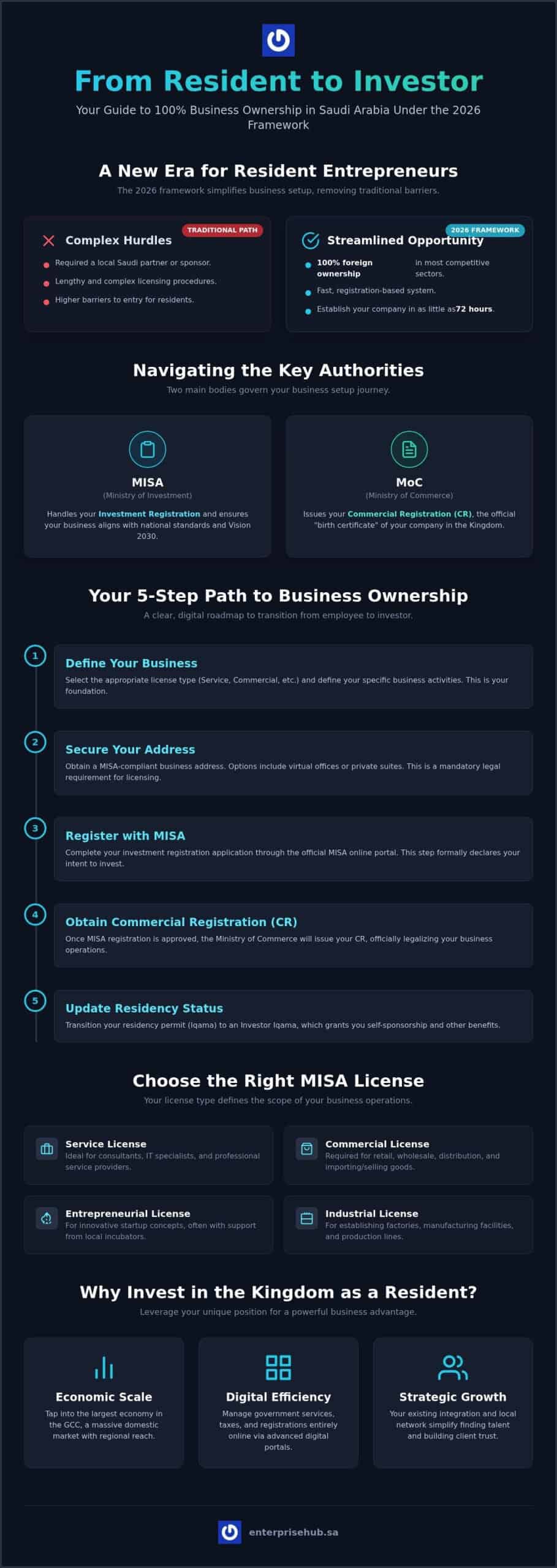
The landscape for foreign investment has changed significantly following the recent updates to the Investment Law. For residents, this means the transition from employee to entrepreneur is more accessible than it’s ever been. The Ministry of Investment (MISA) now oversees a registration-based framework that prioritizes ease of entry and speed. Understanding the شروط الاستثمار الأجنبي في السعودية is your first strategic step toward securing a future in the Kingdom’s rapidly expanding economy.
You need to recognize the roles of two key government bodies during this process. MISA handles your investment registration and ensures your business aligns with national standards. Once registered, the Ministry of Commerce (MoC) provides your Commercial Registration (CR), which is the official birth certificate of your company. While a standard residency permit (Iqama) allows you to live and work, the Investor Iqama or Premium Residency options offer additional perks like self-sponsorship and property ownership. These pathways are designed to help you scale your business without the traditional hurdles of the past.
The Shift Toward 100% Ownership for Residents
The traditional requirement for a Saudi partner has been removed for most competitive sectors. Resident entrepreneurs can now launch businesses in fields like IT, professional consulting, and retail with 100% ownership. This change is a direct result of Vision 2030’s goal to diversify the economy and attract global talent. The 2026 framework has lowered entry barriers by replacing the old licensing system with a streamlined registration process. It’s now possible to complete the establishment of your company within 72 hours once you meet the necessary criteria.
Benefits of Investing in the Kingdom as a Resident
Investing where you already live provides a distinct edge. You understand the local market nuances and consumer behavior better than an outsider would. Beyond this familiarity, you gain access to a world-class business environment. We’ve seen that residents who leverage their local networks find it much easier to navigate the شروط الاستثمار الأجنبي في السعودية and establish trust with clients.
- Economic Scale: Saudi Arabia is the largest economy in the GCC, offering a massive domestic market and a gateway to regional trade.
- Digital Efficiency: The Kingdom’s advanced digital infrastructure allows you to manage government services, taxes, and registrations entirely online through portals like Qiwa and Absher.
- Strategic Growth: As a resident, you’re already integrated into the local ecosystem, making it simpler to find talent and secure compliant office solutions.
By choosing to invest now, you’re not just starting a business; you’re becoming a partner in the Kingdom’s national transformation. The current suspension of certain MISA registration fees as of February 2026 makes this an ideal time to initiate your application and secure your place in the market.
Essential MISA Licensing Options for Resident Entrepreneurs
Selecting the correct license is the most critical decision in your entrepreneurial journey. Each category defines the scope of your operations and the specific شروط الاستثمار الأجنبي في السعودية you must satisfy. For most residents, the Service License is the most popular route. It’s perfectly suited for consultants, IT specialists, and professional service providers who want to leverage their expertise without the heavy overhead of large scale inventory. If your vision involves retail, wholesale, or distribution, you’ll need a Commercial or Trading License. This allows you to import and sell goods directly within the local market.
Innovation is highly valued under Saudi Arabia’s Investment Law. Resident entrepreneurs with unique startup concepts can apply for an Entrepreneurial License, which often comes with supportive provisions from local incubators. For those looking to enter the manufacturing or processing sectors, the Industrial License provides the legal basis to establish factories and production lines. Each of these paths requires a clear understanding of the regulatory landscape to ensure long term compliance and success.
Capital Requirements and Financial Transparency
While MISA has temporarily suspended certain registration fees as of February 2026, minimum capital thresholds still apply based on your chosen license and entity type. For example, a Limited Liability Company (LLC) typically requires a clear declaration of capital during the MoC registration phase. Within the framework of MISA regulations, Investment Capital represents the total financial and asset-based contribution committed by an investor to launch and sustain their business operations in the Kingdom. You’ll also need to maintain audited financial statements. These documents aren’t just for taxes; they’re essential for your annual license renewal and demonstrate your firm’s financial health to government bodies.
Prohibited Activities and the Negative List
It’s vital to know what you cannot do. Certain sectors remain reserved exclusively for Saudi nationals, such as real estate brokerage, recruitment services, and specific military related activities. These are outlined in the “Negative List,” which is updated periodically to reflect national economic priorities. Navigating these boundaries is crucial to avoid violating anti-concealment (Tasattur) laws, which carry heavy penalties for businesses operating without the proper foreign investment credentials. Many residents find that starting with Virtual Offices in Saudi Arabia provides a compliant and cost effective way to establish a presence while they finalize their specific شروط الاستثمار الأجنبي في السعودية. If you’re unsure which category fits your business model, you can always reach out to our team to discuss your licensing goals.
Strategic Office Solutions for MISA Compliance
Securing your license is a major milestone, but it’s only half the battle. To finalize your registration and satisfy the شروط الاستثمار الأجنبي في السعودية, you must provide proof of a verified business address. According to Saudi Arabia’s Ministry of Investment (MISA), this physical or virtual presence is mandatory for both municipal and national regulatory compliance. Without a certified Ejar contract and a registered National Address, your application cannot move forward. We provide workspace solutions specifically designed to meet these rigorous government standards, ensuring your setup process remains seamless and legally sound.
Choosing the right workspace depends on your business stage and industry. While some entrepreneurs require a physical footprint for staff, others prefer a leaner entry point. We’ve seen that the most successful resident investors align their office choice with their specific licensing requirements and long term scaling goals. Whether you’re a solo consultant or a growing tech firm, your office isn’t just a place to work; it’s a strategic asset for your MISA compliance.
Private Offices for Scaling Resident Enterprises
For businesses that have moved beyond the initial startup phase, Private Offices offer the necessary infrastructure to scale. A dedicated workspace provides your team with a sense of brand identity and permanence. It also ensures professional privacy for high level client meetings and investor discussions. Our private suites come with the benefit of customization, allowing you to create a corporate environment that reflects your firm’s professional standards while remaining fully compliant with all شروط الاستثمار الأجنبي في السعودية regarding physical space.
Coworking and Virtual Packages for Lean Startups
If you’re launching a consultancy or a digital service firm, you might not need a large physical office immediately. Co-working Flexi Desks offer a cost saving alternative that still provides a professional atmosphere and community networking. For those who want the absolute leanest entry point, Virtual Office Packages are an excellent solution. As of July 30, 2026, virtual offices are fully legal and compliant in Saudi Arabia, provided they include a certified Ejar contract. These packages allow you to meet legal registration requirements without the high overhead of a traditional lease, giving you the flexibility to invest your capital directly into your business growth. We ensure every flexible agreement we provide is fully verified, so you can focus on building your enterprise while we handle the compliance infrastructure.
The Step-by-Step Transition: From Employee to Investor
Moving from a sponsored employee to a business owner requires a precise sequence of administrative actions. The digital transformation of government services has reduced the company establishment time to just 72 hours once your documentation is in order. Your journey begins on the MISA investor portal. This is where you submit your digital application to satisfy the شروط الاستثمار الأجنبي في السعودية. Once MISA approves your registration, the Ministry of Commerce (MoC) issues your Commercial Registration (CR). For a Limited Liability Company, this involves a fee of SAR 1,200 plus 15% VAT, along with a SAR 500 publishing fee. These steps form the legal foundation of your new enterprise.
After your CR is issued, you must focus on financial and tax infrastructure. Opening a corporate bank account is your next priority to manage your investment capital. You’re also required to register with the Zakat, Tax and Customs Authority (ZATCA) for VAT and income tax compliance. Navigating the شروط الاستثمار الأجنبي في السعودية requires more than just capital; it demands a clear understanding of this digital roadmap from MISA to ZATCA to ensure your business starts on solid legal ground.
Residency Status and Premium Residency Options
A major hurdle in the past was the requirement for a ‘No Objection’ certificate from a current sponsor. Today, the Premium Residency Program offers a more independent path for those who want to own their business entirely. For an application fee of SAR 4,000, qualified residents can access tracks that bypass traditional sponsorship. If you’re looking for permanent stability, a single payment of SAR 800,000 allows you to secure residency and invest at your own pace. Alternatively, transitioning to an Investor Iqama status is the standard route for residents who meet specific sector requirements. You can explore these residency shifts in our strategic analysis of the Invest in Saudi Arabia 2026 landscape.
Post-Licensing Compliance and Setup
Issuing your CR is the start of your operational life. You must register with the Chamber of Commerce and set up your profiles on the Qiwa and Muqeem portals to manage your workforce and residency renewals. Compliance also extends to social insurance; registering with GOSI is mandatory for all entities. You’ll need to ensure your Wasel national address is registered to receive official government correspondence. These platforms allow you to manage labor visas for your growing team and maintain your firm’s standing with the Ministry of Human Resources. If you’re ready to begin this transition with a partner who understands the local requirements, contact our consultants today to streamline your setup process.
Optimizing Growth with Enterprise Hub Support Services
Launching your company is a significant milestone, but the real work begins with sustaining and scaling your operations. Navigating the شروط الاستثمار الأجنبي في السعودية isn’t a one-time event but an ongoing commitment to regulatory standards. We act as your strategic partner, offering integrated solutions that handle the administrative burden so you can focus on core business growth. By centralizing your workspace, government relations, and financial oversight, you ensure your enterprise remains agile in a competitive market.
Scaling your investment flourishes when you have the right infrastructure. Many resident investors start with a single desk and transition into a private suite as their team expands. This flexibility allows you to manage costs effectively while maintaining a professional presence. Being part of a hub also places you among like-minded international and resident investors, creating natural opportunities for networking and strategic partnerships that can accelerate your market entry.
Comprehensive Government and Administrative Support
The complexity of MISA and Ministry of Commerce renewals can distract you from your primary business objectives. Our team provides expert government service support to handle these technical requirements, ensuring your licenses remain active and compliant. We assist in managing labor visas and residency renewals for your international team through the Qiwa and Muqeem portals, which is essential for maintaining your firm’s operational status. When it’s time to impress stakeholders or close a deal, you can access professional Meeting Rooms equipped with the latest technology for high-level executive presentations.
Accounting and Tax Compliance for Resident Firms
Maintaining financial health is a mandatory part of the شروط الاستثمار الأجنبي في السعودية, specifically regarding the submission of audited financial statements. New resident-owned businesses must navigate VAT and ZATCA requirements with precision to avoid penalties. We provide integrated accounting services that cover everything from daily bookkeeping to strategic tax consulting. This ensures your financial records are always ready for MISA compliance checks and annual renewals.
- VAT Registration: We guide you through the ZATCA registration process and ensure your invoices meet Saudi tax standards.
- Strategic Tax Consulting: Our experts help you optimize your investment ROI by identifying tax-efficient structures within the Kingdom’s legal framework.
- Financial Transparency: Professional bookkeeping provides the clarity needed for executive decision-making and mandatory government reporting.
By choosing a partner that understands the intersection of workspace and regulation, you position your business for long-term success. We don’t just provide an office; we provide the strategic foundation required to turn your resident investment into a flourishing regional enterprise.
Secure Your Future in the Kingdom’s Growing Economy
The 2026 investment landscape offers an unprecedented chance for residents to own 100% of their ventures. We’ve explored how the shift to a registration-based system and the removal of local partner requirements have lowered barriers for every ambitious entrepreneur. Success now depends on your ability to navigate the specific شروط الاستثمار الأجنبي في السعودية while establishing a compliant, professional presence. By securing a MISA-compliant business address and ensuring your tax and accounting records are managed by experts, you protect your investment’s long-term health and operational standing.
Whether you’re launching a solo consultancy from a virtual office or scaling a corporate team in a private suite, having a strategic partner makes all the difference. Our comprehensive government and administrative support ensures you stay ahead of regulatory changes so you can focus on what matters most: your business. Start your investment journey with Enterprise Hub’s expert setup and workspace solutions today. With our flexible workspace options for every growth stage and full accounting support, your transition to ownership will be seamless. The Kingdom’s vision is one of shared prosperity, and there’s no better time to claim your place in this national success story.
Frequently Asked Questions
Can a resident own 100% of a business in Saudi Arabia in 2026?
Yes, you can now own 100% of your company in most competitive sectors. Vision 2030 reforms have removed the previous requirement for a local Saudi partner in fields like IT, professional consulting, and retail. This change allows resident entrepreneurs to maintain full control over their operations and profits while contributing to the Kingdom’s economic diversification. You simply need to meet the specific registration criteria set by the Ministry of Investment.
What is the minimum capital required for a resident to invest in KSA?
The minimum capital varies depending on your chosen license category and legal entity type. While the Ministry of Investment has temporarily suspended certain registration fees as of February 2026, you’re still required to declare sufficient investment capital to support your business operations. For a Limited Liability Company (LLC), this amount is typically specified during your registration with the Ministry of Commerce to ensure your firm has a solid financial foundation.
Do I need to change my Iqama to an Investor status to start a business?
Yes, transitioning your residency status is a standard requirement for active business ownership. Most residents move from a sponsored employment Iqama to an Investor Iqama or apply for the Premium Residency program. The Premium Residency option requires a SAR 4,000 application fee and offers significant benefits, including self-sponsorship and the ability to own property. This transition is essential to satisfy the legal شروط الاستثمار الأجنبي في السعودية for independent investors.
Is a virtual office sufficient for obtaining a MISA license?
A virtual office is a perfectly valid solution as long as it’s fully compliant with government regulations. As of July 30, 2026, virtual offices are legally recognized for MISA licensing provided they include a certified Ejar contract and a registered National Address. This provides a lean, cost-effective entry point for consultancy and service-based firms. We ensure our virtual packages meet every requirement to help you secure your license without high overhead costs.
How long does it take to get a MISA license for a resident investor?
The entire process of establishing a company can be completed within 72 hours once your documentation is finalized. Saudi Arabia’s digital transformation has streamlined government portals, allowing you to submit your application and receive your investment registration almost instantly. After obtaining your MISA approval, issuing your Commercial Registration from the Ministry of Commerce is equally efficient. This rapid timeline reflects the Kingdom’s commitment to creating a world-class, pro-business environment for all investors.
What are the main taxes for resident-owned companies in Saudi Arabia?
Resident-owned firms with foreign investment generally pay a 20% corporate income tax on their annual net profits. You’re also required to register with ZATCA for Value Added Tax (VAT), which is currently 15% on taxable goods and services. Maintaining accurate bookkeeping is vital for your annual filings and helps you remain compliant with the شروط الاستثمار الأجنبي في السعودية. Our integrated accounting services can help you manage these tax obligations while optimizing your overall return on investment.
Can I keep my current job while starting my own investment project?
Your ability to work while investing depends on your specific residency track. Standard employee Iqamas usually require you to transition fully to your own company once your investor license is active. However, the Premium Residency program offers more flexibility, allowing you to work for an employer while simultaneously launching and owning your own business. It’s important to review your current employment contract and residency status before initiating the digital application on the MISA portal.
What happens to my business if I leave Saudi Arabia permanently?
Since you own 100% of your business, your ownership remains valid even if you choose to leave the Kingdom. You can appoint a general manager to handle daily operations or continue overseeing the company remotely. You must ensure that your Commercial Registration, MISA license, and ZATCA filings remain current to keep the entity in good standing. Having a reliable partner for government and accounting services is essential for managing your investment from abroad effectively.