
Did you know that foreign direct investment in Saudi Arabia surged by over 24% to reach SAR 119.2 billion recently? This massive influx of capital reflects the Kingdom’s transformation under Vision 2030, yet many strategic investors still find themselves stalled by a single question. What is the actual cost of business license in Saudi Arabia when you factor in the fine print?
It’s natural to feel overwhelmed by the overlapping requirements of MISA and the Ministry of Commerce. You likely want to capitalize on this growth without being blindsided by hidden office costs or the “Year 2” renewal shocks that catch many off guard. We understand that transparency is the foundation of any successful market entry strategy. This guide provides a comprehensive breakdown of government fees, capital requirements, and operational expenses for 2026. You’ll gain a clear 12-month budget and learn how to minimize your initial burn rate by choosing the right infrastructure. We’ll explore the impact of the new Investment Law and identify specific ways to turn your regulatory compliance into a strategic market asset.
Key Takeaways
- Master the 2026 MISA fee structure, including the initial 2,000 SAR issuance fee and the essential 10,000 SAR service subscription for your first year of operations.
- Identify the multi-layered mandatory costs beyond the primary license, such as Commercial Registration and tiered Chamber of Commerce membership fees.
- Understand how to navigate industry-specific capital requirements, which can range from 25,000 SAR to over 30 million SAR depending on your business activity.
- Develop a precise 12-month budget that captures the total cost of business license in Saudi Arabia while accounting for hidden operational overheads.
- Learn how to leverage strategic workspace solutions, including virtual offices, to satisfy physical address mandates while significantly reducing your initial setup burn rate.
The Economic Landscape: Understanding the Value of a Saudi Business License in 2026
Entering the Saudi market is no longer a leap into the unknown. It’s a calculated move into a high-growth environment. By 2026, the regulatory framework has matured significantly under the umbrella of Vision 2030. The government has shifted from complex, cost-heavy entry barriers to a streamlined, efficiency-driven model. This evolution means the cost of business license in Saudi Arabia should be viewed as a strategic investment in market access rather than a mere administrative hurdle. With Foreign Direct Investment reaching SAR 119.2 billion in 2024, the infrastructure is now ready to support rapid scaling for international firms of all sizes.
Choosing 2026 for your market entry is a pivotal decision. The legal landscape is clearer than ever, thanks to the new Investment Law that took effect in February 2025. This law replaced older, more restrictive regulations with a unified system designed to treat foreign and local investors with greater parity. You don’t have to worry about the opaque structures of the past. Instead, you can focus on leveraging a system built for speed, transparency, and long-term economic integration.
The Ministry of Investment (MISA) vs. Ministry of Commerce
Success starts with understanding which doors to knock on. The Ministry of Investment (MISA) acts as the primary regulator for foreign entities, while the Ministry of Commerce handles the Commercial Registration (CR). These bodies now coordinate through integrated digital platforms to simplify fee collection and document verification.
MISA serves as the strategic architect of the Kingdom’s investment environment, ensuring international businesses align with national economic goals.
While MISA grants you the right to invest as a foreign entity, the Ministry of Commerce provides the legal identity required to trade, hire, and sign contracts within the local market. Understanding this distinction helps you map out your first 90 days without unnecessary delays.
100% Foreign Ownership: Eligibility and Financial Implications
The introduction of the Investment Registration Certificate (IRC) has transformed the landscape for international players. Most sectors now allow for 100% foreign ownership, removing the traditional requirement for a local partner in areas like technology, manufacturing, and professional services. This structural shift directly influences the cost of business license in Saudi Arabia by eliminating profit-sharing arrangements and local sponsorship fees that previously inflated the true cost of doing business. Choosing full ownership offers a higher long-term ROI because it allows you to maintain total corporate control and brand integrity. To optimize this transition, many savvy investors utilize virtual office packages to satisfy physical address requirements while keeping initial overhead low and maintaining 100% equity.
Breakdown of MISA License Fees: Costs for Foreign and Local Investors
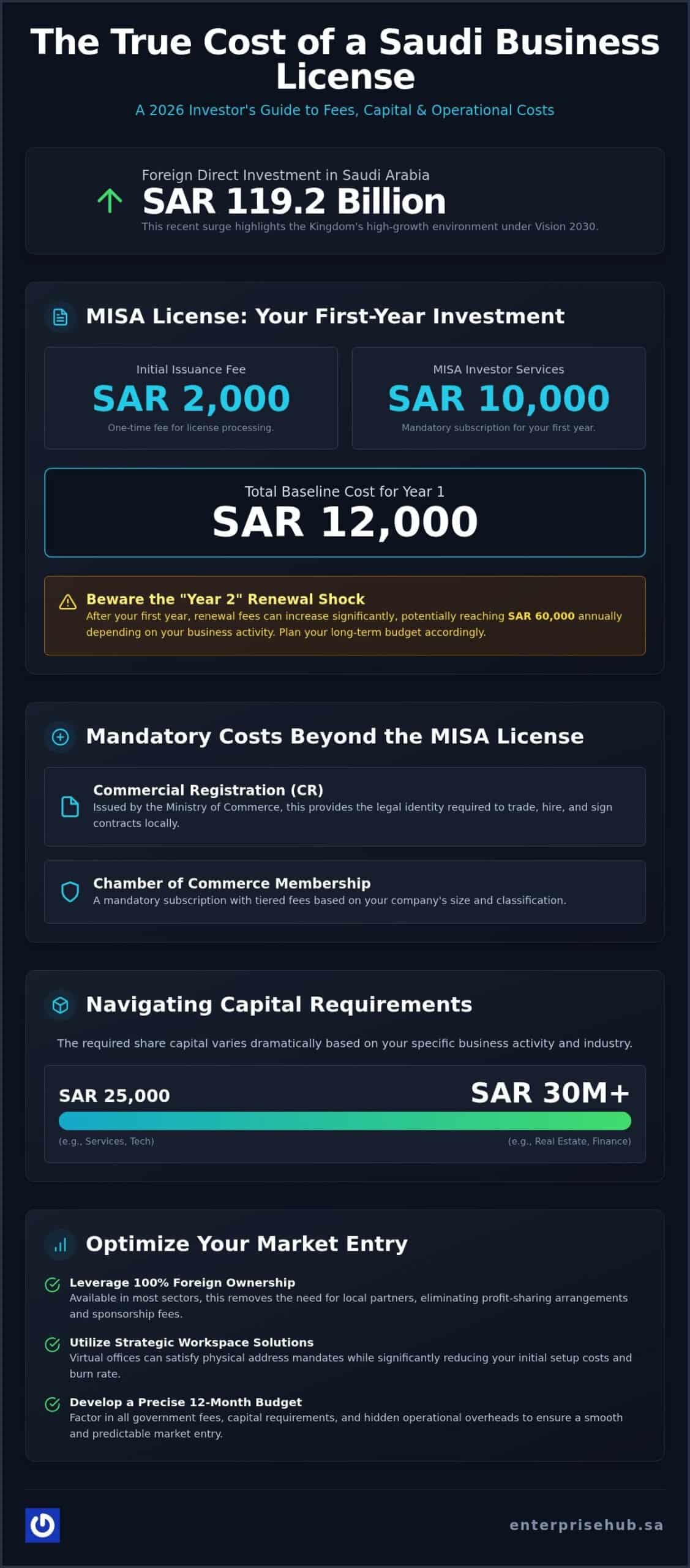
Precision in budgeting is the hallmark of a sophisticated investor. When calculating the cost of business license in Saudi Arabia, you must look beyond the initial application. For 2026, the standard MISA issuance fee remains a lean SAR 2,000. This is paired with a mandatory SAR 10,000 subscription to the MISA Investor Relations Center for the first year. Together, these SAR 12,000 in primary fees represent the baseline for foreign entities. It’s a competitive entry price designed to attract global talent. However, you should prepare for the transition after your first anniversary. Renewal fees in subsequent years can jump significantly, sometimes reaching SAR 60,000 depending on your business activity. This makes choosing the correct license category essential for your long-term fiscal health.
Data from the World Bank’s Doing Business report underscores how these tiered structures help investors align their entry costs with their operational scale. The Kingdom has worked hard to ensure that these fees correlate with the level of support and infrastructure provided to international firms. By understanding these costs upfront, you can build a five-year financial model that remains resilient as your Saudi presence grows.
Cost Variation by License Type: Service, Industrial, and Professional
Your specific business activity dictates your capital requirements and ongoing fees. Service licenses, which are ideal for IT, consulting, and marketing firms, are often the most accessible path. They typically require a minimum capital of SAR 25,000, making them a low-barrier option for service-oriented firms looking to scale quickly. Industrial and agricultural licenses sit at the other end of the spectrum. While they require much higher capital injections, they unlock access to specialized tax incentives and industrial land subsidies that aren’t available to other sectors. Professional licenses are reserved for individual experts, such as legal consultants or specialized engineers. These require proof of qualifications but offer a direct route for practitioners to establish a presence without the overhead of a large corporate structure.
The Entrepreneurial License: A Low-Cost Entry for Startups
Startups and innovators have a unique advantage in 2026. The Entrepreneurial License provides a high-speed, low-cost gateway for companies backed by recognized Venture Capital firms or those holding approved patents. This license type bypasses standard capital requirements and offers deep discounts on government fees during the initial years. It’s a core component of the Kingdom’s strategy to become a global tech hub. Eligible startups can also tap into government support programs that provide recruitment assistance and ecosystem networking. If you’re scaling a disruptive technology, this is the most cost-effective way to secure your footprint. To navigate these choices and build a custom roadmap for your entity, you can reach out to our strategic advisors for a personalized breakdown of your specific requirements.
The Total Cost of Incorporation: Mandatory Fees Beyond the Initial License
Securing your MISA certificate is a major milestone, but it’s only the first step in your financial journey. To understand the complete cost of business license in Saudi Arabia, you must account for the secondary layers of government and administrative fees. Once the investment license is in hand, you must apply for a Commercial Registration (CR) through the Ministry of Commerce. This typically costs around SAR 1,200 annually. Shortly after, you’ll need to join the Chamber of Commerce. This mandatory membership fee isn’t fixed; it scales between SAR 2,000 and SAR 10,000 depending on your company’s classification and capital grade.
We see many investors overlook the “hidden” administrative stack. For instance, obtaining a Municipality (Baladiya) license for your premises can range from SAR 1,000 to SAR 10,000 depending on your activity. While registering with ZATCA for tax and GOSI for social insurance doesn’t carry a direct government price tag, the administrative complexity often requires professional oversight. Citing the breakdown of MISA investment license fees and associated Ministry of Commerce costs helps you visualize the full stack before you commit. This comprehensive view prevents the “fee fatigue” that often hits unprepared startups in their first quarter.
The Physical Office Mandate: A Significant Cost Driver
A physical address isn’t just a convenience; it’s a legal requirement to finalize your Commercial Registration. Traditional office leases are often the largest drain on initial capital due to long-term contracts and expensive fit-outs. We help our partners navigate this by offering a stand-alone shared office that satisfies MISA’s physical address mandates. This approach transforms a heavy fixed cost into a flexible operational asset, allowing you to secure your CR without the financial burden of a five-year lease.
Government Relations Officer (Mandoob) and Legal Fees
Precision in your legal documentation is non-negotiable. Budgeting for a Government Relations Officer (Mandoob) and professional legal counsel is essential for drafting the Articles of Association and handling document authentication. Professional service fees for these tasks generally fall between SAR 10,000 and SAR 25,000. We recommend outsourcing these setup services. It’s the most effective way to prevent costly filing errors and ensure your application moves through the system with the speed your business demands. Investing in expert guidance early on ensures your first 12 months are spent on growth, not regulatory repairs.
Capital Requirements and Operational Overheads: Navigating the Financial Barriers
Liquidity is the lifeblood of your Saudi expansion. While the cost of business license in Saudi Arabia covers the legal right to operate, your capital requirement represents your commitment to the market. These requirements vary wildly by industry. For most service-based licenses, you’ll need a minimum capital of SAR 25,000. However, if you’re entering the trading sector with 100% foreign ownership, that figure can climb to SAR 30 million. It’s vital to view this capital not as a fee, but as operational fuel that remains within your company’s control after the verification process is complete.
Verifying this capital is a structured process. You must deposit the specified amount into a local corporate bank account and obtain a certificate of deposit. This document is a prerequisite for finalizing your Commercial Registration. Beyond the initial deposit, you should budget for ongoing compliance. Annual audits, professional accounting services, and regular ZATCA tax filings are mandatory. These administrative overheads ensure your business remains in good standing, protecting your investment from regulatory penalties or operational freezes.
Banking and Financial Setup Costs
Opening a corporate bank account is a critical milestone that requires patience and precision. Most banks don’t charge exorbitant fees for the account itself, but the “cost” is often measured in time. During the incorporation phase, your capital may be locked for several weeks until the bank finalizes its KYC (Know Your Customer) procedures. Maintaining absolute financial transparency is the cornerstone of 2026 compliance, as the Kingdom continues to integrate advanced digital tracking for all commercial transactions.
Managing the Nitaqat (Saudization) Financial Impact
Your workforce strategy directly influences your initial burn rate. Under the Nitaqat program, businesses are required to hire a specific percentage of Saudi nationals based on their industry and company size. Budgeting for these roles is essential from day one. Additionally, you’ll need to account for expatriate visa costs. Initial issuance for an investor or employment visa typically ranges between SAR 10,000 and SAR 15,000 per person, including mandatory medical insurance. Strategic hiring isn’t just about compliance; it’s about building a balanced team that leverages local insight and global expertise. To ensure your financial model accounts for every variable of the cost of business license in Saudi Arabia, you can consult with our setup experts for a detailed feasibility study.
Ongoing operational success also depends on your ability to manage social insurance contributions through GOSI. These monthly payments are a percentage of your employees’ salaries and represent a fixed operational cost. By mapping out these labor and compliance expenses alongside your licensing fees, you create a realistic 12-month roadmap that avoids the common pitfalls of undercapitalization.
Optimizing Your Market Entry: How Strategic Workspace Solutions Reduce Initial Costs
Strategic market entry requires a balance between regulatory compliance and capital efficiency. While the cost of business license in Saudi Arabia is a fixed government requirement, your largest variable expense is often the physical infrastructure. Traditional commercial leases in Riyadh or Jeddah frequently demand multi-year commitments and significant upfront deposits. We help you bypass these hurdles by providing flexible alternatives that satisfy every legal mandate. By leveraging Virtual Office Packages in Saudi Arabia, you can secure your Commercial Registration without the immediate burden of a long-term real estate contract. This approach preserves your liquidity for market-facing activities during the critical first 12 months.
For firms that require an active presence but aren’t ready for a full-scale headquarters, Coworking and Flexi Desk Solutions offer a rapid testing ground. These all-inclusive spaces consolidate utilities, high-speed internet, and maintenance into a single monthly fee. This transparency eliminates the “hidden” costs of traditional office management. Our integrated setup services further streamline the process by consolidating licensing, CR issuance, and workspace procurement into one managed workflow. This coordination prevents the expensive delays that occur when legal and logistical steps are handled in isolation.
Virtual vs. Physical Offices: A Cost-Benefit Analysis
A virtual office is often sufficient for initial MISA and CR requirements, particularly for service-based and consultancy firms. It provides a verified national address and the necessary documentation for your government file at a fraction of the cost of physical square footage. As your business scales and you begin hiring a local workforce under the Nitaqat program, you can seamlessly transition from a virtual setup to a private, serviced office. This phased approach ensures your infrastructure costs always align with your actual operational needs. Serviced offices also remove the need for initial fit-out capital, which can save you hundreds of thousands of riyals in early-stage setup burn.
Consolidating Setup and Operational Costs
Managing the cost of business license in Saudi Arabia effectively means reducing the friction between different government layers. Choosing “all-in-one” setup packages allows you to bundle legal documentation, Mandoob services, and workspace into a single budget line. This consolidation reduces individual service fees and ensures that your Articles of Association are drafted with your workspace requirements in mind. Additionally, having access to onsite Meeting Rooms and Event Spaces allows you to maintain professional credibility with local partners and clients without the overhead of a large, underutilized boardroom. You only pay for the space you use, ensuring your Saudi presence remains lean, agile, and positioned for long-term growth.
Securing Your Strategic Footprint in the Kingdom’s Future
The economic landscape of 2026 offers unprecedented clarity for international investors ready to align with Vision 2030. You now have the framework to navigate the total cost of business license in Saudi Arabia with precision. By accounting for the full stack of MISA, Commercial Registration, and municipality fees upfront, you eliminate the risk of budget surprises. Leveraging flexible workspace solutions further ensures that you satisfy legal address mandates without sacrificing the liquidity needed for rapid scaling.
Success in this high-growth market depends on moving with speed and regulatory accuracy. We’re committed to turning your market entry into a streamlined, high-ROI operation. Start Your Saudi Expansion with Enterprise Hub’s Expert Setup Services to benefit from our comprehensive support for MISA and CR registration, strategic address solutions, and deep expertise in 2026 Saudi business regulations. Your journey toward regional leadership starts with a single, well-informed step. Let’s build your success story together in the heart of the Middle East’s most dynamic economy.
Frequently Asked Questions
What is the minimum cost to get a MISA license in 2026?
The minimum first-year cost is SAR 12,000 for the primary investment license. This figure consists of a SAR 2,000 initial issuance fee and a mandatory SAR 10,000 subscription to the MISA Investor Relations Center. This baseline fee provides the legal foundation for foreign entities to operate within the Kingdom before secondary administrative costs are applied.
Can I own 100% of my business in Saudi Arabia as a foreigner?
Yes, you can maintain 100% foreign ownership in the majority of economic sectors. The current investment framework has removed the requirement for a local partner in high-growth industries like technology, manufacturing, and professional services. This allows international investors to retain full corporate control and equity without the need for profit-sharing arrangements.
How long does it take to issue a business license after paying the fees?
Issuance typically occurs within 3 to 5 business days once the fees are settled and documentation is verified. Saudi Arabia’s integrated digital platforms have significantly accelerated the process. Once your payment is confirmed through the MISA portal, your Investment Registration Certificate is generated electronically, allowing you to proceed to the Commercial Registration phase immediately.
Are there different costs for an Entrepreneurial license vs. a Service license?
Yes, the Entrepreneurial license offers a significantly lower entry barrier than the standard Service license. Startups backed by recognized Venture Capital firms or those holding patents can access reduced government fees and bypass traditional capital requirements. A Service license, while standard for consultants and IT firms, involves the full subscription fee and typically requires a minimum capital of SAR 25,000.
What are the annual renewal fees for a Saudi business license?
Annual renewal fees can increase to SAR 60,000 starting from the second year of operation. While the initial cost of business license in Saudi Arabia is designed to attract new entries, the renewal fee reflects the ongoing Investor Relations Center support. We recommend that strategic investors build this step-up into their five-year financial models to ensure sustainable growth.
Is a physical office mandatory for obtaining a Commercial Registration?
A physical address is a mandatory requirement to finalize your Commercial Registration with the Ministry of Commerce. However, you don’t need to sign a traditional long-term lease immediately. Flexible workspace solutions and virtual offices satisfy all legal mandates, providing a verified national address that meets government standards at a much lower cost than traditional real estate.
What additional fees should I expect for ZATCA and Chamber of Commerce registration?
You should expect a Commercial Registration fee of approximately SAR 1,200 and a Chamber of Commerce membership fee ranging from SAR 2,000 to SAR 10,000. While ZATCA registration itself doesn’t carry a government price tag, you must account for the administrative costs of maintaining tax compliance, as these are critical for keeping your license active and in good standing.
How can I reduce the initial cost of business setup in Saudi Arabia?
You can significantly reduce the initial cost of business license in Saudi Arabia by utilizing virtual office solutions and outsourcing the setup process to specialists. These strategies eliminate high upfront real estate deposits and prevent costly filing errors. Choosing the right license category and infrastructure early on allows you to launch with a lean budget while maintaining full regulatory compliance.