
Did you know that between January 2024 and July 2025, more than 40,000 visionaries applied for the Saudi Premium Residency program? This massive influx marks a historic shift in the Kingdom’s economic landscape, transforming it into a primary destination for global innovators. If you’re ready to scale your startup in the world’s most dynamic market, learning exactly how to get an entrepreneur visa for Saudi Arabia is the most strategic move you can make this year.
We understand that the path to residency often feels like a maze of complex government portals and confusing regulatory distinctions. You’re likely trying to determine if you need a MISA license first or how to find the right incubator endorsement to qualify. It’s a lot to handle while managing your core business operations. This guide simplifies every step, promising you a clear roadmap to secure your entrepreneurship license and establish a fully compliant business presence. We’ll walk you through updated 2026 funding requirements, residency perks for your team, and the essential setup costs you need to know to launch successfully.
Key Takeaways
- Understand the strategic role of the MISA Entrepreneurship License and how Vision 2030 has streamlined the entry process for innovative global startups.
- Learn the exact requirements for how to get an entrepreneur visa for Saudi Arabia, including securing critical endorsements from accredited venture capitals or incubators.
- Master the application sequence on the MISA e-portal to ensure your submission meets 2026 regulatory standards for a seamless approval process.
- Identify why a compliant physical business address is a legal necessity for your Commercial Registration (CR) and how to avoid common licensing pitfalls.
- Discover how professional government relations and strategic workspace solutions accelerate your transition from visa approval to full operational readiness.
Understanding the Saudi Entrepreneur Visa Landscape in 2026
Vision 2030 has fundamentally reshaped the Saudi economy. It moved the Kingdom from a resource-dependent model to a global innovation hub. This transformation created a streamlined environment for foreign founders. The MISA Entrepreneurship License is a specialized investment permit issued by the Ministry of Investment. It serves as the legal backbone for your startup. You’re no longer just a foreign investor; you’re a strategic partner in a national mission of growth and diversification.
Learning how to get an entrepreneur visa for Saudi Arabia requires recognizing the dual-pathway system now in place. Founders can pursue a standard MISA Investment License or the specialized entrepreneur track within the Saudi Premium Residency program. While both offer significant advantages, the choice depends on your specific funding stage and long-term residency goals. The 2026 landscape offers unprecedented perks, including 100% foreign ownership and the right to bid on government tenders without a local partner. These changes aim to lower entry barriers and accelerate the time it takes for a startup to go from concept to operation.
The Strategic Importance of the MISA License
The MISA Entrepreneurship License is the primary gateway for foreign innovators seeking a foothold in the Gulf’s largest market. It acts as the foundation for every corporate activity. Once you hold this license, you gain access to the Saudi venture capital ecosystem and various government grants. It’s the key to unlocking operational readiness. You’ll need this permit to issue your Commercial Registration (CR) and register with the Ministry of Labor. It simplifies the hiring process and allows you to scale your team quickly to meet market demands. Without this foundation, accessing the full suite of Saudi business incentives remains impossible.
Eligibility: Who Qualifies as an Entrepreneur?
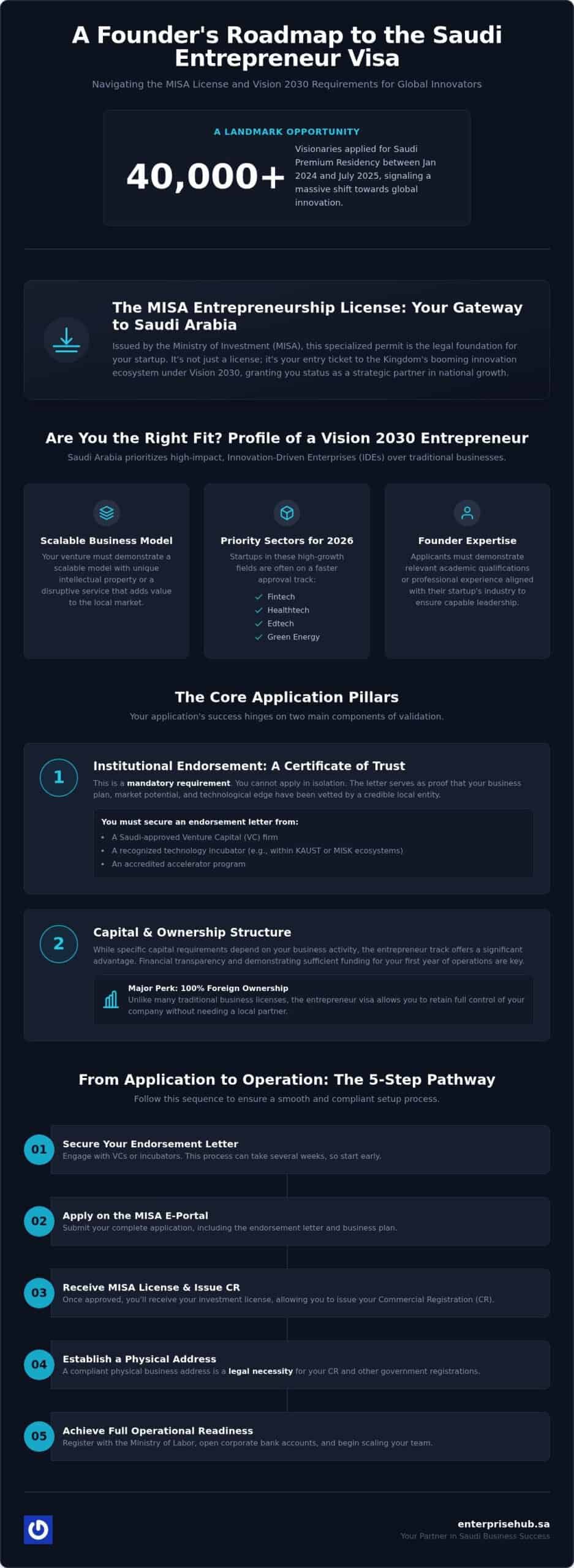
The Saudi government prioritizes Innovation-Driven Enterprises (IDEs) over traditional retail or basic service models. To qualify, your business must demonstrate a scalable model according to Monsha’at standards. In 2026, sector priorities have sharpened. If your startup operates in Fintech, Healthtech, Edtech, or Green Energy, you’re positioned for a faster approval track. You must prove that your venture brings unique intellectual property or a disruptive service to the local market. This isn’t just about starting a business; it’s about introducing innovation that contributes to the Kingdom’s strategic growth. Understanding these sectoral nuances is the first step in mastering how to get an entrepreneur visa for Saudi Arabia effectively.
The Core Requirements: Endorsements and Capital
Precision is paramount. While the Saudi landscape is welcoming, the entry criteria are rigorous to ensure that only sustainable, high-impact ventures receive support. Your journey toward understanding how to get an entrepreneur visa for Saudi Arabia centers on two main pillars: institutional validation and financial readiness. The General Authority for Small and Medium Enterprises (Monsha’at) sets these standards to filter for startups that offer genuine scalability. You must demonstrate that your venture isn’t just a business, but a strategic addition to the Kingdom’s innovation goals.
Compliance begins with your professional background. Applicants must showcase relevant experience or academic qualifications that align with their startup’s sector. This ensures that founders possess the technical and managerial expertise to navigate a competitive G20 economy. The official government announcement regarding these residency tracks emphasizes attracting global talent that can actively contribute to national economic diversification. Meeting these baseline expectations is the first step in positioning yourself as a credible partner in the Saudi market.
Securing an Endorsement Letter
You cannot apply for the entrepreneur track in isolation. You need an endorsement letter from a Saudi-approved incubator, accelerator, or venture capital firm. This document serves as a certificate of trust. Approved entities, such as those within the KAUST or MISK ecosystems, evaluate your business plan for its technological edge and market potential. VCs look for a clear path to profitability and local job creation before issuing their support. Typically, obtaining this institutional backing takes several weeks, so it’s vital to initiate these relationships well before you start the formal visa submission. Without this letter, your application will not proceed through the MISA e-portal.
Capital and Ownership Structure
Financial transparency is non-negotiable. For the Entrepreneur Residency (Category A), you must document a minimum investment of SAR 400,000 from an accredited entity. You are also required to hold at least a 20% ownership stake in the startup. If you are pursuing the established entrepreneur track (Category B), the funding requirement rises significantly to SAR 15,000,000, with a 10% ownership minimum. Beyond the capital, you must appoint a General Manager and provide clear documentation proving the legal source of all funds. Establishing a compliant ownership structure is significantly more efficient when partnering with experts in company formation who understand these specific regulatory nuances. These financial thresholds ensure that every licensed entrepreneur has the liquidity needed to survive the initial phases of market entry and operational setup.
Step-by-Step: How to Apply for the Entrepreneurship License
Transforming your startup vision into a legal reality in the Kingdom requires a disciplined approach to government portals. The process is linear but demands absolute accuracy at every stage. Once you’ve secured your institutional backing, you’re ready to engage with the Ministry of Investment. This transition toward a self-sponsored, innovation-first model is supported by international investment policy analysis, which highlights how these measures align with global trends in attracting high-value human capital. Understanding the sequence of these interactions is the secret to mastering how to get an entrepreneur visa for Saudi Arabia without facing unnecessary delays.
Follow this established roadmap to navigate the regulatory landscape effectively:
- Step 1: Secure your formal endorsement letter from an approved Saudi incubator or venture capital firm.
- Step 2: Register and submit your investment license application through the MISA e-portal, ensuring all data matches your endorsement.
- Step 3: Settle the required license fees upon approval to receive your digital MISA Entrepreneurship License.
- Step 4: Initiate your residency permit or work visa application via the Ministry of Interior’s platforms.
- Step 5: Finalize your Commercial Registration (CR) to obtain your national unified number for business operations.
Navigating the MISA E-Portal
The MISA e-portal is your primary interface with the Saudi investment ecosystem. You’ll need to upload high-quality scans of your passport, endorsement letter, and articles of association. All foreign documents must be translated into Arabic by certified translators and attested by the relevant authorities. A common pitfall is a mismatch between the business activities listed in your endorsement and those selected on the portal. The typical processing time for a MISA entrepreneurship license in 2026 is approximately three to five business days once all documents are verified. Precision in your initial submission prevents the system from flagging your application for manual review, which can extend timelines.
Post-License Documentation
Receiving your license is a major milestone, but it’s not the final step. You must attest your articles of association with a Saudi notary to give them full legal weight. This is followed by mandatory registration with the Chamber of Commerce and the Zakat, Tax and Customs Authority (ZATCA). To manage your future team, you’ll need to link your new business entity to the ‘Qiwa’ and ‘Muqeem’ portals. These platforms handle everything from employment contracts to residency renewals. Completing these registrations quickly ensures you’re fully compliant and ready to hire your first employees. If you’re wondering how to get an entrepreneur visa for Saudi Arabia while keeping these technical steps organized, focusing on portal integration early is key.
Establishing Your Presence: CR and Physical Office
Securing your residency permit is a significant milestone, but your startup isn’t legally operational until you establish a verified physical presence. The Ministry of Commerce requires a registered business address to issue your Commercial Registration (CR). This is where many founders stumble. They focus heavily on the initial steps of how to get an entrepreneur visa for Saudi Arabia but overlook the fact that the license must be anchored to a physical location. The ‘Ejar’ system acts as the digital bridge here. Every lease must be registered on this platform to be recognized by government authorities. Your choice of workspace also dictates your initial Nitaqat status, which determines your ability to hire foreign talent during your first years of operation.
In 2026, regulatory inspections have become more frequent. Authorities verify that the space listed on your CR matches your actual business activities. While the entrepreneur track offers a three-year exemption from standard Saudization quotas, this benefit is contingent on maintaining a compliant office. Choosing an address isn’t just about location; it’s about ensuring your infrastructure meets the rigorous standards set by the Ministry of Investment and the Ministry of Labor. Failure to provide a valid Ejar contract can halt your bank account opening and your ability to issue work permits for your core team.
Choosing a Compliant Business Address
A registered office isn’t just a mailing address; it’s a site for potential inspections. You must distinguish between a simple functional workspace and a registered office that satisfies MISA requirements. For many modern founders, our Virtual Offices in Saudi Arabia: The 2026 Strategic Guide provides the flexibility needed to stay compliant without the high overhead of a large traditional lease. These spaces must include a dedicated desk or private area that meets the minimum square footage required for your specific license type. Ensuring your workspace is pre-approved for government inspections prevents administrative delays that could postpone your market entry by months.
Finalizing the Commercial Registration (CR)
Converting your MISA license into a functional CR is the final hurdle in the establishment phase. This document gives your business its unique legal identity and national unified number. You must select the correct ISIC codes to match your licensed activities exactly. Any discrepancy between your MISA license and your CR can lead to issues with ZATCA or the Ministry of Labor. If you’re setting up in the capital, our دليل تأسيس شركات في الرياض 2026 offers a localized breakdown of the steps required to finalize your registration. We provide the registered office solutions and government navigation services you need at Enterprise Hub to bridge the gap between visa approval and your first day of business.
Maximizing Success with Strategic Support
Securing your residency is just the beginning of your journey in the Kingdom. While understanding how to get an entrepreneur visa for Saudi Arabia is critical, the real challenge lies in maintaining long-term operational excellence. Many founders attempt the DIY route only to face significant delays due to minor documentation errors or missed portal deadlines. A strategic partner provides the local intelligence needed to navigate government relations (PRO services) and ensures your business remains in good standing with all regulatory bodies. This professional oversight allows you to focus on scaling your innovation while experts handle the administrative complexities of the Saudi market.
Success in 2026 requires integrating accounting and tax compliance from your very first day of operation. Registering with the Zakat, Tax and Customs Authority (ZATCA) and implementing E-invoicing are mandatory requirements that carry strict penalties if ignored. By aligning with a partner that offers comprehensive government services and accounting support, you build a resilient foundation. This proactive approach prevents the common pitfalls that hinder foreign startups during their first year. We empower you to transition from a licensed entity to a flourishing market leader through integrated solutions that cover every legal and operational touchpoint.
End-to-End Formation Services
Enterprise Hub manages the entire workflow from your initial MISA application to the final issuance of your Commercial Registration. Having a single point of contact for both legal setup and physical infrastructure eliminates the friction of dealing with multiple vendors. Our Invest in Saudi Arabia 2026: Strategic Analysis details the broader economic shifts that make this unified approach essential. We provide the expertise needed to navigate the nuances of how to get an entrepreneur visa for Saudi Arabia while simultaneously preparing your company for immediate market entry. This ensures your transition is seamless, compliant, and accelerated.
Infrastructure for High-Growth Startups
Your physical environment should catalyze your growth, not limit it. Accessing premium meeting rooms and professional coworking spaces allows you to network with local investors and potential partners in a high-stakes environment. A prestigious business address enhances your brand credibility and meets all regulatory standards for government inspections. If you’re looking for specific locations, our guide on مكاتب للإيجار في الرياض 2026 provides a comprehensive look at the best options for modern startups. We offer scalable workspace solutions that expand alongside your team, ensuring you always have the right infrastructure to support your strategic goals in the region’s most dynamic economy.
Accelerate Your Entry into the Middle East’s Leading Economy
The Saudi market is no longer a future opportunity; it’s a present reality for global founders. By mastering how to get an entrepreneur visa for Saudi Arabia, you unlock a landscape defined by 100% foreign ownership and unprecedented access to the region’s largest venture capital ecosystem. Success requires more than just an idea. It demands institutional endorsements, precise financial documentation, and a compliant physical presence that meets the Kingdom’s rigorous standards.
Navigating these layers of government portals and regulatory requirements doesn’t have to be a solo effort. We provide the strategic bridge you need to move from vision to operation without the typical administrative delays. From expert MISA license guidance and compliant registered office solutions to comprehensive tax and accounting support, we handle the technical details so you can focus on innovation.
Launch your Saudi startup with Enterprise Hub’s expert formation services and join a community of global leaders driving the Kingdom’s economic transformation. Your success is part of a shared journey toward growth and prosperity.
Frequently Asked Questions
Can I get an entrepreneur visa for Saudi Arabia without a local partner?
Yes, you can obtain this visa with 100% foreign ownership. The current regulatory framework allows innovative founders to self-sponsor their ventures without the need for a local Saudi partner. This model provides you with full operational and equity control over your startup while you scale within the Kingdom’s economy.
What is the minimum investment for a Saudi entrepreneurship license in 2026?
For the Category A Entrepreneur Residency, you must secure a minimum investment of SAR 400,000 from an accredited Saudi entity. If you’re applying for the Category B track for established entrepreneurs, the requirement increases to SAR 15,000,000. These funds must be documented and verified during the application process to prove financial stability.
How long does the MISA entrepreneur visa application take?
The MISA entrepreneurship license itself is typically issued within 3 to 5 business days after your documents are verified on the e-portal. However, the entire process of how to get an entrepreneur visa for Saudi Arabia, including institutional endorsements and final residency permits, generally takes several weeks. Planning for a one to two-month timeline ensures you can manage all government portal interactions without rushing.
Do I need a physical office to get my entrepreneur visa approved?
Yes, a physical office address is a mandatory requirement for issuing your Commercial Registration (CR). You must have a valid lease agreement registered in the ‘Ejar’ system to prove your business has a functional presence in the Kingdom. This address is used for official government inspections and is a prerequisite for opening corporate bank accounts.
Is the Saudi entrepreneur visa the same as Premium Residency?
The Entrepreneur Residency is a specific category sitting under the umbrella of the Saudi Premium Residency program. While people often use the terms interchangeably, the entrepreneur track is tailored for founders who have secured institutional backing. It offers unique benefits, such as a three-year exemption from Nitaqat labor quotas and the ability to nominate employees for talent residency.
Can I bring my family to Saudi Arabia on an entrepreneur visa?
Yes, the entrepreneurship residency allows you to sponsor your spouse and children for residency. This is a core feature of the program designed to help global innovators build a stable life in the Kingdom. Your family will have access to local healthcare and education services once their permits are processed.
What happens if my startup fails while I am on an entrepreneur visa?
Your residency status is directly tied to the validity of your MISA investment license and your business operations. If the startup ceases to exist or the license is revoked, your residency status may be impacted. However, the Saudi government often provides grace periods or alternative tracks for founders to pivot their business models or restructure their legal presence.
Can I change my business activity after the MISA license is issued?
You can modify or expand your business activities, but it requires formal approval from MISA. Any change must be reflected in your articles of association and your Commercial Registration. You’ll need to update your ISIC codes to ensure your startup remains compliant with the specific sector regulations governing your new activities.