
Getting a commercial license in Saudi Arabia used to be a relatively straightforward process. In 2026, it’s something else entirely. The commercial license requirements in Saudi Arabia now demand alignment across multiple government authorities, a verified physical address, and in many cases, compliance with Regional Headquarters mandates that simply didn’t exist a few years ago. This isn’t a single form and a fee; it’s a layered certification process that catches unprepared investors off guard.
You already know the Kingdom is one of the most compelling markets in the region. The opportunity is real, the regulatory momentum is real, and so is the complexity of getting it right. Businesses that underestimate the interplay between MISA, Balady, and the Ministry of Commerce don’t just face delays; they face compliance costs that can derail an entire market entry strategy.
This guide cuts through that complexity. By the end, you’ll have a clear checklist of legal, financial, and operational requirements, a realistic picture of approval timelines, and a framework for choosing the right setup partner to handle the bureaucracy on your behalf. Let’s build your path to the Kingdom, step by step.
Key Takeaways
- The commercial license requirements in Saudi Arabia in 2026 involve coordinated approvals across MISA, the Ministry of Commerce, and Balady — understanding this layered process is the difference between a smooth entry and a costly delay.
- Your ownership structure determines your capital threshold: 100% foreign-owned entities and joint ventures follow different financial and legal paths, and choosing the wrong model upfront can set your timeline back significantly.
- A verified physical address is not optional — it is a regulatory prerequisite, and the right workspace solution can satisfy this requirement while keeping your operational costs lean from day one.
- Vision 2030 reforms have genuinely improved the investment climate, but the licensing process still demands precise documentation, including Articles of Association and Board Resolutions, before any authority will move forward.
- Selecting the right setup partner — one with direct expertise in government relations and MISA compliance — can compress your approval timeline and eliminate the compliance risks that derail unprepared investors.
Navigating the Saudi Commercial Licensing Landscape in 2026
A commercial license in Saudi Arabia is the legal instrument that authorizes a business entity to trade, import, export, or deliver services within the Kingdom. It’s not a formality. It’s the foundation on which every operational, financial, and contractual right your business holds in the KSA is built. Without it, you don’t have a business; you have a liability.
The commercial license requirements in Saudi Arabia have been reshaped significantly by Vision 2030. The National Transformation Program pushed Saudi Arabia up the World Bank’s Ease of Doing Business rankings by digitizing key approval pathways and consolidating registration steps across government platforms. What once required weeks of manual submissions across disconnected ministries now moves through integrated digital systems. That progress is real, but it doesn’t eliminate the need for precision. It shifts the burden from paperwork volume to documentation accuracy.
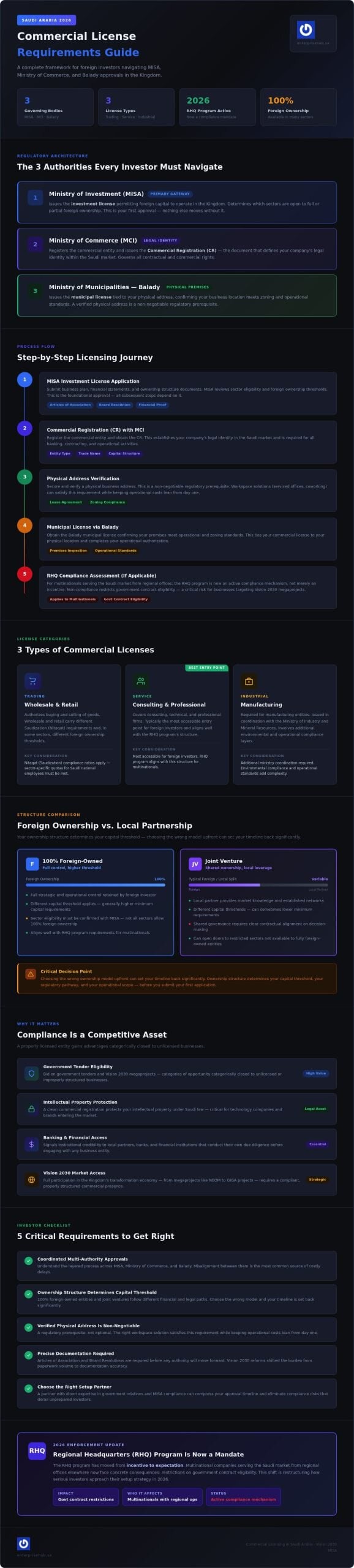
Three governing bodies define the licensing architecture every investor must understand:
- Ministry of Investment (MISA): The primary gateway for foreign investors. MISA issues the investment license that permits foreign capital to operate in the Kingdom and determines which sectors are open to full or partial foreign ownership.
- Ministry of Commerce (MCI): Registers the commercial entity, issues the Commercial Registration (CR), and governs the company’s legal identity within the Saudi market.
- Ministry of Municipalities and Housing (Balady): Issues the municipal license tied to your physical premises, confirming that your business location meets zoning and operational standards.
2026 is a pivotal year for one specific reason: the Regional Headquarters (RHQ) program has matured into an active compliance mechanism. Multinational companies that serve the Saudi market from regional offices elsewhere now face concrete consequences, including restrictions on government contract eligibility. The program has moved from incentive to expectation, and that shift is restructuring how serious investors approach their setup strategy.
Types of Commercial Licenses Available
Your license type determines your regulatory pathway, your capital obligations, and your operational scope. The three primary categories are:
- Trading Licenses (Wholesale and Retail): Authorize the buying and selling of goods. Wholesale and retail activities carry different Saudization (Nitaqat) requirements and, in some sectors, different foreign ownership thresholds.
- Service Licenses: Cover consulting, technical, and professional firms. These are typically the most accessible entry point for foreign investors and align well with the RHQ program’s structure.
- Industrial Licenses: Required for manufacturing entities and issued in coordination with the Ministry of Industry and Mineral Resources. These involve additional environmental and operational compliance layers.
The Strategic Importance of Compliance
Compliance isn’t just about avoiding penalties. It’s a competitive asset. A properly licensed entity in Saudi Arabia can bid on government tenders and Vision 2030 megaprojects, categories of opportunity that are categorically closed to unlicensed or improperly structured businesses. Beyond tenders, a clean commercial registration protects your intellectual property under Saudi law and signals institutional credibility to local partners, banks, and financial institutions that conduct their own due diligence before engaging. Understanding the full scope of commercial license requirements in Saudi Arabia from the outset is what separates businesses that scale from those that stall.
Essential Legal and Financial Requirements for Commercial Licenses
Meeting the commercial license requirements in Saudi Arabia starts long before you submit your first application. The documentation and capital structure you bring to the table determine which regulatory pathway opens to you and which doors stay firmly closed. Get this foundation wrong, and no amount of local expertise will recover the time you’ve lost.
Two requirements sit at the core of every foreign business setup: a legally sound corporate structure and a verified physical presence. Neither is negotiable, and both require preparation that begins in your home country.
Documentation Checklist for International Investors
Every authority in the approval chain, MISA, the Ministry of Commerce, and Balady, will demand a consistent set of documents. Inconsistencies between submissions are the single most common cause of processing delays. Prepare these before initiating any application:
- Attested passport copies for all shareholders and directors, authenticated through the relevant Saudi embassy or consulate in your home country.
- Home country commercial registration, fully attested and translated into Arabic by a certified legal translator.
- Articles of Association (AoA) for the parent entity, establishing the legal authority of the individuals signing on behalf of the company.
- Board Resolution authorizing the Saudi market entry, naming the authorized signatory, and confirming the proposed ownership structure.
- Power of Attorney (PoA) appointing your local representative in the Kingdom. This document carries significant legal weight; it must be drafted precisely and attested accordingly.
- Audited financial statements from the parent company, typically covering the most recent two to three fiscal years. This is a transparency requirement that many competitors’ guides overlook entirely.
- MISA investment license, which must be secured before the Ministry of Commerce will process your Commercial Registration (CR). The sequence is fixed; there’s no parallel-tracking this step.
Capital and Shareholding Structures
Ownership structure directly shapes your capital obligations. Joint ventures with Saudi partners generally carry lower minimum capital thresholds, while 100% foreign-owned entities in retail face substantially higher requirements. The commonly cited SAR 30 million minimum for fully foreign-owned retail operations reflects a longstanding policy position, but specific thresholds can vary by sector and activity classification. Verify the current figure applicable to your specific commercial activity with MISA directly before committing to a structure.
The investment landscape in Saudi Arabia has shifted meaningfully with the RHQ program’s maturation. Companies that establish a Regional Headquarters in the Kingdom may access preferential licensing conditions and, critically, remain eligible for government procurement. Those still operating from regional offices outside the Kingdom face growing eligibility restrictions. The RHQ program isn’t just a strategic advantage anymore; it’s becoming a baseline requirement for serious market participation.
The physical address requirement deserves direct attention. A registered commercial address isn’t a formality you satisfy with a P.O. box. Balady requires a verifiable, operational premises tied to your business activity. A premium virtual office or private workspace can satisfy this requirement cost-effectively from day one, giving your entity a credible address while keeping overhead lean during the setup phase. Explore workspace solutions designed to meet Saudi licensing standards without locking you into long-term real estate commitments before your operations are established.
Strategic Comparison: Foreign Ownership vs. Local Partnerships
The ownership decision you make at the outset shapes every dimension of your Saudi market entry: capital requirements, tax treatment, Saudization targets, and how quickly you can move through the approval chain. Understanding this choice is central to meeting the commercial license requirements in Saudi Arabia on your terms, not the regulator’s default terms.
Pros and Cons of 100% Foreign Ownership
Full foreign ownership delivers something genuinely valuable: complete operational autonomy. Your brand standards, pricing decisions, profit distribution, and long-term strategy remain entirely within your control. There’s no negotiation with a local partner over dividends, no alignment required on operational direction, and no ambiguity about intellectual property ownership. Profit repatriation is direct and unencumbered by partnership agreements.
The trade-off is real, though. MISA applies more stringent performance benchmarks to fully foreign-owned entities, including higher Saudization (Nitaqat) targets that must be met to maintain your license in good standing. Capital thresholds are also higher, particularly in retail. Verify the current minimum applicable to your specific commercial activity directly with MISA before locking in a structure, as these figures are sector-specific and subject to regulatory revision.
The Role of Local Partners in 2026
Joint ventures aren’t a concession. In the right sectors and contexts, they’re a genuine strategic accelerator. A credible Saudi partner brings established government relations, cultural fluency in procurement processes, and existing relationships with municipal authorities that can meaningfully compress your Balady approval timeline, particularly in niche sectors where local trust carries institutional weight.
The capital hurdle is also lower in joint venture structures, which matters for businesses prioritizing capital efficiency in their early operational phase. For a deeper look at how partnership structures interact with registration timelines and entity formation, review our guide on business setup in Saudi Arabia.
One distinction that’s often underestimated is the difference between a professional license and a commercial license. Service-oriented businesses, particularly consulting and advisory firms, frequently qualify for a professional license rather than a full commercial registration. The regulatory pathway is distinct, the capital requirements differ, and the Saudization obligations are structured differently. Choosing the wrong license category doesn’t just create administrative friction; it can mean operating under obligations that don’t fit your actual business model.
Tax treatment adds another layer to this decision. Saudi national partners are subject to Zakat on their share of profits, while foreign shareholders pay Corporate Income Tax at the standard rate on their portion. In a joint venture, both tax regimes apply simultaneously to their respective ownership shares. Structuring your equity split without accounting for this creates surprises at year-end that could have been avoided with proper planning from the start.
The right structure isn’t universal. It’s specific to your sector, your capital position, your operational model, and your growth timeline in the Kingdom.
Step-by-Step Guide to Issuing Your Saudi Commercial License
The licensing process follows a fixed sequence. Each phase unlocks the next, and no authority will process your application out of order. Understanding this architecture before you begin is what separates a clean, predictable timeline from a cycle of resubmissions and waiting rooms.
Phase 1: MISA Investment License
Foreign entities start here, without exception. Submit your investment license application through the MISA portal, along with your attested corporate documents and audited financials. MISA reviews your proposed activity against the Foreign Investment Positive List to confirm sector eligibility and ownership permissions. Average processing time runs between five and ten business days for complete applications. Incomplete submissions reset that clock entirely.
Phase 2: Trade Name Reservation
Once MISA approves your investment license, move immediately to the Ministry of Commerce portal to reserve your trade name. The name must comply with Arabic naming conventions, avoid prohibited terms, and not conflict with existing registrations. Reserve two or three alternatives in advance. Name rejections are common and add days to your timeline if you haven’t prepared backups.
Phase 3: Commercial Registration (CR)
The Ministry of Commerce issues the CR after reviewing your Articles of Association, the MISA license, and your confirmed trade name. This is your entity’s legal identity in the Kingdom. The CR must accurately reflect your licensed commercial activities; mismatches between the CR activity list and your actual operations create compliance exposure during renewal cycles.
Phase 4: Municipal and Civil Defense Permits
Balady and Civil Defense (Salamah) approvals run in parallel after CR issuance. Both are tied to your physical premises.
Your office lease must be registered through the Ejar platform before Balady will process your municipal license application. The Ejar-registered contract links directly to the Balady portal, confirming the premises’ legal status. Balady then verifies zoning compliance for your specific commercial activity. Civil Defense inspects the premises against fire safety and evacuation standards before issuing the Salamah certificate. Don’t schedule the Civil Defense inspection until your space is fully fitted out; a failed inspection adds weeks, not days.
The Instant License feature on Balady is available for a defined list of low-risk activities, primarily simple retail and service categories. It bypasses the standard municipal review cycle but doesn’t eliminate the Civil Defense requirement. If your activity isn’t on the eligible list, standard processing applies.
Phase 5: Chamber of Commerce and Labor Office Registration
The final phase covers Chamber of Commerce membership, which is mandatory for most commercial entities, and Labor Office registration, which opens your Nitaqat compliance file and enables you to issue work visas. Both registrations are completed digitally and typically process within two to three business days.
Timeline and Costs
End-to-end, a well-prepared application moves through all five phases in four to eight weeks. MISA and MCI approvals are the longest stages; Balady and Chamber registrations are faster when your documentation is clean. Government fees vary by entity type, capital structure, and activity classification. Chamber of Commerce subscriptions are tiered by capital size.
The most common bottleneck across all phases is documentation inconsistency: a name spelled differently across the AoA, the MISA application, and the CR triggers review holds that compound across every subsequent step. Professional Government Relations Officers (GROs) who manage submissions directly with each authority eliminate this risk and keep your timeline moving without gaps between phases.
Meeting the commercial license requirements in Saudi Arabia precisely, at every phase, is what protects your market entry investment. Work with Enterprise Hub’s business setup team to manage your licensing process end-to-end, from MISA submission through Chamber registration, with a verified commercial address included from day one.
Beyond the License: Establishing a High-Performance Business Presence
Securing your commercial license is the starting line, not the finish. What comes next determines whether your Saudi market entry delivers on its strategic promise or stalls in operational friction. The businesses that scale quickly in the Kingdom treat licensing and physical presence as a single integrated decision, not two separate projects managed months apart.
This is the gap most guides miss entirely. They treat the physical address requirement as a checkbox buried in the documentation list. It isn’t. Your office address is a regulatory instrument. It appears on your Commercial Registration, your MISA license, your Balady municipal permit, and every government filing that follows. An address that satisfies one authority but not another creates compliance inconsistencies that surface at renewal, not at setup, when the cost of correction is far higher.
Workspace Solutions that Meet Regulatory Standards
Enterprise Hub’s workspace solutions are designed specifically around this regulatory reality. For businesses in early-stage market entry, a virtual office in Saudi Arabia provides a prestigious, verifiable business address that satisfies the CR and MISA address requirements without locking you into long-term real estate overhead before your operations are established. It’s a structurally sound starting point, not a workaround.
For companies that require a physical footprint from day one, private offices deliver the verified presence that MISA compliance audits demand. A dedicated office within a premium business hub provides the documentation trail, the professional environment, and the operational credibility that government inspections and banking relationships both require. The address on your license and the address on your lease match precisely, because they’re the same address.
Comprehensive Support Services
Meeting the commercial license requirements in Saudi Arabia is a one-time milestone. Maintaining compliance is an ongoing operational discipline. Three service categories matter most in the post-license phase:
- Accounting and tax compliance: Corporate Income Tax filings, VAT returns, and Zakat obligations all carry fixed deadlines. Integrated accounting support ensures your financial reporting stays current with GAZAN standards and that your tax position is managed proactively, not reactively at year-end.
- Government Relations (GRO) services: Your MISA license, CR, and municipal permits all carry renewal cycles. A dedicated GRO manages those renewals, tracks expiry dates, and handles submissions directly with each authority, so your licenses never lapse and your operational continuity is never at risk.
- Company formation support: For businesses still finalizing their structure, end-to-end formation services cover entity registration, document attestation, and portal submissions across every phase of the licensing sequence.
The value of consolidating these services under one partner isn’t convenience. It’s coherence. When your workspace, your licensing, your GRO, and your accounting operate as a unified system, the documentation stays consistent across every authority, every filing, and every renewal cycle. That consistency is what protects your investment in the Kingdom over the long term.
Partner with Enterprise Hub for your Saudi expansion and move from licensing to operational excellence with a team that manages every layer of your market entry, from your first MISA submission to your ongoing compliance calendar.
Your Saudi Market Entry Starts with the Right Foundation
The commercial license requirements in Saudi Arabia in 2026 are demanding by design. They reflect a market that’s serious about who participates in it, and that seriousness works in your favor once you’re properly established. The investors who move confidently through MISA, the Ministry of Commerce, and Balady are the ones who prepared their documentation precisely, chose their ownership structure deliberately, and treated their physical address as a regulatory asset, not an afterthought.
Three things determine your outcome: the accuracy of your documentation, the structure of your entity, and the quality of the partner managing your approvals. Get those right, and the Kingdom’s opportunity opens up fully.
Enterprise Hub brings together MISA-compliant office solutions, end-to-end business setup and government relations support, and a strategic presence in the Kingdom’s premier financial districts. Everything your market entry requires is available under one roof.
Secure your Saudi commercial license with Enterprise Hub’s expert support and build your presence in the Kingdom on ground that holds.
Frequently Asked Questions About Commercial License Requirements in Saudi Arabia
What is the minimum capital for a commercial license in Saudi Arabia?
Minimum capital requirements vary significantly by ownership structure and commercial activity. Fully foreign-owned retail operations face substantially higher thresholds than joint ventures with Saudi partners, with figures commonly cited around SAR 30 million for certain retail categories. Service-oriented businesses generally face lower requirements. Because these thresholds are sector-specific and subject to regulatory revision, confirm the exact figure applicable to your activity directly with MISA before committing to a structure.
Can a foreigner own 100% of a commercial business in the KSA?
Yes, 100% foreign ownership is permitted across a broad range of sectors in Saudi Arabia, particularly in services, consulting, and technology. MISA maintains a Foreign Investment Positive List that defines which activities are open to full foreign ownership and which require a Saudi partner. Some sectors remain restricted or require joint venture structures. Checking your specific activity classification against the current Positive List before choosing your ownership model is essential, not optional.
How long does it take to get a commercial license in Saudi Arabia?
A well-prepared application moving through all five phases, from MISA investment license to Chamber of Commerce registration, typically completes in four to eight weeks. MISA review runs five to ten business days for complete submissions. The most common cause of delays isn’t the authorities themselves; it’s documentation inconsistencies that trigger review holds at multiple stages simultaneously, compounding your total timeline in ways that are entirely avoidable with proper preparation.
What is the difference between a MISA license and a Commercial Registration (CR)?
They serve distinct functions and neither replaces the other. The MISA investment license authorizes foreign capital to operate in the Kingdom and confirms sector eligibility. It’s the prerequisite that unlocks everything else. The Commercial Registration, issued by the Ministry of Commerce, is your entity’s legal identity within the Saudi market. The sequence is fixed: MISA approval comes first, and the Ministry of Commerce won’t process your CR until that investment license is in hand.
Do I need a physical office to get a commercial license in Saudi Arabia?
Yes, a verifiable physical address is a genuine regulatory requirement, not a formality. Your premises must be registered through the Ejar platform before Balady will process your municipal license. A P.O. box doesn’t satisfy this requirement. A premium virtual office or private workspace can meet the regulatory standard cost-effectively, providing a credible, documented address that appears consistently across your CR, MISA license, and municipal permit without committing to long-term real estate overhead before your operations are established.
What are the annual fees for maintaining a commercial license in Saudi Arabia?
Ongoing costs include CR renewal fees, Chamber of Commerce subscription fees (tiered by capital size), and municipal license renewals. The exact amounts vary by entity type, activity classification, and capital structure, so quoting a universal figure here would be misleading. What’s consistent across all entities is that each license and permit carries its own renewal cycle with fixed deadlines. Missing a renewal doesn’t just incur a penalty; it can create compliance gaps that affect your ability to operate, issue visas, and bid on contracts.
Can I change my commercial activity after the license is issued?
Yes, commercial activity amendments are possible after your CR is issued, but the process isn’t simple. You’ll need to apply through the Ministry of Commerce to update your activity list, and depending on the nature of the change, MISA may also need to review and approve the amendment against the Foreign Investment Positive List. Some activity changes trigger revised capital requirements or Saudization targets. Treating your initial activity selection as a permanent decision rather than a placeholder saves significant administrative effort down the line.
Is the Regional Headquarters (RHQ) license mandatory for all foreign companies?
The RHQ program isn’t a universal legal requirement for every foreign company operating in Saudi Arabia. It applies specifically to multinational companies that serve the Middle East region and want to remain eligible for Saudi government contracts and procurement opportunities. As of 2026, the program has matured from an incentive structure into an active compliance mechanism with concrete consequences for non-participation. Companies that serve the Saudi market from regional offices elsewhere now face growing eligibility restrictions on government tenders, making the RHQ decision a strategic one with direct commercial implications.