
Saudi Arabia’s non-oil tax revenue grew by more than 120% between 2015 and 2025, signaling a definitive shift toward a transparent, high-growth economy that rewards compliant businesses. You’ve likely recognized that the Kingdom is currently the premier global destination for expert advisors, yet the technicalities of how to set up a consulting firm in Saudi Arabia often feel clouded by bureaucratic complexity. It’s natural to feel concerned about navigating the 40% Saudization workforce quota or choosing between the various MISA license types while trying to secure a prestigious physical presence.
This strategic guide provides a definitive roadmap for your expansion, ensuring you bypass common pitfalls to launch a fully compliant and high-growth practice. We’ll explore the step-by-step journey from securing your initial investment license to establishing a prestigious business address that meets 2026 regulatory standards. You’ll gain a clear understanding of the current fee structures, workspace mandates, and financial frameworks required to move from a vision to a fully operational legal entity with confidence.
Key Takeaways
- Understand the strategic growth of the Kingdom’s professional services sector and how it aligns with Vision 2030 objectives for 2026.
- Master the essential five-step roadmap of how to set up a consulting firm in Saudi Arabia, from securing your MISA license to final commercial registration.
- Learn how to select a compliant workspace solution that fulfills mandatory physical address requirements while enhancing your firm’s professional credibility.
- Navigate the 2026 regulatory landscape, including ZATCA-compliant e-invoicing systems and specific Saudization quotas for the consulting industry.
- Discover how to streamline your operational launch by integrating legal setup, government relations, and accounting services through a single strategic partner.
The Consulting Landscape in Saudi Arabia: Why Now?
Saudi Arabia represents the world’s most ambitious economic laboratory. The drive toward Saudi Vision 2030 has created a vacuum for high-level expertise that only specialized firms can fill. This isn’t about traditional oil and gas anymore. It’s about digital transformation, sustainable urban planning, and sophisticated financial modeling. If you’re wondering how to set up a consulting firm in Saudi Arabia, the timing is critical because the Kingdom is moving rapidly from the planning phase to full-scale execution.
Vision 2030 and the Advisory Boom
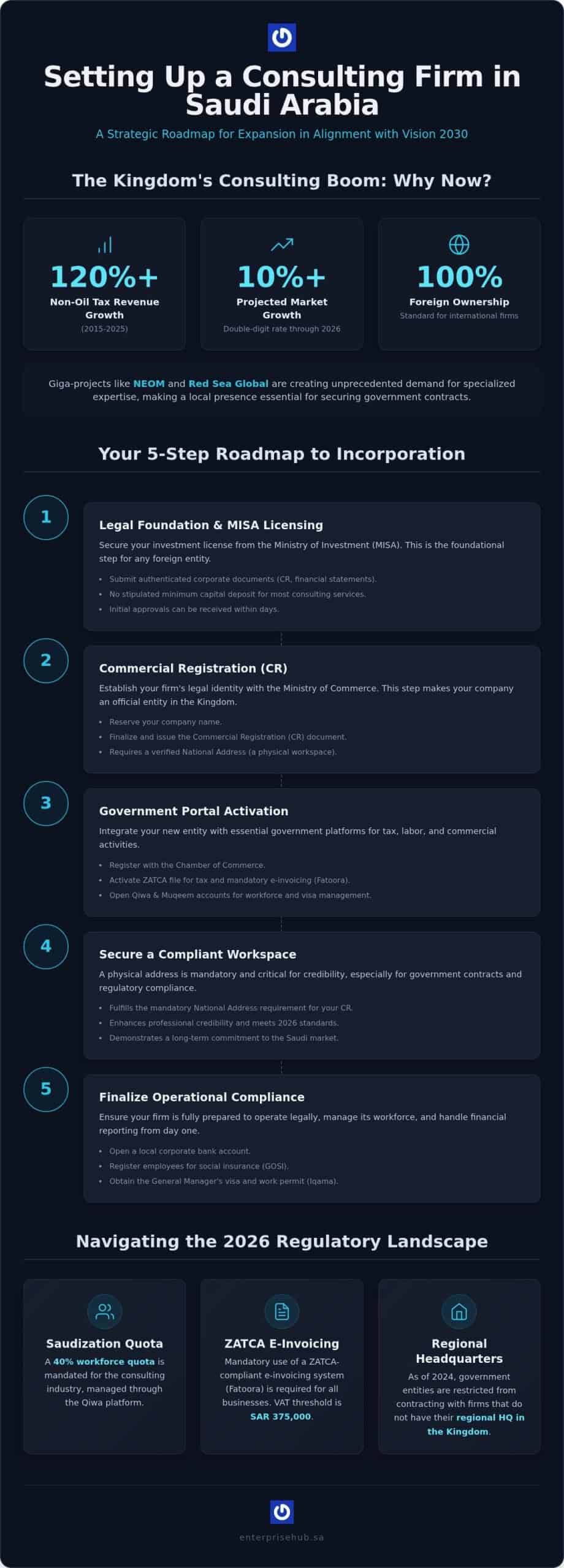
National transformation projects like NEOM and the Red Sea Global initiatives demand a constant stream of niche expertise. These giga-projects don’t just need generalists; they require specialists in everything from water desalination to AI ethics. The Saudi consulting market is projected to maintain a double-digit growth rate through 2026, outperforming most global benchmarks. Having a local presence isn’t just a “nice to have” anymore. It’s a fundamental requirement for securing government-linked contracts. Public sector entities now prioritize firms that demonstrate a long-term commitment to the Kingdom’s soil through physical offices and local teams.
Foreign Ownership and Regulatory Evolution
Securing 100% foreign ownership is now a standard reality for international firms. Regulatory hurdles that once hindered international experts have largely been dismantled, allowing you to establish a firm without a local partner in most service categories. This change has fundamentally altered the competitive landscape. However, the introduction of the Regional Headquarters (RHQ) program adds a layer of strategy to your entry. As of 2024, the government has restricted contracting with foreign companies that don’t have their regional headquarters in the Kingdom. This policy ensures that the value created by consulting services stays within the local economy.
Engaging with the regulatory gatekeepers requires a clear understanding of the Ministry of Investment (MISA) and the Ministry of Commerce. These bodies have streamlined the process to make it as friction-less as possible. Mastering how to set up a consulting firm in Saudi Arabia requires a grasp of this ecosystem, where ZATCA manages your tax compliance and the Ministry of Human Resources oversees your 40% Saudization quotas. The shift toward specialized advisory means the scope of your MISA license must be precisely defined. Whether you provide engineering, management, or financial consulting, each sub-category carries specific professional requirements. For example, engineering consultants must often register with the Saudi Council of Engineers. This precision ensures your firm remains legally protected and eligible for the right tenders.
5 Essential Steps to Incorporate Your Consulting Firm
Success in the Saudi market depends on a precise sequence of actions. You can’t skip steps or ignore the digital integration required by today’s regulators. Navigating the technicalities of how to set up a consulting firm in Saudi Arabia requires a disciplined approach to the following five foundational phases.
Phase 1: Legal Foundation and MISA Licensing
Securing your investment license from the Ministry of Investment (MISA) is your first priority. For international entities, this involves submitting authenticated corporate documents, including your parent company’s commercial registration and audited financial statements. In 2026, the process is remarkably efficient; initial approvals often arrive within days once your documentation is verified. It’s a common misconception that you need massive capital to start. For most consulting sub-sectors, there’s no longer a stipulated minimum capital requirement. While you’ll likely state a nominal amount like SAR 25,000 in your Articles of Association, you don’t need to deposit this upfront in a local bank to get started.
Phase 2: Commercial Registration and Government Portals
Once you have your MISA license, you’ll move to the Ministry of Commerce to reserve your name and finalize your Commercial Registration (CR). This document is your firm’s identity. You must link your CR to a verified National Address, which is why securing a physical workspace early is vital. Following this, you’ll register with the Chamber of Commerce and activate your files with the Zakat, Tax and Customs Authority (ZATCA). Even if you haven’t hit the SAR 375,000 VAT threshold yet, early registration ensures your systems are ready for the mandatory e-invoicing (Fatoora) requirements. Finally, you’ll open accounts on the Qiwa and Muqeem platforms to manage your 40% Saudization quotas and employee visas. Managing these multiple portals can be daunting, but our team provides comprehensive business setup services to ensure every digital link is correctly established from day one.
Your final step involves registering with the General Organization for Social Insurance (GOSI). This is mandatory for all employees, both Saudi and expat. By completing this five-step roadmap, you transition from an international prospect to a fully recognized Saudi entity, ready to compete for the Kingdom’s most prestigious advisory contracts. Understanding how to set up a consulting firm in Saudi Arabia is about mastering these integrations to ensure your license remains active and your operations stay fully compliant.
Workspace Strategies: Meeting MISA and Operational Needs
Securing a physical footprint is a mandatory milestone in the journey of how to set up a consulting firm in Saudi Arabia. Regulators at MISA require a verified lease or a service agreement to issue your investment license. This isn’t just a administrative hurdle. Your choice of workspace directly impacts your firm’s professional image and its ability to win high-value contracts. According to Forbes on gaining credibility in the Saudi market, a local presence is a primary factor in building trust with Saudi stakeholders who value face-to-face engagement and long-term commitment.
Private Offices vs. Virtual Solutions
Determining which model fits your firm depends on your immediate headcount and long-term expansion goals. For many international advisors, Virtual Offices in Saudi Arabia offer a compliant and cost-effective entry point. This model provides the necessary legal address for your Commercial Registration while keeping overhead minimal during the initial setup phase. However, as you begin active consulting, the need for privacy becomes paramount. High-stakes advisory requires a space where data is secure and conversations are shielded. Private offices within a managed hub provide this confidentiality without the logistical headaches of a traditional long-term commercial lease.
Infrastructure for Consultants
Boutique firms and specialized practitioners often struggle with the hidden costs of setting up a traditional office. From high-speed internet and secure IT infrastructure to professional reception services, the expenses add up quickly. Managed workspaces eliminate these variables by providing a plug-and-play environment. This allows you to focus on client delivery rather than office management. For firms that operate primarily on-site with clients but need a prestigious base for pitches, using meeting rooms for rent provides a high-impact environment on an as-needed basis.
Scalability is the final piece of the workspace puzzle. The consulting sector in the Kingdom is fast-moving. A team of three consultants in early 2026 could easily double by year-end as giga-project tenders are awarded. Choosing a flexible provider ensures you can upgrade from a few desks to a dedicated suite without the friction of moving your legal address or updating your MISA license details. This agility is a strategic advantage when mastering how to set up a consulting firm in Saudi Arabia, allowing you to scale your physical presence at the same pace as your revenue.
Operational Compliance: Tax, Accounting, and Labor
Running a consulting practice in the Kingdom requires more than just expert advice; it demands a flawless back-office operation. The regulatory environment has moved toward a digital, data-driven model where transparency is the baseline. If you’re learning how to set up a consulting firm in Saudi Arabia, you must prepare for a compliance schedule that leaves no room for error. The era of “grey-area” compliance is over, and your firm’s longevity depends on precise reporting from day one.
Financial Management and ZATCA Compliance
Foreign investors face a 20% corporate income tax rate on their share of the firm’s net profits. If your firm includes Saudi or GCC partners, their share is instead subject to Zakat at 2.5% of the Zakat base. Beyond these direct taxes, the Zakat, Tax and Customs Authority (ZATCA) requires every consulting firm to implement the FATOORAH e-invoicing system. We’ve entered Phase 2, the Integration Phase, which means your billing software must link directly to ZATCA’s portal for real-time validation of every invoice issued. Don’t overlook the necessity of annual audited financial statements. These aren’t just for tax filing; they’re a mandatory requirement for renewing your MISA investment license and maintaining your legal standing in the Kingdom.
Talent Acquisition and Saudization
The Nitaqat program is the formal framework that governs your workforce composition. For consulting and professional services, the current Saudization quota is 40%. This requires strategic workforce planning. To count toward your quota, each Saudi employee must receive a minimum monthly salary of SAR 4,000. Managing these roles happens through the Qiwa platform, which serves as the central hub for employment contracts and work permits. You’ll also need to sync with the Mudad platform to satisfy the Wage Protection System, ensuring all salaries are paid through approved channels. Balancing these labor laws while managing an expat levy of SAR 9,600 per foreign employee requires careful financial forecasting. Our team offers integrated accounting and tax services to ensure your firm meets these rigorous standards without disrupting your core advisory work.
Staying compliant involves a mix of monthly VAT filings and annual tax returns. While the 15% VAT only becomes mandatory once you hit the SAR 375,000 revenue threshold, most firms register early to claim input tax credits on their setup costs. By treating compliance as a strategic pillar rather than a mere administrative task, you protect your firm’s reputation and ensure a seamless operational launch in the thriving Saudi economy.
Accelerating Your Launch with Enterprise Hub
Navigating the intricate layers of MISA licensing, ZATCA e-invoicing, and workspace mandates can divert your focus from your core advisory mission. This is where a strategic partnership becomes your greatest asset. At Enterprise Hub, we don’t just provide a desk; we provide a launchpad. Our integrated approach ensures that every hurdle mentioned in this guide, from managing the 40% Saudization quota to securing a prestigious physical address, is handled by experts who live and breathe the local ecosystem.
A Strategic Partner for Your Saudi Expansion
We simplify the establishment of companies by acting as your direct government liaison. This involvement bypasses the bureaucratic friction that often delays new market entries. Our community-driven environment isn’t just about office space; it’s about networking with high-growth firms and potential partners who are also driving the 2030 vision. When you’re figuring out how to set up a consulting firm in Saudi Arabia, having an in-house team that manages your Commercial Registration and tax filings under one roof is a strategic advantage. We ensure your firm is 100% compliant from the moment you receive your license, allowing you to bid on government tenders with a verified physical presence and a clean regulatory record.
Next Steps: Your Roadmap to Launch
Your path to a successful Saudi practice starts with a clear, actionable roadmap. We’ve refined this process to ensure speed without sacrificing the accuracy required by modern regulators. Our support follows a logical progression designed to get you operational in record time:
- Initial Consultation: We conduct a feasibility assessment to align your license type with your specific consulting sub-sector.
- Document Preparation: Our team manages the authentication and submission of all corporate documents to MISA.
- Workspace Selection: We secure a workspace that meets MISA’s strict physical address requirements while providing the prestige your clients expect.
- Portal Activation: We handle the setup of Qiwa, Muqeem, and ZATCA accounts to ensure you can hire talent and issue e-invoices immediately.
Scaling your firm shouldn’t mean renegotiating your legal foundation. Whether you start with a private office for a small team or a virtual office for initial setup, our flexible solutions grow with you. We manage the high-speed internet, secure meeting environments, and reception services so you can dedicate your energy to client delivery. Don’t let administrative complexity slow your momentum in the world’s fastest-growing consulting market. Contact Enterprise Hub to start your consulting firm today.
Securing Your Position in the Kingdom’s Advisory Future
The roadmap for 2026 is clear. Success requires a harmonious blend of legal precision, strategic physical presence, and digital-first financial compliance. You’ve seen the immense growth potential within the professional services sector and the specific steps needed to transition from an international entity to a local market leader. Mastering how to set up a consulting firm in Saudi Arabia isn’t just about obtaining a license; it’s about building a foundation that supports long-term scalability and trust with Saudi stakeholders who value commitment and local expertise.
Enterprise Hub stands ready to be your strategic partner in this journey. We provide the expert MISA licensing support you need to navigate bureaucratic hurdles and offer ZATCA-compliant accounting services to keep your operations flawless from day one. With our premium professional workspaces, you gain more than just an address; you gain a prestigious base for your high-level advisory work that meets all regulatory mandates. It’s time to turn your strategic vision into an operational reality and contribute to the Kingdom’s historic transformation.
Launch your consulting firm in Saudi Arabia with Enterprise Hub and join a community of innovators shaping the future of the Kingdom’s economy. Your path to growth starts here.
Frequently Asked Questions
Can a foreigner own 100% of a consulting firm in Saudi Arabia?
Yes, you can hold 100% ownership of your consulting entity. The Kingdom has removed the requirement for a local partner in the professional services sector to encourage international experts to establish a permanent presence. This allows you to maintain full control over your firm’s strategy and operations while benefiting from a pro-investment regulatory environment.
How long does it take to set up a consulting business in the Kingdom?
The timeline for how to set up a consulting firm in Saudi Arabia typically ranges from four to eight weeks. While the initial MISA investment license can be issued within a few working days, subsequent steps like Commercial Registration and opening a corporate bank account require more detailed processing. Coordinating these phases with a strategic partner can significantly reduce delays.
What is the minimum capital required for a MISA consulting license?
There’s currently no stipulated minimum capital requirement for most service and consulting licenses in 2026. While a nominal amount, such as SAR 25,000, is usually stated in your Articles of Association, you aren’t required to make a large upfront capital deposit. This lower barrier to entry makes it easier for boutique firms to enter the market without heavy initial liquidity.
Is a physical office mandatory for business registration in Saudi Arabia?
Yes, having a physical address is a mandatory requirement for both your MISA license and your Commercial Registration. You must provide a verified lease or service agreement that links to the National Address system. Many consultants choose managed private offices or compliant virtual offices to satisfy this regulation while maintaining operational flexibility.
What are the main taxes applicable to consulting firms in KSA?
Foreign-owned shares of a consulting firm are subject to a 20% corporate income tax on net profits. Additionally, a 15% Value Added Tax (VAT) applies to most services if your annual taxable revenue exceeds SAR 375,000. It’s also important to account for the expat levy, which is approximately SAR 9,600 per foreign employee annually.
What is the Regional Headquarters (RHQ) program and does it affect consultants?
The RHQ program incentivizes multinational companies to move their regional hubs to Saudi Arabia by offering a 30-year, 0% corporate tax holiday. It affects consultants because public sector entities now prioritize contracting with firms that have established their regional headquarters in the Kingdom. This makes the program a vital consideration for firms chasing large government tenders.
What is the difference between a MISA license and a Ministry of Commerce CR?
A MISA license is your initial permission to invest in the Kingdom as a foreign entity. The Commercial Registration (CR), issued by the Ministry of Commerce, is your firm’s legal identity and serves as its “birth certificate.” You must secure the MISA license first before you can apply for the CR and begin formal operations.
Do I need a local partner to start a consulting practice?
No, you don’t need a Saudi partner to learn how to set up a consulting firm in Saudi Arabia. While some firms choose to partner with local entities for market access or networking, the law allows for full foreign ownership. This flexibility ensures you can protect your intellectual property and manage your firm according to your own global standards.