
With Riyadh’s Grade A office occupancy hitting a staggering 99% in 2026, the real challenge isn’t just finding a desk; it’s surviving the wait. Many executives find themselves trapped in a cycle of hidden fit-out costs and vendor delays that stall their market entry for months. When analyzing the cost of a furnished office vs traditional office, the sticker price of a lease is often the most misleading metric in your budget. Choosing the wrong path doesn’t just cost Riyals; it costs you time in a market that’s moving at the speed of Vision 2030.
We know you’re looking for more than just four walls. You need a launchpad that aligns with Saudi Arabia’s rigorous regulatory environment and your own aggressive growth targets. This guide provides the true Total Cost of Occupancy (TCO) breakdown to help you justify your workspace strategy to the board with confidence. We’ll examine why furnished workspaces are outperforming traditional leases by eliminating downtime and simplifying compliance. By the end of this article, you’ll have a clear financial framework to choose a solution that ensures your business is operational in days, not months.
Key Takeaways
- Shift your focus from simple base rent to a comprehensive Total Cost of Occupancy (TCO) model to protect your bottom line.
- Identify the “Financial Iceberg” of traditional leases, including fit-out capital risks and the opportunity costs of long-term commitments.
- Quantify the strategic advantage of “Zero Downtime” by choosing workspaces that allow for immediate operational capacity.
- Evaluate the cost of a furnished office vs traditional office by factoring in the speed of securing MISA licenses and municipality permits.
- Leverage integrated corporate services, from accounting to government relations, to streamline your entry into the Saudi market.
Beyond the Base Rent: Redefining Office Costs in the 2026 Saudi Economy
In the high-velocity Saudi market of 2026, comparing the cost of a furnished office vs traditional office by looking only at the monthly rent is a strategic mistake. A traditional lease usually involves “shell and core” space. This means you’re renting concrete floors and exposed ceilings. You’re responsible for everything from HVAC installation to the last ergonomic chair. Conversely, a serviced office or furnished workspace provides a fully managed environment. It’s the difference between buying a plot of land and booking a luxury suite. You aren’t just paying for a desk; you’re paying for an operational ecosystem that’s ready to perform from day one.
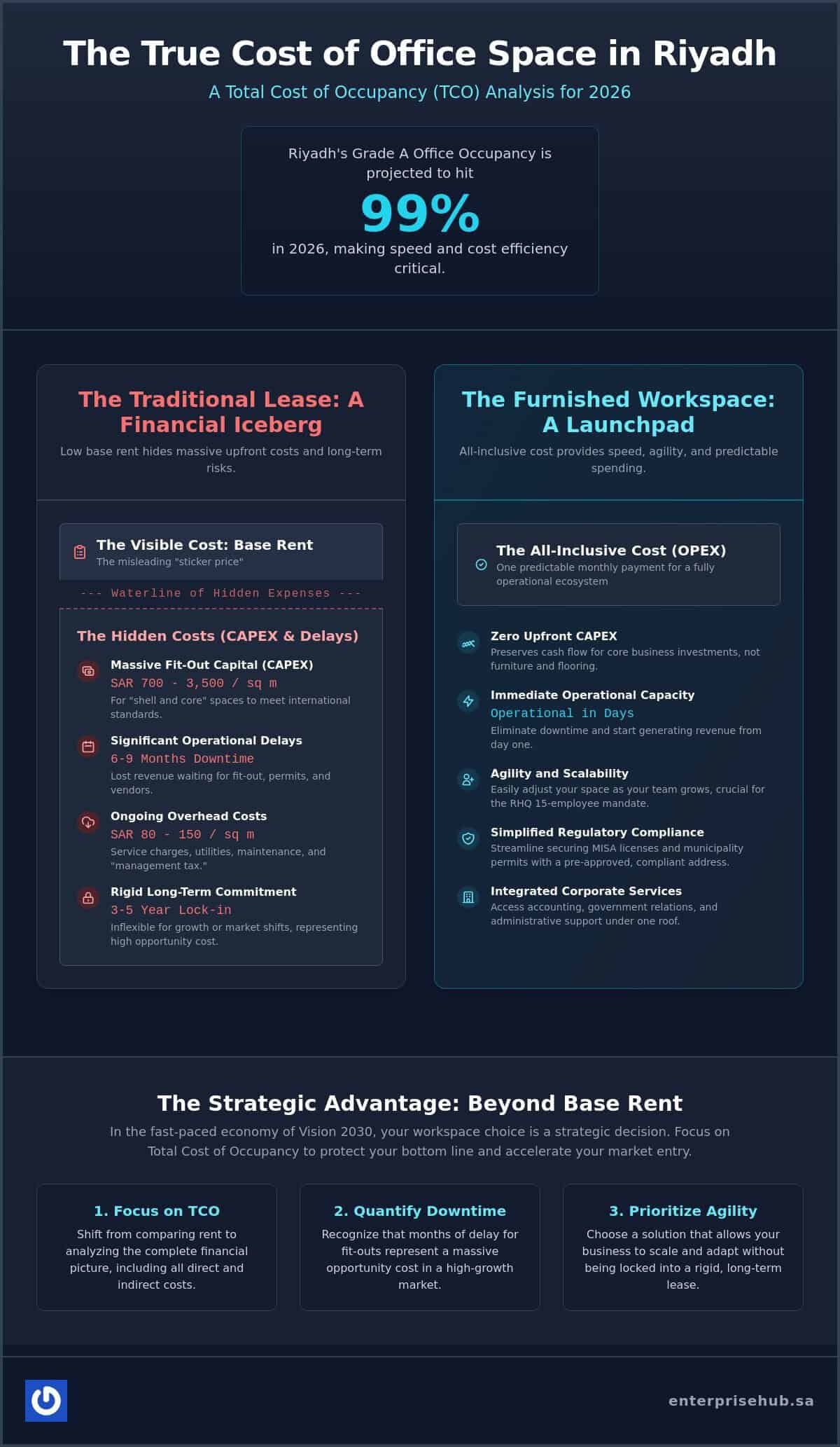
Total Cost of Occupancy (TCO) is the only metric that matters for a growing enterprise. Rent is just the tip of the iceberg. In Riyadh, where Grade A office occupancy has reached 99%, the competition for space is fierce. If you choose a traditional lease, you must factor in the SAR 700 to SAR 1,200 per square meter required for a standard mid-level fit-out. Add service charges, which typically range from SAR 80 to SAR 150 per square meter, plus utility management and facility maintenance. Suddenly, that “cheap” base rent becomes a complex financial burden.
The Evolution of the Saudi Workspace
Vision 2030 has transformed Riyadh into a global business magnet. With the Regional Headquarters (RHQ) mandate requiring a minimum of 15 employees in the first year, international firms need to be operational immediately. They don’t have six months to wait for a fit-out. This urgency has fueled the rise of agile business hubs across the Kingdom. In 2026, agility is the ultimate currency. Plug-and-play solutions allow businesses to bypass the construction phase entirely. They meet international standards without the headache of managing local contractors.
CAPEX vs. OPEX: A CFO’s Perspective
The Financial Iceberg: Why Traditional Office Leases Carry Hidden Capital Risks
Traditional leases often appear attractive because of their lower base rent per square meter. However, this figure is merely the tip of a financial iceberg. For most enterprises, the true cost of a furnished office vs traditional office becomes clear only after accounting for the massive capital sinks required to make a shell and core space functional. In a market as dynamic as Riyadh’s, locking capital into non-liquid assets like flooring, partitions, and ceiling fixtures can severely limit your strategic mobility. These assets depreciate rapidly, yet you’re forced to pay for their maintenance and eventual removal at the end of your tenure.
Rigidity is perhaps the most significant hidden risk. A standard three to five year commitment is a lifetime in the 2026 Saudi economy. If your headcount doubles due to a new government contract, or if you need to pivot your operations, a traditional lease leaves you stuck. You’re either paying for empty space or outgrowing your capacity with no easy exit. This lack of agility represents a massive opportunity cost that rarely shows up on a balance sheet but heavily impacts your bottom line. Beyond the physical space, you must also consider the “Management Tax.” This is the hundreds of hours your administrative and HR teams spend managing facility vendors instead of focusing on core business growth.
The Upfront Cost Trap
Setting up a traditional office in Riyadh requires a significant initial outlay. High-specification fit-outs for international standards can reach between SAR 2,000 and SAR 3,500 per square meter. When you add legal fees, brokerage commissions (often 5% to 10% of the first year’s rent), and hefty security deposits, your initial cash requirement skyrockets. Furthermore, cybersecurity and IT infrastructure compliance are non-negotiable for modern enterprises. Citing Key Real Estate Trends in Saudi Arabia, the shift toward high-tech, sustainable buildings means that DIY infrastructure setup is becoming increasingly complex and expensive.
Operational Friction and Maintenance
Once the doors open, the operational burden begins. Managing separate contracts for cleaning, security, fire safety, and utilities creates constant friction. A single HVAC failure or internet outage can lead to costly downtime, and in a traditional lease, you’re the one calling the technicians. These distractions are unnecessary hurdles when you’re trying to navigate the guide to setting up a company in Saudi Arabia and establishing your market presence. To avoid these capital risks, many leaders are moving toward integrated workspace solutions that consolidate all operational costs into a single, predictable monthly payment.
Strategic TCO: Analyzing the All-Inclusive Value of Furnished Workspaces
Comparing the cost of a furnished office vs traditional office requires a shift from viewing real estate as an asset to viewing it as a service. While a traditional lease offers a shell, a furnished workspace provides a fully operational business environment. This all-inclusive model consolidates rent, utilities, maintenance, and high-tier amenities into a single line item. This transparency is vital for accurate financial planning. According to Forbes, understanding Total Cost of Ownership (TCO) is the only way to ensure you’re making profitable decisions that support long-term growth rather than just minimizing short-term rent.
The most significant value of a furnished office is “Zero Downtime.” In the traditional model, the gap between signing a lease and actually working can span six months of fit-outs and permit approvals. Furnished spaces allow you to be operational within 24 hours. For a high-growth enterprise, those months of lost productivity represent a massive deficit in market entry speed. When you choose a furnished solution, you’re buying immediate access to the Saudi market, which is a strategic advantage that far outweighs any perceived saving in base rent.
The Premium Feature Set
Modern business hubs provide more than just desks. They offer a sophisticated infrastructure that would be prohibitively expensive for a single company to build from scratch. Standard inclusions usually feature high-speed internet with redundant backups and secure server rooms that meet international cybersecurity standards. You also gain access to professional meeting rooms and high-end boardrooms on an as-needed basis. This ensures an “Executive Presence” from day one, with professional reception services acting as a seamless extension of your brand to greet investors and partners.
Flexibility as a Financial Hedge
Market conditions in 2026 demand agility. Furnished workspaces offer short-term, flexible contracts that act as a hedge against economic volatility. You can test new service lines or enter the Riyadh market with a small team before committing to a larger footprint. Furnished offices eliminate the risk of paying for empty space during growth phases by allowing you to add or remove workstations as your headcount fluctuates. This scalability ensures your cost of a furnished office vs traditional office remains optimized for your actual usage, preventing the “wasted square meter” syndrome common in long-term traditional leases. This focus on optimization and strategic planning is a hallmark of global commercial real estate experts; for example, you can learn more about Petram House and their specialized approach to retail investment advisory.
The Saudi Advantage: Regulatory and Operational Efficiency in 2026
Securing a MISA license or a municipality permit is often the most significant bottleneck for new market entrants. In the Saudi market, your physical address is inextricably linked to your legal right to trade. When you analyze the cost of a furnished office vs traditional office, you must include the price of regulatory compliance. Traditional leases require you to navigate the Balady portal, civil defense certificates, and municipality inspections independently. These steps can take weeks or even months. Conversely, premium furnished offices are pre-certified. They provide an immediate, compliant address that satisfies all Commercial Registration (CR) requirements, effectively removing the regulatory friction that stalls most global expansions.
A common objection to furnished spaces is the perceived lack of brand identity. Many executives ask, “Can I customize a furnished office to reflect my corporate culture?” The answer in 2026 is a resounding yes. Modern providers now offer bespoke fit-out options within their managed frameworks. You get the benefit of a professional, high-end lobby and boardroom while maintaining a private, branded workspace. This hybrid approach gives you the “Executive Presence” needed to impress local partners and government stakeholders without the long-term capital risk of a traditional build-out.
Licensing and Compliance Synergy
A certified business center address does more than just host your team; it accelerates your legal standing. These providers have established relationships with local authorities, ensuring that your CR and municipality permits are processed without the typical back-and-forth delays. This synergy is particularly valuable for international firms that need to meet specific Saudization and local presence mandates quickly. If your strategy doesn’t require a full physical team immediately, a strategic guide to virtual offices in Saudi Arabia can show you how to maintain compliance while you scale your physical footprint.
The Integrated Support Ecosystem
The true value of a managed workspace lies in the support team that comes with it. Beyond the physical space, you gain access to an on-site ecosystem that understands the nuances of Saudi labor laws and government portals. Managing Muqeem, Qiwa, and GOSI requirements is a full-time job that often leads to “Administrative Leakage” in traditional setups. By combining your office space with accounting and tax services, you consolidate your back-office operations into a single, efficient stream. This integration allows your leadership to focus on high-level strategy while experts handle the day-to-day regulatory heavy lifting. To streamline your market entry today, explore our integrated solutions and see how we bridge the gap between space and success.
Choosing Your Strategic Base: How Enterprise Hub Optimizes Your Market Entry
In the high-stakes environment of 2026, your office choice is a statement of intent. It’s the difference between a business that’s waiting for permits and one that’s winning contracts. Throughout this guide, we’ve dissected the cost of a furnished office vs traditional office to reveal that agility is the most valuable asset in the Kingdom today. Traditional leases lock your capital into depreciating physical assets and long-term liabilities. In contrast, furnished workspaces offer a high-agility, low-risk alternative. This model aligns perfectly with the rapid pace of Vision 2030.
Choosing Enterprise Hub means choosing a partner that understands the nuances of the Saudi market. We don’t just provide space; we provide a bridge to business success. Our model integrates premium private offices with high-tier consulting. This ensures you have the legal and operational support required to thrive. By consolidating your Total Cost of Occupancy into one predictable payment, you free your leadership team to focus on growth and strategic positioning.
The Enterprise Hub Difference
Our private offices are designed for high-ticket executive presence. They offer the privacy and prestige your brand deserves. We’ve built an ecosystem that includes a comprehensive suite of government and business setup services to ensure your transition is seamless. You’ll join a community of ambitious brands and market leaders who value efficiency and excellence. This isn’t just about sharing a building. It’s about being part of a professional environment that elevates your brand and simplifies your operations.
Your Next Strategic Move
Don’t let the complexity of traditional real estate stall your progress. Whether you’re transitioning from a virtual setup or establishing a new regional headquarters, we make the process effortless. You can secure a physical private office that meets all regulatory requirements in a fraction of the time it takes to fit out a shell-and-core space. Our team is ready to provide a personalized analysis of the cost of a furnished office vs traditional office tailored to your specific headcount and growth targets. Take the lead in the Saudi market by making an informed, strategic choice for your base of operations. Contact Enterprise Hub today to secure your premier workspace and discover how we optimize your market entry.
Master Your Market Entry with Strategic Workspace Decisions
Navigating the Saudi economy in 2026 requires a focus on agility and regulatory precision. We’ve explored how the cost of a furnished office vs traditional office extends far beyond the monthly rent check. By accounting for fit-out capital risks, administrative leakage, and the value of zero downtime, the financial argument for managed workspaces becomes undeniable. You aren’t just renting a desk; you’re securing a compliant, high-tier launchpad that moves at the speed of your ambitions.
Enterprise Hub serves as your strategic partner in this journey. We offer more than just premium private offices in a premier business hub. Our integrated model provides essential MISA and government service support to ensure your licensing is seamless and your operations are lean. With flexible terms designed to match the growth targets of Vision 2030, we empower you to scale without the burden of long-term capital lock-in. Your success in the Kingdom depends on the foundation you build today. Secure your premium furnished office with Enterprise Hub today and take the next step toward sustainable prosperity in the region’s most dynamic market.
Frequently Asked Questions
Is a furnished office more expensive than a traditional office in the long run?
It’s actually more cost-effective when you calculate the Total Cost of Occupancy (TCO). Traditional leases require massive upfront capital for fit-outs and furniture that depreciate over time. When comparing the cost of a furnished office vs traditional office, you’ll find that furnished spaces eliminate hidden maintenance fees and the need for a dedicated facility management team. This preserves your cash flow for core business investments.
Can I use a furnished office address for my MISA investment license?
Yes, you can use a certified business center address for your MISA license and Commercial Registration (CR). Premium furnished offices are pre-approved by the municipality and civil defense. This removes the regulatory hurdles of shell-and-core spaces that require independent inspections. It’s a strategic move for international firms that need to be legally operational in the Kingdom without waiting months for permit approvals.
What is typically included in the monthly fee of a furnished office?
Your monthly fee usually covers high-speed internet, utilities, cleaning, and professional reception services. You also gain access to shared boardrooms and kitchen facilities without paying extra for the square footage. This all-inclusive model replaces dozens of separate vendor contracts with one predictable invoice. It’s designed to simplify your accounting and ensure your team has everything they need to perform from day one.
How long does it take to move into a furnished office vs a traditional one?
You can move into a furnished workspace in as little as 24 hours. Conversely, a traditional office fit-out can take three to six months depending on construction and municipality permits. This speed-to-market is a significant factor in the cost of a furnished office vs traditional office. Avoiding months of downtime means your business starts generating revenue immediately rather than waiting for contractors to finish.
Are furnished offices suitable for large corporate teams or only startups?
They’re ideal for both startups and large enterprise teams. Many multinational corporations establishing a Regional Headquarters (RHQ) in Riyadh choose furnished offices to meet their minimum 15-employee requirement quickly. These spaces provide the executive presence and high-end infrastructure that global brands expect. They offer a level of professional polish that’s difficult and expensive to replicate in a traditional shell-and-core lease.
Can I customize the branding and layout of a furnished private office?
Yes, modern providers offer bespoke customization for private office suites. While communal areas are managed, your dedicated workspace can be branded to reflect your corporate identity. You can adjust the layout to fit your specific workflow or headcount. This gives you the best of both worlds: a space that feels like your own with the operational ease of a managed facility.
What are the typical lease terms for furnished offices in Saudi Arabia for 2026?
Lease terms in 2026 are highly flexible, ranging from monthly rolling contracts to annual agreements. This is a major advantage over traditional leases that often lock you into three to five year commitments. Flexibility acts as a financial hedge against market volatility. It allows you to expand or contract your office footprint as your business objectives evolve within the dynamic Saudi market.
How does a furnished office help with Saudi government portals like Muqeem?
Many premium providers offer integrated support for government portals like Muqeem, Qiwa, and GOSI. Having an on-site team that understands local labor laws reduces the risk of administrative errors and fines. They act as a bridge between your business and local regulations. This support minimizes the “Administrative Leakage” that often occurs when a company tries to manage these complex portals without local expertise.