
Did you know that foreign direct investment commitments in the Kingdom reached SAR 222 billion by mid-2025, yet many ambitious investors still find themselves stalled at the starting line? It’s a common frustration. You likely feel that the challenges of setting up a business in Saudi Arabia involve more than just a signature; they require navigating a complex web of MISA licensing, ZATCA tax requirements, and the latest Nitaqat documentation on the Qiwa platform. We agree that the multi-agency licensing process can feel overwhelming when you’re also managing the high costs and long timelines of traditional office fit-outs.
This 2026 strategic guide promises to help you master these regulatory, logistical, and cultural hurdles with a proven dual-track strategy. We’ll show you how to achieve full legal compliance in record time while establishing a prestigious business presence that integrates seamlessly into the local landscape. By focusing on immediate logistical readiness and psychological adaptability, we’ll help you bypass the typical barriers to entry so you can focus on growth and long-term success in the Kingdom. This is your roadmap to turning complex requirements into a competitive advantage.
Key Takeaways
- Understand the “New Environment Paradox” to bridge the gap between Saudi Arabia’s massive market opportunities and the operational friction of entry.
- Navigate the 2026 regulatory maze by mastering MISA investment licensing and ZATCA e-invoicing standards to ensure full legal compliance.
- Solve the primary challenges of setting up a business in Saudi Arabia by opting for 24-hour ready managed office solutions instead of high-cost traditional fit-outs.
- Execute a dual-track strategic roadmap that combines a rigorous regulatory audit with a prestigious physical or virtual presence in the Kingdom’s high-growth hubs.
- Leverage a single-partner ecosystem for space, licensing, and government services to prevent administrative failure and ensure seamless team integration.
The 2026 Saudi Landscape: Challenges of Setting Up a Business in a New Environment
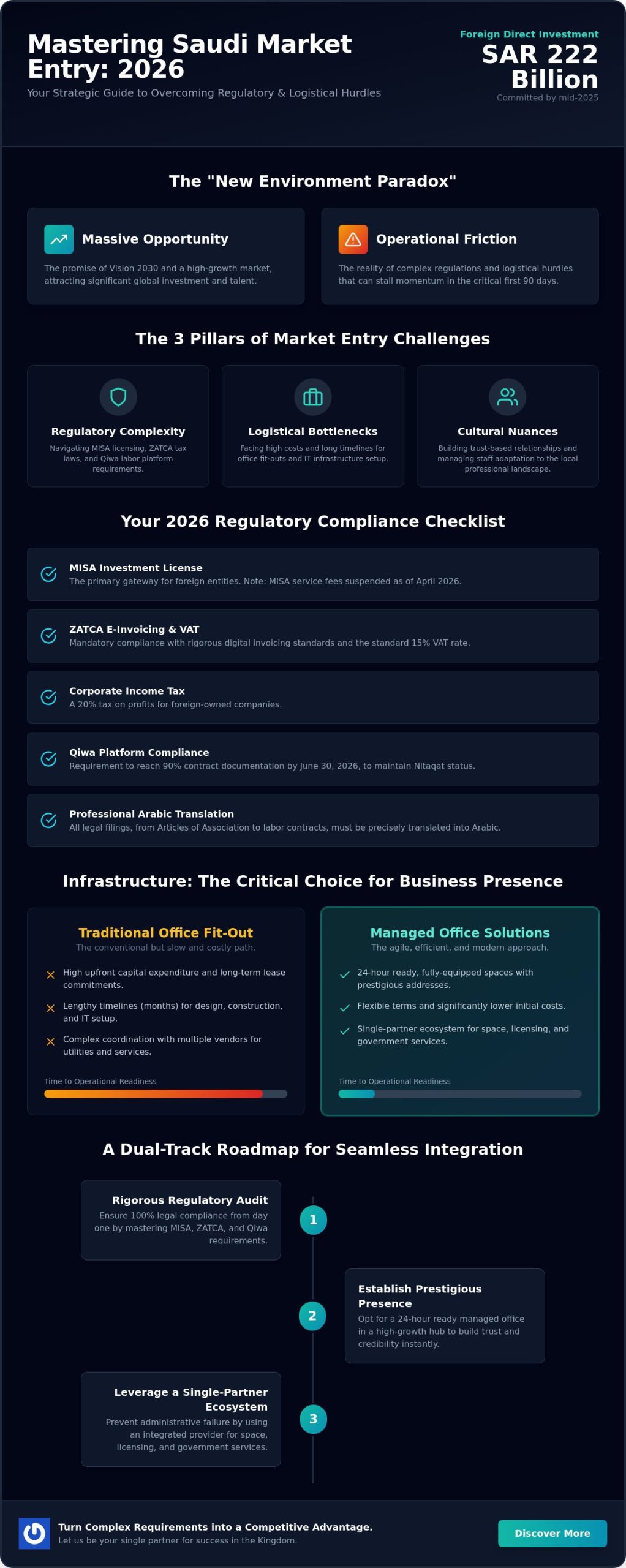
Entering the Saudi market in 2026 feels like stepping into a high-speed engine of growth. While foreign direct investment commitments reached SAR 222 billion by mid-2025, many investors face what we call the “New Environment Paradox.” This is the stark gap between the massive market opportunities promised by Vision 2030 and the operational friction encountered during the first 90 days. The primary challenges of setting up a business in Saudi Arabia stem from three pillars: regulatory complexity, logistical bottlenecks, and cultural nuances in professional negotiations.
Success in this landscape requires more than just capital. It demands a sophisticated understanding of how Entrepreneurship policies in Saudi Arabia have evolved. By 2026, the Kingdom has accelerated its digital transformation, making digital-first compliance mandatory through portals like Qiwa and ZATCA. If your team isn’t prepared for this environmental shock, the resulting administrative delays can quickly erode executive confidence and stall your strategic momentum.
The Psychological Transition of Market Entry
It’s common for international leadership teams to experience a form of “Imposter Syndrome” when entering a market as fast-paced as Riyadh or Jeddah. You’re dealing with high-stakes targets and a local professional landscape that values deep, trust-based relationships. Managing the adjustment curve for relocating staff is vital. Without a clear strategy for the initial 90-day transition, team morale can suffer. We recommend focusing on immediate small wins to build confidence while your larger corporate structure settles into the local regulatory framework.
Identifying Latent Logistical Hurdles
The visible hurdles are often the easiest to plan for. It’s the hidden logistical challenges that cause the most damage. Beyond simply finding an office, you must account for the time required to activate IT infrastructure and utilities. In a market where a prestigious national address serves as a badge of trust, a temporary or poorly located setup can hinder your ability to close deals. Navigating the challenges of setting up a business in Saudi Arabia means looking past the lease agreement to ensure your physical presence reflects your brand’s global standards from day one. Administrative delays in simple services shouldn’t be the reason your growth plateaus before it truly begins.
Navigating the Regulatory Maze: Licenses, Compliance, and MISA Requirements
The Ministry of Investment (MISA) serves as the primary gateway for any foreign entity entering the Kingdom. As of April 2026, MISA has suspended service fees for new investment licenses, a strategic move that significantly lowers the initial financial barrier for global firms. However, obtaining this license is just the beginning. You’ll quickly need to align with ZATCA’s rigorous e-invoicing standards and the standard 15% VAT rate. Foreign-owned companies also face a 20% corporate income tax on profits. Navigating these challenges of setting up a business in Saudi Arabia requires meticulous attention to detail. According to the U.S. State Department Investment Climate Report, a deep understanding of the local legal and regulatory environment is critical for mitigating long-term operational risks.
Securing Your Commercial Registration (CR)
Transitioning from a MISA license to a formal Commercial Registration is where many organizations encounter friction. For LLCs with capital up to SAR 500,000, the initial registration fee has been reduced to SAR 1,000, making the process more accessible. However, pitfalls in the drafting of the Articles of Association can still cause weeks of delays if not handled by experts. Successfully investing in Saudi Arabia requires a proactive legal strategy that resolves these administrative requirements before they stall your launch timeline.
Government Services and the ‘Muqeem’ System
Managing the residency and visas of your international talent is handled through the Muqeem and Absher platforms. The Kingdom’s shift toward fully digital government interactions by 2026 has vastly increased processing speeds, yet it leaves zero room for data entry errors. A minor discrepancy in a passport number or job title can freeze your ability to issue essential work permits. Utilizing professional government services allows you to bypass these administrative bottlenecks, ensuring your team is integrated and operational without unnecessary downtime.
Infrastructure Hurdles: Traditional Office Leases vs. Managed Solutions
Physical infrastructure is a critical pillar that often determines the speed of your market entry. While digital licensing has become remarkably efficient, securing a physical workspace remains one of the most tangible challenges of setting up a business in Saudi Arabia. Many international firms underestimate the complexity of the local real estate market, often falling into the trap of traditional “shell and core” leases that require extensive fit-outs before operations can even begin.
Traditional leases in major hubs like Riyadh or Jeddah typically involve long-term liabilities and hidden costs. You aren’t just paying for square footage; you’re responsible for managing construction projects, electrical wiring, and HVAC installations. These fit-outs often take six months or longer to complete. In a high-growth environment, losing half a year to a construction project is a significant strategic setback. Managed solutions, however, offer 24-hour readiness. This “plug-and-play” model allows your team to move in and start working immediately, bypassing the administrative and logistical headaches of traditional property management.
Connectivity is another area where managed spaces excel. Setting up high-speed fiber and secure IT networks independently can take weeks of coordination with local utility providers. Managed environments provide this infrastructure instantly, ensuring your team stays productive from their first hour on the ground. This immediate operational readiness removes a massive psychological burden from incoming leadership, allowing them to focus on high-stakes negotiations rather than office maintenance.
The Strategic Case for Private Managed Offices
Immediate operational readiness is a massive competitive advantage. Private managed offices offer pre-furnished, high-quality environments that uphold your global brand standards from day one. You also gain access to shared premium amenities, such as professional meeting rooms and executive lounges. These spaces serve as vital hubs for local networking, helping your team build the social capital necessary for success in the Kingdom. It’s about more than just a desk; it’s about being part of a professional ecosystem that facilitates growth.
Virtual Offices: A Low-Risk Market Entry Strategy
If you aren’t ready for a full physical relocation, a virtual office in Saudi Arabia offers a low-risk alternative. It provides the prestigious national business address required for MISA licensing and Commercial Registration without the overhead of a full lease. This address is vital for local procurement and government tenders. It signals to potential partners and government agencies that you’re a serious, compliant entity. It’s a smart way to test the market’s pulse and fulfill legal requirements before committing to a larger physical footprint.
A Strategic Roadmap for Seamless Integration into the Saudi Market
Moving from the theoretical “what” to the practical “how” requires a chronological plan that accounts for the specific challenges of setting up a business in Saudi Arabia. You shouldn’t tackle these hurdles in isolation. Instead, execute a sequence that builds momentum and secures your legal standing early. This roadmap is designed to transition your operations from a foreign entity to a fully integrated national player within your first quarter.
- Step 1: Conduct a regulatory audit and finalize your MISA investment license. Leverage the 2026 suspension of MISA service fees to secure your entry while ensuring your business activity aligns perfectly with your long-term goals.
- Step 2: Establish a physical or virtual presence in a high-growth national hub. Whether you choose Riyadh, Jeddah, or Dammam, your address serves as your corporate identity. It’s the foundation for your Commercial Registration.
- Step 3: Localize HR and accounting workflows. Meet the June 30, 2026, mandate for 90% contract documentation on Qiwa and integrate ZATCA-compliant e-invoicing systems from day one.
- Step 4: Build a support network of local advisors. Connect with experts in محاسبة وضرائب to ensure your Zakat and VAT filings remain flawless as you scale.
- Step 5: Implement a 90-day ‘Environment Integration’ review. Assess your leadership team’s productivity and morale to ensure they’re adapting to the local market’s unique pace.
Mastering Cultural Intelligence in Business
The Saudi professional landscape is shifting from transactional to deeply relational models. In 2026, the ‘Majlis’ style of decision-making persists even in modern corporate boardrooms. This means consensus and trust often outweigh a simple contract. You’ll find that face-to-face interactions remain the gold standard for high-stakes negotiations. Understanding these nuances helps you avoid cultural friction that can stall even the most logically sound business deals.
The Power of High-Performance Meeting Spaces
Your physical environment speaks volumes before you even open your mouth. Using professional غرف اجتماعات equipped with high-end hybrid technology is essential for impressing local partners and government stakeholders. These spaces reflect international excellence at a national level. They provide the technical reliability needed for global coordination while offering the prestigious atmosphere required for local success. Don’t let a poor meeting environment be the reason a strategic partnership fails to launch.
Leveraging Integrated Ecosystems for Immediate Operational Success
Entering a new market is a test of endurance. Attempting a “DIY” approach to handle the challenges of setting up a business in Saudi Arabia often leads to administrative exhaustion. When your leadership team spends their first 100 days chasing government stamps or troubleshooting IT connectivity, your strategic growth suffers. We’ve seen that a fragmented entry strategy results in higher long-term costs and significant team burnout. Instead, forward-thinking firms are moving toward integrated ecosystems that consolidate every operational requirement under one roof.
A single-partner approach provides a seamless bridge between your global standards and local requirements. By choosing a partner that offers تأسيس الشركات alongside physical infrastructure, you eliminate the friction of dealing with multiple vendors. This isn’t just about convenience; it’s about speed and reliability. The ROI of a managed professional environment far outweighs the perceived savings of budget alternatives. Cheap office spaces often hide costs in the form of delayed permits, poor maintenance, and a lack of professional prestige that can damage your brand’s reputation in the Kingdom.
Strategic integration means your focus stays on the market, not the paperwork. An integrated ecosystem acts as a shock absorber for the environmental and regulatory shifts that occur in a high-growth economy. It allows you to scale up or down with agility, ensuring your overhead remains optimized while your presence remains prestigious.
Beyond Real Estate: The Ecosystem Advantage
Our integrated model goes beyond providing four walls. We weave المحاسبة والضرائب and الخدمات الحكومية directly into your workspace solution. This ensures your business remains future-proof against evolving regulations like the 2026 ZATCA e-invoicing updates or Qiwa documentation targets. You also gain immediate access to a community of global leaders and local entrepreneurs, fostering a networking environment that would take years to build independently. It’s a comprehensive support system designed for long-term prosperity.
Next Steps: Your Launchpad for 2026
It’s time to move from planning to execution. You can customize our المكاتب الخاصة to reflect your brand’s unique identity from the very first day. Whether you need the flexibility of مساحات العمل المشتركة or the prestige of a full-service headquarters, we provide the infrastructure for excellence. Don’t let the challenges of setting up a business in Saudi Arabia slow your momentum. Schedule a consultation today to design a comprehensive transition plan that secures your market leadership in the Kingdom.
Accelerate Your Success in the Kingdom’s Dynamic Economy
Navigating the Saudi market in 2026 requires a shift from traditional operational models to agile, integrated ecosystems. Success depends on your ability to balance rigorous regulatory compliance with immediate physical readiness. By prioritizing managed infrastructure and leveraging local expertise, you transform potential bottlenecks into strategic advantages. While the challenges of setting up a business in Saudi Arabia are significant, they shouldn’t dictate your timeline or drain your executive resources. The right partnership allows your team to focus on building relationships and capturing market share from day one.
We invite you to Secure your strategic business base with Enterprise Hub. Our platform provides premium national business addresses that build immediate trust with local stakeholders. We offer comprehensive business setup and government service integration alongside fully equipped private offices tailored for 2026 operational demands. Don’t leave your market entry to chance. Partner with a team that understands the local landscape and is committed to your long-term growth. Your journey toward national leadership in the Kingdom starts with a single, decisive step toward excellence.
Frequently Asked Questions
What are the biggest challenges of setting up a business in Saudi Arabia in 2026?
The primary challenges include navigating the interconnected digital portals like Qiwa and ZATCA while meeting the June 30 mandate for 90% contract documentation. Investors also face logistical hurdles related to high-cost traditional office fit-outs and the need for rapid cultural adaptation. Successfully managing these challenges of setting up a business in Saudi Arabia requires a dual-track strategy that combines regulatory precision with immediate logistical readiness.
How long does it typically take to obtain a MISA license for a foreign company?
Obtaining a MISA investment license generally takes between 3 and 5 working days once your documentation is submitted through the digital portal. While the license itself is issued quickly, you must account for additional time to finalize your Commercial Registration and open a local corporate bank account. For businesses looking to automate their financial service infrastructure, ge.mba provides a helpful roadmap for setup. Preparation is key; having your translated Articles of Association ready can prevent unnecessary delays in the earlier stages.
Do I need a physical office to register a business in Saudi Arabia?
You absolutely need a physical address to register your business and obtain a Commercial Registration (CR) in the Kingdom. A registered lease agreement is a prerequisite for most government portals and is essential for opening a corporate bank account. Managed workspaces provide a compliant, immediate solution that satisfies these regulatory requirements without the long lead times of traditional property leases.
What is the difference between a virtual office and a private office for market entry?
A virtual office provides a prestigious national address for legal compliance and MISA requirements without the overhead of physical space. In contrast, a private office offers a fully equipped, secure environment for your team to work from daily. Choosing between them depends on whether you need immediate operational capacity or a low-risk entry point to test the market’s pulse before committing to a larger footprint.
How can I ensure my business complies with ZATCA’s 2026 tax regulations?
Ensuring ZATCA compliance requires integrating certified e-invoicing software into your accounting workflows and maintaining accurate records for the 15% VAT and 20% corporate income tax. It’s vital to stay updated on the latest technical requirements for Phase 2 of the e-invoicing mandate. Partnering with professional experts ensures your filings meet the latest standards and protects your business from administrative penalties.
What role does cultural intelligence play in Saudi business success?
Cultural intelligence is the foundation of trust in the Saudi professional landscape, where business is often relational rather than purely transactional. Understanding local etiquette and the ‘Majlis’ style of decision-making can be the difference between a stalled negotiation and a successful partnership. Investing time in face-to-face interactions shows respect for local customs and helps you build the social capital necessary for long-term growth.
Are managed workspaces more cost-effective than traditional leases in Saudi Arabia?
Managed workspaces are significantly more cost-effective because they eliminate the need for expensive upfront fit-outs and ongoing maintenance. You avoid the hidden costs of IT setup, utilities, and long-term property liability. These solutions offer a fixed monthly cost and 24-hour readiness, allowing you to bypass the six-month construction timelines typical of traditional shell-and-core office spaces.
How can I support my team’s transition to a new professional environment?
Supporting your team’s transition involves removing administrative friction so they can focus on their core strategic goals. Providing a “plug-and-play” environment reduces the stress of relocation and ensures they stay productive from day one. Implementing a 90-day integration review helps identify and resolve any latent challenges of setting up a business in Saudi Arabia, ensuring your leadership team feels empowered and settled.